


Ethereum (ETH) is currently navigating a complex market environment, characterized by persistent geopolitical tensions, ongoing inflation concerns, and the anticipation of tighter monetary policies. This broader market pressure, coupled with a notable shift in the behavior of large ETH holders, or "whales," has drawn significant attention from market observers. On-chain data reveals a dramatic decrease in the participation of these significant players, a trend that offers crucial insights into current market sentiment and potential future price movements.
Sharp Decline in Whale Transactions Signals a Cautious Market
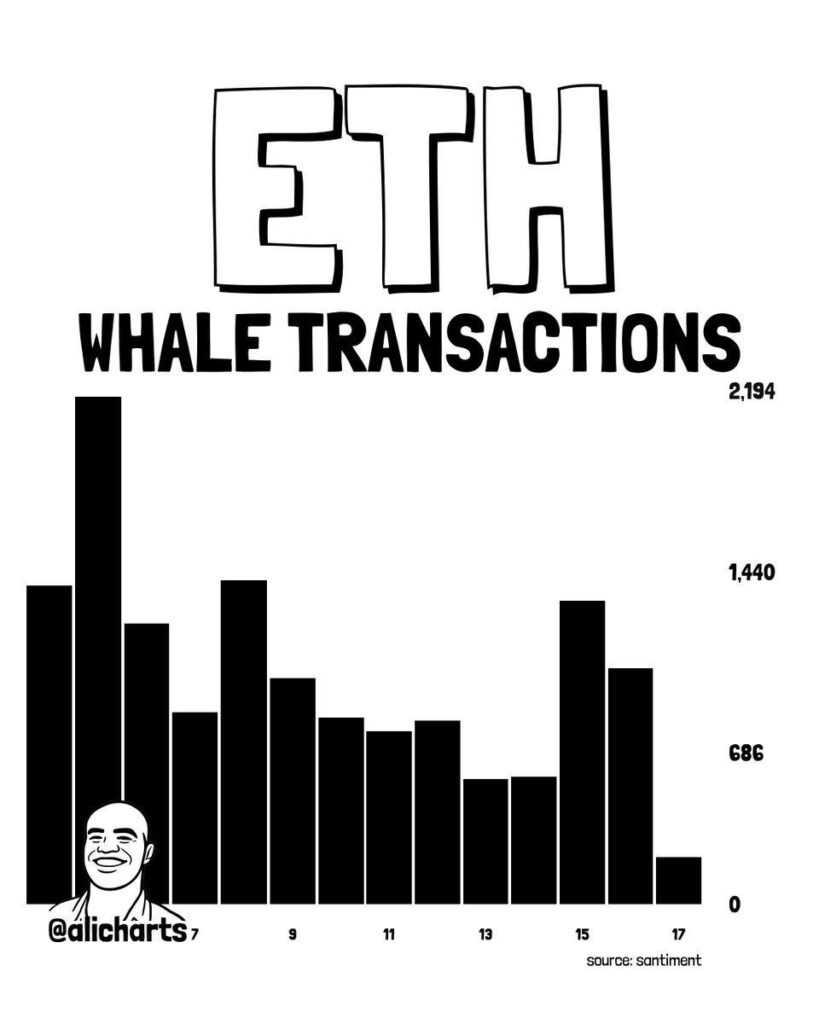
Recent data compiled by blockchain analytics firm Santiment, and highlighted by prominent crypto analyst Ali Martinez, indicates a substantial drop in large Ethereum transactions. Over the past two weeks, the number of these significant transactions has plummeted by an astonishing 86.6%. Specifically, the volume fell from 2,194 large transactions recorded on June 5th to a mere 294 transactions as of the latest reporting period. This represents one of the most pronounced declines in whale activity observed in recent months, suggesting a marked increase in caution among major Ethereum stakeholders.
Large transactions are widely considered by traders and analysts to be bellwethers of institutional interest, capital flows, and the overall conviction within the market. A sharp decline in such activity does not inherently signal immediate selling pressure, but it strongly implies that large investors are adopting a "wait-and-see" approach. This cautious stance is likely driven by the prevailing uncertainty and volatility that characterizes the current global economic and geopolitical landscape.

Macroeconomic and Geopolitical Headwinds Impacting Ethereum
The recent price action of Ethereum has been significantly influenced by a confluence of external factors. Escalating geopolitical tensions in the Middle East, particularly between Israel and Iran, have heightened concerns about potential disruptions to global energy markets. Such disruptions could reignite inflationary pressures, prompting a more risk-averse sentiment among investors. Consequently, demand for speculative assets like cryptocurrencies has seen a dip.
Furthermore, robust U.S. employment data has reinforced expectations that the Federal Reserve may maintain its current interest rate policy for an extended period. Higher interest rates generally lead to reduced market liquidity and can put downward pressure on assets perceived as riskier, including digital currencies. This macroeconomic backdrop contributes to the increased volatility observed in Ethereum markets. The Ethereum Volmex Implied Volatility Index, a measure of expected future price swings, surged by 26% over the past week, underscoring the heightened uncertainty among traders regarding ETH’s future trajectory.
Technical Analysis: Navigating Support and Resistance Levels
From a technical perspective, Ethereum continues to face significant challenges. The cryptocurrency is currently trading below key long-term moving averages, including the 50-day, 100-day, and 200-day simple moving averages. This positioning reinforces the prevailing bearish trend observed in its price chart. Momentum indicators present a mixed signal; while the MACD (Moving Average Convergence Divergence) remains in a downward trajectory, suggesting bearish momentum, the Relative Strength Index (RSI) has entered oversold territory, potentially indicating a short-term buying opportunity.
Market participants are closely observing the $1,500 price level, which has emerged as a critical support zone. A sustained defense of this area could provide a foundation for a potential recovery. However, a decisive breach below $1,500 could expose Ethereum to further losses, with some analysts identifying the $1,000 mark as the next significant psychological support level. On the upside, a re-establishment of bullish momentum would likely require Ethereum to reclaim the $2,000 level, paving the way for a potential advance towards stronger resistance identified around $2,380.
Long-Term Optimism Amidst Short-Term Uncertainty
Despite the current headwinds and the observable reduction in whale activity, a segment of market analysts remains optimistic about Ethereum’s long-term prospects.
Analyst Projections and Historical Context
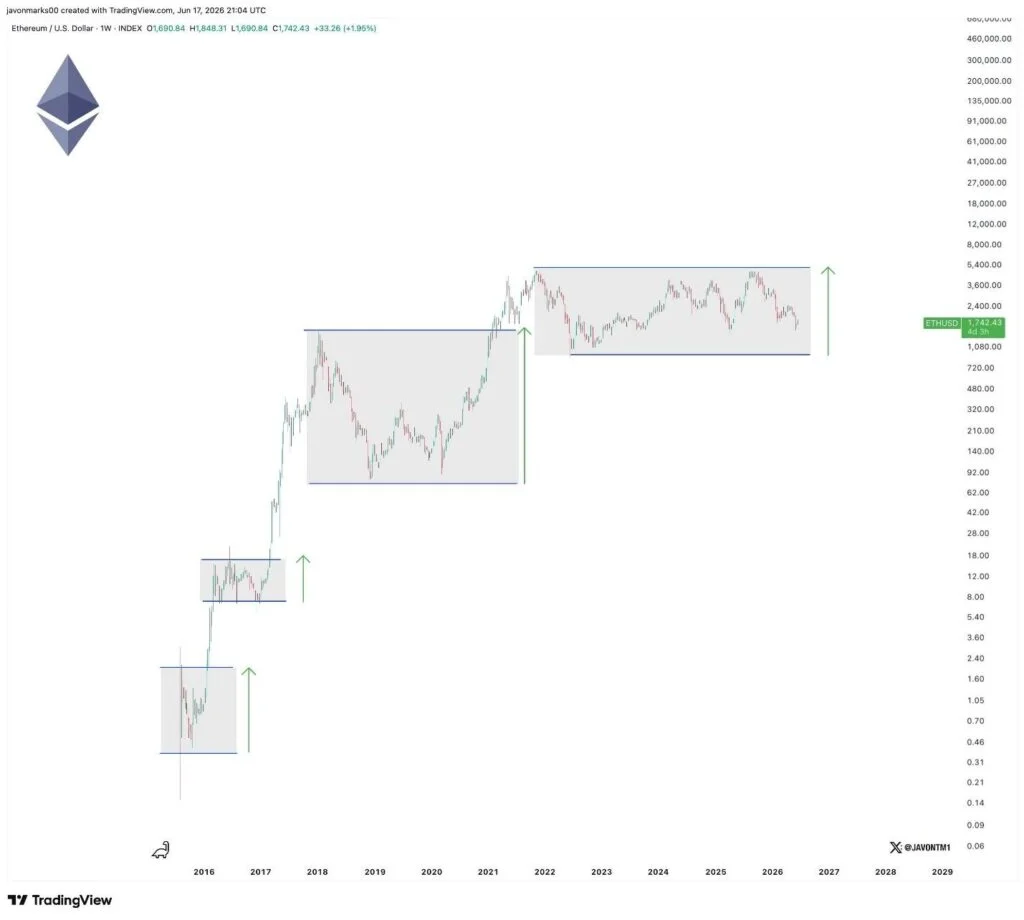
Analyst Javon Marks, in a recent analysis of a weekly ETH/USD chart, highlighted historical consolidation patterns and breakout formations dating back to 2016. Marks suggests that Ethereum’s current market structure exhibits "structural integrity" at its prevailing price levels. Drawing parallels with past expansion cycles, he projects an initial upside target for ETH between $4,800 and $5,000. Looking further ahead, Marks posits that if historical market behavior continues to repeat, Ethereum could potentially reach approximately $8,500. This long-term outlook is underpinned by the belief that Ethereum’s underlying technology and ecosystem growth will eventually drive significant value appreciation.
In a similar vein, analyst Crypto Patel has outlined an even more ambitious roadmap for Ethereum, extending into the years 2029 and 2030. Patel’s framework presents a spectrum of potential valuation scenarios. His "ultra-bear" outlook suggests a valuation around $5,000, while a more moderate "base-case" scenario targets approximately $12,000. Under the most aggressive bullish assumptions, Patel forecasts that ETH could eventually trade within the significant range of $30,000 to $60,000.

These projections are often informed by comparisons of Ethereum’s potential future market capitalization to that of established global corporations. For instance, comparing ETH’s potential future valuation to that of technology giants like Nvidia suggests that the asset may increasingly be perceived not merely as a speculative cryptocurrency but as a foundational element of a maturing global financial network. This perspective implies that Ethereum’s utility and adoption as a decentralized platform for applications and financial services could be a primary driver of its long-term value.
Broader Implications and Market Outlook
The current market environment, marked by reduced whale participation and macroeconomic uncertainty, presents a period of consolidation and strategic reassessment for many investors. While short-term price action may remain volatile, the long-term optimistic projections from analysts underscore the perceived fundamental strength and future potential of the Ethereum network.
The decrease in whale activity, while notable, could also be interpreted as a sign of market maturation. Rather than frantic trading by large holders, a more measured approach might indicate a deeper conviction in the long-term value proposition of Ethereum, driven by its ongoing development, the growth of decentralized finance (DeFi), and the expanding ecosystem of non-fungible tokens (NFTs).
At the time of reporting, ETH was trading at approximately $1,700, reflecting a modest decline of 0.65% over the preceding 24-hour period. This price point reflects the current balance between prevailing market pressures and the underlying optimism surrounding Ethereum’s technological advancements and its role in the future of digital finance. The coming weeks and months will be crucial in observing whether Ethereum can overcome its immediate technical hurdles and macroeconomic headwinds, potentially validating the ambitious long-term price targets set by market analysts. The continued development of the Ethereum network, including the successful implementation of future upgrades and the sustained growth of its user base and dApp ecosystem, will be key determinants of its trajectory.














