
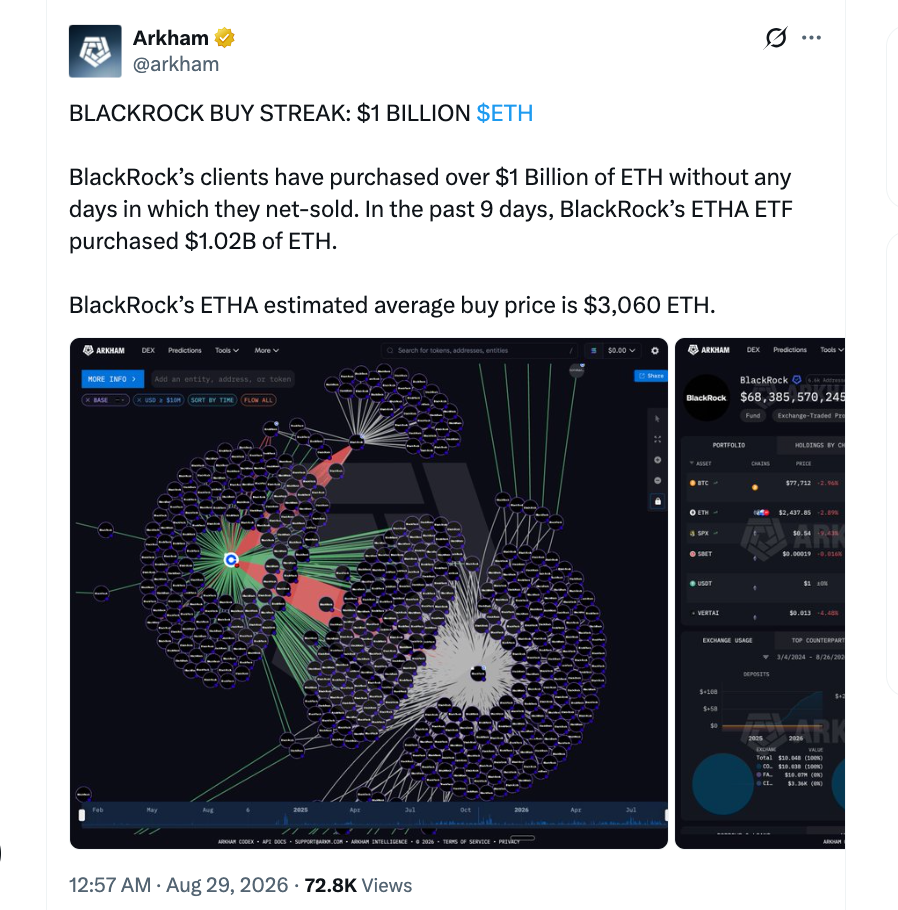
The digital asset landscape is experiencing a seismic shift as major financial institutions, notably BlackRock and Fidelity, intensify their pursuit of regulatory approval for spot Ether Exchange Traded Funds (ETFs). This heightened activity, coupled with BlackRock’s significant accumulation of Ether, suggests a growing institutional conviction in the second-largest cryptocurrency, potentially signaling a new era of mainstream adoption. BlackRock’s publicly traded Ether ETF has quietly amassed over $1 billion in the digital currency within a mere nine days, with no instances of net selling recorded during this period, according to data highlighted by the on-chain intelligence platform Arkham. This sustained buying pressure from one of the world’s largest asset managers underscores a strategic approach, positioning Ether not as a fleeting speculative play but as a foundational holding. Arkham reported that BlackRock’s average acquisition price for Ether during this accumulation phase was approximately $3,060 per coin, a figure that offers insight into their perceived value of the asset.
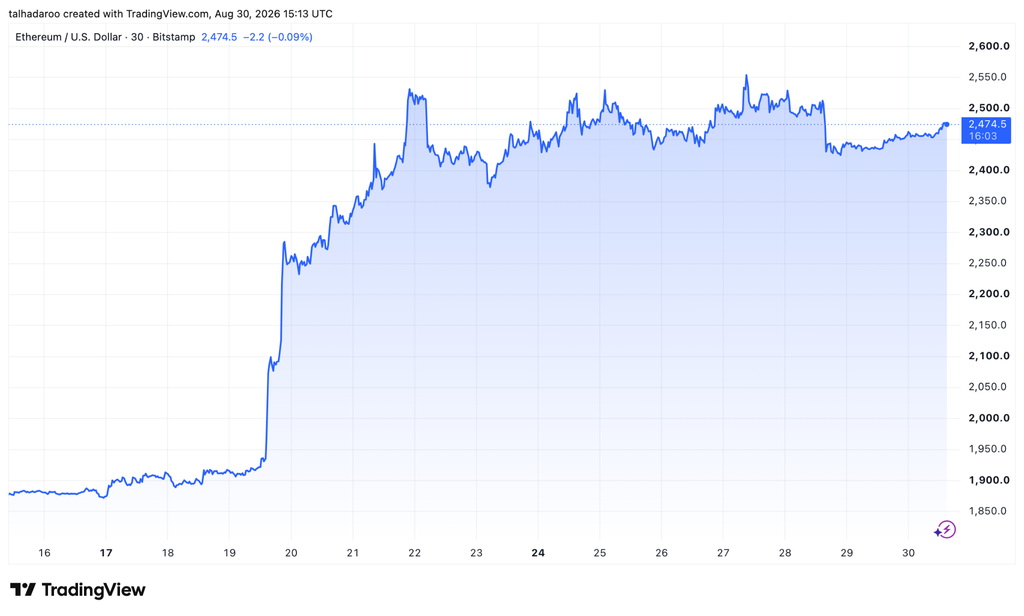
The sheer scale and consistency of BlackRock’s investment are particularly noteworthy. In a market often characterized by volatility, rapid price reversals, and profit-taking strategies, the commitment of over a billion dollars to Ether represents a powerful endorsement from a titan of traditional finance. This robust buying streak has occurred concurrently with a significant price recovery for Ether over the past two weeks, during which it has appreciated by more than 28%. This period of consistent accumulation, devoid of any net selling, strongly suggests deliberate and strategic acquisition rather than opportunistic trading driven solely by short-term market fluctuations.
The Unfolding Narrative: A Timeline of Institutional Interest in Ether
The journey towards institutional acceptance of digital assets has been a gradual but accelerating one. While Bitcoin has paved the way with several spot Bitcoin ETF approvals, the focus has now firmly shifted to Ethereum. The groundwork for this current momentum was laid in late 2023, when major financial players began filing applications for spot Ether ETFs.

October 2023: BlackRock, a behemoth in asset management, submitted its application for a spot Ether ETF with the U.S. Securities and Exchange Commission (SEC). This move was a significant development, signaling that the institutional appetite for Ether-based investment products was growing beyond Bitcoin. Fidelity, another leading financial services company, followed suit, also filing for its own spot Ether ETF. These initial filings marked the formal entry of these giants into the race for Ether ETF approval, setting the stage for a potential landmark decision by the SEC.
Early 2024: The anticipation surrounding potential approvals built throughout the early months of the year. The SEC’s review process is typically extensive, involving multiple stages of public comment and internal deliberation. During this period, analysts and market participants closely watched for any indications of the SEC’s stance, with many predicting a more challenging approval process for Ether compared to Bitcoin due to certain regulatory ambiguities surrounding the asset.
May 2024: A surprising shift in sentiment occurred in May when the SEC, in a move that caught many by surprise, approved the listing and trading of spot Ether ETFs by several issuers, including BlackRock and Fidelity. This decision was widely interpreted as a significant victory for the digital asset industry, validating the increasing maturity and institutional readiness of the Ethereum ecosystem. While the approval allowed for listing, the actual trading of these ETFs on exchanges was contingent on the SEC’s declaration of effectiveness for the issuers’ registration statements.
Following Approvals (Post-May 2024): The period immediately following the SEC’s approval saw a flurry of activity. Issuers worked to finalize the necessary regulatory filings and prepare for the launch of their products. BlackRock’s proactive accumulation of Ether, as reported by Arkham, began in this post-approval phase, demonstrating their readiness to deploy capital as soon as regulatory hurdles were cleared. This rapid accumulation is a direct consequence of the anticipation and eventual approval of their spot Ether ETF.
BlackRock’s Accumulation: A Deeper Dive into the Numbers and Implications
The $1 billion accumulation by BlackRock’s spot Ether ETF within a mere nine days is a remarkable feat, especially considering the relatively nascent stage of institutional Ether investment products. The absence of any net selling during this period is a critical data point. It suggests that BlackRock is not engaging in short-term trading strategies but is rather building a substantial position, viewing Ether as a long-term investment.
To contextualize this accumulation, consider the average acquisition price of $3,060. This price point falls within a significant trading range for Ether in recent months, indicating that BlackRock has been strategically buying across various market conditions. The sheer volume of Ether acquired translates to approximately 327,000 ETH, assuming an average price of $3,060 per ETH. This substantial inflow of institutional capital can exert upward pressure on Ether’s price, especially if this accumulation trend continues.
The implications of this consistent buying are multifaceted:
- Validation of Ether as an Institutional Asset: BlackRock’s commitment signals a strong belief in Ether’s long-term value proposition, moving beyond its perception as a purely speculative digital currency. This institutional endorsement lends significant credibility to the Ethereum network and its native asset.
- Potential Price Support: Consistent buying pressure from a major financial institution can provide a floor for Ether’s price, mitigating some of the volatility often associated with cryptocurrencies.
- Increased Liquidity and Accessibility: The presence of spot Ether ETFs makes it easier for traditional investors to gain exposure to Ether through familiar brokerage accounts, potentially leading to broader adoption and increased liquidity in the market.
- Competitive Landscape: The success of BlackRock’s ETF is likely to spur further competition among asset managers, potentially leading to innovative products and services catering to institutional and retail investors alike.
Broader Market Context and Supporting Data
The recent price action of Ether provides a compelling backdrop to BlackRock’s accumulation. Following a period of consolidation, Ether experienced a notable rally, surpassing the $3,000 mark and, at times, approaching $4,000. This price resurgence can be attributed to several factors, including the positive regulatory developments surrounding ETFs, the anticipation of the Dencun upgrade (which significantly reduced transaction fees on the Ethereum network), and a general improvement in broader market sentiment towards digital assets.

The Dencun upgrade, implemented in March 2024, introduced proto-danksharding (EIP-4844), a significant step towards scaling Ethereum by making transaction data more efficiently storable. This reduction in gas fees has made the Ethereum network more accessible and cost-effective for a wider range of applications, including decentralized finance (DeFi) and non-fungible tokens (NFTs), further bolstering Ether’s utility and appeal.
The ETH/USD chart from TradingView illustrates this upward trend. In the period preceding and following the ETF approvals, Ether has shown a sustained recovery, indicating that the market has been receptive to positive news and the prospect of increased institutional investment. The consistent accumulation by BlackRock, even during periods of price volatility, suggests a strategic belief in Ether’s long-term growth potential, independent of short-term market fluctuations.
Reactions from the Crypto Community and Analysts
The news of BlackRock’s substantial Ether holdings has predictably generated considerable discussion within the cryptocurrency community and among financial analysts. While the overarching sentiment is positive, some voices offer caution and nuanced perspectives.
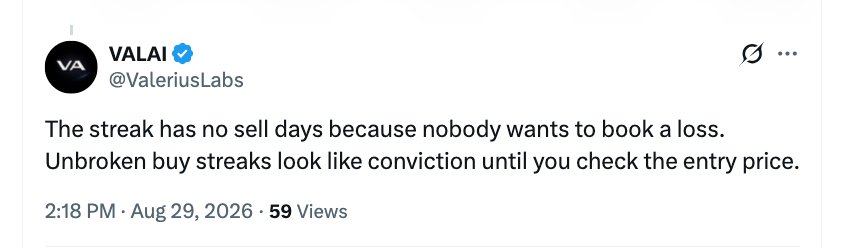
On X (formerly Twitter), users have expressed a range of reactions. One perspective, highlighted by user @ValeriusLabs, suggests that while BlackRock’s current order book may appear strong, it could be misleading, urging caution for speculators. This viewpoint reflects a historical pattern in cryptocurrency markets where periods of rapid price appreciation have often been followed by sharp corrections, leading to significant losses for inexperienced traders who engage in excessive leverage or speculative bets. The sentiment echoes the adage that "the market can remain irrational longer than you can remain solvent."
Conversely, other users, such as @zxcVika_ell, interpret BlackRock’s actions as part of a "quiet accumulation phase." This strategy, often employed by sophisticated investors, involves discreetly acquiring assets during periods of market uncertainty or price dips, anticipating a future rally. Such buyers aim to capitalize on price movements when mainstream attention is elsewhere, benefiting significantly from an eventual upward trend. This interpretation aligns with the observed pattern of consistent buying without net selling, suggesting a deliberate strategy to build a substantial position without signaling intent to the broader market.
Financial analysts generally view BlackRock’s move as a strong indicator of institutional confidence in Ethereum. They point to the fact that BlackRock’s ETF is structured to hold actual Ether, rather than futures contracts, which requires direct on-chain acquisition. This necessitates the purchase of Ether from the open market, directly impacting supply and demand dynamics. The sustained buying streak indicates a belief in Ether’s intrinsic value, driven by its utility as the fuel for the Ethereum network, the platform for smart contracts, DeFi, NFTs, and a growing array of decentralized applications.
The Future Landscape: Implications and Outlook
The recent developments surrounding spot Ether ETFs and BlackRock’s aggressive accumulation of Ether signal a pivotal moment for the cryptocurrency market. The increased accessibility for institutional investors through regulated financial products is expected to drive further adoption and capital inflow into the digital asset space.
Key implications include:
- Mainstream Integration: The approval and subsequent trading of spot Ether ETFs are critical steps towards integrating cryptocurrencies into the traditional financial system. This can lead to greater investor confidence, reduced stigma, and broader acceptance.
- Ethereum’s Ecosystem Growth: The influx of institutional capital is likely to benefit the entire Ethereum ecosystem. Increased demand for ETH as a store of value and medium of exchange could spur further development and innovation on the network.
- Regulatory Scrutiny: While approvals are a positive sign, regulators will continue to monitor the market closely. The success of these ETFs will likely inform future regulatory decisions regarding other digital assets.
- Market Volatility and Maturation: While institutional involvement can lead to greater stability, the cryptocurrency market is still prone to volatility. However, the presence of major players like BlackRock and Fidelity suggests a maturing market that is becoming more resilient to extreme price swings.
Looking ahead, the market sentiment is cautiously optimistic, with many anticipating a continued upward trajectory for digital assets, buoyed by the recent price recoveries and the growing institutional embrace. However, the inherent nature of financial markets, characterized by cycles and unforeseen events, necessitates a prudent approach. Staying informed through credible news sources and rigorous on-chain analytics remains crucial for understanding the complex dynamics of the digital currency market and navigating its future trajectory. The current momentum suggests that Ethereum is poised for significant growth, with institutional backing playing an increasingly dominant role in shaping its destiny.