


The digital asset landscape continues to witness a profound disparity between euro-pegged and dollar-pegged stablecoins, with the entire euro stablecoin category currently valued at a mere $759.9 million. This figure pales in comparison to the colossal dollar stablecoin market, which has surged past $300 billion, representing a gap of several orders of magnitude that underscores fundamental differences in market adoption, liquidity, and infrastructural integration. Recent data indicates that far from closing this chasm, the euro stablecoin market is experiencing a slight contraction, having decreased by 0.3% in a single day, a trend that challenges earlier, more optimistic estimates of its growth trajectory. This dynamic suggests that despite an active ecosystem with new entrants and fluctuating trading volumes, the sector remains deeply overshadowed by its dollar-denominated counterpart, with no immediate signs of a significant shift in this entrenched power imbalance.
The profound divergence in market capitalization between euro and dollar stablecoins is not merely a statistical anomaly but a reflection of deep-seated structural issues within the global cryptocurrency ecosystem and traditional finance. Stablecoins, designed to maintain a stable value relative to a fiat currency or other assets, serve as critical bridges between the volatile world of cryptocurrencies and the stability of traditional currencies. They facilitate trading, lending, and remittances, offering a digital alternative to fiat for rapid, low-cost transactions. The dollar’s enduring status as the world’s primary reserve currency and the dominant medium for international trade has naturally extended its influence into the digital asset space. Early cryptocurrency exchanges and decentralized finance (DeFi) protocols universally adopted dollar-pegged stablecoins like USDT and USDC as their default settlement and trading assets, creating an insurmountable first-mover advantage and network effect that continues to compound.
The current market valuation of $759,921,275 for all euro-pegged stablecoins, as reported by CoinGecko, stands in stark contrast to the dollar stablecoin market. This figure is even below some estimates from earlier in the year that placed the category closer to $900 million to $1 billion. This downward revision signifies that the market is not on a consistent upward trajectory but is subject to the same pressures of redemptions, protocol adjustments, and shifting liquidity that affect other segments of the digital asset market. Furthermore, the 24-hour trading volume across the entire euro stablecoin category barely reached $25,012,797. This thin liquidity is a critical indicator of the market’s immaturity and limited utility for large-scale operations. For institutional investors or even substantial retail traders, such low volumes mean higher slippage during trades, making it impractical for significant capital deployment and severely limiting the ability to execute large-scale swaps, participate in robust lending markets, or facilitate complex cross-chain routing, all of which are commonplace with dollar stablecoins.

The Dominance of Key Players and Market Fragmentation
Within this comparatively small market, concentration is remarkably high, with a single entity commanding the majority share. Circle’s EURC, operating under the same full-reserve model that backs its highly successful USDC, accounts for approximately 60% of the entire euro stablecoin category. With a market capitalization of $457,098,965, EURC stands as the undisputed leader. This level of dominance implies that the euro stablecoin market is less a diverse competitive landscape and more a single major player trailed by a fragmented field of smaller competitors. EURC has consistently maintained its peg to the euro, trading around its €1.00 equivalent value, demonstrating the stability expected of such an asset, bolstered by Circle’s established reputation and operational expertise in the stablecoin sector. A representative from Circle, speaking on the importance of regulatory clarity for expansion, might plausibly state, "EURC’s robust reserve model and compliance-first approach position it as a trusted digital euro, and we anticipate that the evolving regulatory frameworks, particularly MiCA in Europe, will be instrumental in expanding its utility across the continent."
A significant institutional entrant has emerged in the second position: Société Générale-FORGE’s EUR CoinVertible. With a market capitalization of $190,972,638, it represents a clear example of a major traditional bank venturing into the stablecoin arena at a substantial scale. The involvement of an entity like Société Générale, a prominent European financial institution, signals a growing interest from traditional finance in leveraging blockchain technology for digital assets. However, its market cap, less than half that of EURC, illustrates the considerable distance even well-capitalized institutional players must cover to meaningfully challenge the established leader. The bank’s move is often seen as a strategic step towards institutional DeFi and tokenized assets, aiming to provide a regulated and secure digital euro for its corporate and institutional clients. A spokesperson for Société Générale-FORGE might comment, "EUR CoinVertible is a testament to our commitment to innovation, offering institutional clients a secure, regulated on-ramp to digital assets within the European financial ecosystem. We believe in the transformative potential of tokenized finance, and our stablecoin is a crucial step in that direction."
The third position is currently held by Royal Euro (REUR) at $62,008,637. Its ascent into the top three is largely attributed to a striking price surge, recording a gain of 262.8% on the day the data was captured. Such a dramatic swing is highly atypical for a stablecoin, which is designed for minimal volatility, and instead mirrors the price action of a small-cap speculative token rather than a stable asset pegged to a fiat currency. This highlights the inherent volatility and speculative nature still present in the less liquid segments of the euro stablecoin market.

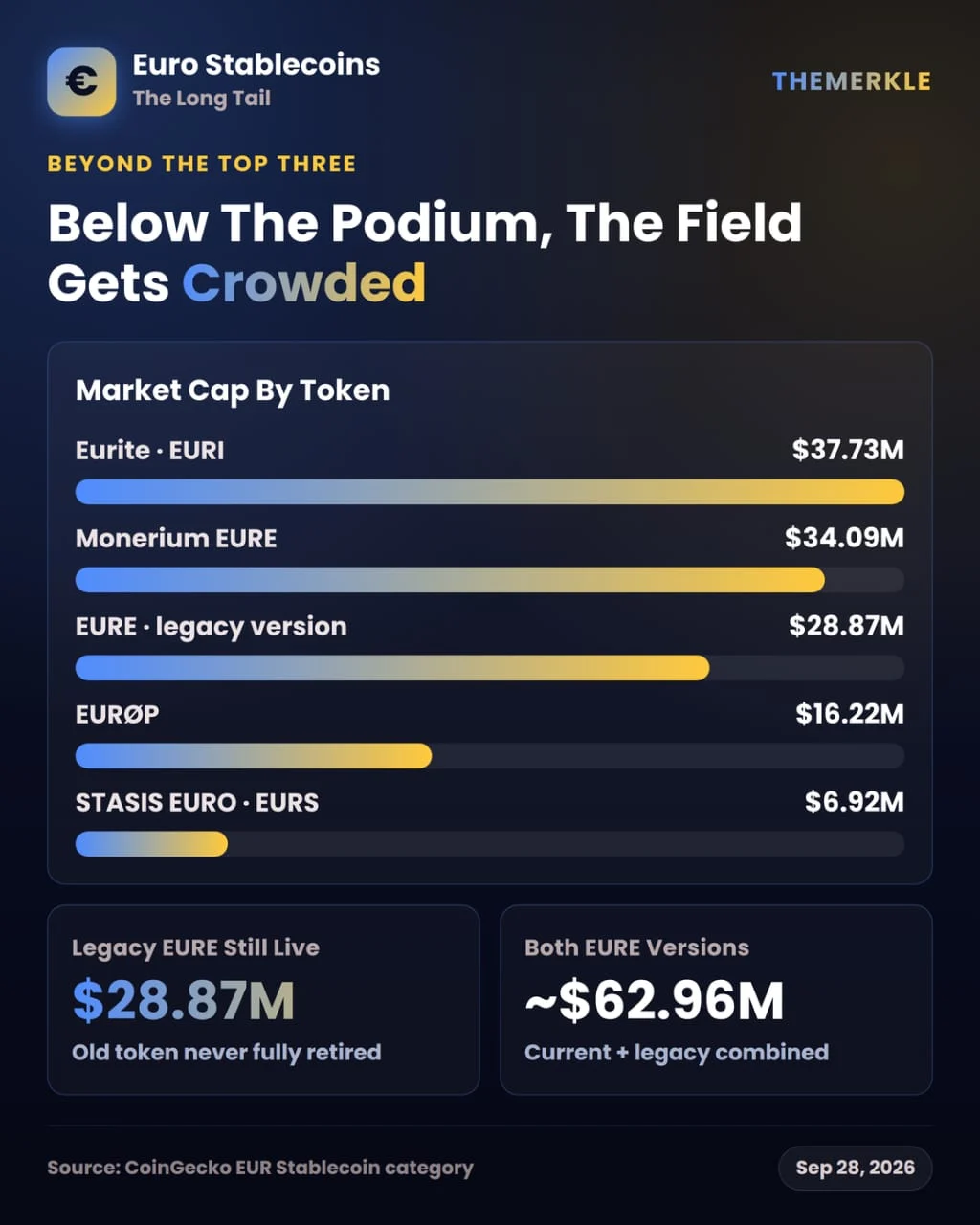
Beyond these top three, the category becomes genuinely crowded and highly fragmented. Eurite (EURI), issued by Banking Circle, sits at $37,728,637. Monerium’s EUR emoney token (EURE) appears twice in the rankings, with its current version at $34,089,978 and an older, legacy version still in circulation at $28,871,544. This peculiar situation serves as a reminder that stablecoin migrations and upgrades do not always result in the immediate and full retirement of older token versions, adding complexity to market analysis. Further down the list, EUR₮ (Euro Tether) and STASIS EURO (EURS) are also present. STASIS EURO, one of the oldest euro stablecoins, currently trails at $6,924,733, despite being one of the day’s stronger movers, up 32.8%. Euro Tether also saw significant gains, up 39.7%, though its market capitalization remains a fraction of the more established names. The prevalence of such double-digit percentage movements in assets designed for stability underscores the thin liquidity and relative immaturity of this market segment.
The Structural Problem: Liquidity Depth and Infrastructural Default
The fundamental problem hindering the growth of euro stablecoins is not a lack of options or issuers, as the market clearly has a plethora of contenders. Instead, it is a critical deficiency in liquidity depth and the prevailing default status of dollar-denominated assets across the global crypto trading infrastructure. With the entire euro stablecoin category generating only $25 million in daily trading volume, these tokens simply cannot support the kind of large-scale, low-slippage transactions, extensive lending markets, and efficient cross-chain routing that dollar stablecoins handle seamlessly across virtually every major DeFi protocol and centralized exchange.
This issue creates a self-reinforcing cycle: traders and institutions avoid euro stablecoin pairs because the thin liquidity leads to higher slippage and greater difficulty in executing large orders, which in turn perpetuates the low liquidity. Without deep order books and widespread integration into key protocols, euro stablecoins struggle to attract the significant capital flows necessary for growth. Dollar stablecoins, by contrast, did not achieve their $300 billion-plus market position purely through superior technology. They earned it through years of being the default settlement asset on a global scale, deeply integrated into nearly every facet of the cryptocurrency economy, from centralized exchanges to decentralized liquidity pools and lending platforms. This default status has created an unassailable network effect that euro stablecoins are only just beginning to contend with.

MiCA: A Regulatory Catalyst for European Digital Assets
Amidst these challenges, the European Union’s Markets in Crypto-Assets (MiCA) regulation stands as a beacon of potential change and a significant background context for the future of euro stablecoins. MiCA, a comprehensive regulatory framework for crypto-assets, has been genuinely instrumental in pulling the European digital asset segment out of a multi-year slump characterized by regulatory uncertainty. For stablecoins, particularly e-money tokens (EMTs) and asset-referenced tokens (ARTs), MiCA introduces stringent requirements for issuers, including robust reserve management, operational resilience, and transparent disclosure obligations.
The stablecoin-specific provisions of MiCA are slated to come into full effect in June 2024. This regulatory clarity is expected to foster greater institutional trust and potentially pave the way for broader adoption within the EU. The fact that legitimate institutional issuers like Société Générale are actively growing their euro-pegged tokens under the shadow of impending MiCA implementation is a tangible sign of progress. MiCA provides a standardized legal framework across all 27 EU member states, removing the patchwork of national regulations that previously hindered cross-border operations and innovation. This unified approach is crucial for creating a truly integrated European digital asset market. Analysts widely agree that MiCA’s robust consumer protection and market integrity measures could significantly de-risk stablecoin usage for both retail and institutional participants, encouraging greater participation and potentially attracting more capital into euro-denominated digital assets. An expert from a financial consultancy might offer, "MiCA is not a silver bullet, but it provides the essential regulatory bedrock upon which a mature euro stablecoin market can eventually be built. It addresses key concerns around reserves, governance, and transparency, which are critical for institutional confidence."
Broader Implications and The Road Ahead

While MiCA offers a powerful regulatory tailwind, the honest assessment of the current numbers reveals that euro stablecoins remain a marginal player in the global digital asset economy. Their collective market cap is, for all intents and purposes, a rounding error compared to the dollar-denominated market. The category’s slight contraction, even on a day when individual tokens like Royal Euro and STASIS EURO posted significant double-digit gains, underscores that much of this space is still driven by small-cap volatility rather than the deep, "boring" liquidity that characterizes a mature and truly stable stablecoin market.
The implications of this disparity extend beyond mere market figures. A robust euro stablecoin ecosystem is crucial for Europe’s digital economic sovereignty, offering an alternative to reliance on dollar-denominated digital assets. It could facilitate more efficient cross-border payments within the Eurozone, enable new DeFi applications tailored to European users, and provide a stable on-ramp and off-ramp for the burgeoning European Web3 economy. However, overcoming the entrenched network effects of dollar stablecoins requires more than just a good regulatory framework or a few strong quarters of growth. It demands a fundamental shift where euro-denominated liquidity becomes the default choice in significant segments of the digital economy, particularly within Europe.
This shift would necessitate major European cryptocurrency exchanges to prioritize euro stablecoin pairs, a greater integration into mainstream financial services, and potentially even explicit support or endorsement from European central banks or governments, alongside the existing MiCA framework. Without a concerted effort to build deep liquidity pools, attract significant institutional capital, and foster widespread adoption across various use cases, the euro stablecoin market will likely remain fragmented, volatile, and perpetually overshadowed by its dollar counterpart. The journey towards achieving a true "default" status for euro-denominated digital liquidity is a long and arduous one, requiring sustained innovation, strategic partnerships, and a collective commitment from both the private sector and regulatory bodies to cultivate a thriving European digital asset ecosystem.














