


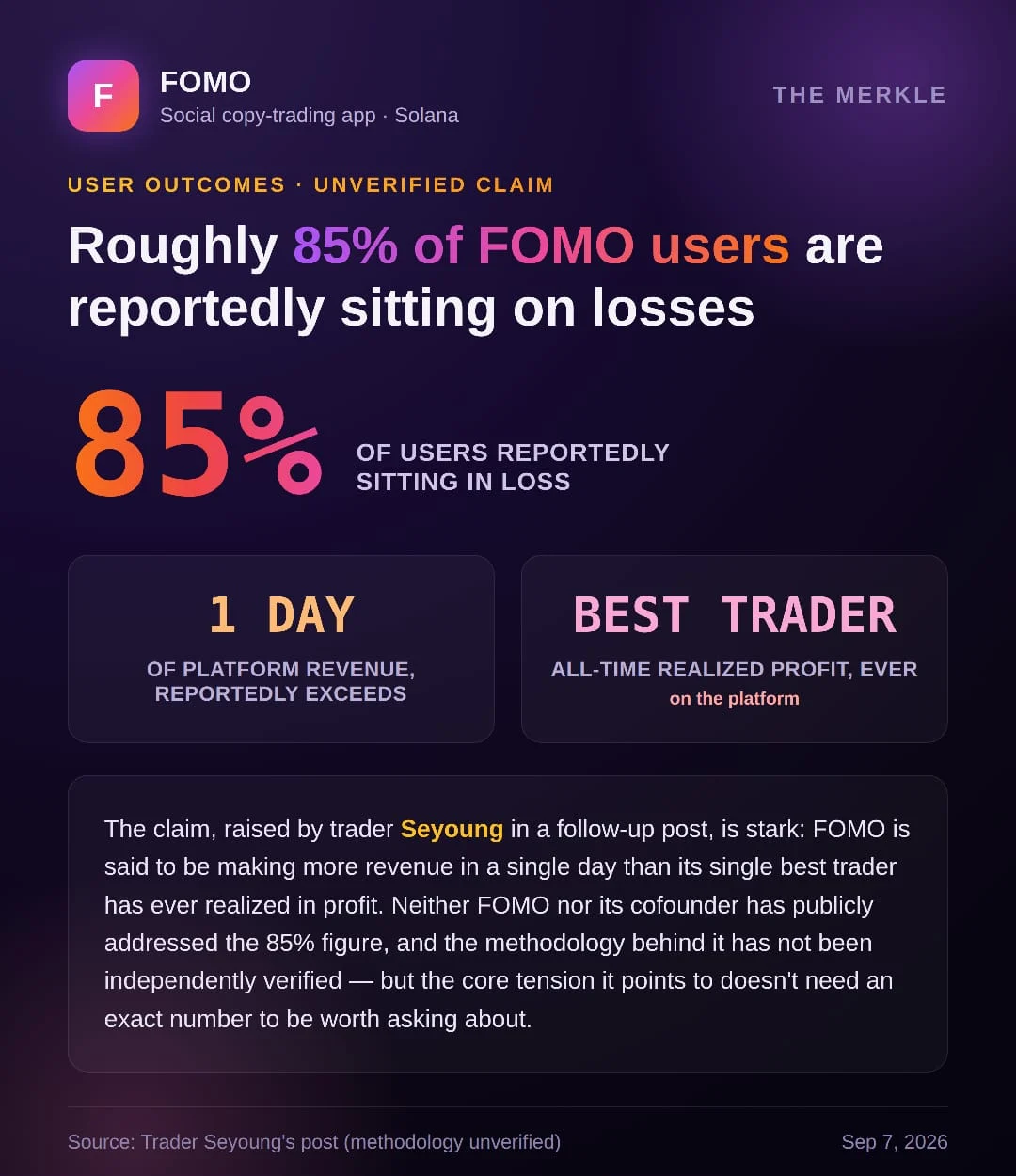
A striking dissonance has emerged within the dynamic Solana blockchain ecosystem, where the celebrated achievement of a burgeoning social trading application, FOMO, in surpassing a major rival for daily revenue has been met with a stark counter-narrative of significant user losses. This unfolding situation highlights a critical and often uncomfortable tension inherent in many retail trading platforms: the potential for a company’s financial success to diverge sharply from the profitability of its user base. The moment, characterized as "tone-deaf" by observers, encapsulates a broader discussion about transparency, user welfare, and the sustainability of business models predicated on high-frequency trading.
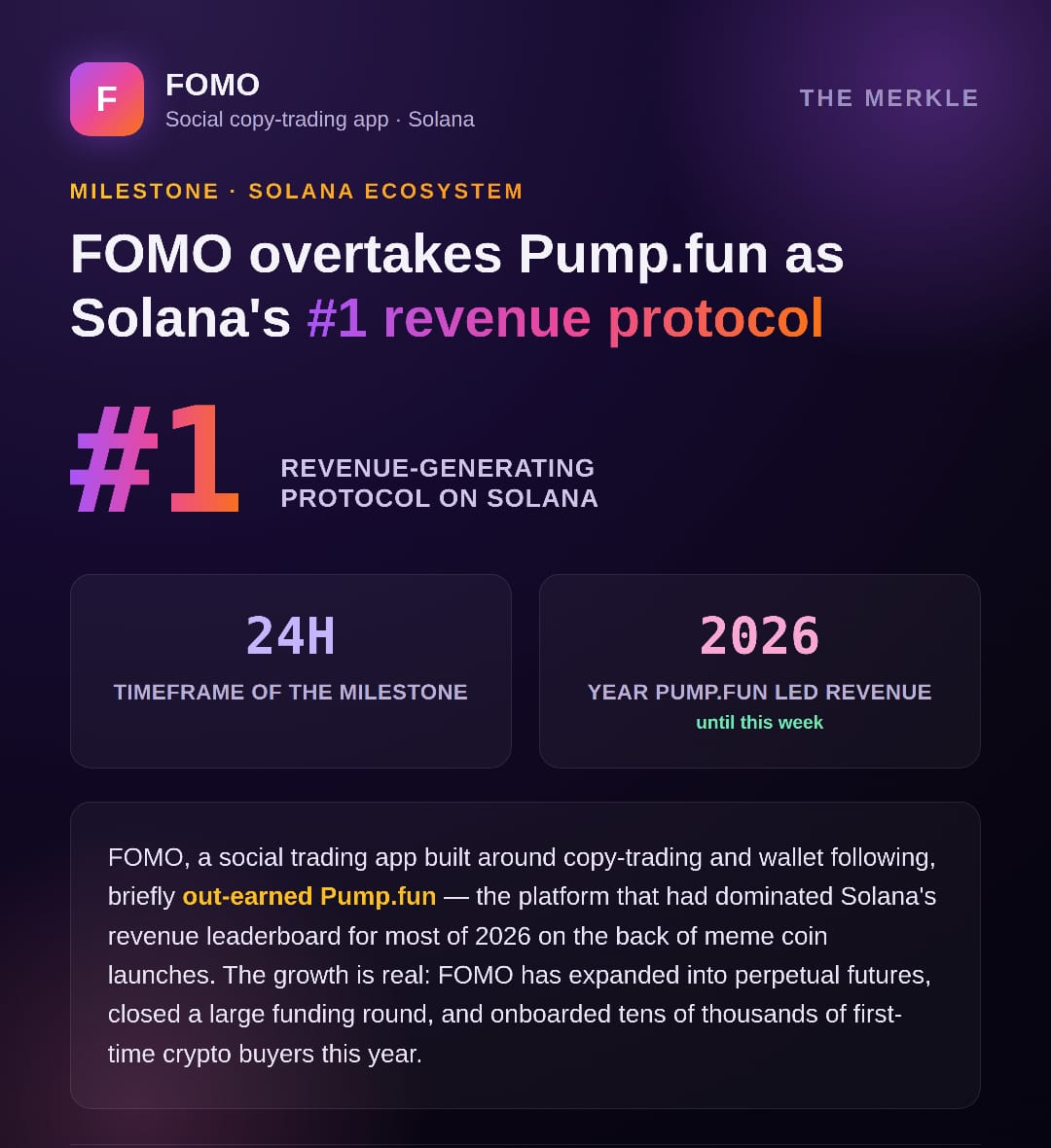
The core of the controversy centers on FOMO, an application designed to facilitate copy-trading, wallet following, and real-time trade feeds, which recently claimed the top spot as Solana’s leading revenue-generating protocol over a 24-hour period. This milestone, publicly heralded by FOMO’s co-founder, represents a notable shift in the Solana landscape, traditionally dominated by platforms like Pump.fun, known for its prolific meme coin launches. However, this celebratory announcement quickly encountered a sobering reality check. According to a prominent crypto trader, Seyoung, who has actively utilized the platform, a reported 85% of FOMO’s users are currently experiencing net losses. This juxtaposition of corporate triumph and user adversity has ignited a fervent discussion within the crypto community, prompting deeper scrutiny into the platform’s operational mechanics and ethical responsibilities.
Solana’s Competitive Landscape: The Rise of FOMO and Pump.fun
To fully grasp the significance of FOMO’s recent achievement and the subsequent controversy, it is essential to understand the vibrant and fiercely competitive environment of the Solana blockchain. Solana has, in recent years, emerged as a formidable rival to Ethereum, largely due to its high transaction throughput, low fees, and robust developer ecosystem. These attributes have made it a fertile ground for decentralized applications (dApps), particularly in the realm of decentralized finance (DeFi) and non-fungible tokens (NFTs). Its appeal to retail investors and traders has been particularly strong, fostering a culture of rapid innovation and, at times, speculative fervor.
Within this ecosystem, Pump.fun has long stood as a titan, particularly in the niche of meme coin creation and trading. Its simplified interface allows anyone to launch a token with minimal technical knowledge, fostering an environment where viral assets can emerge and trade with unprecedented speed. This "democratization" of token launches, while offering opportunities for significant gains, also carries substantial risks, often leading to volatile markets and "rug pulls" – where developers abandon a project after raising funds. Pump.fun’s model, largely based on fees from these launches and subsequent trading, has consistently placed it at the apex of Solana’s revenue charts for much of the current year. Its dominance underscored the pervasive interest in speculative, community-driven assets that characterize a significant portion of the crypto market.
FOMO, on the other hand, represents a different facet of Solana’s innovation. Positioned as a social trading application, it capitalizes on the human tendency to follow successful individuals and leverage collective intelligence. Its core functionalities – allowing users to track the trades of others, mirror their positions, and observe real-time market movements – tap into the psychological drivers of social proof and the desire for simplified access to trading strategies. The platform’s recent growth trajectory has been steep, marked by expansion into perpetual futures, successful funding rounds, and concerted efforts to simplify onboarding for first-time crypto buyers. This strategic expansion and user-friendly approach positioned FOMO as a significant challenger, making its temporary outperformance of Pump.fun a genuinely noteworthy event in the Solana ecosystem. The revenue figure itself, derived from genuine trading activity and platform engagement, is not in question; rather, the ethical implications of how that revenue is generated, and at what cost to its users, have become the central point of contention.

The Profit Paradox: Unpacking User Losses Amidst Record Revenue
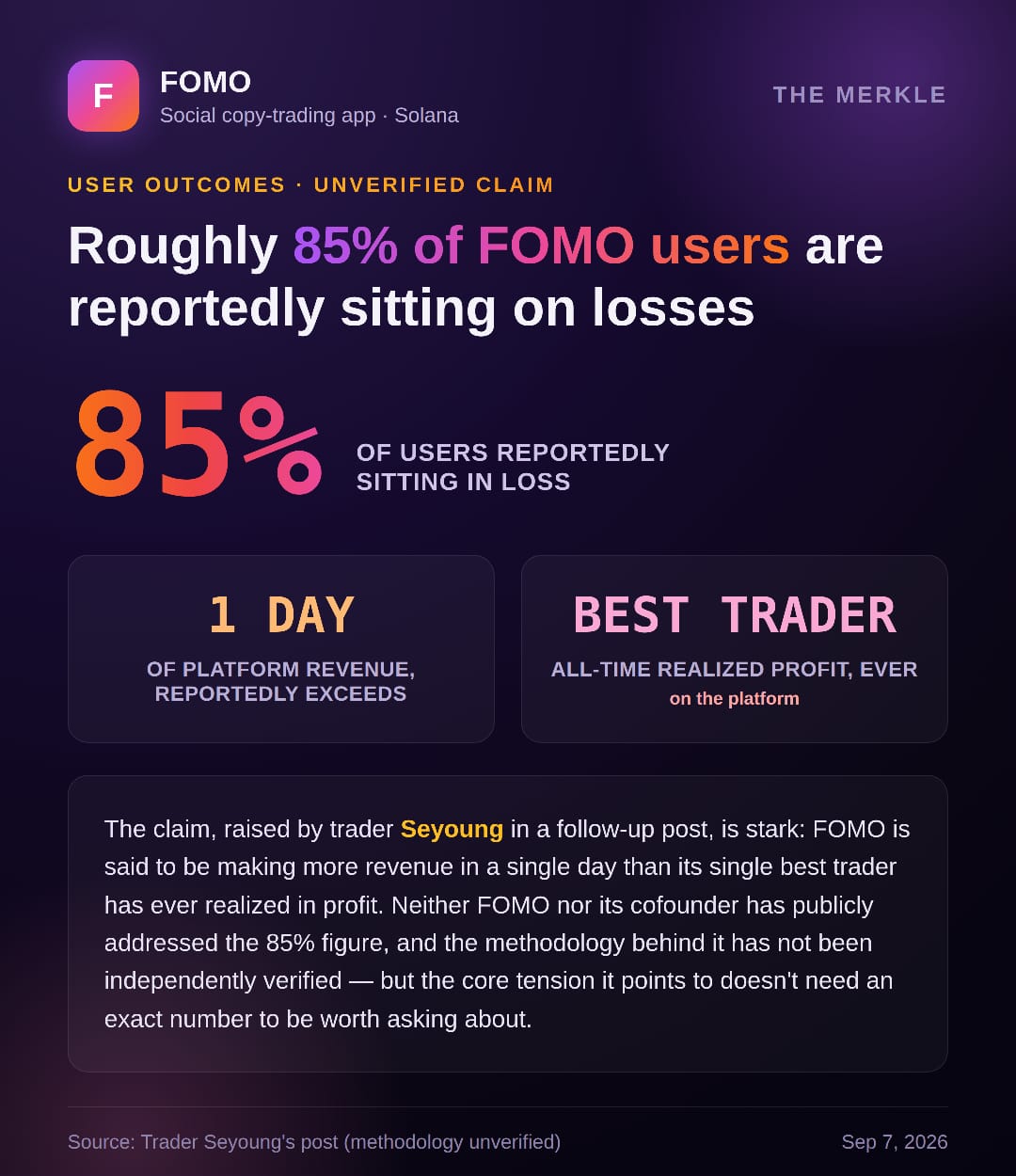
The celebratory announcement from FOMO’s co-founder regarding the platform’s record revenue was swiftly undercut by the pointed observations of crypto trader Seyoung. Seyoung’s public post directly challenged the narrative of success, highlighting a crucial and uncomfortable statistic: an estimated 85% of FOMO’s users are reportedly experiencing financial losses. This figure, while currently unverified by independent auditing and requiring appropriate caution, immediately injects a sobering reality into the platform’s proclaimed triumph.
Further intensifying the critique, Seyoung’s analysis suggested that FOMO’s single-day revenue now surpasses the cumulative lifetime profit ever realized by its most successful individual trader. This comparison, if accurate, paints a stark picture of imbalance. It implies a scenario where the platform, as an entity, benefits disproportionately from the collective activity of its user base, to an extent that its own daily earnings eclipse the peak financial achievements of its most skilled participants. Such a disparity raises fundamental questions about the value proposition for individual users and the long-term sustainability of user engagement if the overwhelming majority are not finding success.
The implications of such a "profit paradox" extend beyond mere statistics. It forces a re-evaluation of the platform’s underlying business model. While trading platforms earning revenue from fees is a standard industry practice across both traditional finance and crypto – every exchange operates on this principle – the reported scale of user losses against record platform revenue shifts the perception of these fees. They transition from being seen as a reasonable service charge for facilitating trades to potentially being viewed as the primary product itself. The phrase "the extraction machine churns," used in the critical post, vividly captures this sentiment, suggesting that the platform’s core function, from the user’s perspective, may be less about enabling profitable trading and more about systematically generating revenue through transaction volume, irrespective of individual outcomes. This perspective casts a shadow on the celebration, transforming a corporate milestone into a potential indictment of the platform’s design and its impact on its community.
The Mechanics of Extraction: A Deep Dive into FOMO’s Flat-Fee Structure and its Incentives
Understanding the genesis of this revenue-loss dichotomy necessitates a closer examination of FOMO’s fee structure. The platform operates on a flat $1 fee per trade, a model that, while seemingly straightforward and transparent, carries specific and far-reaching consequences for user behavior and profitability. This flat-fee approach disproportionately impacts smaller trades and, crucially, incentivizes frequent trading – precisely the behaviors that FOMO’s social, copy-trading, and feed-driven design is engineered to encourage.
The compelling product experience offered by FOMO lies in its ability to provide real-time visibility into other traders’ moves and the instant gratification of mirroring those actions. This creates a constant psychological pressure to engage, to "chase whatever’s moving in the feed," and to participate in every perceived opportunity. Each of these reactive trades, regardless of its size or ultimate outcome, incurs the flat $1 fee. This means that the platform consistently accumulates revenue, whether the underlying trade results in a profit or a loss for the individual user.
This mechanical explanation forms the bedrock of the reported 85% user loss figure. A social feed intrinsically designed to foster frequent, often reactive, trading is paired with a fixed cost per transaction. This combination creates a powerful revenue-generating engine for the platform that operates largely independent of individual user success. In this model, the platform’s exponential growth and the prevalence of user losses are not mutually exclusive or contradictory; rather, they can be seen as two intertwined outcomes of the same operational design. The system effectively monetizes volume and activity, making user profitability a secondary, or even tangential, concern for the platform’s revenue generation. This structural alignment means that the platform’s "success" can, paradoxically, be amplified by user misfortunes, as continuous trading in an attempt to recover losses still generates fee income.
Broader Context: This Pattern Isn’t Unique to FOMO, But the Framing Is Critical
While the current spotlight is on FOMO, it is imperative to acknowledge that the tension between platform revenue and user profitability is not a novel phenomenon, nor is it exclusive to this particular application or even the crypto space. This pattern is well-documented across the broader landscape of retail trading, both in traditional finance and throughout various segments of the cryptocurrency market.
Numerous studies and analyses of retail trading behavior consistently reveal that a significant majority of individual traders, whether in stocks, forex, or crypto, do not achieve sustained profitability over time. A small percentage of highly active or exceptionally skilled traders often account for a disproportionate share of trading volume and, occasionally, profits, while the vast majority experience net losses. This dynamic is observed in traditional retail brokerages, high-frequency trading platforms, and even in the rapidly evolving meme coin launchpads within crypto, where speculative bubbles frequently lead to significant wealth redistribution rather than widespread gains.
The underlying economic principle is straightforward: platforms that generate revenue from transaction fees (whether flat fees, commissions, or spreads) inherently benefit from trading volume. The more frequently users trade, the more revenue the platform accrues, irrespective of whether those individual trades are profitable. This basic economic reality is the foundation for many financial services entities.
What distinguishes the current situation with FOMO and elevates it to a significant news story is not the existence of this dynamic itself, but rather its specific timing and the manner in which it has been framed. Publicly celebrating a substantial revenue milestone, particularly when positioned as triumphing over a major competitor like Pump.fun, while simultaneously having credible data circulated that suggests the overwhelming majority of the user base funding that milestone is experiencing losses, creates a profoundly negative perception. Had the milestone been met with silence, or a more nuanced acknowledgement, it might have attracted less critical attention. However, the active and public celebration, juxtaposed directly against a specific and damning statistic regarding user losses, transforms what might otherwise be a routine business announcement into a compelling narrative of ethical concern and potential exploitation. This specific convergence of events forces a re-evaluation of how success is measured and communicated in the fast-paced, often opaque, world of decentralized finance.
Implications and Potential Responses: User Trust, Regulatory Scrutiny, and Industry Standards
The unfolding situation surrounding FOMO carries significant implications, not only for the platform itself but also for the broader Solana ecosystem and the nascent decentralized finance industry. At its core, the controversy directly impacts user trust, which is a cornerstone of any successful financial platform, especially in an environment like crypto that often operates with less formal regulatory oversight. If users perceive that a platform’s success is directly correlated with their own financial detriment, it can rapidly erode confidence, leading to user churn and reputational damage that is difficult to repair.
While FOMO and its co-founder have not yet publicly addressed the specific 85% loss claim as of this writing – and it is crucial to reiterate that this figure’s methodology has not been independently verified – the broader question raised by this situation demands a response. Silence or dismissive remarks could exacerbate the negative sentiment. A potential response from FOMO might involve defending its business model by emphasizing its transparency regarding fees, highlighting the inherent risks of trading, or perhaps showcasing the small percentage of highly successful traders. They might also choose to present aggregated data that tells a different story, though this would need to be robust enough to counter the existing claims. Alternatively, the platform could consider implementing changes to its fee structure or introducing new features aimed at promoting more responsible trading, though such shifts could impact its revenue.
From a regulatory perspective, incidents like this, even in the relatively unregulated crypto space, can draw unwanted attention. As governments globally grapple with how to regulate DeFi and protect retail investors, stories of platforms achieving record profits while users incur heavy losses could serve as a powerful impetus for stricter oversight. This might include demands for greater transparency in reporting user profitability metrics, mandates for clearer risk disclosures, or even re-evaluation of business models that are perceived as inherently predatory. The "extraction machine" label, if it gains traction, could become a significant liability in any future regulatory discussions.
For the Solana ecosystem, this event serves as a reminder of the need for robust ethical standards and a focus on long-term sustainability. While rapid growth and innovation are celebrated, they must ideally be balanced with user protection and responsible platform design. The community’s reaction, whether through continued engagement, vocal criticism, or a shift to alternative platforms, will ultimately shape the narrative around FOMO and influence future developments within the ecosystem. The incident underscores that while technological advancements and revenue milestones are important, the health and prosperity of the user community remain paramount for the sustained legitimacy and growth of any decentralized platform.
Moving Forward: Navigating the Ethical Labyrinth of Social Trading
For current or prospective users of FOMO, the key takeaway from this controversy is not necessarily that the platform is fraudulent or that its revenue figures are fabricated. Instead, it is a crucial reminder to internalize the structural incentives embedded within the application’s design. The combination of a social feed encouraging frequent copy-trading and a flat per-trade fee model inherently prioritizes trading volume and activity over individual user profitability. The platform is engineered to reliably generate revenue from transaction flows, regardless of whether those transactions ultimately benefit the users initiating them.
This understanding is vital before succumbing to the allure of watching other traders’ successes scroll past in real-time. The platform’s record-breaking revenue day, while an impressive corporate achievement, provides no direct indication of the probability of success for any individual trade a user might copy. It signifies the efficiency of the platform’s revenue generation mechanism, not necessarily the collective prosperity of its user base.
Ultimately, the gap between "the platform is thriving" and "the users are thriving" constitutes the true narrative here. Based on the information publicly shared, these two trajectories appear to be moving in divergent directions, presenting a complex ethical challenge for FOMO and a critical cautionary tale for the broader crypto community. As the industry matures, the ability of platforms to demonstrate not just financial success but also a genuine commitment to the welfare and profitability of their users will be increasingly vital for earning trust and ensuring long-term viability.
Disclosure: This is not trading or investment advice. Always do your research before buying any cryptocurrency or investing in any services.














