
Foundry, the digital asset infrastructure provider and operator of the world’s largest Bitcoin mining pool, has officially announced its strategic expansion into the Zcash (ZEC) ecosystem with the development of a dedicated mining pool tailored for institutional participants. Scheduled for a commercial debut in April 2026, this initiative marks a significant milestone in the maturation of privacy-preserving blockchain technologies, aiming to provide public companies and large-scale enterprises with a compliant, high-availability gateway to Zcash mining. As the operator of Foundry USA, which currently commands a plurality of the global Bitcoin hashrate, the company’s move into Zcash signals a growing institutional appetite for diversified Proof-of-Work (PoW) assets that offer sophisticated cryptographic features.
The announcement comes at a pivotal time for Zcash, a decentralized cryptocurrency that leverages zero-knowledge proofs to provide enhanced financial privacy. While Zcash has long been a staple of the cryptocurrency market, the infrastructure supporting its mining operations has historically been fragmented or catered primarily to retail miners and hobbyists. Foundry’s entry into this space is designed to bridge this gap, offering the same level of rigorous operational standards, reporting tools, and regulatory alignment that propelled its Bitcoin pool to the top of the global rankings.
Bridging the Institutional Infrastructure Gap
The primary driver behind Foundry’s expansion is the perceived lack of "enterprise-grade" infrastructure within the Zcash network. In a statement accompanying the announcement, Foundry CEO Mike Coyler noted that while Zcash has matured significantly as an asset class since its inception in 2016, the underlying mining support has failed to keep pace with the requirements of modern financial institutions. Publicly traded mining firms and institutional funds require specific features—such as transparent payout structures, robust audit trails, and North American-based operations—to satisfy internal compliance and external regulatory mandates.
By launching a US-based Zcash pool, Foundry aims to provide a localized solution that mitigates the geopolitical risks often associated with overseas mining pools. This strategy mirrors the success of Foundry USA, which leveraged the massive migration of mining hardware to North America following China’s 2021 ban on the industry. For institutional players, the ability to mine ZEC through a domestic provider offers a layer of legal and operational security that has previously been elusive in the privacy coin sector.

The Evolution and Mechanics of Zcash
To understand the significance of Foundry’s move, it is essential to examine the technical foundation of Zcash. Launched in late 2016 by the Electric Coin Company (ECC), Zcash was the first widespread application of zk-SNARKs (Zero-Knowledge Succinct Non-Interactive Arguments of Knowledge). This form of zero-knowledge cryptography allows parties to verify transactions without revealing the sender, receiver, or transaction amount.
Unlike Bitcoin, where the entire history of every transaction is visible on a public ledger, Zcash offers users a choice between "transparent" (t-addresses) and "shielded" (z-addresses) transactions. This dual-nature approach allows Zcash to maintain a public audit trail for those who require it while offering the option of total financial anonymity. The Foundry press release emphasized that this combination of cutting-edge privacy and transparent verification demonstrates how financial privacy and compliant digital infrastructure can coexist in a regulated global economy.
From an economic perspective, Zcash was modeled closely after Bitcoin. It shares the same hard supply cap of 21 million tokens and utilizes a similar "halving" mechanism, where the issuance of new coins is reduced by 50% approximately every four years. This disinflationary model is a core component of its value proposition for long-term investors and miners, providing a predictable issuance schedule that mirrors the scarcity of gold.
Strategic Partnerships and Industry Reaction
The development of the Foundry Zcash pool is being met with enthusiasm from the core developers and support organizations within the ZEC ecosystem. Shielded Labs, a Switzerland-based independent organization dedicated to supporting the Zcash protocol, has voiced strong support for the project. Zooko Wilcox, the founder of Zcash and Chief Product Officer at Shielded Labs, hailed the move as a major step forward for the network’s decentralization and security.
"We at Shielded Labs are delighted that Foundry—the largest Bitcoin mining pool, and one based in North America—is launching an enterprise-grade Zcash mining pool," Wilcox stated. He further noted that the presence of a reputable, large-scale operator like Foundry would likely encourage more institutional-grade hardware to point toward the Zcash network, thereby increasing its overall resilience against potential attacks.

The collaboration between Foundry and Shielded Labs highlights a broader trend of "professionalization" within the privacy coin sector. As regulatory scrutiny of the cryptocurrency industry intensifies, projects like Zcash are increasingly focusing on how their privacy features can be used responsibly within existing financial frameworks, such as the Travel Rule and Anti-Money Laundering (AML) standards.
Analyzing the Recent Surge in Zcash Hashrate
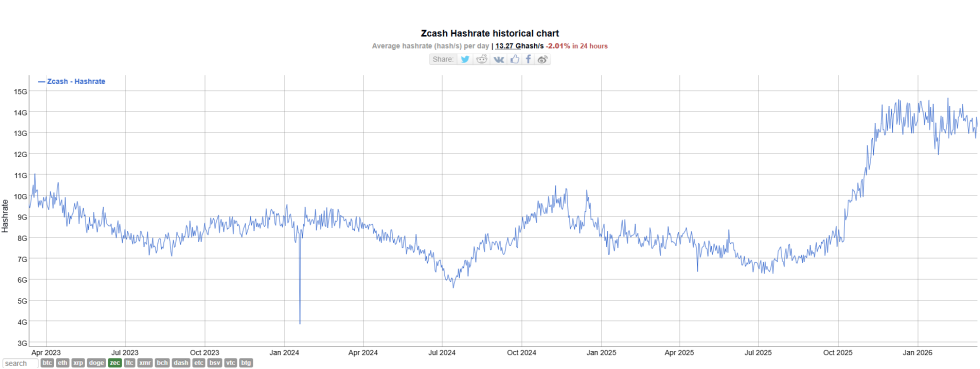
Foundry’s decision to enter the ZEC market is backed by compelling on-chain data. Over the past several months, the Zcash network has experienced a substantial "hashrate boom," indicating a surge in the total computing power dedicated to securing the blockchain. Data from BitInfoCharts reveals that the network hashrate sat at approximately 8 Gigahashes per second (Ghash/s) in October 2025. By early 2026, that figure had climbed to over 13 Ghash/s, representing a nearly 63% increase in network difficulty in a relatively short timeframe.
This increase in hashrate is often a precursor to institutional interest, as a higher hashrate makes the network more expensive to attack, thereby increasing the "security budget" of the asset. The influx of new computing power suggests that miners are either upgrading to more efficient ASIC (Application-Specific Integrated Circuit) hardware or that new large-scale operations are coming online in anticipation of future price appreciation or protocol upgrades.
Market Context and Price Performance
Despite the positive infrastructure developments, the price of Zcash has remained volatile. At the time of the announcement, ZEC was trading at approximately $209, reflecting an 11% decline over the trailing seven-day period. This price action suggests a period of consolidation following a broader market recovery.
For miners, the profitability of Zcash is determined by the interplay between the ZEC price, the network difficulty (hashrate), and the cost of electricity. The entry of a major player like Foundry could potentially stabilize the mining ecosystem by providing more consistent payout structures and reducing the "pool luck" variance for smaller institutional participants. Furthermore, if Foundry’s entry attracts more capital to the asset, it could serve as a long-term catalyst for price stability and liquidity.
Timeline and Future Implications
The scheduled launch in April 2026 provides a significant runway for Foundry to refine its technical architecture and for institutional partners to prepare their mining fleets. This timeline also aligns with the broader roadmap of the Zcash protocol, which has been exploring various upgrades, including the potential transition from Proof-of-Work to Proof-of-Stake (PoS) in the distant future. However, by launching a PoW mining pool, Foundry is signaling its belief that mining will remain a critical component of the Zcash security model for the foreseeable future.
The implications of this move extend beyond Zcash. If Foundry successfully replicates its Bitcoin mining pool model for ZEC, it may set a precedent for other privacy-focused or alternative PoW assets. It demonstrates that with the right infrastructure and compliance protocols, even assets focused on anonymity can be integrated into the portfolios of public companies.
Conclusion: A New Era for Privacy-Preserving Assets
Foundry’s expansion into Zcash represents a convergence of institutional-grade operational excellence and advanced cryptographic privacy. By addressing the infrastructure gap that has historically limited enterprise participation in ZEC mining, Foundry is positioning itself as a central pillar of the privacy coin ecosystem.
As the April 2026 launch date approaches, the industry will be watching closely to see how the influx of institutional hashrate affects the decentralization and security of the Zcash network. For now, the move serves as a powerful validation of Zcash’s technology and its potential to serve as a compliant yet private digital asset in an increasingly transparent financial world. With the backing of the world’s largest mining pool operator, Zcash is poised to enter a new chapter of growth, defined by professionalization, domestic security, and institutional adoption.