In an increasingly crowded landscape of cryptocurrency token launchpads, where platforms often present variations on a similar theme of token creation and speculative trading, a new entrant named Genius.fun is distinguishing itself through a structurally innovative approach centered on Real-World Assets (RWAs). While many platforms allow users to simply name a token, assign a ticker, and initiate a launch with the hope of rapid price appreciation, Genius.fun, operating under the GeniusTerminal brand, endeavors to transcend this conventional model by integrating tokenization with the actual acquisition of stakes in publicly listed companies. This novel framework seeks to move beyond mere secondary trading exposure, aiming instead to foster collective ownership and coordinate buying power for tangible assets.
The Evolution of Token Launchpads and the Rise of RWAs
The concept of a token launchpad has been a cornerstone of the decentralized finance (DeFi) ecosystem for several years, providing a streamlined mechanism for projects to issue new cryptocurrencies and raise capital. Early iterations often focused on initial coin offerings (ICOs) or initial DEX offerings (IDOs), enabling rapid deployment of tokens, many of which were purely speculative or meme-based. While these platforms democratized access to fundraising and investment, they also frequently faced criticism for facilitating projects with unclear utility or unsustainable economics, often leading to volatile market cycles and investor losses.
Against this backdrop, the concept of Real-World Assets (RWAs) in blockchain has gained significant traction. RWAs refer to tangible or intangible assets that exist in the traditional financial world, such as real estate, commodities, private equity, bonds, and even company shares, which are then tokenized on a blockchain. The tokenization of RWAs promises to unlock liquidity, reduce friction in asset transfer, enhance transparency, and fractionalize ownership, making high-value assets accessible to a broader investor base. However, the implementation of RWA tokenization has faced challenges, primarily in establishing a clear, legally compliant link between the on-chain token and its off-chain underlying asset, and ensuring that token holders gain more than just price exposure—true ownership or claim.

Genius.fun positions itself within this evolving paradigm, specifically addressing the gap where most tokenized equity products halt at secondary trading. Traditional models often provide exposure to a stock’s price movements without conferring the underlying coordination or ownership rights typically associated with holding shares in a company. Genius.fun’s explicit goal is to push past this limitation, leveraging tokenization as a tool for organizing collective buying power rather than merely a wrapper for speculative trading.
Genius.fun’s Distinctive Real-World Asset Model
Launched on the BNB Chain, a blockchain known for its high transaction throughput and relatively low fees, Genius.fun has developed a mechanism that allows tokenized shares created on its platform to be split and pooled. This innovative structure empowers token holders to coordinate collective stakes in publicly listed firms. The platform’s framing emphasizes this crucial distinction: it’s not just about trading a token; it’s about accumulating enough tokens collectively to acquire a piece of a real, publicly listed company. This shifts the focus from individual speculation to a coordinated effort towards tangible asset acquisition.
A deep dive into the platform reveals a deliberate design choice that bifurcates a token’s economic destiny, a feature that profoundly differentiates Genius.fun from its predecessors. Every token launched on Genius.fun is subject to a 2% total trading fee. However, the allocation of this fee is determined by a pivotal decision made by the token creator at the point of launch. This decision directly aligns the token’s path with either the platform’s core mission of RWA acquisition or a more conventional creator payout model.
The Pivotal Fee Structure: Foundation vs. Creator Payout

The fee allocation mechanism is arguably the most significant structural innovation introduced by Genius.fun. Token creators are presented with two distinct paths for the 2% trading fee:
-
Genius Foundation Vault: Opting for this path directs a portion of the trading fee towards a dedicated Genius Foundation vault. The platform explicitly states on its creation page that routing fees to this vault is the enabling mechanism for the underlying tokenized equities to eventually be "unwrapped," thereby facilitating real-world acquisition. This path is directly tied to the platform’s overarching mission of collective ownership of public company shares.
- Detailed Breakdown (Foundation Path): In this model, the 2% total trading fee is distributed as follows: 1% goes towards the Genius Foundation’s accumulation efforts, 0.25% is allocated as a creator payout, 0.5% is directed to the Genius platform itself for operational costs and development, and the remaining 0.25% is dedicated to a mandatory meme buyback-and-burn mechanism. Importantly, tokens purchased through this mechanism are permanently burned, reducing supply rather than being recycled. The foundation’s share accumulates in a shared vault, held in BNB, and the platform unequivocally states that these vault assets belong to the foundation, with meme token holders having no direct redemption claim over them. This clarifies that contributions via this path are towards a collective, foundational pool aimed at real acquisitions, not for individual claim.
-
Creator Payout: The alternative path allows creators to opt for a more familiar model where a larger share of the trading fee is routed directly back to them. This mirrors the revenue generation model commonly seen in many meme coin or speculative token launches, where creators profit directly from trading volume.
The explicit nature of this choice, presented to creators at the very moment of launch, is a strategic move by Genius.fun. It acts as a clear differentiator and a mechanism to safeguard the platform’s core mission from being diluted by projects solely focused on quick creator fees. By forcing creators to actively select a path, Genius.fun ensures a level of intentionality behind each token launched, fostering an ecosystem where projects aligned with RWA acquisition can thrive alongside those pursuing more traditional speculative models. This transparency in fee distribution and its implications for the token’s long-term utility sets a new standard for launchpad accountability and mission clarity.
Initial Traction and Early Performance Indicators

Despite being in its nascent stages, Genius.fun has demonstrated compelling early traction, indicating significant immediate engagement and trading volume. Within just six hours of its launch, token deployers on the platform collectively earned approximately 150 BNB in creator rewards. This figure is substantial for a newly launched platform and suggests a rapid influx of activity rather than a gradual trickle. Creators, depending on their chosen fee path, were able to earn up to 1.25% of the collected fees, showcasing the immediate financial incentives available within the ecosystem. This rapid accumulation of creator rewards underscores robust trading activity and keen interest from the community.
This initial surge in activity suggests a strong market appetite for innovative launchpad models, particularly those offering clearer value propositions beyond pure speculation. The immediate trading volume is a critical indicator of a platform’s viability, and Genius.fun’s performance in its first few hours positions it as a noteworthy contender in the competitive DeFi space.
Strategic Incentives: The $10,000 Buyback and $GCAT’s Ascendancy
To further incentivize creators to align with its foundation model and foster real-world asset accumulation, Genius.fun has implemented a concrete, time-bound commitment: the Genius Foundation plans to execute a $10,000 buyback of the highest market capitalization token launched on the platform on September 25th. This direct, dated action provides a tangible incentive for creators to route their fees towards the foundation path, offering a clear reward for building a project that achieves significant market adoption and contributes to the RWA mission.
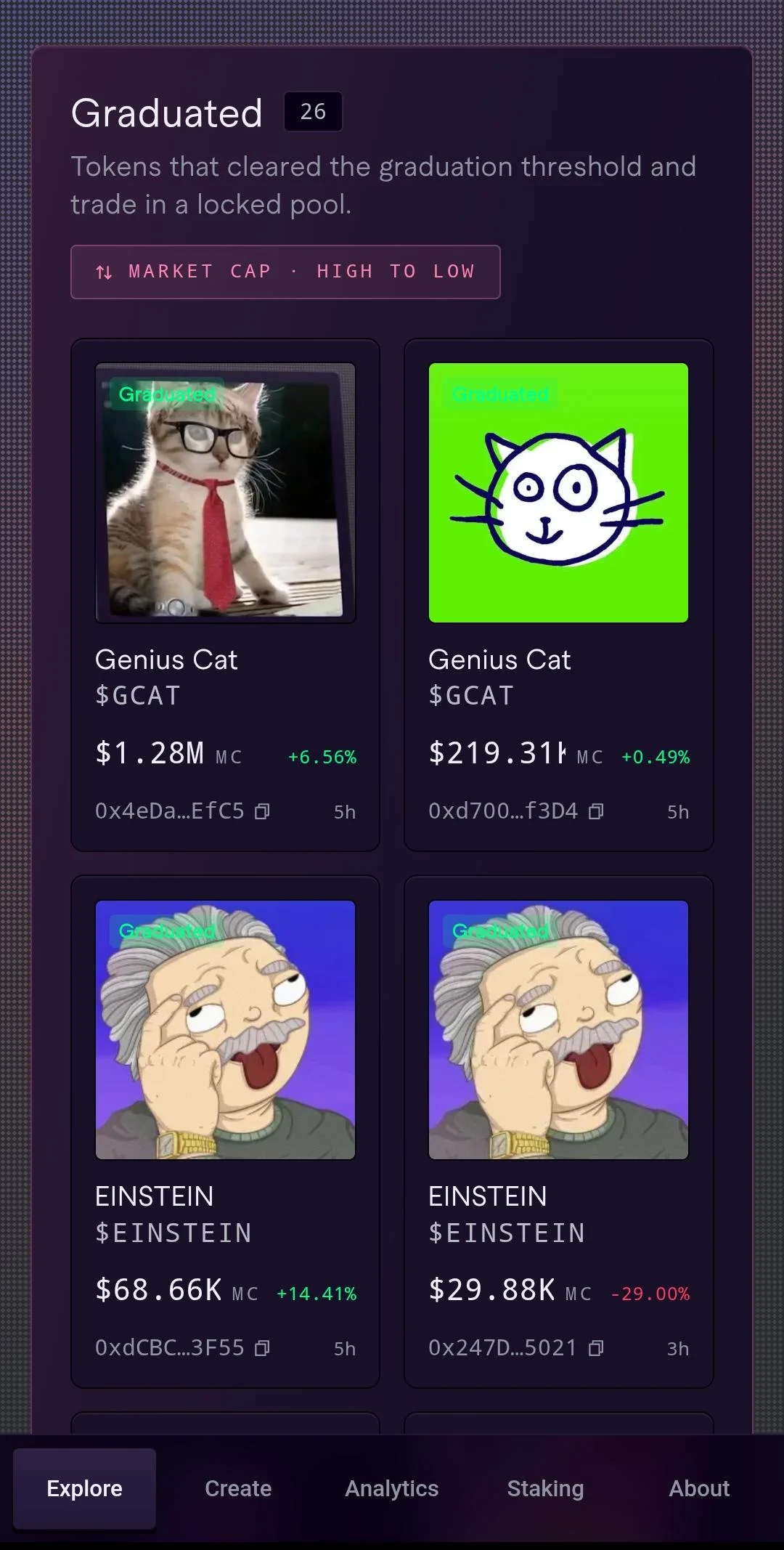
As of the reporting period, 26 tokens have successfully launched on the platform, with "Genius Cat" (trading as $GCAT) emerging as the clear frontrunner. $GCAT has rapidly achieved a market capitalization of approximately $1.28 million, making it the flagship early success story for Genius.fun. This token’s prominence demonstrates the potential for projects aligned with the foundation model to gain significant market traction and community support. The upcoming $10,000 buyback specifically targets the leading token, providing a powerful competitive element and a direct financial boost to the project that best embodies the platform’s goals. This mechanism not only rewards success but also reinforces the platform’s commitment to its stated mission, distinguishing it from launchpads that merely facilitate token creation without active ecosystem support.

Broader Market Implications and Future Outlook
Genius.fun’s emergence could have significant implications for the broader DeFi and RWA landscapes. By creating a direct pathway for token holders to collectively acquire stakes in publicly listed companies, the platform is pioneering a new form of decentralized corporate governance and investment. This model potentially opens up fractional ownership of traditional equities to a global, blockchain-native audience, bypassing many of the traditional intermediaries and geographical barriers.
- Democratization of Investment: The ability to pool resources for collective equity acquisition could democratize access to investments in blue-chip companies, making them accessible to individuals who might not have the capital to purchase full shares or navigate complex traditional brokerage systems.
- Enhanced Utility for Tokens: Unlike many speculative tokens, those launched on Genius.fun with the foundation path activated possess a direct, tangible link to real-world value creation, potentially enhancing their long-term utility and stability. This could attract a different class of investors, more focused on fundamental value than fleeting speculation.
- Innovation in Launchpad Models: Genius.fun’s deliberate fee split and incentive structure could inspire other launchpads to move beyond basic token generation, fostering platforms that are more mission-driven and aligned with tangible outcomes. This could lead to a maturation of the launchpad ecosystem, with a greater emphasis on utility and less on pure speculation.
- Regulatory Considerations: As Genius.fun delves into the acquisition of real, publicly listed company shares, it will undoubtedly navigate a complex web of regulatory requirements across different jurisdictions. The legal framework around tokenized securities and collective investment schemes is still evolving, and the platform’s long-term success will depend on its ability to ensure compliance while maintaining decentralization.
- Scalability and Adoption: The success of the collective acquisition model hinges on widespread adoption and sufficient pooling of resources. While early traction is promising, sustaining this momentum and scaling the platform to facilitate significant RWA acquisitions will be a continuous challenge.
The platform’s explicit mission to connect tokenization with real-world asset acquisition represents a forward-thinking approach that could redefine the utility of blockchain technology in finance. The initial performance, marked by substantial creator earnings and the rapid rise of tokens like $GCAT, indicates a strong market reception to this innovative model. While the long-term sustainability and regulatory landscape remain areas for continuous monitoring, Genius.fun has, in its early days, certainly earned more attention than the average token-generator site, signaling a potentially significant shift in how real-world assets are integrated into the decentralized digital economy.
The journey towards the September 25th buyback will be a critical test for Genius.fun, demonstrating not only the platform’s ability to maintain its early momentum but also the community’s commitment to its RWA-focused vision. Should this model prove successful in facilitating genuine collective ownership and real-world asset acquisition, it could establish a precedent for a new generation of launchpads, transforming them from mere speculation facilitators into powerful engines for decentralized financial innovation and tangible value creation.
Disclosure: This is not trading or investment advice. Always do your research before buying any cryptocurrency or investing in any services.