The decentralized finance (DeFi) landscape has long been characterized by a proliferation of token launchpads, many of which offer straightforward mechanisms for creating and deploying digital assets, often with a primary focus on speculative trading. However, a new entrant, Genius.fun, operating under the GeniusTerminal brand, has emerged on the BNB Chain, signaling a significant structural departure from this established norm. Unlike platforms that primarily facilitate the creation of tokens for immediate secondary market activity, Genius.fun is engineered to bridge the gap between digital assets and tangible ownership of real-world assets (RWAs), specifically publicly listed companies. This initiative represents a concerted effort to transform tokenization from a mere vehicle for speculation into a mechanism for coordinated collective acquisition, a critical evolution in the RWA sector.
The Evolution of Token Launchpads and the RWA Imperative
For years, token launchpads have served as crucial gateways for new projects entering the cryptocurrency ecosystem. These platforms typically streamline the technical process of token generation, allowing creators to define parameters such as name, ticker, supply, and basic economic models, often with minimal barriers to entry. This accessibility has fueled innovation but also contributed to a highly speculative environment, where many tokens lack intrinsic value beyond their trading price and potential for rapid appreciation. The majority of these platforms conclude their utility at the point of token issuance, leaving the subsequent market dynamics, often characterized by volatility and short-term trading, entirely to the broader DeFi market.
The concept of Real-World Assets (RWAs) in blockchain technology represents a fundamental shift away from purely digital, native crypto assets towards tokenized representations of tangible or intangible assets that exist in the traditional economy. This includes everything from real estate and commodities to intellectual property and, increasingly, equities of publicly traded companies. The growing interest in RWAs stems from a desire to imbue digital assets with more stable, verifiable value, integrate blockchain technology with traditional finance, and unlock new avenues for liquidity and fractional ownership. However, a recurring challenge for tokenized equity products has been their tendency to stop at mere price exposure. While users might gain synthetic exposure to a stock’s price movements, they rarely acquire the underlying ownership rights or the ability to coordinate collective action that comes with actual shareholding. Genius.fun directly addresses this limitation, positioning itself as a platform that pushes beyond simple price correlation to enable genuine, albeit collective, stake acquisition.

Genius.fun’s Differentiated Mechanism: The Dual Fee Structure
At the core of Genius.fun’s innovative approach is a uniquely designed fee structure that explicitly bifurcates the economic destiny of every token launched on the platform. Each token carries a 2% total trading fee, a standard mechanism in many decentralized exchanges and launchpads. However, the critical divergence lies in the creator’s choice at the point of launch regarding the allocation of this fee. This decision is not merely a preference but a foundational choice that dictates the token’s purpose and its alignment with the platform’s overarching mission.
Creators are presented with two distinct paths:
- Genius Foundation Vault: This path directs a portion of the trading fees towards a dedicated Genius Foundation vault. The platform unequivocally states that routing fees here is the mechanism that enables the eventual unwrapping of underlying tokenized equities and their conversion into real-world acquisitions. This option is intrinsically tied to the platform’s ambition of collective ownership.
- Creator Payout: This alternative path routes a larger share of the trading fee directly back to the token creator. This model closely resembles the fee structures observed in conventional meme coin launches, where a primary incentive for creators is direct financial remuneration from trading volume.
The explicit nature of this choice, presented to creators at the very moment of token deployment, is a strategic design element. It prevents the platform’s core mission of RWA acquisition from being diluted by purely speculative ventures, by forcing creators to consciously align their token’s economic model with either collective asset accumulation or individual profit generation. This transparency and mandatory decision point underscore Genius.fun’s commitment to its stated purpose, making it a pivotal differentiation in a crowded market of launchpads.
The Mechanics of the Genius Foundation Path

Delving deeper into the Genius Foundation path reveals the intricate mechanics designed to facilitate real-world asset acquisition. When creators opt for this route, the 2% total trading fee is meticulously broken down and allocated as follows:
- 1% to Foundation Accumulation: This significant portion of the fee is directed towards the Genius Foundation’s shared vault, accumulating in BNB. Crucially, the platform specifies that these vault assets belong exclusively to the foundation, and meme token holders have no direct redemption claim over them. This ensures that the accumulated capital is solely dedicated to its stated purpose: acquiring stakes in publicly listed companies. This collective pooling of resources, free from individual claims, is fundamental to the platform’s ability to aggregate sufficient capital for meaningful acquisitions.
- 0.25% as Creator Payout: Even when choosing the Foundation path, creators receive a modest payout, acknowledging their role in initiating the token and its ecosystem. This serves as an incentive for creators to align with the RWA mission without entirely foregoing personal reward.
- 0.5% to Genius Platform: A portion of the fee supports the operational costs, development, and maintenance of the Genius.fun platform itself, ensuring its continued functionality and growth.
- 0.25% to Mandatory Meme Buyback-and-Burn: This innovative mechanism channels a fraction of the fees towards buying back and permanently burning specific meme tokens associated with the platform. This deflationary pressure on related tokens can potentially enhance their value over time, creating a symbiotic relationship between the RWA acquisition goal and the broader Genius ecosystem. The tokens purchased are not recycled but irrevocably removed from circulation, reinforcing scarcity.
The explicit statement that vault assets belong to the foundation, and not to individual meme holders, is a crucial legal and operational distinction. It underscores that participation in the Genius Foundation path is a contribution to a collective endeavor aimed at tangible corporate ownership, rather than an investment that grants individual claims on the accumulated capital. This design is critical for maintaining the integrity and legal clarity of the RWA acquisition process, differentiating it from traditional investment funds or security tokens with direct redemption rights.
Early Traction and Performance Metrics
Despite being barely a day into its operational life, Genius.fun has demonstrated remarkable early traction, suggesting a strong market appetite for its differentiated model. Within just six hours of its launch, token deployers on the platform had collectively earned an impressive 150 BNB in creator rewards. This figure, roughly equivalent to $35,000 at the time of reporting (based on BNB’s approximate value), indicates substantial trading volume moving through the platform almost immediately. Such rapid accumulation of creator earnings is uncommon for nascent launchpads, which typically experience a gradual build-up of activity. The fact that creators could earn up to 1.25% of collected fees, depending on their chosen path, highlights the immediate financial incentive provided by the platform.
The swift generation of significant rewards points to several factors: strong pre-launch interest, effective marketing, and perhaps most importantly, a clear value proposition that resonated with the crypto community. This early momentum is a critical indicator of the platform’s potential to attract both creators and traders, laying a solid foundation for its long-term ambitions.

Strategic Incentives: The $10,000 Buyback Commitment
To further incentivize creators to choose the Genius Foundation path and align with its RWA acquisition mission, the platform has implemented a concrete and time-bound commitment: the Genius Foundation plans to execute a $10,000 buyback of the highest market cap token launched on the platform on September 25. This direct, dated action provides a powerful, tangible incentive for creators to route fees towards the foundation.
The buyback mechanism serves multiple strategic purposes:
- Validation of the Foundation Model: It demonstrates the Foundation’s active role in supporting the ecosystem and its commitment to deploying accumulated capital.
- Creator Incentive: It offers a clear, measurable reward for tokens that successfully build community and market capitalization while contributing to the Foundation. This encourages competition and quality within the RWA-aligned token launches.
- Market Support: The buyback provides direct liquidity and price support for the leading token, potentially increasing its appeal to investors and further fueling its growth.
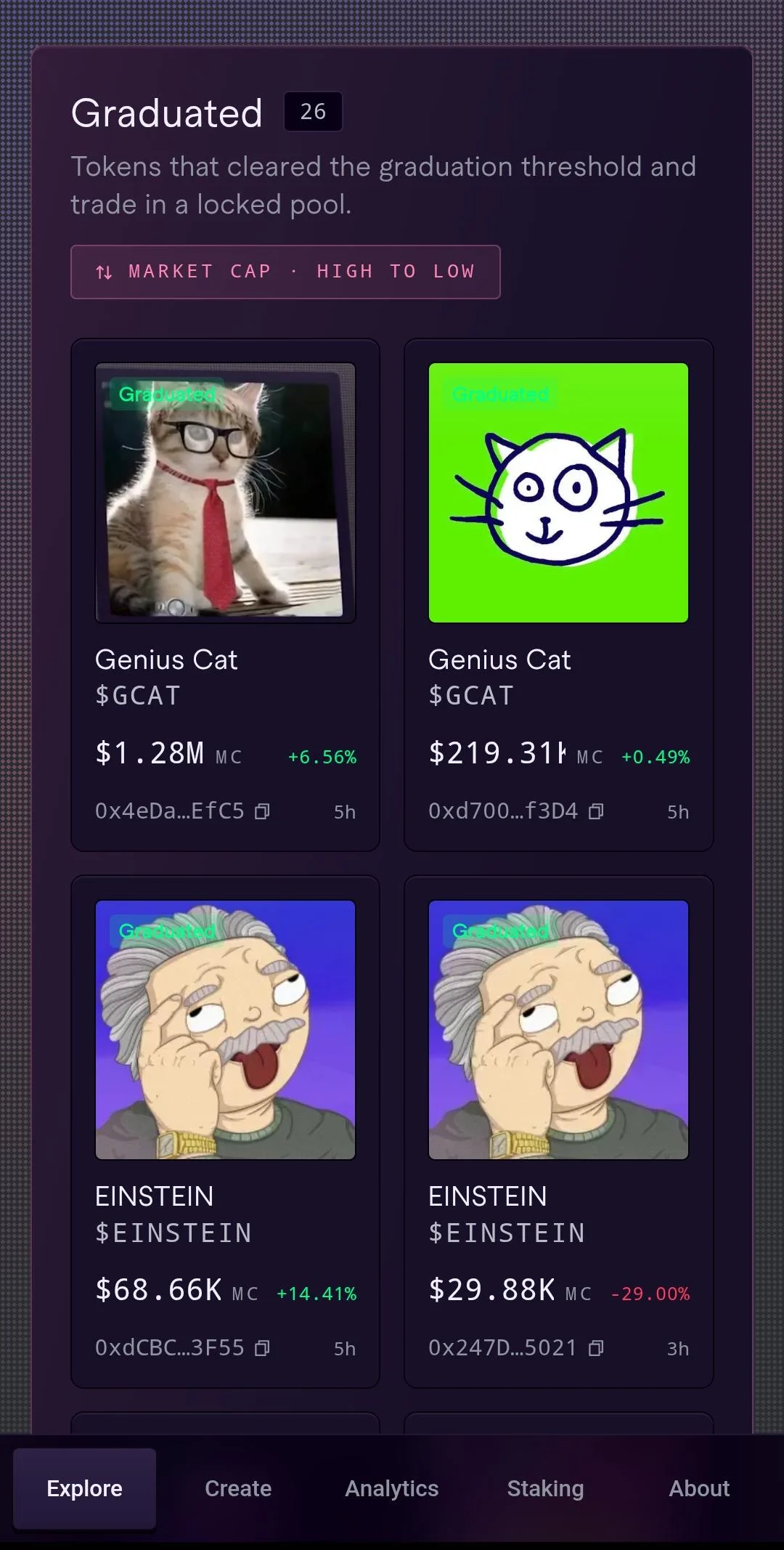
As of the current reporting, 26 tokens have successfully launched and graduated on the platform. The undisputed leader by a substantial margin is Genius Cat, trading as $GCAT, which has achieved an impressive market capitalization of approximately $1.28 million. The success of $GCAT, which was reportedly created by the author as part of a platform walkthrough, underscores the potential for rapid growth and community engagement within the Genius.fun ecosystem. Its position as the current frontrunner for the September 25 buyback provides a real-world example of the incentives at play and the immediate impact of the platform’s design. The performance of $GCAT will be a key metric to watch as the buyback date approaches, offering insights into the effectiveness of Genius.fun’s incentive structure.
Broader Impact and Implications for the RWA Sector

Genius.fun’s innovative model carries significant implications for the broader Real-World Asset sector and the future of tokenization:
- Shifting the Narrative from Speculation to Utility: By explicitly tying token fees to tangible asset acquisition, Genius.fun challenges the pervasive speculative nature of many DeFi projects. It offers a clear pathway for tokens to evolve beyond mere trading instruments into components of a collective investment strategy in traditional assets. This could attract a new demographic of users and investors who are wary of pure crypto speculation but interested in the enhanced liquidity and fractional ownership offered by tokenized RWAs.
- Democratizing Access to Traditional Investments: The ability to pool resources through tokenization and acquire fractional stakes in publicly listed companies could democratize access to investments traditionally reserved for institutional investors or high-net-worth individuals. Smaller investors, by contributing to the Genius Foundation, can collectively gain exposure to assets that would otherwise be out of reach.
- Addressing Regulatory Complexities: The tokenization of real-world assets, particularly equities, navigates a complex and evolving regulatory landscape. While Genius.fun’s model of a foundation making acquisitions on behalf of a collective pool, without direct individual redemption claims, might offer a degree of separation, it will inevitably draw scrutiny from financial regulators. The platform’s success will depend on its ability to operate within existing legal frameworks or adapt to emerging regulations concerning tokenized securities and collective investment schemes. Transparency in the foundation’s operations, governance, and acquisition processes will be paramount.
- Enhancing Trust and Transparency: A well-governed and transparent Genius Foundation could foster greater trust in the RWA space. By clearly outlining how funds are accumulated and used for acquisitions, the platform can build a reputation for reliability, a crucial factor in attracting institutional interest and broader adoption.
- Potential for New Economic Models: The dual fee structure and the buyback mechanism represent novel economic models that could be adopted or adapted by other platforms. The idea of linking token economics directly to real-world outcomes, rather than just on-chain activity, opens up new possibilities for sustainable tokenomics and value creation.
Challenges and Future Outlook
While the initial success of Genius.fun is compelling, its long-term viability and impact will depend on navigating several challenges:
- Sustained Community Engagement: The platform’s RWA acquisition model relies heavily on sustained community participation and the willingness of creators to opt for the Foundation path. Maintaining engagement beyond the initial hype will be crucial.
- Legal and Regulatory Clarity: The acquisition of traditional equities by a blockchain-based foundation, even without direct token holder claims, will require robust legal counsel and potential adaptation to varying international securities laws.
- Operational Scalability: As the number of tokens and the accumulated capital grow, the operational complexities of identifying, acquiring, and managing real-world assets will increase significantly.
- Market Volatility: While aiming for RWA stability, the underlying crypto market, including BNB, remains volatile. Fluctuations in the value of accumulated BNB could impact the purchasing power of the Foundation.
In conclusion, Genius.fun represents a significant evolutionary step in the token launchpad ecosystem. By moving beyond simple speculation and actively building towards collective ownership of real-world assets, it offers a compelling vision for the future of tokenization. Its unique fee structure, coupled with strong early traction and strategic incentives, positions it as a platform that warrants close observation. Whether this momentum holds and its ambitious RWA model can successfully navigate the complexities of both the crypto and traditional financial worlds will be a defining factor in its journey, but it has certainly earned more attention than the average token-generator site on its launch day.