Japan’s intricate effort to support its beleaguered yen while simultaneously containing escalating borrowing costs has exposed a critical policy imbalance, one whose ramifications extend far beyond its domestic economy. The recent surge in Japanese Government Bond (JGB) yields is intensifying pressure on the nation’s public finances, challenging its long-standing currency policy, and threatening to trigger significant shifts in international capital flows. This delicate balancing act, rooted in decades of unprecedented monetary easing, now stands at a pivotal juncture, demanding careful navigation to avert potential financial instability both at home and abroad.
The current strain is a direct consequence of over three decades of ultra-cheap money, a policy paradigm initiated in the wake of the devastating collapse of Japan’s property and equity bubble in the early 1990s. This prolonged period, often referred to as the "Lost Decades," saw the Bank of Japan (BOJ) implement aggressive measures, including near-zero interest rates, quantitative easing, and massive bond purchases. These policies were designed to combat persistent deflation and stimulate economic growth by reducing financing costs, even as government debt expanded to historic and often alarming levels. While successful in keeping borrowing costs low for an extended period, this strategy has created an immense vulnerability now exposed by a changing global economic landscape.
Historical Context: The Long Shadow of Deflation and Abenomics
To fully grasp Japan’s current predicament, it’s essential to understand the unique economic trajectory that led to its unconventional monetary policy. Following the bursting of its asset bubble, Japan entered a prolonged period of stagnation and deflation. Businesses and consumers alike hoarded cash, delaying investment and consumption in anticipation of further price declines, creating a self-reinforcing cycle of economic contraction. Conventional monetary tools proved largely ineffective, prompting the BOJ to innovate with increasingly aggressive measures.
The arrival of "Abenomics" in 2012, spearheaded by then-Prime Minister Shinzo Abe, marked a new era of policy coordination. It comprised three "arrows": aggressive monetary easing, flexible fiscal policy, and structural reforms. The monetary arrow, championed by BOJ Governor Haruhiko Kuroda, involved an unprecedented expansion of the central bank’s balance sheet through massive asset purchases, aiming to achieve a 2% inflation target. A cornerstone of this strategy was Yield Curve Control (YCC), introduced in September 2016. YCC aimed to keep the 10-year JGB yield around 0% by committing the BOJ to buy an unlimited amount of bonds at a fixed rate, thereby providing stable long-term borrowing costs for the government and businesses. For years, YCC served its purpose, anchoring bond yields despite Japan’s colossal debt burden.
Rising Bond Costs Test Japan’s Debt Strategy
The core challenge facing Japan today, as described by financial commentators like EGRAG CRYPTO, is a fundamental conflict between safeguarding the yen’s value and preserving the stability of the sovereign bond market. This tension is magnified by the Bank of Japan’s vast holdings of government securities, which reached an astonishing ¥518.2 trillion (approximately $3.3 trillion USD) as of July 20. This figure underscores the central bank’s unparalleled role in propping up the bond market. A BOJ policymaker candidly stated in May that the central bank still owned about half of all outstanding Japanese government bonds, a proportion unmatched by any other major economy. Meanwhile, the central government’s total debt, encompassing bonds, borrowings, and financing bills, swelled to a staggering ¥1.3438 quadrillion (roughly $8.6 trillion USD) in March, pushing Japan’s debt-to-GDP ratio well over 260% – the highest among developed nations.
Against this backdrop, the implications of higher interest rates are multifaceted and complex. On one hand, tighter monetary policy could strengthen the yen, offering a much-needed reprieve from imported inflation, which has seen prices for fuel, food, and raw materials soar. Japan, heavily reliant on imports, has seen its consumer price index (CPI) consistently above the BOJ’s 2% target for an extended period, reaching 2.8% year-on-year in May, excluding fresh food. A stronger yen would alleviate this pressure, boosting purchasing power.

However, the downside of tighter monetary policy is equally formidable. An increase in interest rates would directly raise refinancing costs across one of the world’s largest sovereign debt markets. Even a modest increase in yields translates into billions of dollars in additional interest payments for the government, severely straining public finances already under pressure from an aging population and mounting social security costs. The government’s annual budget allocates a substantial portion to debt servicing, and higher rates would necessitate either cuts to other essential spending or further borrowing, exacerbating the debt spiral.
Furthermore, rising borrowing costs would inevitably reduce the market value of existing long-duration bonds. This poses a significant risk to Japan’s financial institutions. Banks, insurers, and pension funds hold enormous portfolios of JGBs, which have historically been considered safe, low-yielding assets. As JGB yields increase, the value of these assets declines, potentially leading to substantial unrealized losses on their balance sheets. This could erode their capital buffers, trigger liquidity concerns, and even threaten their solvency, drawing parallels to past financial crises where institutions were caught off guard by sudden shifts in bond valuations.
These risks materialized visibly in July, when the benchmark 10-year JGB yield climbed to 2.9%, marking its highest level since 1996. Concurrently, the 30-year yield surged past 4%, signaling a significant tightening of long-term financing conditions. These spikes occurred despite the BOJ’s efforts to cap yields, necessitating several adjustments to its YCC policy throughout the year. In a significant move in July, the BOJ further relaxed its YCC framework, effectively allowing the 10-year yield to rise above its previous 1% cap, acknowledging the growing pressures. While still maintaining a loose monetary stance, the central bank indicated that a formal rate hike could be considered as early as September if inflation risks persisted, signaling a gradual but undeniable shift away from its decades-long ultra-loose policy.
Conversely, maintaining persistently low interest rates, while supporting bond prices and preventing immediate losses for financial institutions, presents its own set of severe pressures. Such a policy would leave the yen vulnerable to further weakness, particularly as other major central banks like the U.S. Federal Reserve and the European Central Bank have embarked on aggressive tightening cycles. The widening interest rate differential between Japan and the rest of the world makes the yen less attractive to investors, accelerating its depreciation and perpetuating the cycle of imported inflation. This "damned if you do, damned if you don’t" scenario encapsulates the profound dilemma confronting Japanese policymakers.
Yen Support Risks Spilling Into Global Markets
The policy decisions made in Tokyo resonate far beyond Japan’s borders, largely due to the yen’s historic role as a funding currency for international carry trades. For decades, investors have leveraged the yen’s persistently low interest rates to borrow cheaply, then investing the proceeds in higher-yielding assets elsewhere – be it government bonds, equities, or even digital assets in other countries. This strategy has been a cornerstone of global liquidity, fueling investment across diverse markets.
However, a stronger yen, coupled with higher domestic interest rates, fundamentally alters the economics of these carry trades. As the cost of borrowing in yen rises, and the currency appreciates, maintaining these positions becomes significantly more expensive and risky. Investors face not only higher financing costs but also potential losses when converting their returns back into a stronger yen. Consequently, a broad unwinding of these carry trades could ensue, with investors selling off foreign assets to repay their yen-denominated debts. This mass liquidation could transmit significant financial pressure across global markets, potentially triggering volatility and liquidity crunches in various asset classes.
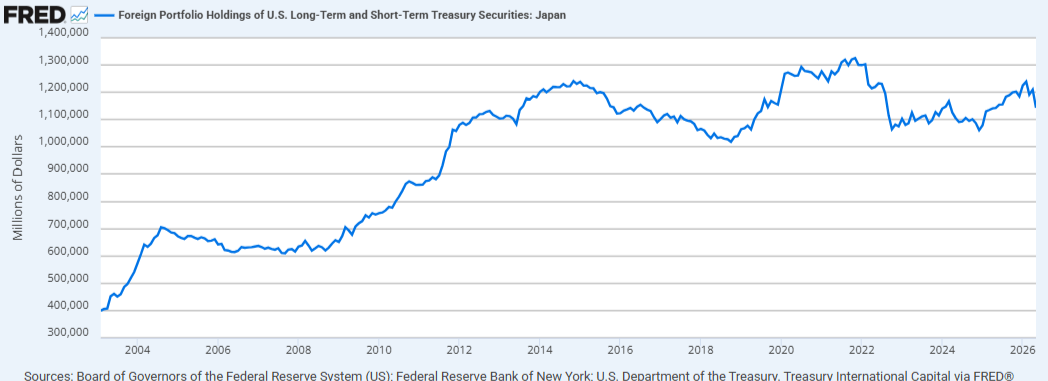
The United States faces particular exposure to these shifts, given Japan’s status as the largest foreign holder of U.S. Treasury securities. As of May, Japan’s holdings of U.S. Treasuries stood near $1.143 trillion. This substantial investment links Japanese capital flows directly to American debt markets. As JGB yields become more attractive relative to their foreign counterparts, Japanese investors – including banks, insurers, and pension funds – may find domestic bonds more appealing. This "homecoming" of capital could lead to a reduction in their holdings of U.S. Treasuries. While a gradual shift might be manageable, a sudden or large-scale divestment, particularly if exacerbated by official Treasury sales used to finance currency intervention, could place significant upward pressure on U.S. borrowing costs, with ripple effects across the global financial system.
Chronology of Recent Interventions and Market Reactions:
- May: A BOJ policymaker confirms the central bank owns approximately half of all outstanding JGBs, highlighting its market dominance.
- May (ongoing): Japanese central government debt reaches ¥1.3438 quadrillion, emphasizing the scale of the fiscal challenge.
- July: The benchmark 10-year JGB yield reaches 2.9%, its highest level since 1996, while the 30-year yield climbs above 4%.
- July (mid-month): The Bank of Japan adjusts its Yield Curve Control (YCC) framework, allowing the 10-year yield to fluctuate more freely, acknowledging market pressures.
- July 30: Japan intervenes heavily in the currency market, spending an estimated $58.97 billion to buy yen as the dollar approaches ¥164, a level not seen in decades. This marks one of the largest single-day interventions in recent memory.
- Post-July 30: Reuters reports that the U.S. Treasury also participated in buying yen through the New York Federal Reserve. This coordinated action underscores a shared international concern over the yen’s precipitous decline and the broader risks associated with disorderly exchange-rate movements, suggesting a consensus among major economies on the need for stability.
Historical Parallels and Contemporary Risks
The coordinated currency intervention in July draws parallels to the events of June 1998, when a similar joint effort was undertaken to stabilize the yen. During that period, the American side contributed $833 million to the intervention. However, the market turmoil that ensued in 1998 had several larger and more immediate causes. The International Monetary Fund (IMF) and the Federal Reserve primarily linked the 1998 disruption to Russia’s sovereign default, the widespread contagion of the Asian financial crisis, and the near-collapse of the highly leveraged hedge fund Long-Term Capital Management (LTCM).
The comparison serves not to prove that intervention alone causes financial instability, but rather to highlight the inherent vulnerability of interconnected global markets when underlying stresses are present. The current risk lies not in intervention itself, but in the complex interaction between rising global debt costs, Japan’s imperative to support its currency, and the potential unwinding of cross-border funding mechanisms. While the scale of the 1998 crisis was driven by specific exogenous shocks, the interconnectedness of today’s financial system means that a significant shock from a major economy like Japan could propagate rapidly.
The Path Forward: Policy Options and Challenges
The Bank of Japan and the Japanese government face an exceptionally delicate balancing act. The BOJ’s options are severely constrained:
- Further Tightening: Raising interest rates more aggressively would strengthen the yen and curb inflation but could destabilize the bond market, increase government debt servicing costs dramatically, and potentially trigger a recession by stifling economic activity.
- Maintaining Loose Policy: Keeping rates low would protect the bond market and limit immediate fiscal strain but would leave the yen exposed to further depreciation, exacerbate imported inflation, and maintain the existing disequilibrium with global rates.
- Gradual Normalization: This appears to be the BOJ’s preferred, albeit challenging, path. It involves carefully calibrating small rate hikes and further adjustments to YCC, aiming to normalize policy without causing abrupt market dislocations. This strategy relies heavily on clear communication and market confidence.
Economists and market analysts are closely watching BOJ Governor Kazuo Ueda’s approach. His nuanced communication and willingness to adjust YCC have been interpreted as attempts to prepare markets for a gradual exit from ultra-loose policy. However, the sheer scale of Japan’s debt and the entrenched expectations of low rates make this a perilous undertaking. Any misstep could trigger a sharp sell-off in JGBs, a rapid strengthening of the yen that harms exporters, or a severe tightening of domestic financial conditions.
Beyond monetary policy, the Japanese government faces immense fiscal challenges. With a rapidly aging and shrinking population, the tax base is eroding while social security costs are escalating. The government’s ability to reduce its colossal debt burden through fiscal consolidation is severely hampered. This implies that any significant rise in interest rates will have a magnified impact on Japan’s long-term fiscal sustainability. Structural reforms aimed at boosting productivity and attracting foreign investment remain crucial but are difficult to implement effectively and quickly.
In conclusion, Japan’s current economic predicament is a critical test of its long-standing policy framework and its capacity to adapt to a new global financial reality. The interaction between rising debt costs, the necessity of currency support, and the potential disruption of cross-border funding mechanisms creates a complex web of risks. Japan must manage this intricate adjustment with extreme caution to avoid destabilizing its bond market, safeguarding its financial institutions, and preventing a cascade of disruptions across the highly interconnected global financial system. The outcome of this policy tightrope walk will have profound implications for Japan’s future and for the stability of the international economy.