


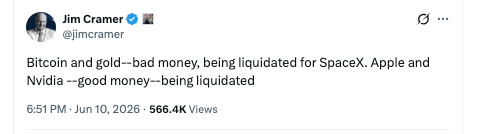
Renowned financial commentator Jim Cramer has ignited a fresh wave of debate within the investment community by labeling both Bitcoin and gold as "bad money" being liquidated to fund the highly anticipated Initial Public Offering (IPO) of Elon Musk’s SpaceX. In a series of pronouncements on social media, Cramer articulated his view that investors are divesting from these traditional and digital safe-haven assets to allocate capital towards what he perceives as more promising ventures, particularly the burgeoning space exploration giant. This assertion, while characteristic of Cramer’s often provocative commentary, has drawn sharp reactions from proponents of both Bitcoin and gold, underscoring the persistent ideological divide in modern investment strategies.
Cramer’s latest salvo, delivered via his X (formerly Twitter) account, suggested a significant capital rotation occurring in the financial markets. He posited that "bad money" – a term he defines as assets that consume liquidity without generating commensurate returns – was being systematically sold off from Bitcoin and gold holdings. This liquidity, he claimed, was being channeled into the $75 billion SpaceX IPO, a valuation that places the private aerospace company among the most valuable entities globally. Intriguingly, Cramer also included shares of established tech giants like Apple in his discussion, but distinguished them by categorizing them as "good money," implying their intrinsic value and revenue-generating capabilities warranted a different classification.
The distinction Cramer draws between "good money" and "bad money" is central to his argument. He elaborates that "good money" is derived from cash flow generated by high-quality, income-producing assets. In the context of his SpaceX IPO commentary, he specifically cited companies like Apple and Nvidia as examples of such assets, whose performance is tied to robust earnings and market dominance. Conversely, "bad money" is characterized by the "sunk cost fallacy," where an asset continues to demand further capital injections without yielding tangible benefits or growth. By labeling Bitcoin and gold in this manner, Cramer suggests they have entered a phase where their perceived value is diminishing, and they are becoming liabilities rather than appreciating assets in the current market climate.
Jim Cramer’s Evolving Stance on Bitcoin and Gold
This latest pronouncement is not an isolated incident in Cramer’s commentary on digital assets and precious metals. His relationship with Bitcoin, in particular, has been a subject of considerable scrutiny and often, derision, from the cryptocurrency community. Over the years, Cramer has exhibited a notably volatile and seemingly contradictory approach to Bitcoin, a trait that has led many to question the consistency and reliability of his market predictions.
For instance, as recently as February of the current year, Cramer made a striking prediction that the United States government, under a potential Donald Trump administration, might consider purchasing Bitcoin for its strategic reserve once the cryptocurrency reached the $60,000 mark. At the time of this prediction, Bitcoin was trading around $69,000, and while it subsequently experienced a price correction, dipping back towards the $60,000 level, there has been no indication of such a government acquisition. This particular forecast highlights Cramer’s susceptibility to speculative narratives and his tendency to align his commentary with prevailing market sentiments, only to pivot when those sentiments shift.
Looking further back, Cramer’s perspective on Bitcoin was markedly different. In earlier periods, characterized by a strong bull market in cryptocurrencies, he was more effusive in his praise for digital assets. He publicly lauded Bitcoin, at times positioning it as a superior alternative to gold and even asserting that his personal investments in cryptocurrencies had yielded greater returns than those derived from traditional assets like gold and equities. These statements, made during periods of significant price appreciation for Bitcoin, reflected the prevailing bullish optimism within the market.
However, the current market downturn, marked by a pronounced price pullback from the peaks of the previous bull cycle, appears to have fundamentally altered Cramer’s outlook. His current characterization of both Bitcoin and gold as "bad money," despite his past self-identification as a "gold bug," underscores a significant shift in his investment philosophy or, perhaps, a strategic recalibration in response to market realities. This fluctuation in his public pronouncements has fueled accusations from critics that Cramer employs "rage bait" tactics, deliberately making controversial statements to generate engagement and attention on social media platforms like X.
Market Reactions and the "Cramer Bottom" Theory
Cramer’s assertions have, predictably, elicited swift and often pointed responses from the cryptocurrency and gold-holding communities on X. Many users have taken to the platform to voice their dissent, challenge his analysis, and, in some cases, engage in humorous counter-commentary. A recurring theme in these responses is the notion that when Jim Cramer turns bearish on an asset, it signals a potential market bottom. This has led to the informal "Cramer Bottom" theory, a tongue-in-cheek observation suggesting that his negative pronouncements might, paradoxically, presage a period of recovery for the criticized assets.
One notable response, from user @BigRyan, humorously suggested that Cramer’s declaration was precisely the catalyst needed for a market rebound: "When Jim Cramer calls something ‘bad money,’ that’s the sign. Bottom is in. He’s officially the canary in the coal mine for crypto." This sentiment was echoed by other users who interpreted Cramer’s bearish outlook as a contrarian indicator. Another user, @realpeteyb123, quipped, "The only thing being liquidated is Cramer’s credibility." These reactions highlight a degree of skepticism towards Cramer’s market calls, particularly within the crypto space, where his pronouncements are often viewed through the lens of his past inconsistencies.
The SpaceX IPO: A Deep Dive into the Market Phenomenon
The context for Cramer’s comments lies in the immense anticipation surrounding the potential SpaceX IPO. While SpaceX has not officially announced a definitive timeline for its public offering, speculation has been rife for years. Valued at an estimated $180 billion as of early 2024, SpaceX has achieved remarkable milestones in space exploration, including the development of reusable rockets, the deployment of the Starlink satellite internet constellation, and ambitious plans for crewed missions to the Moon and Mars. These achievements have fueled investor interest and positioned SpaceX as a potentially transformative force in both the aerospace and technology sectors.
The prospect of a SpaceX IPO has generated considerable buzz due to several key factors:
- Innovation and Market Disruption: SpaceX has fundamentally altered the aerospace industry through its innovative approach to rocket design and launch services. Its success in reducing launch costs through reusability has opened up new possibilities for satellite deployment, space tourism, and deep-space exploration.
- Elon Musk’s Vision: Led by Elon Musk, a visionary entrepreneur known for his ambitious and often reality-bending projects (including Tesla, Neuralink, and The Boring Company), SpaceX commands significant attention and investor confidence. Musk’s ability to execute on audacious goals has a proven track record.
- Starlink’s Potential: The Starlink project, SpaceX’s ambitious satellite internet service, aims to provide broadband internet access to underserved and remote areas globally. Its rapid expansion and growing subscriber base represent a significant revenue stream and a potential disruptor to traditional telecommunications companies.
- Government Contracts and Commercial Opportunities: SpaceX holds lucrative contracts with NASA for cargo and crew transport to the International Space Station, as well as for future lunar and Martian missions. Beyond government work, the company is increasingly securing commercial launch contracts for satellites and other payloads.
Given these factors, an IPO could unlock substantial capital for SpaceX, enabling it to accelerate its ambitious long-term goals, such as the development of its Starship vehicle for interplanetary travel and further expansion of its Starlink network. However, the timing and valuation of such an IPO remain subjects of intense market speculation.
The "Bad Money" Argument: Bitcoin and Gold in Context
Cramer’s classification of Bitcoin and gold as "bad money" warrants a closer examination of their current market positions and historical roles as investment assets.

Bitcoin: As the flagship cryptocurrency, Bitcoin has long been touted as a potential hedge against inflation and a store of value, often drawing parallels to digital gold. Its decentralized nature, limited supply (capped at 21 million coins), and growing adoption have fueled its price appreciation over the years. However, Bitcoin is also known for its extreme volatility. In recent years, it has experienced significant price swings, influenced by regulatory developments, macroeconomic factors, technological advancements, and shifts in investor sentiment. While some investors view its volatility as a risk, others see it as an opportunity for substantial gains. The argument for Bitcoin as "bad money" might stem from its persistent price corrections following periods of rapid ascent, leading some to question its reliability as a consistent store of value or income-generating asset, especially when compared to assets with predictable cash flows.
Gold: Gold has historically served as a traditional safe-haven asset, sought after during times of economic uncertainty, geopolitical instability, and high inflation. Its tangible nature and long-established role in global finance have provided a sense of security for investors. However, gold’s price performance can be cyclical and is influenced by factors such as interest rates, the strength of the U.S. dollar, and global demand. While it can offer stability, it typically does not generate income through dividends or interest payments, unlike stocks or bonds. Cramer’s view might reflect a sentiment that in a rapidly evolving economic landscape, where technological innovation offers potentially higher returns, gold’s traditional role as a passive store of value is becoming less attractive to capital seeking aggressive growth.
The "Good Money" Argument: Apple and Nvidia
In contrast, Cramer’s endorsement of Apple and Nvidia as "good money" is rooted in their strong performance and market positioning.
Apple: Apple Inc. is one of the world’s largest and most valuable technology companies, renowned for its ecosystem of hardware (iPhones, Macs), software (iOS, macOS), and services (App Store, Apple Music, iCloud). The company consistently generates substantial profits, pays dividends, and has a loyal customer base, making it a cornerstone of many investment portfolios. Its consistent revenue growth and profitability solidify its status as a "good money" asset.
Nvidia: Nvidia Corporation has emerged as a dominant force in the semiconductor industry, particularly in graphics processing units (GPUs). Its GPUs are critical for high-performance computing, gaming, artificial intelligence (AI), and data centers. The surging demand for AI applications has propelled Nvidia’s growth and market valuation to unprecedented levels, making it a prime example of a company at the forefront of technological innovation with a clear path to sustained profitability.

Implications for the Investment Landscape
Cramer’s commentary, while often polarizing, reflects a broader debate occurring within the financial markets about asset allocation in the face of evolving economic paradigms and technological advancements. The potential SpaceX IPO represents a significant event that could reshape investor priorities, drawing capital away from more established or speculative assets towards a high-growth, disruptive company.
The perceived shift from Bitcoin and gold to ventures like SpaceX highlights a few key trends:
- The Rise of Tech and Innovation: Investors are increasingly seeking exposure to companies driving innovation in areas like artificial intelligence, space technology, and renewable energy, which promise substantial long-term growth.
- The Maturation of Alternative Assets: While Bitcoin has gained traction as an alternative store of value, its volatility and regulatory uncertainties continue to make some investors cautious. Gold, while a traditional safe haven, may be viewed as less dynamic in an era of rapid technological change.
- The Power of Narrative and Vision: Companies like SpaceX, under the leadership of charismatic figures like Elon Musk, can capture the imagination of investors and command premium valuations based on their long-term vision and potential for disruption, even if they are not yet generating significant profits in the traditional sense.
The ongoing dialogue surrounding "good money" versus "bad money" underscores the dynamic nature of investment. As the global economy continues to evolve, driven by technological breakthroughs and shifting geopolitical landscapes, the definition of what constitutes a sound investment is constantly being re-evaluated. Jim Cramer’s pronouncements, however controversial, serve as a barometer for shifting investor sentiment and the ongoing search for assets that can deliver robust returns in an increasingly complex financial world. The true impact of his commentary will only be fully understood as capital flows continue to adjust and the outcomes of major financial events, such as the potential SpaceX IPO, unfold.














