JPMorgan strategists have offered a nuanced perspective on the potential impact of approved spot Bitcoin Exchange-Traded Funds (ETFs), suggesting that while the approval itself might not be a revolutionary catalyst for the broader cryptocurrency industry, the current market positioning could ultimately offer stronger support for Bitcoin than for gold. This outlook stems from an analysis of investor sentiment and trading patterns observed in both Bitcoin and gold ETFs, revealing a notable divergence in how market participants are approaching these two asset classes.
Contrasting Investor Positioning in Bitcoin and Gold ETFs
The core of JPMorgan’s analysis, led by strategist Nikolaos Panigirtzoglou, lies in the stark differences in short interest and options activity between the iShares Bitcoin Trust (IBIT), managed by BlackRock, and the SPDR Gold Shares ETF (GLD). Data indicates that short interest in IBIT remains elevated, hovering near its yearly high. This suggests a significant number of investors are betting on a decline in the price of Bitcoin through this ETF. In contrast, short interest in GLD, a well-established gold ETF, is currently below its historical average, implying a less bearish or even neutral stance from short-sellers towards gold.
Further underscoring this disparity, the put-to-call open interest ratio for IBIT is notably higher than that of GLD. This metric signifies a greater demand for options that profit from a price decrease (puts) relative to options that profit from a price increase (calls) in the Bitcoin ETF. This heightened demand for downside protection within the Bitcoin ETF market points to a prevailing skepticism among a segment of investors, a sentiment less pronounced in the gold market.
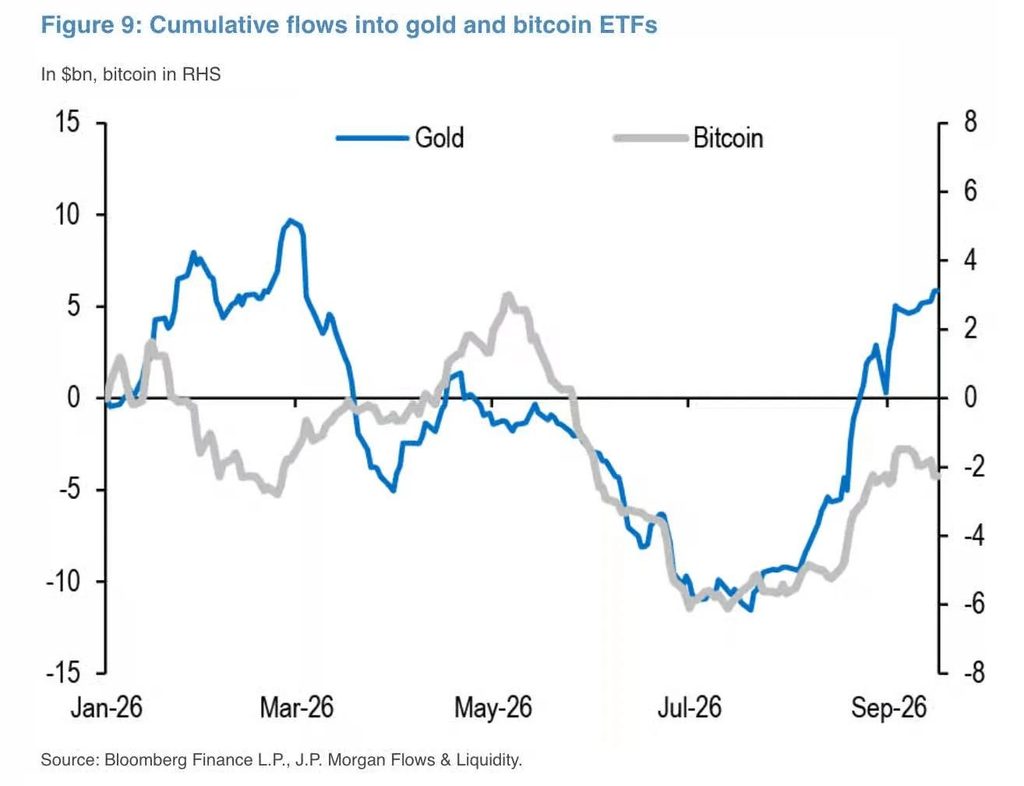
"This contrast suggests that Bitcoin still faces an overall more skeptical positioning backdrop than gold," the JPMorgan analysts stated in their report. This skepticism, while seemingly a headwind, could paradoxically become a tailwind for Bitcoin. The strategists elaborated that if hedging demand, which often manifests as short-selling and the purchase of put options, begins to wane, it could create a significant buying pressure for Bitcoin. Investors who have shorted ETF shares are obligated to buy them back to cover their positions, a process that directly increases demand. Similarly, a reduction in options hedging by market makers, who often take the opposite side of these trades, could necessitate adjustments to their own portfolios, potentially leading to further buying of the underlying asset or related derivatives.
The "Debasement Trade" and Shifting Investor Flows
The recent market dynamics have seen both Bitcoin and gold ETFs attract fresh inflows following the Federal Reserve’s July meeting. This surge in investment is attributed to investors returning to what is commonly referred to as the "debasement trade." This investment strategy involves acquiring scarce assets as a hedge against potential inflation, currency devaluation, and the increasing levels of government debt. In an environment of economic uncertainty, assets perceived as stores of value, such as gold and, increasingly, Bitcoin, become attractive to investors seeking to preserve their wealth.
However, the momentum of this trend appears to have moderated since its peak. JPMorgan pointed to several factors contributing to this slowdown in Bitcoin demand. Firstly, higher inflation-adjusted bond yields have made fixed-income investments more appealing, drawing capital away from riskier assets like cryptocurrencies. Secondly, the legislative landscape has also played a role. The failure of the CLARITY Act, a piece of legislation that could have provided further regulatory clarity for the crypto space, in the Senate has been cited as a dampener on investor enthusiasm for Bitcoin.
Gold’s Resilience and Bitcoin’s Potential for Recovery
The analysis highlights a key differentiator in the recovery trajectories of gold and Bitcoin ETFs. JPMorgan estimates that gold ETFs have fully recouped all the outflows they experienced in 2026. This indicates a robust and sustained return of investor capital to the gold market. In stark contrast, Bitcoin ETFs have only managed to recover approximately half of their 2026 outflows. This disparity leaves Bitcoin with significantly more "room to recover" should investor demand pick up. The implication is that a resurgence of interest in Bitcoin could translate into a more pronounced price appreciation due to the unmet demand and the potential for previously withdrawn capital to re-enter the market.

On-Chain Indicators Signal Stabilization Amidst Market Fluctuations
While macro-economic factors and ETF flows provide a broad market perspective, on-chain data offers granular insights into the behavior of cryptocurrency holders. Recent indicators suggest a stabilization within the Bitcoin network, hinting at underlying strength despite short-term price consolidations.
Darkfost, a contributor to CryptoQuant, noted that short-term Bitcoin holders have managed to maintain their holdings in profit for nearly a month. This sustained profitability among a segment of the market often considered more sensitive to price movements is a positive sign. The analysis estimates that approximately $168 billion worth of Bitcoin held by short-term holders is currently in profit, a figure substantially higher than the just over $100 billion in losses held by this cohort. This suggests that a significant portion of recent buyers have seen their investments appreciate, reducing the immediate pressure to sell at a loss.
The Role of Large Bitcoin Holders ("Whales")
Beyond retail and institutional ETF investors, large Bitcoin holders, often referred to as "whales," have continued to exert a significant influence on the market throughout the year. Data compiled by analyst Woominkyu reveals that wallets holding at least 100 Bitcoin have been net accumulators, adding approximately 115,000 BTC between January and mid-September. The most aggressive accumulation occurred during Bitcoin’s price surge in August, indicating that large holders continued to increase their positions even as the price climbed.
However, this accumulation trend has shown signs of slowing in September. This coincides with Bitcoin’s inability to sustain levels above $80,000. The latest weekly data indicates some selling activity from these large holders. Woominkyu characterized this shift not as a wholesale abandonment of the market but rather a "pause" in their buying activity. He pointed out that whales have only relinquished a portion of the Bitcoin they accumulated earlier in the year, suggesting that their long-term conviction may remain intact. "This is not a buy or sell call," Woominkyu cautioned, adding that the recent dip in accumulation represents "a change of pace, not proof the move is over."
Key Resistance Zone and Current Market Price
The current price action for Bitcoin is occurring below a critical resistance area identified by Glassnode analysts. This zone, situated between $83,000 and $86,000, is significant for two primary reasons: it represents a concentration of supply held by long-term holders, and it aligns with the estimated breakeven price for many of these investors. Breaking through this level could signal a significant shift in market sentiment and potentially unlock further upside.
As of the latest reporting, Bitcoin was trading at approximately $84,086, reflecting a minor decrease of 0.50% over the preceding 24 hours. This price point places Bitcoin just above the identified long-term holder resistance zone, highlighting the immediate battleground for market direction. The interplay between institutional flows via ETFs, the behavior of large holders, and the broader macroeconomic environment will likely dictate Bitcoin’s ability to breach this key resistance and continue its upward trajectory. The JPMorgan analysis, while tempering expectations of an immediate "game-changer" scenario from ETF approvals alone, underscores the potential for Bitcoin to outperform gold if investor sentiment shifts decisively away from skepticism and towards conviction, a scenario that on-chain data and current positioning may be subtly foreshadowing.