This Friday, we examine Ethereum, Ripple, Cardano, Binance Coin, and Hyperliquid in greater detail.
Ethereum (ETH): Navigating Resistance Amidst a Broader Downtrend
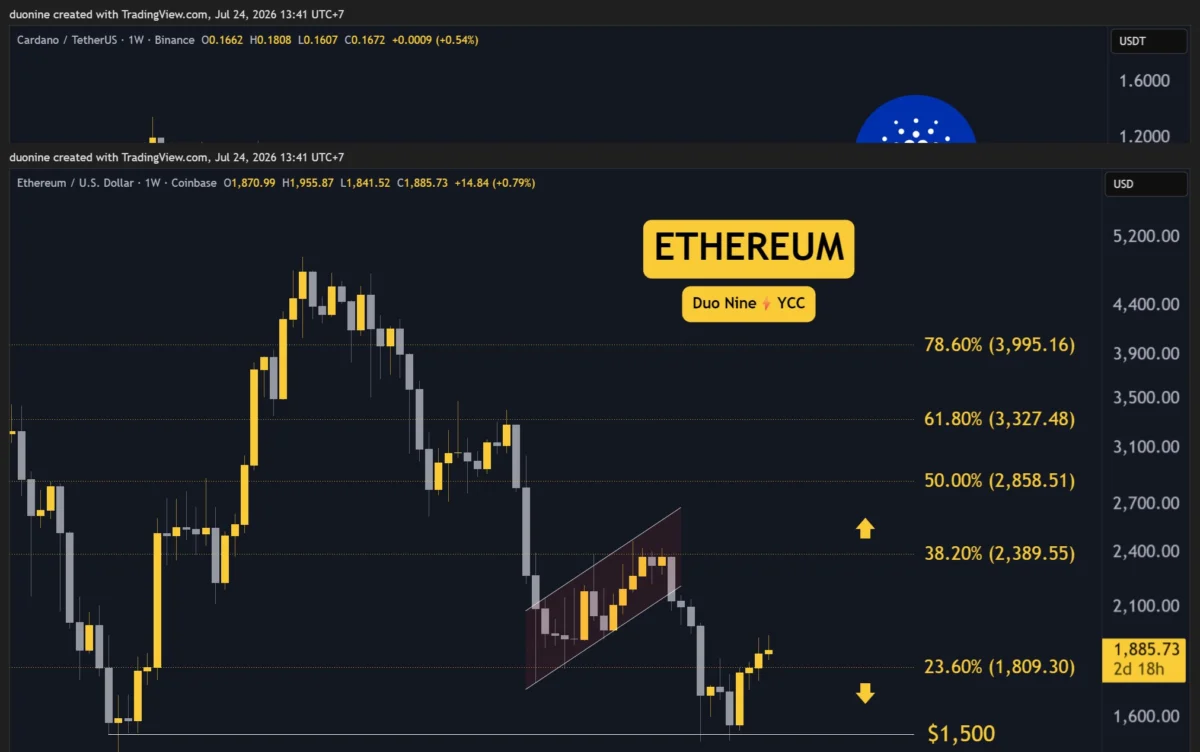
Ethereum has demonstrated a notable upward movement of 3% this week, signaling a potential shift in buyer sentiment that has been observable since late June. This relief rally commenced following a successful test and consolidation above the critical support level at $1,500. As of this report, ETH is encountering resistance as its price trajectory approaches the significant psychological threshold of $2,000. This level is anticipated to reintroduce sellers into the market, potentially triggering a price pullback.
Looking at the broader market context, Ethereum remains entrenched in a macro downtrend. While the current rally offers a positive divergence from this trend, sustaining momentum beyond the $2,000 mark appears to be a formidable challenge in the immediate future. A sustained bullish outlook for ETH hinges on its ability to not only breach $2,000 but also to convert this level into robust support. Such a development would significantly bolster the case for breaking the prevailing downtrend and ushering in a new phase of upward price discovery.
The underlying factors contributing to Ethereum’s current market position are multifaceted. The broader cryptocurrency market has been subject to significant volatility, influenced by macroeconomic indicators, regulatory developments, and shifts in investor risk appetite. Ethereum, as the second-largest cryptocurrency by market capitalization, often reflects these broader market sentiments. Its ecosystem, driven by decentralized applications (dApps), NFTs, and the burgeoning DeFi sector, continues to evolve, creating both opportunities and potential vulnerabilities. The successful transition to Proof-of-Stake (PoS) through "The Merge" was a monumental achievement, reducing energy consumption and setting the stage for future scalability upgrades like sharding. However, the realization of these technological advancements and their impact on price appreciation is a longer-term narrative that investors are closely watching. The recent price action suggests that while short-term gains are possible, the overarching trend will likely dictate the medium-term direction.
Ripple (XRP): Consolidation Above Key Support Amidst Declining Volume
Ripple (XRP) has mirrored Ethereum’s modest gains, also achieving a 3% increase this week. The price action has been characterized by its ability to remain comfortably above the crucial support level of $1. The immediate resistance that XRP faces is at the $1.20 mark, and a sustained upward movement is considered unlikely until this barrier is decisively broken.
A significant observation in XRP’s market dynamics is the steady month-over-month decline in trading volume. This trend suggests a lack of robust momentum required for a substantial breakout. Market participants appear to have adopted a more cautious stance, with a notable retreat observed since the price drop experienced in February, a sentiment that has persisted.
Looking ahead, the current period of consolidation above the $1 support level can be interpreted as a positive development, indicating buyer resilience. However, this consolidation could equally represent a temporary pause by sellers before they re-engage and test this critical support level once more.
The regulatory landscape has been a dominant factor influencing XRP’s price performance. The ongoing legal battle between Ripple Labs and the U.S. Securities and Exchange Commission (SEC) has cast a long shadow over the token’s valuation and adoption. While there have been intermittent favorable rulings for Ripple, the overall uncertainty has dampened investor enthusiasm and limited the token’s ability to capitalize on broader market rallies. The company has been actively pursuing international expansion and exploring various use cases for its technology, particularly in cross-border payments, aiming to diversify its revenue streams and reduce reliance on the U.S. market. The outcome of the SEC lawsuit remains a pivotal event that will likely determine XRP’s future trajectory. The declining volume suggests that many investors are awaiting greater clarity before committing significant capital.
Cardano (ADA): Bullish Signals Emerge from Technical Indicators
Cardano (ADA) has experienced a more substantial positive week, closing 6% higher. This uptick follows the formation of what appears to be a head and shoulders reversal pattern, with a key support level established around $0.15. As long as this support level remains intact, buyers are perceived to hold the advantage in the current market dynamics.
Despite this recent positive momentum, Cardano still needs to demonstrate a consistent pattern of higher lows and higher highs before analysts can confidently declare an end to its current macro downtrend. To achieve this, the price would need to decisively surpass the $0.25 resistance level.
Looking ahead, the weekly momentum indicators, such as the Moving Average Convergence Divergence (MACD), are exhibiting a bullish bias. This is a promising sign, suggesting that seller exhaustion might be occurring, potentially allowing buyers to regain control for a more extended period.
Cardano’s development roadmap has been a significant driver of its narrative. Known for its academic, research-driven approach to blockchain development, Cardano has focused on rigorous peer-reviewed research and a phased rollout of its features. The implementation of smart contract capabilities through the Alonzo hard fork was a major milestone, enabling a more diverse range of decentralized applications. However, the pace of development has sometimes led to criticisms of being slow. The project’s commitment to security, sustainability, and scalability through its Ouroboros consensus protocol remains a core tenet. The current technical indicators suggest a potential shift in sentiment, but the broader market conditions and the continued development and adoption of its ecosystem will be crucial for ADA to solidify a sustained recovery.
Binance Coin (BNB): Sideways Movement and Regulatory Headwinds
Binance Coin (BNB) has exhibited weakness over the past seven days, failing to register any significant gains. The price is currently struggling to break through the resistance at $580, a level that has acted as a significant impediment to buyers for the past month. Without a clear breakout above this resistance, BNB is likely to remain in a period of sideways trading or potentially seek lower levels to find buyer interest.
The cryptocurrency has also experienced decreased volatility and trading volume. This subdued market activity could be partly attributed to recent regulatory changes, particularly those affecting EU users who have been compelled to seek alternative exchanges. Such developments have a bearish implication for BNB’s price, as they directly reduce the demand for the token within key markets.
Looking ahead, BNB is situated within a broader downtrend, with no immediate indications of a trend reversal. Consequently, attention is being directed towards the support level at $500, which may be tested before any substantial return of buyer activity.
The regulatory scrutiny faced by Binance, the world’s largest cryptocurrency exchange by trading volume, has been a persistent concern for BNB. Various jurisdictions have imposed restrictions or launched investigations into the exchange’s operations, citing concerns related to anti-money laundering (AML) and know-your-customer (KYC) compliance. These regulatory challenges not only impact the exchange’s global operations but also indirectly affect the demand and perceived value of BNB, which is intrinsically linked to the Binance ecosystem. Despite these headwinds, Binance continues to innovate and expand its services, including its launchpad for new token offerings and its growing presence in areas like NFTs and the metaverse. However, the ongoing regulatory uncertainties remain a significant overhang for BNB.
Hyperliquid (HYPE): Signs of Correction After a Strong Rally
Hyperliquid (HYPE) has shown surprising resilience this week, trading flat, but it has experienced a 5% decline in its valuation over the past month. This plateauing in price action suggests that the earlier uptrend may have concluded. The current trading price below $60 is a point of concern, as it could embolden sellers to push the price even lower.
If Hyperliquid were to lose its established macro uptrend, a more significant and pronounced correction could ensue. The longer the price remains below the $60 threshold, the higher the probability of a substantial downward move. Key support levels to watch in such a scenario are identified at $56 and $52.
Looking ahead, Hyperliquid experienced a remarkable rally in the first half of 2026. The second half of the year may now be characterized by a major correction, potentially leading to HYPE revisiting levels below $50. Such a decline, if it materializes, could also present a significant buying opportunity for investors looking to enter the market at potentially discounted prices.
The performance of HYPE is indicative of the broader market cycle, where assets that experience parabolic growth often undergo substantial corrections. Investors who profited from the initial rally may be looking to de-risk, while new entrants might be waiting for a more opportune entry point. The sustainability of any future rally will depend on factors such as continued project development, adoption rates, and the overall market sentiment for similar high-growth, high-volatility assets. The identification of key support levels provides crucial reference points for traders and investors to gauge potential entry and exit strategies during this corrective phase.
Disclaimer: The information presented in this article is based on the analysis of market data and trends. It is intended for informational purposes only and does not constitute financial advice. Investors are advised to conduct their own thorough research and consult with a qualified financial advisor before making any investment decisions. Use of this information is at your own risk.