


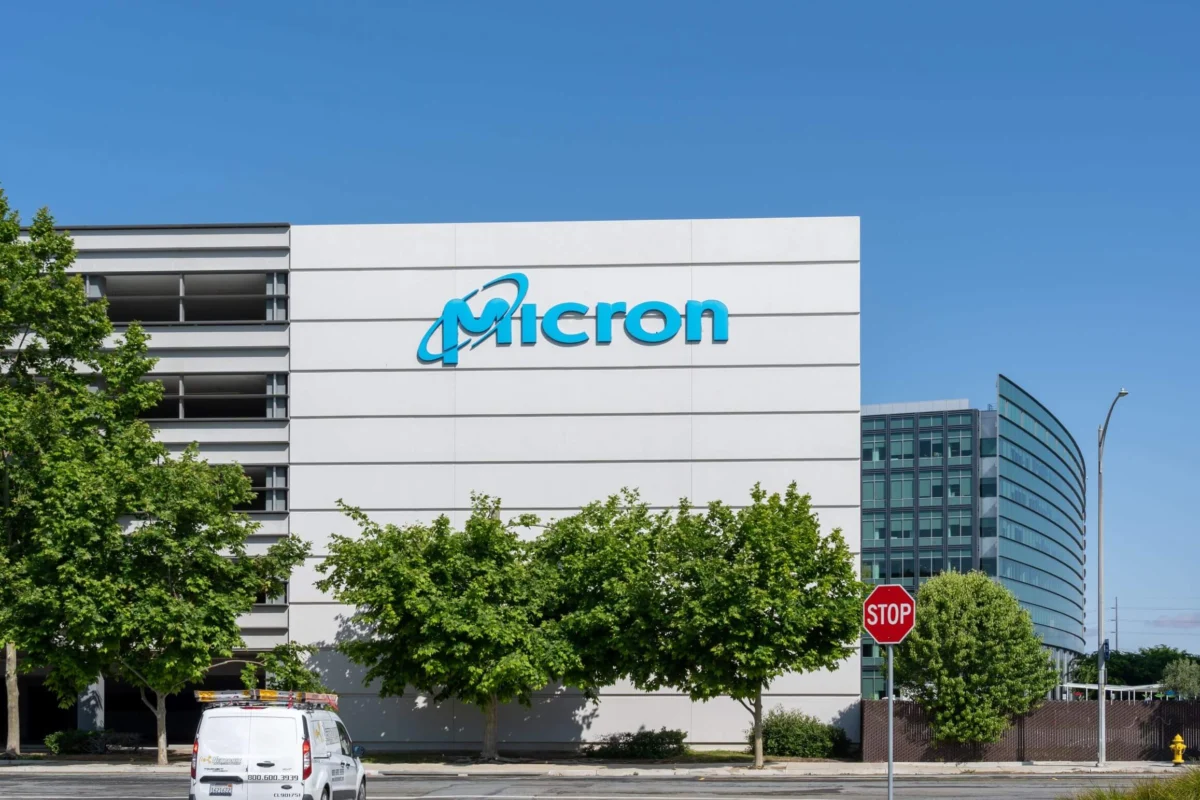
Shares of Micron Technology experienced minimal movement in early Tuesday trading, dipping approximately 0.1% to $1,144.00 during premarket hours. This marginal shift follows an extraordinary rally that has significantly captivated semiconductor investors throughout the current year, positioning the memory giant at the forefront of the artificial intelligence boom. The recent calm in trading activity presents a moment of reflection for market participants, who have witnessed a remarkable period of growth for the company, even as underlying industry dynamics introduce both opportunities and potential headwinds.
The Genesis of an Extraordinary Rally: Market Dynamics and Investor Enthusiasm
The journey for Micron Technology’s stock (MU) in recent periods has been nothing short of spectacular. Data from Dow Jones Market Data highlights a staggering 232% gain during the current quarter alone, a testament to the immense investor confidence and the surging demand for memory solutions. Since the beginning of the current year, shares have increased more than fourfold, placing Micron among the top-performing stocks in the technology sector. This dramatic appreciation has not only drawn the gaze of institutional investors but has also significantly captured the attention of a growing cohort of retail investors, whose participation often introduces increased volatility into market movements. The rapid ascent has naturally led to market participants closely scrutinizing various indicators that might signal a potential correction or consolidation phase, especially given the historical cyclicality inherent to the semiconductor industry.
The semiconductor industry, particularly the memory segment, is notorious for its boom-and-bust cycles, characterized by periods of robust demand and undersupply followed by expansions in manufacturing capacity that can lead to oversupply and price erosion. However, the current cycle appears to be uniquely influenced by the meteoric rise of artificial intelligence. The insatiable demand for high-performance computing, critical for training and deploying AI models, has created an unprecedented need for advanced memory solutions, primarily High-Bandwidth Memory (HBM). This structural shift in demand has provided a powerful tailwind for companies like Micron, allowing them to potentially transcend some of the traditional cyclical patterns. The rally in Micron’s stock reflects a collective belief among investors that the AI revolution represents a sustained, long-term growth driver that will reshape the economics of the memory market, offering a more stable and profitable environment than previous cycles.
Micron’s Strategic Reinvention: Mitigating Cyclical Risks with Long-Term Agreements
Recognizing the inherent volatility of the memory semiconductor industry, Micron Technology has embarked on a strategic transformation aimed at buffering itself against the traditional patterns of expansion and contraction. A cornerstone of this strategy involves establishing multi-year supply agreements that guarantee baseline pricing structures. These agreements are a significant departure from the historical spot market dynamics that often exposed memory manufacturers to drastic price fluctuations, leading to unpredictable revenue streams and profitability. By securing these long-term contracts with key customers, Micron aims to achieve greater revenue stability and predictability, a crucial factor for sustained profitability and investor confidence.
Currently, these strategic supply contracts account for approximately 40% of Micron’s total revenue stream. The company’s leadership has signaled an intention to further expand this coverage, indicating a clear commitment to de-risking its business model and building a more resilient financial foundation. UBS analyst Timothy Arcuri interprets this proactive strategy as a strong indication that Micron anticipates maintaining robust gross profit margins within the 70%-75% range. While this projected range represents a slight decline from the exceptional 85% margin achieved in the most recent quarter – a figure likely boosted by unusually tight supply and high demand for specialized AI memory – it substantially surpasses the approximately 62% peak the company reached during the previous boom cycle in 2018. This comparison underscores the transformative potential of Micron’s new strategy and the structural shift in market dynamics driven by AI. Arcuri maintains a "Buy" rating on the stock, accompanied by an ambitious price target of $1,625, reflecting his confidence in Micron’s strategic direction and market position within this evolving landscape. The ability to lock in pricing and supply over multiple years provides a competitive advantage and a degree of insulation from rapid market shifts.
The Indispensable Role of High-Bandwidth Memory (HBM) in the AI Revolution
The bullish investment thesis surrounding Micron centers heavily on the pervasive growth of artificial intelligence applications and, specifically, the critical role of High-Bandwidth Memory (HBM). HBM is a revolutionary type of stacked synchronous dynamic random-access memory (SDRAM) that offers significantly higher bandwidth, lower latency, and greater power efficiency compared to traditional DDR (Double Data Rate) memory modules. This makes HBM an indispensable component in high-performance computing systems, particularly in AI accelerators, GPUs, and specialized processors developed by industry leaders like Nvidia. The demand for HBM has surged exponentially as the complexity and scale of AI models continue to grow, requiring unprecedented levels of data throughput and processing power to handle massive datasets and intricate computations.
Micron has strategically positioned itself as a key player in the HBM market, particularly with its advanced HBM3E products. These cutting-edge memory solutions are designed to meet the rigorous demands of next-generation AI infrastructure, where data transfer speeds of terabytes per second and optimal energy efficiency are paramount. The robust demand for these specialized, high-value products, especially from major AI hardware developers like Nvidia, has been a primary driver of Micron’s recent financial performance and stock appreciation. The company’s ability to innovate and scale production of these high-margin memory solutions is critical to its continued success in the AI era. Industry analysts project the HBM market to grow at a compound annual growth rate (CAGR) exceeding 30% over the next five years, fueled by continued AI investment across various sectors, from hyperscale cloud computing to autonomous vehicles, scientific research, and advanced robotics. This sustained growth trajectory provides a strong foundation for Micron’s long-term prospects, cementing its role as a foundational technology provider for the AI revolution.
The Evolving Global Competitive Landscape and Supply Chain Dynamics
While the demand for HBM is robust, the broader memory semiconductor industry remains highly competitive, with a few dominant players. This week brought announcements from South Korean chip manufacturers, notably Samsung Electronics and SK Hynix – Micron’s primary competitors in the high-end memory space – regarding additional production capacity. These expansions, while aimed at capitalizing on the AI boom and meeting anticipated demand for HBM and other advanced memory, have raised concerns among some traders about potential future oversupply conditions. Such concerns echo historical cycles where aggressive capacity additions led to price wars and margin compression across the industry. However, the unique nature of HBM production, which involves complex 3D stacking and advanced packaging technologies, often limits the speed at which new capacity can come online and achieve high yields, potentially mitigating immediate oversupply risks compared to standard DRAM or NAND flash. The technical hurdles and capital intensity of HBM manufacturing create higher barriers to entry.
Competition from Chinese manufacturers has also been a long-standing geopolitical and commercial concern for global chipmakers. CXMT (ChangXin Memory Technologies), a prominent Chinese memory chip producer, disclosed in its initial public offering (IPO) documentation that its current production volume falls significantly short of domestic requirements. This constraint severely limits its capacity to effectively serve major international clients, such as Apple, for high-end memory components. This situation suggests that, for now, Chinese competitors have yet to materially impact the high-end, specialized memory segment where Micron primarily operates, particularly in HBM. However, ongoing geopolitical tensions, trade restrictions, and national industrial policies could influence the competitive landscape in the longer term, potentially fostering domestic alternatives or restricting market access for non-Chinese firms. Micron’s strategy of diversifying its customer base, focusing on high-value, specialized memory products, and maintaining technological leadership helps to insulate it from some of these broader market and geopolitical pressures, although the global supply chain remains a complex and dynamic environment.
Wall Street’s Bullish Outlook and a Perceived Valuation Discrepancy
The broader Wall Street consensus on Micron Technology remains overwhelmingly positive, reflecting strong confidence in the company’s future. According to FactSet data, the average analyst price target currently stands at $1,543. Within the past week, some analysts have even established significantly higher price objectives, with Cantor Fitzgerald and Barclays both setting targets as high as $2,000. These ambitious targets reflect a deep conviction in Micron’s pivotal and indispensable role in the AI infrastructure buildout, suggesting that the current market price may not fully capture its intrinsic value.
A key argument underpinning this bullish sentiment is the perceived undervaluation of the AI memory sector compared to other segments of the semiconductor industry. D.A. Davidson analyst Gil Luria articulated this perspective in a recent CNBC interview, arguing that the market is fundamentally undervaluing companies like Micron, which are critical suppliers to the AI ecosystem. Luria suggested that Micron and its high-profile customer, Nvidia, are currently trading as though AI capital expenditure (capex) is approaching its zenith, implying a slowdown in future growth. This contrasts sharply with the valuations of equipment and networking stocks, which Luria noted reflect pricing consistent with sustained growth extending potentially to 2030. This discrepancy suggests an inconsistent market narrative regarding the longevity of the AI investment cycle.
Luria emphasized that this valuation gap could imply that Micron deserves a market value approximately four times its current level if AI infrastructure investment maintains its projected trajectory. He highlighted that Micron trades at a modest eight to nine times forward earnings, a stark contrast to the 40 to 50 times multiples typical of many CPU-focused semiconductor companies. This significant difference in valuation multiples suggests that the market may not yet be fully pricing in the long-term, structural demand shift driven by AI, which positions high-performance memory as an increasingly strategic and high-value component, rather than a cyclical commodity. If Luria’s analysis holds true, Micron could experience further significant re-rating as the market gains a clearer and more consistent understanding of the sustained nature of AI-driven demand and its impact on the memory market’s structural economics.
Technical Indicators: Signals of Strength and Anticipated Consolidation
From a technical analysis perspective, Micron Technology’s stock exhibits significant strength, reinforcing the positive long-term trend that has defined its performance this year. The current price positioning places it substantially above all major moving averages, a classic indicator of a robust upward trajectory and strong investor confidence. Specifically, the stock trades approximately 9.8% above its 20-day moving average of $1,044.12, indicating strong short-term momentum and consistent buying interest. More impressively, it sits an astounding 166% above its 200-day moving average of $430.86, signifying a powerful and sustained bullish trend over the longer term. This wide gap between the current price and its long-term moving averages often suggests that the stock has experienced rapid appreciation and might be due for a period of consolidation as investors take profits or re-evaluate positions.
While the overall trend remains undeniably positive, some technical indicators suggest a potential near-term pause or cooling off period. The Moving Average Convergence Divergence (MACD) technical indicator has recently crossed below its signal line. This specific crossover is often interpreted by traders as a sign that upward momentum may be weakening, even if the broader upward trajectory remains intact. It doesn’t necessarily signal a reversal of the trend but rather a potential period of sideways trading or a minor pullback as the market digests the significant gains. The stock’s 52-week peak, reached at $1,255, serves as a significant resistance level that previous rallies have struggled to breach definitively. Traders and investors are closely watching technical support levels, identified near the 20-day moving average. Should selling pressure intensify, April’s previous low would serve as the subsequent reference point for potential support, indicating key price levels where buyers might step in to prevent further declines.
Beyond traditional technicals, Micron also demonstrates strong performance across various quantitative metrics. Benzinga Edge’s proprietary analysis assigns strong ratings to Micron for its momentum, quality, and growth metrics, underscoring its robust fundamental performance and market perception. However, its value rating is comparatively low, which is an expected consequence of the premium valuation investors currently assign to the shares, reflecting the strong demand and future growth prospects already largely baked into the price.
Broader Market Integration and Investment Accessibility
Micron Technology’s significance in the broader market is further underscored by its substantial presence in multiple exchange-traded funds (ETFs). These include the Invesco S&P 500 Momentum ETF (SPMO), which tracks companies exhibiting strong price momentum; the Invesco PHLX Semiconductor ETF (SOXQ), a specialized fund focused on the semiconductor industry and its key players; and the Global X DAX Germany ETF (DAX), although its inclusion here might be more related to global market exposure rather than direct German market operations. The inclusion in these prominent ETFs means that Micron’s stock is held by a wide array of institutional and retail investors seeking exposure to specific market segments or investment strategies. This broad ownership contributes to liquidity and market stability, even during periods of increased volatility, and demonstrates its recognized importance within the global financial ecosystem. Its presence in semiconductor-specific ETFs highlights its acknowledged leadership and importance within this critical technology sector, while its inclusion in momentum-based funds reflects its strong recent performance and appeal to growth-oriented investors.
As the semiconductor industry continues to evolve and artificial intelligence reshapes technological landscapes, Micron Technology stands at a pivotal juncture. Its strategic shift towards multi-year supply agreements, coupled with its critical role in the burgeoning HBM market, positions it favorably for sustained growth and potentially reduced cyclical volatility. While concerns about broader industry cyclicality, potential competitive pressures from rivals expanding capacity, and geopolitical dynamics persist, the company’s proactive measures and the overwhelming demand driven by artificial intelligence applications offer a compelling narrative for investors. The market’s current valuation, while reflecting significant gains, still leaves room for debate regarding the full extent of AI’s long-term impact on memory demand and pricing. As such, Micron Technology remains a closely watched stock, emblematic of the broader shifts occurring within the global technology sector and a bellwether for the continued expansion of AI infrastructure. Micron Technology shares were last quoted down 0.11% at $1,144.00 during Tuesday’s premarket trading session, a subtle pause in a year defined by extraordinary growth and strategic transformation that could redefine its market trajectory.














