NEAR Intents, the innovative cross-chain swap layer, reported a monumental third quarter, processing an unprecedented $10.41 billion in volume. This staggering figure represents a significant surge, underscoring its growing dominance in the fragmented blockchain landscape. However, concurrent claims regarding the allocation of over $8 million to NEAR buybacks require careful clarification, as this substantial sum pertains to the lifetime cumulative total of the buyback mechanism, rather than a specific Q3 contribution. While the buyback itself is demonstrably active and verifiable on-chain, a closer examination reveals inconsistencies in public reporting, including an understated dashboard balance, a lack of staking for repurchased tokens, and the absence of a distinct Q3 buyback total.
Unpacking NEAR Intents’ Q3 Performance: A Surge in Cross-Chain Activity
The third quarter of the fiscal year has proven to be a watershed moment for NEAR Intents, solidifying its position as a critical infrastructure layer within the decentralized finance (DeFi) ecosystem. The platform, designed to facilitate seamless asset transfers and trades across more than 35 distinct blockchain networks without requiring users to manually bridge assets, recorded an impressive $10.41 billion in processed volume. This figure marks a substantial increase of 66.8% compared to the previous quarter and an astounding 891% year-over-year, indicating an accelerating adoption rate and market penetration.
The quarterly growth trajectory highlights a consistent upward trend in user engagement and transaction activity. Monthly volume figures illustrate this momentum vividly, doubling from $2.40 billion in July to $4.80 billion by September. This implies that August’s volume stood at approximately $3.21 billion, demonstrating steady, month-on-month expansion throughout Q3. For context, these growth rates suggest that Q2 volume hovered around $6.24 billion, while Q3 of the preceding year (2025) was considerably lower, at roughly $1.05 billion. Such exponential growth underscores the increasing demand for efficient and user-friendly cross-chain solutions, which NEAR Intents appears to be effectively addressing.
Industry analysts have been closely monitoring NEAR Intents’ trajectory, particularly its potential to emerge as a foundational cross-chain layer. The Q3 performance lends significant credence to this hypothesis. According to a comprehensive Q3 2026 report by Nansen, a leading blockchain analytics firm, NEAR Protocol’s native frontend, near.com, was responsible for approximately $2.57 billion of the total volume. This means that roughly a quarter of all transactions originated directly from NEAR’s own interface, while the vast majority of activity — approximately three-quarters — flowed through external wallets and integrated decentralized applications (dApps). This distribution is a positive indicator, suggesting broad integration and reliance on NEAR Intents across the wider Web3 landscape, rather than being confined to its proprietary ecosystem.
Further supporting this growth narrative, Confidential Intents Total Value Locked (TVL) experienced a remarkable surge of approximately 463% during Q3, reaching an estimated $160 million by the quarter’s end. Confidential Intents, an integral component of NEAR’s privacy-focused capabilities, allows users to execute transactions with enhanced privacy, contributing to a more robust and versatile cross-chain environment. The significant increase in TVL for this specific feature signals growing trust and utilization of NEAR’s advanced functionalities.
The $8 Million Buyback: A Lifetime Accumulation Requiring Context
While the headline figure of $10.41 billion in Q3 volume is a quarterly achievement, the accompanying mention of "more than $8 million directed to NEAR buybacks" requires crucial clarification. This $8 million figure, as detailed in Nansen’s report, represents the cumulative total of fees captured for NEAR buybacks since the mechanism’s inception, not the amount allocated solely within Q3.
Nansen’s report specifies that NEAR Intents’ cumulative fees have surpassed $52 million. Of this substantial sum, over $8 million has been channeled into the buyback program. The report frames this as a "running total," indicating that the share of lifetime fees dedicated to buybacks had risen to approximately 16.4% as of an October 6 update, up from 11.5% reported at the end of Q2. The mathematical alignment is clear: 16.4% of roughly $52 million indeed approximates $8.5 million, confirming that "$8M+" is an all-time, rather than a quarterly, number.
The distinction between a quarterly volume figure and a lifetime buyback total is critical for accurate reporting and investor understanding. The flash coverage that inadvertently conflated these two distinct metrics in a single headline risked misinterpreting the financial flows of the NEAR Protocol. The absence of a publicly published Q3-specific buyback figure further complicates the narrative. While the rise in the fee capture rate from 11.5% to 16.4% over the quarter, and Nansen’s observation of a trailing 30-day rate of 28.4% (down slightly from 30.5%), points to an improving efficiency in fee capture, the exact Q3 buyback amount cannot be precisely calculated without the cumulative fee total at the end of Q2. This information gap underscores a need for more granular and period-specific reporting from the NEAR Foundation or associated entities.

The Mechanics of NEAR’s Buyback: "Buy Back and Earn"
The operational framework for NEAR Protocol’s buyback mechanism was outlined in a comprehensive tokenomics update released in February. This update detailed a structured approach to fee utilization, distinguishing between two primary types of fees generated by NEAR Intents: protocol fees and distribution fees. Protocol fees are directed towards the NEAR Protocol itself and are described as "intentionally low," reflecting a strategy to prioritize network utility and adoption. Distribution fees, conversely, are shared with integration partners, incentivizing broader ecosystem participation and development.
For stakeholders monitoring the health and value proposition of the NEAR token, two specific details within the tokenomics update are particularly relevant to the buyback program:
- Fee Utilization: A portion of the protocol fees collected by NEAR Intents is allocated for the repurchase of NEAR tokens from the open market. This process is designed to create buying pressure for the token, potentially supporting its price.
- Repurchased Token Management: The tokens acquired through this buyback mechanism are explicitly stated to be "staked or locked." This means the intent is for these repurchased tokens to be either delegated to validators to earn staking rewards, thereby contributing to network security and potentially generating yield, or to be held in a locked state, effectively removing them from immediate circulation.
It is crucial to understand that "buybacks" in this context signifies the acquisition of tokens, not their destruction or "burning." The tokens are held by the protocol, intended to serve a specific purpose within its economic model, which theoretically should enhance the token’s long-term value through scarcity and utility. The "Buy Back and Earn" model suggests a circular economy where protocol activity directly benefits token holders through strategic repurchases and potential yield generation.
Following the Digital Breadcrumbs: An On-Chain Verification
To verify the operational reality of the buyback mechanism, an on-chain investigation of the designated wallet is essential. NEAR Protocol’s publicly accessible revenue dashboard identifies buybacks.multisignature.near as the official account responsible for holding repurchased tokens. As per the dashboard’s display, this account holds a balance of 1,543,672.9 NEAR, alongside two DAO-controlled fund accounts: fefundsadmin.sputnik-dao.near and 1csfundsadmin.sputnik-dao.near.
However, a direct inspection of the buybacks.multisignature.near address on NearBlocks, a blockchain explorer for the NEAR network, reveals a discrepancy. As of October 23, the actual on-chain balance was notably higher, standing at 2,051,895.5 NEAR. This represents approximately 508,222.6 NEAR more than what the official dashboard reports, a difference valued at roughly $2.5 million based on current market prices. This discrepancy suggests that the dashboard’s figures are indeed "illustrative" and potentially out of date, as indicated by a small footer on the dashboard itself. While a minor lag might be acceptable, a $2.5 million difference raises questions about real-time transparency for stakeholders relying on official channels.
Despite the dashboard’s lag, the good news for the NEAR ecosystem is that the on-chain value of the buyback account significantly exceeds the "$8M+" claim. At its current balance, with NEAR trading around $5 per token, the holdings are valued at over $10.2 million. If the entirety of this balance originated from the $8 million to $8.5 million in captured fees, it implies that NEAR tokens were acquired at an average price ranging from approximately $3.90 to $4.15 per token. This range is plausible given historical NEAR price movements, and the current valuation indicates that the holdings have appreciated since their acquisition, adding to the protocol’s treasury.
A surprising finding from the on-chain analysis pertains to the staking status of these tokens. While NEAR’s tokenomics explicitly describe repurchased tokens as being "staked or locked," the buybacks.multisignature.near account shows a staked balance of zero. The tokens are held in a multisignature wallet, which inherently "locks" them in the sense that multiple authorized parties must approve any movement, thereby preventing unilateral action. However, this is distinct from being actively staked with a validator, which would contribute to network security and earn staking rewards as per the "Buy Back and Earn" model. The absence of staking rewards for these tokens represents a missed opportunity for the protocol to generate additional value from its holdings and deviates from the stated intent of the tokenomics update.
The Unseen Flow: Transactions in Receipts
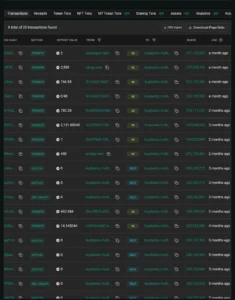
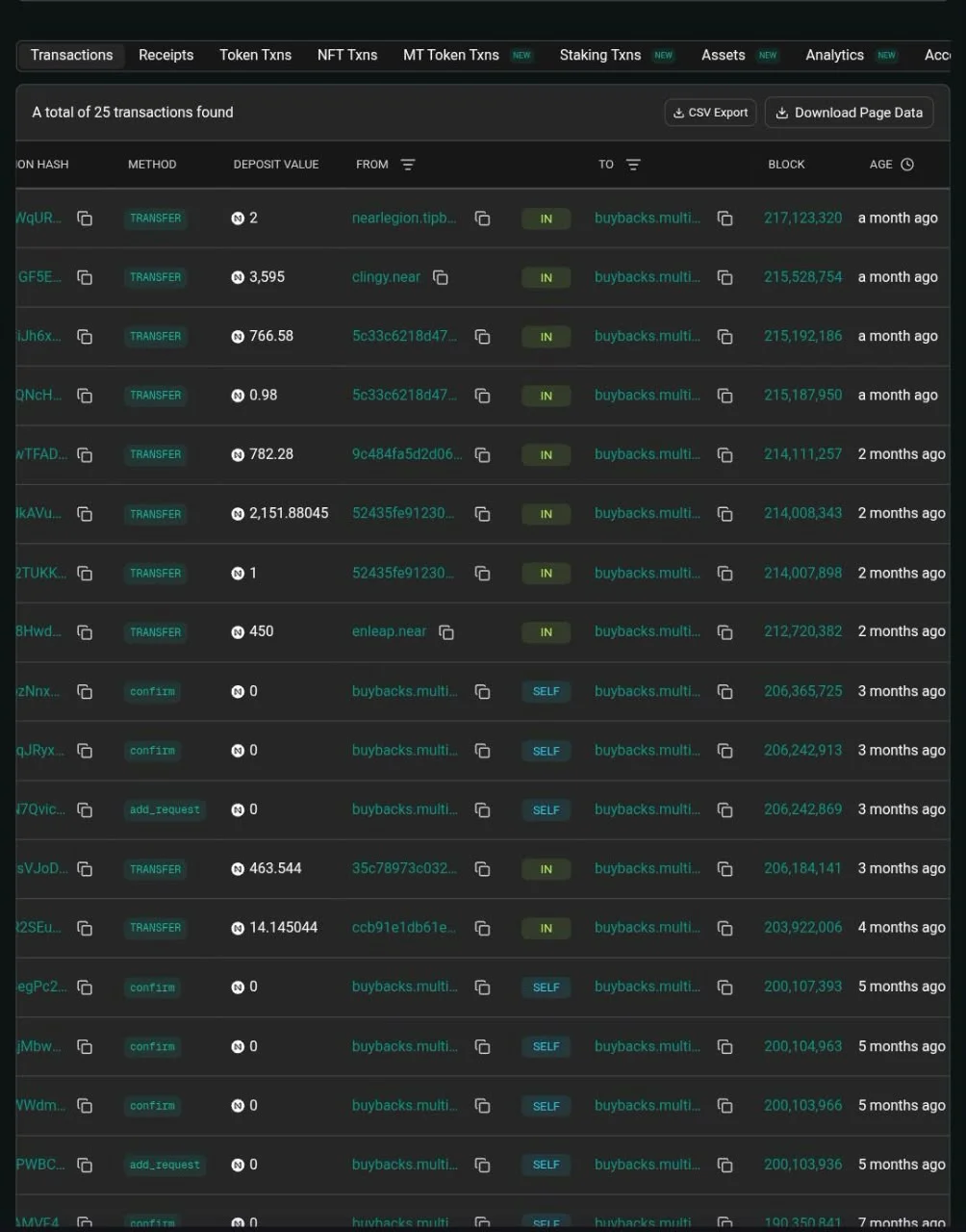
The conventional transaction list for buybacks.multisignature.near on blockchain explorers can be misleading. It typically displays only a small number of entries—in this case, around 25 transactions—primarily comprising minor manual transfers and the add_request and confirm actions inherent to a multisig wallet’s operation. These visible incoming transfers total a mere 8,227 NEAR, or approximately $41,000, which is a fraction of the total balance.

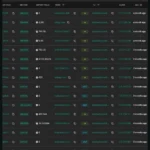
The true, continuous flow of repurchased NEAR tokens is revealed in the account’s "receipts" section on NearBlocks. Receipts represent the internal transfers and contract calls initiated by the network’s automated processes. Here, a staggering 2,831 entries are listed. Critically, in the most recent history, every single one of these incoming transfers originates from intents.near, which is the core NEAR Intents contract. These are plain NEAR transfers, directly landing in the buyback account.
A snapshot of recent activity over a day or so shows approximately 23 such deposits, totaling 6,943.69 NEAR, valued at about $34,400. Each individual deposit typically ranges between 204 and 707 NEAR, occurring consistently every hour or two. This pattern provides compelling, real-time evidence of the fee switch actively working on-chain. It confirms that the buyback mechanism is automated, continuous, and directly funded from the protocol’s own contract, solidifying the veracity of NEAR’s buyback claims.
However, while this on-chain data validates the existence and functionality of the buyback, it also highlights the challenge in determining specific period totals. Based on the current pace, a full quarter of such activity would bring in approximately 639,000 NEAR, equating to roughly $3.2 million. This is a run-rate estimate, not the actual Q3 total. Given that NEAR Intents’ volume doubled over Q3, the buyback deposits would have proportionally increased, meaning earlier Q3 deposits would likely have been smaller, and later ones larger. The total count of 2,831 deposits, if averaged at today’s rate of approximately 300 NEAR per deposit, would only sum up to around 855,000 NEAR. This is less than half of the current total balance, suggesting either that earlier deposits were significantly larger, or that some NEAR tokens in the buyback account originated from other sources not immediately visible through this specific receipt stream. The exact Q3 buyback figure is embedded within these receipts, but it requires a dedicated summation that NEAR Protocol has yet to make publicly available.
Implications and Recommendations for Enhanced Transparency
NEAR Intents’ performance in Q3 is undeniably impressive, demonstrating robust growth and increasing utility in the cross-chain sector. The on-chain record unequivocally backs up the existence and continuous operation of the buyback mechanism: the protocol’s own contract consistently channels NEAR tokens into the designated buyback account, and the account’s holdings currently exceed the "$8M+" lifetime figure.
Despite these positive affirmations, the current state of disclosure lags behind the rapid pace of volume reporting. For an ecosystem that places revenue capture and tokenomics at the core of its value proposition, transparency is paramount for fostering investor confidence and community trust. The observed discrepancies and information gaps present opportunities for improvement.
To close this transparency gap and further solidify its commitment to open and verifiable operations, NEAR Protocol should consider implementing three key additions to its public reporting:
- Quarterly Buyback Report: Just as quarterly volume figures are published, a corresponding report detailing the exact amount of NEAR tokens repurchased within that specific quarter should be provided. This would align the buyback narrative with the performance metrics and provide a clearer picture of the protocol’s economic activity.
- Dashboard Accuracy and Real-Time Updates: The official revenue dashboard, while illustrative, needs to reflect near real-time, accurate balances for critical accounts like
buybacks.multisignature.near. A significant lag or discrepancy can erode trust. Implementing more frequent updates or linking directly to on-chain data for live verification would be beneficial. - Clarification on Staking Status: The discrepancy between the stated intention of "staked or locked" tokens and the observed zero staked balance requires explicit clarification. If the tokens are not being staked, the reasons should be communicated. If they are intended to be staked in the future, a timeline or strategy for doing so would be valuable. This directly impacts the "Buy Back and Earn" model and investor expectations regarding potential yield generation from repurchased assets.
NEAR Protocol has made revenue capture and a deflationary tokenomics model central to its long-term pitch. The buyback mechanism is real, automated, and demonstrably visible on-chain. What it now requires is the same level of granular, quarterly reporting for its buyback figures as it provides for its impressive quarterly volume headlines. This enhanced transparency would not only clarify existing ambiguities but also strengthen the protocol’s credibility and appeal to a broader investor base.
Disclosure: This is not trading or investment advice. Always do your research before buying any cryptocurrency or investing in any services.