The digital realm of cryptocurrency, often lauded for its efficiency and decentralization, occasionally reveals critical vulnerabilities that underscore the fragility of human-machine interaction. This past week, a seemingly innocuous oversight—the omission of a single character in a cryptocurrency address—resulted in a user irrevocably losing approximately $20,000 in USDC on the Solana blockchain. This incident has reignited a dormant yet critical debate within the Solana development community concerning the network’s address format and its inherent susceptibility to such human errors, a discussion that has been quietly documented in Solana’s GitHub repository since 2019.
The Incident Unfolds: A Costly Typo
The unfortunate event transpired when a user, attempting to repay a loan through a decentralized finance (DeFi) protocol integrated with the Backpack wallet, initiated a transaction from the centralized exchange Binance. The standard procedure involved copying their Solana wallet address from the Backpack wallet and pasting it into Binance’s withdrawal interface. However, during this critical copy-paste operation, the final character of the address, a ‘J’, failed to transfer. What remained was a truncated string, which, by an exceptionally rare and unfortunate coincidence, still constituted a technically valid Solana address.
Binance’s automated system, designed to validate addresses based on their structural conformity to Solana’s format, accepted the malformed address. The transaction was subsequently confirmed and broadcast to the Solana network. Crucially, Solana’s protocol, unlike many other major blockchains, does not incorporate a master registry of "real" or active wallets, nor does it employ a checksum mechanism to verify the integrity of an address before funds are transferred. Consequently, the $20,000 in USDC was sent to an address that, statistically, almost certainly belongs to no one and is thus irrecoverable. The funds now reside in a digital void, an unintended destination inaccessible to any legitimate owner. This type of loss, often termed a "fat finger" error in traditional finance, takes on a far more permanent and irreversible nature in the immutable ledger of blockchain.

Technical Deep Dive: Solana’s Address Design
The core of this problem lies not in an exotic exploit or a sophisticated hack, but in a fundamental design aspect of Solana’s address format that makes such errors unusually perilous. The community’s immediate reaction highlighted a long-standing technical question: is a Solana address truly of a fixed length?
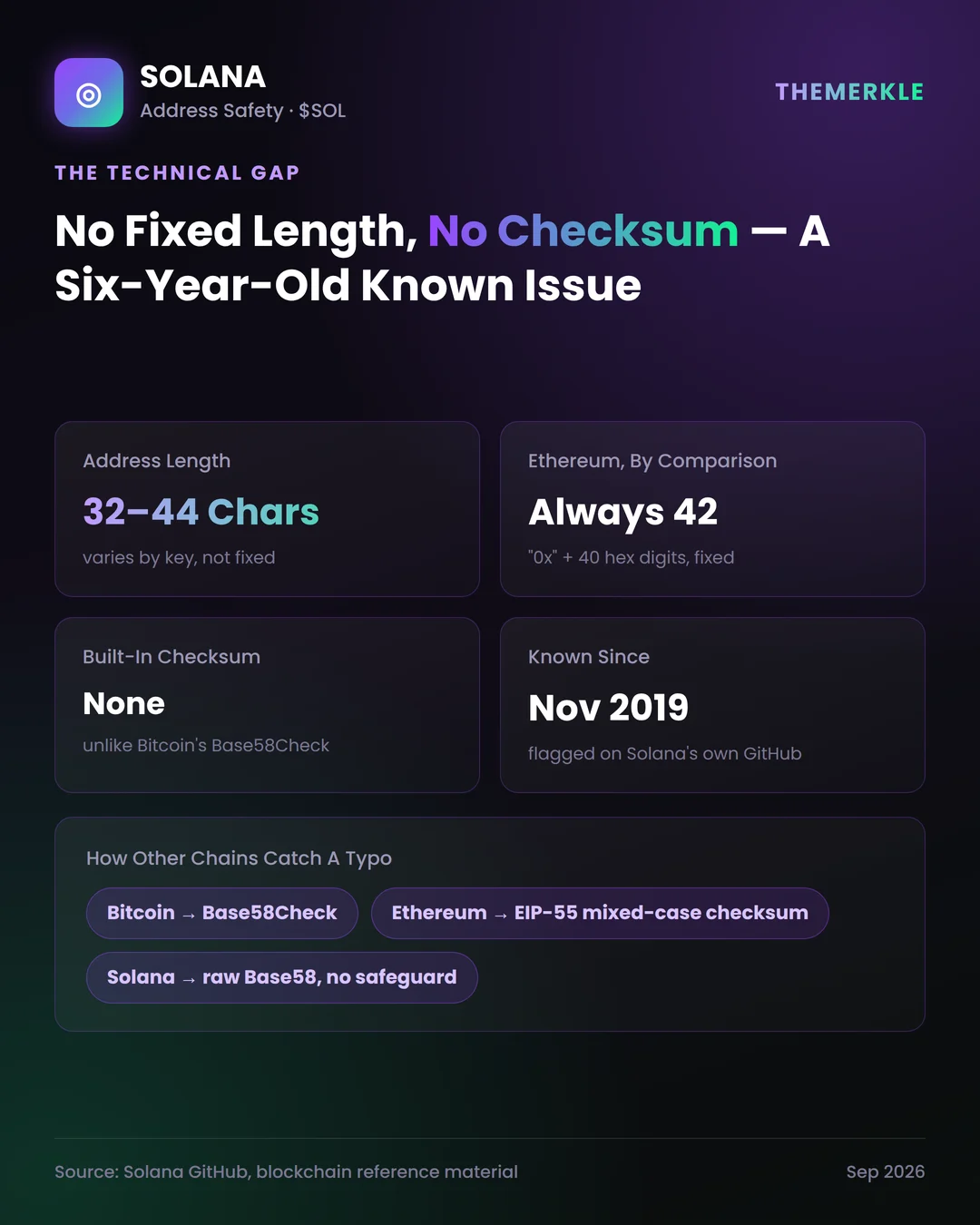
The answer, surprisingly to many, is no. A Solana address is fundamentally the Base58-encoded representation of a 32-byte (256-bit) Ed25519 public key. While the underlying cryptographic key is always precisely 32 bytes, the Base58 encoding process does not guarantee a fixed-length output for a fixed-length input. Specifically, leading zero bytes within the raw 32-byte key are collapsed during the Base58 encoding process. This characteristic means that the resulting string, the human-readable Solana address, can vary in length anywhere between 32 and 44 characters. This variable length is a well-documented feature across wallet providers and blockchain reference materials, yet it significantly complicates manual verification, as there is no single "correct" character count to visually audit.
This contrasts sharply with other prominent blockchain networks. For instance, an Ethereum address is always a hex string of exactly 42 characters, commencing with "0x" followed by 40 hexadecimal digits. If even a single character is dropped or altered in an Ethereum address, it immediately becomes mechanically invalid, preventing the transaction from proceeding. Similarly, Bitcoin addresses, while also using Base58 encoding, incorporate a critical additional layer of security: Base58Check. This method appends a checksum to the address, ensuring that any single incorrect or missing character causes the decoding process to fail outright, thereby rejecting the malformed address.
Solana, however, implements neither of these common error-prevention mechanisms. Without a fixed length or a checksum, a truncated Solana address—like the one missing the ‘J’ in this incident—can still fall within the valid 32-44 character range and successfully decode into what appears to be a legitimate 32-byte public key. This unique combination of variable length and the absence of a checksum creates a scenario where a seemingly minor human error can lead to a catastrophic and irreversible loss of funds, precisely as observed this week.

A Lingering Concern: The 2019 GitHub Issue
This recent incident brings renewed, stark attention to a technical discussion that originated nearly five years ago. In November 2019, a GitHub issue titled "Use Base58Check where humans are involved" was filed against the core Solana repository. This issue explicitly flagged the precise vulnerability now exposed: the inherent error-proneness of raw Base58 encoding without a checksum, particularly in scenarios where humans are directly involved in handling addresses. The contributor argued for the implementation of Base58Check, akin to Bitcoin’s approach, to append a checksum and prevent such typo-induced losses.
The fact that this issue, identifying a critical user experience and security gap, has remained unresolved at the base protocol layer for years weighs heavily on the current debate. It underscores a protocol-level design choice with profound financial implications for its users. While the Solana blockchain has evolved rapidly, becoming a major player in the crypto space with a market capitalization often ranking among the top ten and boasting high transaction throughput, this fundamental address format concern has persisted, quietly awaiting a scenario like the one that unfolded this week to bring it to the forefront. The continuous growth of Solana’s ecosystem, with an increasing number of users and significant transaction volumes, only amplifies the potential impact of such unaddressed vulnerabilities.
The Broader Debate: Protocol vs. Platform Responsibility
The question of culpability in such an incident is rarely straightforward in the decentralized world. On one hand, Solana’s core design undoubtedly plays a significant role. The protocol’s architects chose an address format that, while technically efficient for machine processing, introduces considerable risk for human users. The protocol’s own contributors identified this checksum gap years ago, and its persistence suggests a prioritization that, perhaps unintentionally, sacrifices a layer of user safety. When a blockchain’s address format allows a truncated string to parse as valid, offering no automated mechanism to catch such errors before a transaction is signed and broadcast, it represents a protocol-level user experience (UX) decision with direct and severe financial consequences, moving beyond mere "bad luck" on the user’s part.

On the other hand, centralized exchanges like Binance are not merely passive conduits for blockchain transactions. They operate their own user interfaces and withdrawal systems, which exist as a distinct layer separate from the underlying blockchain protocol. Many major exchanges, recognizing the absence of native checksums in certain blockchain address formats (including Solana’s), have proactively implemented their own supplementary safeguards. These can include mandatory small test transfers before large withdrawals, visual address chunking to make discrepancies easier to spot, or even withdrawal address allowlisting with time delays.
If Binance’s withdrawal flow in this instance only performed a basic validation—checking if the pasted string conformed to Solana’s general Base58 pattern and length range—without incorporating any of these secondary, user-facing safety nets, then a significant gap in Binance’s own product design becomes apparent. This scenario suggests a shared responsibility: Solana for designing an address format that permits a partial, yet valid-looking, paste, and the exchange for failing to implement additional guardrails to intercept such a common human error before irreversible funds movement. The incident highlights a critical need for robust error-checking not just at the protocol level, but also at the application layer where users interact with these complex systems.
Industry Context and User Safety
The incident serves as a stark reminder of the inherent risks associated with transacting in cryptocurrencies, particularly for users less familiar with the underlying technical nuances. While the total value lost to scams and hacks in the crypto space runs into billions of dollars annually, a significant portion of losses can also be attributed to user error, often involving incorrect addresses. The "trust, but verify" mantra of traditional finance is amplified in crypto to "verify, verify, and then verify again."
For users interacting with Solana, this incident means that the common advice of "just verify the address" is not as reassuring as it sounds. Relying solely on a quick visual check for approximate length or pattern is insufficient. On chains with checksums or fixed-length addresses, a glance might suffice to catch an obvious error. On Solana, however, a detailed, character-by-character verification of the entire address string is paramount, a tedious but essential task for any meaningful sum. This level of diligence is an inconvenient reality stemming directly from the protocol’s address design choices.

Furthermore, the role of wallet providers and decentralized applications (dApps) in mitigating such risks cannot be overstated. Wallets could implement more aggressive validation routines, perhaps issuing warnings if an address falls below the typical character count or suggesting a checksum if one were available. dApps could integrate confirmation steps that visually break down the address into manageable chunks, aiding user verification.
Implications for Solana’s Ecosystem and Calls for Enhanced Security
This loss, while isolated to a single user, has broader implications for trust and adoption within the Solana ecosystem. For a network striving for mainstream adoption and competing with established financial systems, such vulnerabilities, even if stemming from user error, can erode confidence. The perception of ease-of-use and security is paramount for attracting new users and retaining existing ones.
The renewed debate around Solana’s address format calls for urgent re-evaluation. While changing a fundamental aspect like address format on an established blockchain is a monumental task, fraught with compatibility issues and migration challenges, the community may need to explore various avenues. These could include:
- Introducing a new, checksum-enabled address format: This would be a long-term solution, potentially requiring a gradual migration path for existing users and applications.
- Standardizing client-side validation: Encouraging or mandating that wallets, exchanges, and dApps implement robust client-side validation, including checksums or more stringent length checks, even if the protocol doesn’t natively enforce them.
- Enhanced visual aids: Developing standardized visual representations of Solana addresses that highlight variations or make truncations more immediately obvious.
Ultimately, the incident serves as a critical learning moment for the entire cryptocurrency industry. It highlights the delicate balance between technical design efficiency and robust user-facing security. As the digital asset space continues to mature, the emphasis on user protection, intuitive interfaces, and resilient error-prevention mechanisms will become increasingly vital to prevent such avoidable and financially devastating losses. Until Solana’s tooling closes this long-standing gap, or exchanges and wallet providers universally implement stronger guardrails, the risk of similar incidents will persist, reminding all participants of the immutable and unforgiving nature of blockchain transactions.