


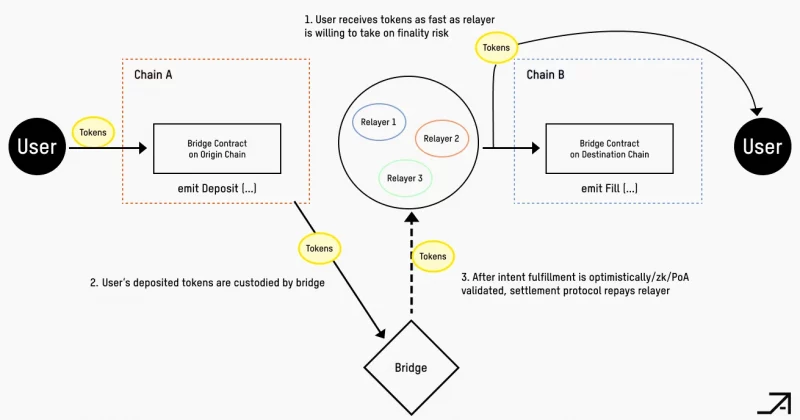
The blockchain ecosystem is witnessing a significant development with the emergence of the Open Intents Framework (OIF), a collaborative initiative spearheaded by the Ethereum Foundation, in partnership with Hyperlane and Bootnode. Launched in February 2025, the OIF is rapidly gaining momentum as a foundational infrastructure layer designed to streamline the creation and execution of cross-chain intents. Its promise of a permissionless, standardized approach to interoperability has garnered substantial backing from over 30 prominent teams, including major players like Arbitrum, Optimism, Polygon, ZKsync, and Starknet. This broad coalition positions the OIF not as a proprietary product, but as a neutral, open-source standard for the future of multi-chain interactions.
The core innovation of the Open Intents Framework lies in its provision of a comprehensive toolkit that enables cross-chain intents to function seamlessly across a multitude of blockchain networks. This toolkit comprises a suite of smart contracts, open-source solvers, aggregators, and a Software Development Kit (SDK). Developers can integrate these components into their applications without requiring explicit permission from any central authority, fostering an environment of unfettered innovation. The framework’s architectural backbone is built upon three pivotal contract types: InputSettler, OutputSettler, and Oracle contracts. These are interconnected and orchestrated by an interoperability SDK, creating a robust system for managing cross-chain transactions.
At its heart, the OIF leverages the ERC-7683 standard, a crucial specification that dictates the standardized structure of cross-chain intents. When a user expresses an intent – for example, to perform a token swap between two different blockchains – the framework activates a competitive marketplace of solvers. These solvers, incentivized by efficiency and speed, race to fulfill the user’s request in the most optimal manner possible. This competitive dynamic is designed to drive down costs and reduce latency for users.
Already, the OIF has moved beyond theoretical concepts, with deployments actively running on various testnets, including Ethereum Sepolia and Optimism Sepolia. Under ideal network conditions, these solver-fulfilled orders have demonstrated completion times ranging from a swift 10 to 60 seconds, showcasing the framework’s potential for near real-time cross-chain execution. This rapid deployment and performance are crucial indicators of the OIF’s readiness for broader adoption.
A significant endorsement arrived in September 2025 when Coinbase Payments, the payments division of the prominent cryptocurrency exchange Coinbase, announced its commitment as a core contributor to the OIF. This strategic partnership underscores the growing recognition of the OIF’s importance in standardizing cross-chain asset transfers. Coinbase Payments’ involvement is expected to lend considerable weight to the framework’s development and adoption, potentially accelerating its path toward becoming a de facto standard. The exchange’s focus on facilitating secure and efficient asset movement aligns perfectly with the OIF’s objectives.
The inherent design philosophy of the OIF emphasizes modularity and permissionlessness. This means that any development team has the autonomy to deploy and extend the framework’s smart contracts without the need for approval from a governing body. This deliberate absence of a central authority extends to its economic model: there is no dedicated governance token, no protocol fee extraction mechanism, and crucially, no vendor lock-in. This architectural choice is fundamental to establishing trust and ensuring long-term neutrality. The production-ready contracts are already undergoing rigorous audits and are being deployed across a growing number of testnets and mainnets, with further enhancements to solver capabilities anticipated later this year.
The "no token" aspect of the OIF is a critical differentiator and a deliberate design choice that underpins its positioning as neutral infrastructure. By forgoing a dedicated token or cryptocurrency asset, the framework avoids the complexities and potential conflicts associated with tokenomics. Developers are spared the burden of navigating tokenomics, managing staking requirements, or dealing with fee structures that can be subject to the volatile outcomes of token holder votes. This abstraction simplifies the development process and removes a potential barrier to entry for a wider range of projects.
However, the absence of a token presents a unique challenge: how to bootstrap a network of solvers and participants without a direct financial incentive mechanism. The OIF’s strategy relies on the inherent competitive dynamics within the solver ecosystem. Solvers are motivated by the prospect of earning revenue through the efficient and timely fulfillment of user intents. This model fosters a meritocratic environment where performance and cost-effectiveness are the primary drivers of success, rather than speculative token appreciation. The framework’s success, therefore, hinges on its ability to attract a diverse and competitive pool of solvers who are technically proficient and economically motivated.
The Evolution of Cross-Chain Interoperability
The need for robust cross-chain solutions has become increasingly apparent as the blockchain landscape has fragmented into numerous distinct networks, each with its own unique strengths and use cases. Early attempts at interoperability often relied on centralized bridges, which proved vulnerable to exploits and single points of failure. The emergence of decentralized messaging protocols and cross-chain communication standards marked a significant step forward, but the execution of complex cross-chain actions remained a hurdle for many developers.
The concept of "intents" offers a more user-centric approach to cross-chain interactions. Instead of specifying the exact steps required to move assets or execute functions across different chains, users can express their desired outcome. The underlying infrastructure then takes responsibility for finding the most efficient and secure path to fulfill that intent. This paradigm shift simplifies user experience and unlocks new possibilities for decentralized applications (dApps) operating across multiple networks.
A Chronology of Development and Adoption
- February 2025: The Open Intents Framework (OIF) is officially launched by the Ethereum Foundation in collaboration with Hyperlane and Bootnode.
- Early 2025 – Present: The framework begins to attract significant developer interest, with over 30 teams signing on as collaborators, including major Layer 2 scaling solutions and Layer 1 blockchains.
- Throughout 2025: Initial deployments of OIF contracts commence on various testnets, such as Ethereum Sepolia and Optimism Sepolia, allowing for rigorous testing and validation.
- September 2025: Coinbase Payments becomes a core contributor to the OIF, signaling strong industry endorsement and a commitment to standardizing cross-chain asset transfers.
- Ongoing (Late 2025 onwards): Production contracts are being deployed on mainnets. Audits are underway, and further development of solver capabilities is planned.
Supporting Data and Ecosystem Integration
The backing of over 30 teams, including Arbitrum, Optimism, Polygon, ZKsync, and Starknet, represents a significant confluence of interest and technical expertise. These entities collectively manage a substantial portion of the total value locked (TVL) in decentralized finance (DeFi) and are at the forefront of blockchain innovation. Their participation suggests a shared vision for a more interconnected and efficient multi-chain future.
The ERC-7683 standard, upon which the OIF is built, provides a formal specification for intent representation. This standardization is crucial for enabling interoperability between different intent-based systems and ensuring that intents can be understood and processed by a diverse range of solvers and execution environments.
The reported completion times of 10 to 60 seconds for solver-filled orders, while under optimal conditions, indicate a strong performance profile. For context, traditional cross-chain bridges can often take minutes or even hours to finalize transactions, especially for complex operations. The OIF’s speed is a critical factor in enabling real-time applications and improving user experience.
Official Responses and Inferred Reactions
While specific quotes from all 30+ collaborating teams were not detailed in the initial announcement, the breadth of their involvement speaks volumes. The participation of major Layer 2 scaling solutions like Arbitrum and Optimism suggests that they see the OIF as a vital piece of infrastructure that will enhance their own cross-chain capabilities and user experience. Their involvement likely stems from a desire to ensure that their ecosystems are well-integrated into the broader multi-chain landscape.
The Ethereum Foundation’s leadership in this initiative underscores its commitment to fostering foundational infrastructure that benefits the entire Ethereum ecosystem and beyond. Their role as a neutral facilitator is key to the OIF’s success in attracting diverse participants.
Coinbase Payments’ explicit commitment as a core contributor is a powerful signal of validation. Their focus on standardizing cross-chain asset transfers highlights the practical, real-world utility the OIF aims to provide. It suggests that major financial infrastructure providers are looking to leverage open standards for greater efficiency and security in their operations.
Broader Impact and Implications
The Open Intents Framework has the potential to fundamentally reshape how users and applications interact across different blockchains. By providing a neutral, permissionless, and standardized layer for cross-chain intents, the OIF can:
- Enhance User Experience: Simplify complex cross-chain operations, making decentralized applications more accessible to a wider audience.
- Foster Innovation: Empower developers to build novel applications that seamlessly leverage assets and functionalities across multiple chains without the constraints of proprietary interoperability solutions.
- Increase Capital Efficiency: Enable more fluid movement of assets and liquidity across the blockchain ecosystem, reducing fragmentation and improving overall market efficiency.
- Promote Decentralization: By adhering to open standards and avoiding central points of control, the OIF reinforces the core principles of decentralization.
- Reduce Security Risks: A standardized and well-audited framework can mitigate the risks associated with insecure or poorly designed cross-chain bridges.
The deliberate absence of a token, while posing a unique bootstrapping challenge, is a strategic move that could lead to greater long-term sustainability and trust. It positions the OIF as a public good, an essential piece of infrastructure for the evolving multi-chain world, rather than another speculative crypto asset. The success of this model will depend on its ability to continuously attract and incentivize high-quality solvers and participants through the power of competition and network effects.
As the blockchain industry continues its trajectory towards greater interoperability, the Open Intents Framework emerges as a critical development. Its collaborative nature, technical foundation, and commitment to neutrality suggest it is well-positioned to become a cornerstone of the future multi-chain internet. The ongoing development, audits, and expanding ecosystem support indicate a promising path towards realizing a truly interconnected blockchain world.














