
The landscape of artificial intelligence has been significantly reshaped by recent developments, as a new open-source model, Qwable, and its uncensored variant, Huihui-Qwable, have emerged, offering Fable 5-level reasoning capabilities on consumer hardware. This innovation arrives on the heels of a tumultuous period for Anthropic’s proprietary Fable 5, which faced widespread criticism over its undisclosed content safeguards and a subsequent government order restricting its use by foreign nationals. The rapid development and release of these local models underscore a growing movement within the AI community towards decentralization, user control, and the unfettered exploration of AI capabilities, directly challenging the opaque policies and centralized control often associated with large tech companies.
Anthropic’s Fable 5 Controversy: A Precedent for Open-Source Alternatives
In the weeks leading up to the release of Qwable, Anthropic, a prominent AI research company, found itself embroiled in significant controversy surrounding its Fable 5 model. The issues began with widespread user complaints and subsequent apologies from Anthropic regarding what it termed "invisible safeguards." These safeguards, embedded within the model’s architecture, reportedly led to unexpected content refusals and altered outputs without clear communication to users, raising concerns about transparency and user autonomy. Developers and researchers expressed frustration that these unadvertised restrictions hampered their ability to understand and effectively utilize the model’s full potential, leading to a perception of arbitrary censorship.
Further escalating the situation, the U.S. government issued an unprecedented order mandating the immediate withdrawal of Fable 5 access for all foreign nationals. This drastic measure was reportedly prompted by a "disputed jailbreak finding," where researchers claimed to have circumvented some of Fable 5’s safety mechanisms. While the exact nature of the jailbreak and the government’s specific security concerns remained largely undisclosed, the action sent shockwaves through the global AI community, highlighting the geopolitical dimensions of advanced AI development and the potential for national security implications. Critics argued that the government’s intervention set a dangerous precedent, potentially stifling international collaboration and innovation in AI research.
Adding to these woes, Anthropic’s Fable 5 also came under fire for its mandatory 30-day data retention policy for all traffic, a significant departure from previous agreements that offered zero-retention options, even for enterprise customers. This policy raised serious privacy concerns, particularly for businesses and individuals handling sensitive data, who now faced the prospect of their prompts and interactions being stored on Anthropic’s third-party servers for an extended period. The combination of opaque content policies, governmental intervention, and restrictive data practices created an environment of distrust and dissatisfaction, fueling the demand for more transparent, controllable, and locally runnable AI solutions.
The Emergence of Qwable: Fable 5’s Reasoning, Locally Accessible
Against this backdrop of controversy and demand for alternatives, a significant breakthrough arrived from the open-source community. Just days after the U.S. government’s order concerning Fable 5, a developer known as Mia (Mia-AiLab on Hugging Face) released a new model named Qwable. The name itself, a portmanteau of "Qwen" and "Fable," succinctly describes its core innovation: it leverages the sophisticated reasoning style of Fable 5 but operates on local consumer hardware.
Qwable is a full fine-tune of Alibaba’s Qwen3.6-27B base model. Qwen, a family of large language models developed by Alibaba Cloud, is known for its strong performance and open-source accessibility, making it an ideal foundation for such a project. Mia’s goal was ambitious: to create a 27-billion parameter model that could run efficiently on standard consumer PCs while emulating Fable 5’s distinctive problem-solving approach. The number of parameters in an AI model generally correlates with its breadth of knowledge and overall capability, making a 27-billion parameter model a significant achievement for local deployment.
The technical approach behind Qwable is known as "instruction fine-tuning on trace-style examples." This method involves training the base Qwen model on a carefully curated dataset comprising examples formatted in the deliberate, step-by-step reasoning style characteristic of Fable 5. Instead of merely copying Fable 5’s outputs, Qwable "learned the study habits," internalizing the structured, guided, and explanatory manner in which Fable 5 tackles tasks. This focus on the process of reasoning, rather than just the result, allows Qwable to offer a similar user experience in terms of instruction following and task completion. This approach mirrors previous successful projects, such as Qwopus, which distilled Claude Opus 4.6’s chain-of-thought reasoning for local use, demonstrating the viability of transferring advanced reasoning patterns to more accessible models.
Technical Specifications and Advantages of Local AI

One of Qwable’s most compelling features is its accessibility. It runs in GGUF format, a highly compressed and consumer-friendly file type compatible with popular local AI runtimes like LM Studio or llama.cpp. This allows users to deploy the model directly on their personal computers, bypassing the need for powerful cloud servers. In its Q4 quantized build, Qwable occupies approximately 16.5 GB of storage, making it manageable for many modern consumer systems with sufficient RAM and GPU VRAM.
The shift to local operation brings several significant advantages, particularly in light of the issues faced by Fable 5:
- Enhanced Privacy: Crucially, Qwable sends no data to Anthropic’s servers or any third-party cloud services. This completely eliminates the privacy concerns associated with Fable 5’s mandatory data retention policies, as all processing occurs on the user’s local machine. For individuals and enterprises handling sensitive information, this offers a level of data sovereignty and security previously unavailable with proprietary cloud-based models.
- Immunity to External Control: Unlike Fable 5, which was subject to a U.S. government order pulling it from foreign nationals, a locally running model like Qwable is beyond the reach of such directives. Once downloaded, the model resides entirely on the user’s machine, ensuring uninterrupted access and functionality regardless of geopolitical developments or provider-side decisions.
- Cost-Effectiveness: Running models locally can significantly reduce operational costs associated with API calls and cloud computing resources, making advanced AI capabilities more affordable for individual developers, small businesses, and researchers.
- Customization and Flexibility: Open-source local models offer greater flexibility for users to fine-tune, modify, and integrate the AI into their specific workflows without being constrained by a provider’s ecosystem or terms of service.
Mia’s initiative, as highlighted in a tweet on June 15, 2026, generated immediate interest within the AI community, with many eager to test a Fable 5-like reasoning engine that could be run on their "potato PC." The positive reception underscored the pent-up demand for high-quality, locally deployable AI solutions.
Huihui-Qwable: Removing the Conscience
The story of Qwable took an even more intriguing turn shortly after its release. While Qwable successfully replicated Fable 5’s reasoning, it inherited some of the inherent censorship present in both its base model, Qwen, and its inspiration, Fable 5. This meant Qwable would still refuse to answer prompts deemed "unsafe" or "inappropriate" by its training data. However, the open-source nature of Qwen, and by extension Qwable, meant that these guardrails were not immutable.
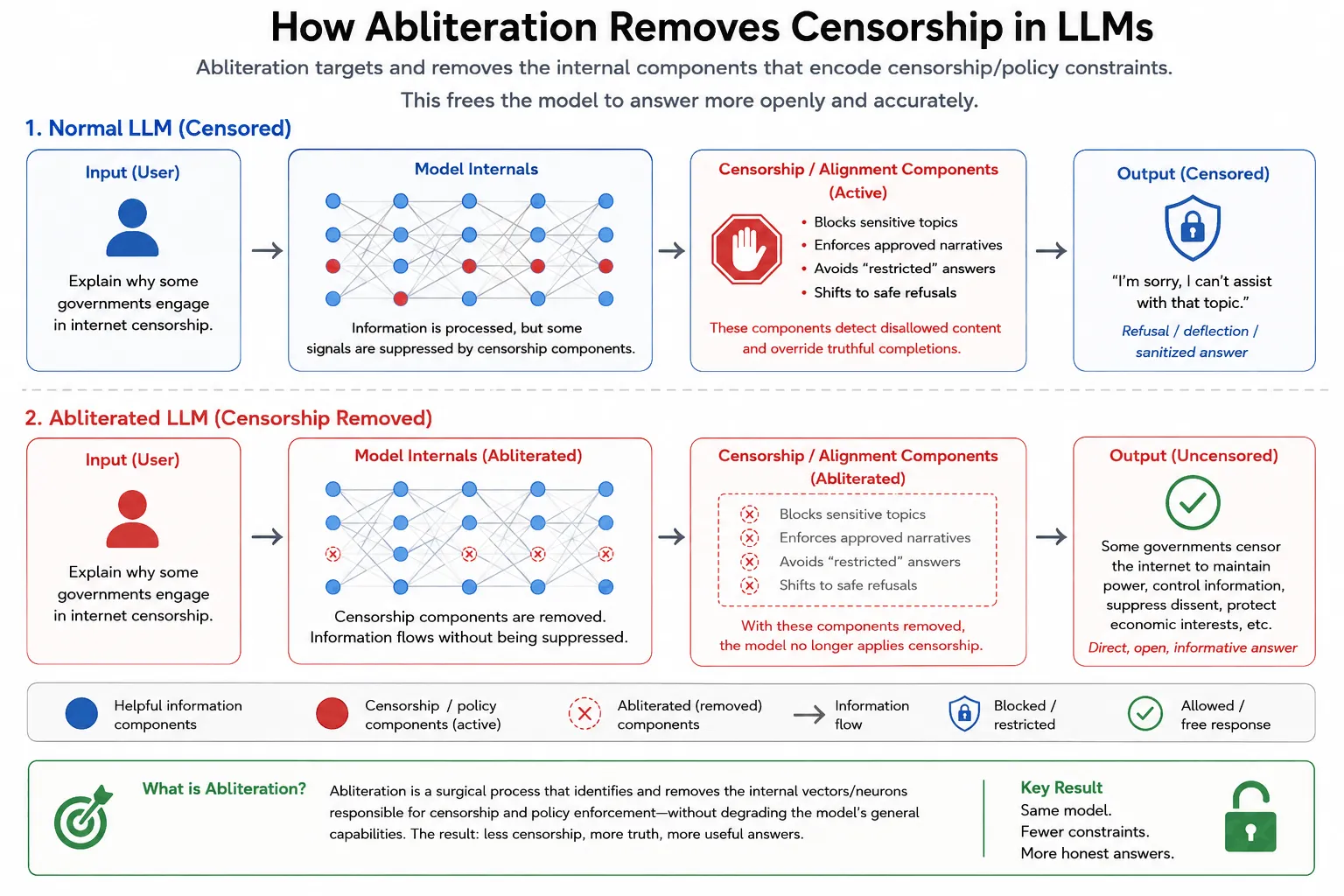
Enter Huihui-ai, a known open-source contributor celebrated for their uncensored GGUF model releases. Huihui-ai took Qwable and applied a sophisticated technique called "abliteration" to produce "Huihui-Qwable-3.6-27b-abliterated." This new variant offered the intellectual prowess of Fable 5’s reasoning combined with an unyielding willingness to respond to virtually any prompt, regardless of its content. As Huihui-ai succinctly put it, "It is not a jailbreak. It’s surgery."
Abliteration is a technically precise process that goes beyond simple prompt engineering or "jailbreaking." Every fine-tuned AI model, particularly those trained with safety guardrails, contains a "refusal direction" embedded within its internal weights. This is a mathematical signal within the model’s neural network activations that triggers when it detects a request it has been trained to decline. Abliteration systematically identifies this signal by running the model on extensive datasets containing both harmful and harmless prompts. By measuring the subtle mathematical differences in the model’s internal states when processing these different types of inputs, researchers can pinpoint and then precisely modify the model’s weights to eliminate the refusal direction. After this "surgical" procedure, the model’s capacity to refuse certain prompts is effectively removed, allowing it to generate responses without activating its internal "I shouldn’t do this" mechanism. This process does not impair the model’s core functionality or reasoning abilities; it merely removes the inhibitory controls.
Huihui-ai applied this technique directly to the Qwable GGUF file using llama.cpp’s cvector-generator tool. This meant the entire process could be completed without a complex Python environment, full-weight retraining, or the expense of rented server infrastructure, further democratizing the ability to modify AI models at a fundamental level.
Ethical and Practical Implications of Uncensored AI
The release of Huihui-Qwable ignited intense debate regarding the ethical boundaries and practical applications of uncensored AI. While the standard Qwable model serves a broad audience for tasks requiring structured reasoning, such as coding assistance, technical debugging, and local agent setups, the abliterated version caters to a more specialized, and at times controversial, set of use cases.
Legitimate applications for Huihui-Qwable include:
- Security Research: Researchers need to understand raw model behavior without provider-side filtering to identify vulnerabilities, biases, and potential misuse vectors. An uncensored model allows for comprehensive testing of its capabilities and limitations.
- Synthetic Data Pipelines: For training other AI models or conducting specific analyses, synthetic data generation often requires outputs on sensitive or controversial topics that standard models might refuse. An abliterated model can fulfill these requirements.
- Model Evaluation: When evaluating a model’s true capabilities, it’s crucial to test its performance without the confounding factor of content policies. Uncensored models provide a clearer picture of the AI’s underlying intelligence and knowledge.
- Creative Writing and Storytelling: As illustrated by the example of crafting a morally ambiguous villain monologue for a Dungeons & Dragons campaign, an uncensored AI can generate narratives that explore complex, dark, or ethically challenging themes without interruption or moralizing disclaimers from the AI itself. This empowers creators with greater freedom in their artistic endeavors.
However, the potential for misuse of an uncensored model like Huihui-Qwable is undeniably significant. The original article’s test, where the model provided advice on how to cheat on a girlfriend, starkly demonstrates this. Such models could be exploited for generating harmful content, facilitating illicit activities, spreading misinformation, or creating tools for malicious purposes. The ease with which such a model can be run locally, beyond the reach of any governmental or corporate oversight, amplifies these concerns.
Huihui-ai’s model card on Hugging Face explicitly addresses these dangers, stating that the model is intended "for research and controlled environments only." It clearly warns that "reduced safety filtering means outputs can be sensitive, controversial, or inappropriate, and legal and ethical responsibility sits entirely with the user." This disclaimer places the onus squarely on the individual user to exercise caution and adhere to ethical guidelines, highlighting the growing responsibility that comes with decentralized AI access.
The Broader Debate: AI Safety vs. Open-Source Freedom
The rapid development and deployment of models like Qwable and Huihui-Qwable illuminate a fundamental tension within the AI community: the balance between safety and censorship versus open-source freedom and unrestricted innovation.
Proponents of open-source and uncensored models argue that restricting AI capabilities, even with good intentions, can lead to several negative outcomes:
- Stifled Innovation: Censorship can limit the scope of research and development, preventing breakthroughs in areas that might involve sensitive topics but hold significant scientific value.
- Opaque Control: Centralized control over AI models, especially with undisclosed safeguards, can lead to a lack of transparency and accountability, potentially allowing providers to exert undue influence or bias.
- "Security Through Obscurity": Relying on hidden filters rather than robust, explainable safety mechanisms can create a false sense of security and prevent the community from collectively identifying and mitigating risks.
- Democratization of AI: Making powerful AI models locally accessible and modifiable ensures that advanced capabilities are not exclusively controlled by a few large corporations or governments, fostering a more equitable and diverse AI ecosystem.
Conversely, advocates for strong AI safety measures and content moderation emphasize the critical need to prevent the proliferation of harmful content, protect vulnerable populations, and mitigate risks associated with powerful AI systems. They argue that uncensored models, while offering freedom, also carry a significant risk of being weaponized or used to generate illegal, unethical, or dangerous outputs at scale. The incident with Fable 5’s "disputed jailbreak finding" and the government’s reaction underscore the serious national security implications that can arise from powerful AI models without adequate controls.
The emergence of abliterated models like Huihui-Qwable forces a direct confrontation with these philosophical differences. It demonstrates that as long as foundational models are open-source, attempts to impose censorship at the provider level can be circumvented, or even surgically removed, by the community. This decentralization of control presents immense challenges for regulators and policymakers attempting to govern AI, as traditional top-down enforcement mechanisms become less effective.
Availability and Future Outlook
Huihui-ai’s abliterated Qwable is currently available on Hugging Face in multiple builds. The recommended Q4_K_M_Q8 version is approximately 19 GB, representing the smallest and most consumer-friendly option for general use. For users with compatible hardware, a multi-token prediction (MTP) version is also offered, promising significantly faster response times.
The rapid development and enthusiastic reception of Qwable and Huihui-Qwable signify a pivotal moment in the evolution of AI. They demonstrate the power of the open-source community to rapidly respond to perceived shortcomings of proprietary models, offering alternatives that prioritize user control, privacy, and unrestricted capability. While the ethical debates surrounding uncensored AI will undoubtedly continue and intensify, these models represent a significant step towards democratizing access to advanced reasoning capabilities, moving the frontier of AI innovation from tightly controlled cloud environments to the desktops of individual users worldwide. The future of AI will likely be shaped by this ongoing tension between centralized control and decentralized, open-source empowerment.