


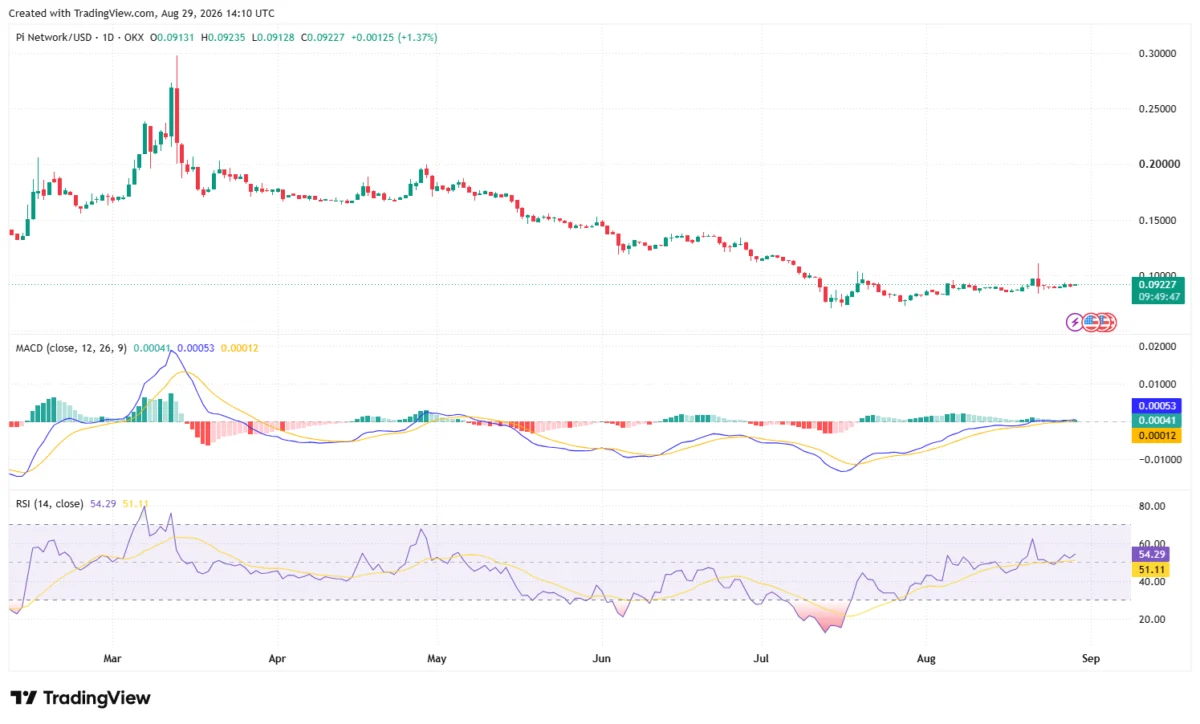
On August 29, the Pi Network (PI) token traded near $0.0917, registering a modest gain of approximately 0.4% over a 24-hour period. This slight upward movement occurred against a backdrop of renewed selling pressure across the broader cryptocurrency market, drawing significant attention to PI’s atypical display of relative strength. Market participants are now keenly observing developments surrounding Protocol 27, a critical network upgrade slated for a Mainnet release on September 15. However, concerns regarding persistent weak participation within the Pi ecosystem continue to temper the otherwise optimistic narrative surrounding this upcoming catalyst.
The daily trading turnover for PI stood near $5.40 million, marking a roughly 20% decrease compared to the preceding day. While buyers have consistently managed to sustain PI’s valuation above the $0.09 threshold, their efforts have yet to translate into a convincing expansion of trading volume. Consequently, the recent price uptick appears to reflect cautious positioning by investors in anticipation of a known future event, rather than signifying a confirmed breakout driven by robust, widespread market demand. The juxtaposition of a key technical upgrade and subdued trading activity underscores the complex dynamics currently influencing Pi Network’s valuation and future trajectory.
Understanding Pi Network’s Journey and Vision
To fully appreciate the significance of Protocol 27, it is essential to contextualize Pi Network’s unique approach within the cryptocurrency landscape. Launched in 2019 by a team of Stanford Ph.D.s, Pi Network distinguished itself by introducing a mobile-first mining concept, allowing users to "mine" PI tokens directly from their smartphones without the heavy energy consumption typically associated with traditional proof-of-work cryptocurrencies like Bitcoin. The project’s vision was to create a decentralized ecosystem that is accessible to everyone, fostering a global peer-to-peer network and economy.
From its inception, Pi Network has operated through distinct phases. The initial phase focused on community building and mobile mining. This transitioned into a Testnet phase, where developers could build and test decentralized applications (dApps) on the Pi blockchain. The current phase, often referred to as the "Enclosed Mainnet," allows KYC-verified users to migrate their mined PI to the Mainnet blockchain and transact within a closed ecosystem of Pi-enabled applications. Crucially, PI tokens cannot yet be freely traded on external cryptocurrency exchanges, a limitation that has been a defining characteristic of the project and a source of both anticipation and frustration among its user base. The ultimate goal remains the transition to an "Open Mainnet," which would permit external connectivity, exchange listings, and broader utility for the PI token.
Protocol 27: A Pivotal Technical Advancement
The Pi Core Team officially announced that the Testnet is currently running Protocol 27, with the ambitious target of deploying this upgrade to the Mainnet by September 15. This update is not merely an incremental change; it introduces significantly more flexible and secure smart contract authentication capabilities. This enhanced framework is designed to empower accounts and decentralized applications to approve actions with a finer degree of control and improved security protocols.
The official communication from the Pi Core Team highlighted Protocol 27 as a natural progression following the successful implementation of Protocol 26 on the Pi Mainnet. The core technical improvement lies in its ability to facilitate more advanced methods for accounts and applications to interact with smart contracts. This means developers will have greater tools to design sophisticated dApps that require granular control over user permissions and transaction approvals, potentially unlocking a new wave of innovation within the Pi ecosystem. For instance, smart contracts could be programmed to release funds only after specific conditions are met, or to require multi-signature approvals for high-value transactions, significantly reducing risks associated with single points of failure.

Testnet Activity Previews Future Mainnet Capabilities
Recent activity on the Pi Testnet provides tangible examples of the types of functionalities Protocol 27 aims to enable. On August 27, wallet records associated with the BNPi booking application displayed intricate escrow functions. These included specific calls such as "server_auto_release" and "release_booking_escrow." Such functions are crucial for real-world applications, allowing for the automatic release of Test-Pi once booking conditions are satisfied, or the application of predefined dispute resolution rules in cases where conditions are not met. This demonstrates a practical implementation of secure, conditional transactions, a cornerstone for any robust decentralized finance (DeFi) or e-commerce platform.
Beyond escrow services, Pi Network has been actively testing a decentralized exchange (DEX), automated market maker (AMM) pools, and a Launchpad on its Testnet. In July, a significant milestone was reached when 242,000 users committed an impressive 15.92 million Test-Pi to acquire 10 million SLICE test tokens through a simulated Launchpad event. The associated pool utilized a constant-product swap formula, mirroring the mechanics of popular DEXs like Uniswap. While these developments remain confined to the Testnet environment and do not yet establish direct Mainnet demand, they are crucial indicators of the network’s technical progress and its ambition to foster a comprehensive DeFi ecosystem. The successful testing of these components suggests that the underlying infrastructure is being laid for a vibrant, functional decentralized economy once the Open Mainnet phase commences.
Broadening Utility: From DeFi to Decentralized AI
Protocol 27 is poised to provide developers with a significantly stronger infrastructural foundation, but its ultimate success hinges on subsequent usage and adoption. The creation of more sophisticated and secure applications would naturally drive transaction volume and enhance liquidity within the network. Without a robust and actively engaged user base interacting with a diverse range of dApps, the Pi coin price may continue to be predominantly influenced by speculative sentiment rather than fundamental utility.
Pi Desktop, the desktop application for node runners, is also actively widening its utility narrative. The latest Node version, 0.6.2, introduced significant enhancements, including OpenClaw and an Atlassian MCP Server to SoloHost. OpenClaw offers the capability to utilize local or cloud-hosted models while efficiently storing memory locally, potentially paving the way for decentralized artificial intelligence (AI) applications. The Atlassian MCP Server, on the other hand, facilitates connectivity between compatible AI clients and Jira, a widely used project management tool, hinting at enterprise-level integration possibilities. Pi Network reports that SoloHost, currently in its beta phase, has the potential to reach over 420,000 node runners. This initiative positions Pi Network not just as a cryptocurrency platform, but as a potential player in the decentralized cloud computing and AI services sector, leveraging its vast network of distributed nodes.
Technical Levels and Market Performance Analysis
From a technical perspective, the Pi Network price is currently navigating key resistance and support levels. The 50-day moving average, positioned at $0.0951, represents immediate resistance. A decisive daily close above this level could pave the way for a retest of the psychological $0.10 barrier. Beyond that, the next significant supply area is situated around $0.11, a level where previous buyers might seek to exit their positions, potentially increasing selling pressure. Overcoming both these resistance points would necessitate a substantial increase in trading turnover, significantly exceeding the volume observed in recent sessions.
Momentum indicators do not yet confirm the imminence of such a strong upward move. The four-hour Relative Strength Index (RSI) was observed near 44, which is below its neutral midpoint of 50, suggesting a lack of strong buying momentum. Similarly, the Moving Average Convergence Divergence (MACD) indicator, at 0.00020, trailed its signal line of 0.00022. The negative histogram reading further indicated that upward momentum was fading, even though both MACD lines remained above zero, hinting at a potential consolidation phase rather than a definitive breakout.
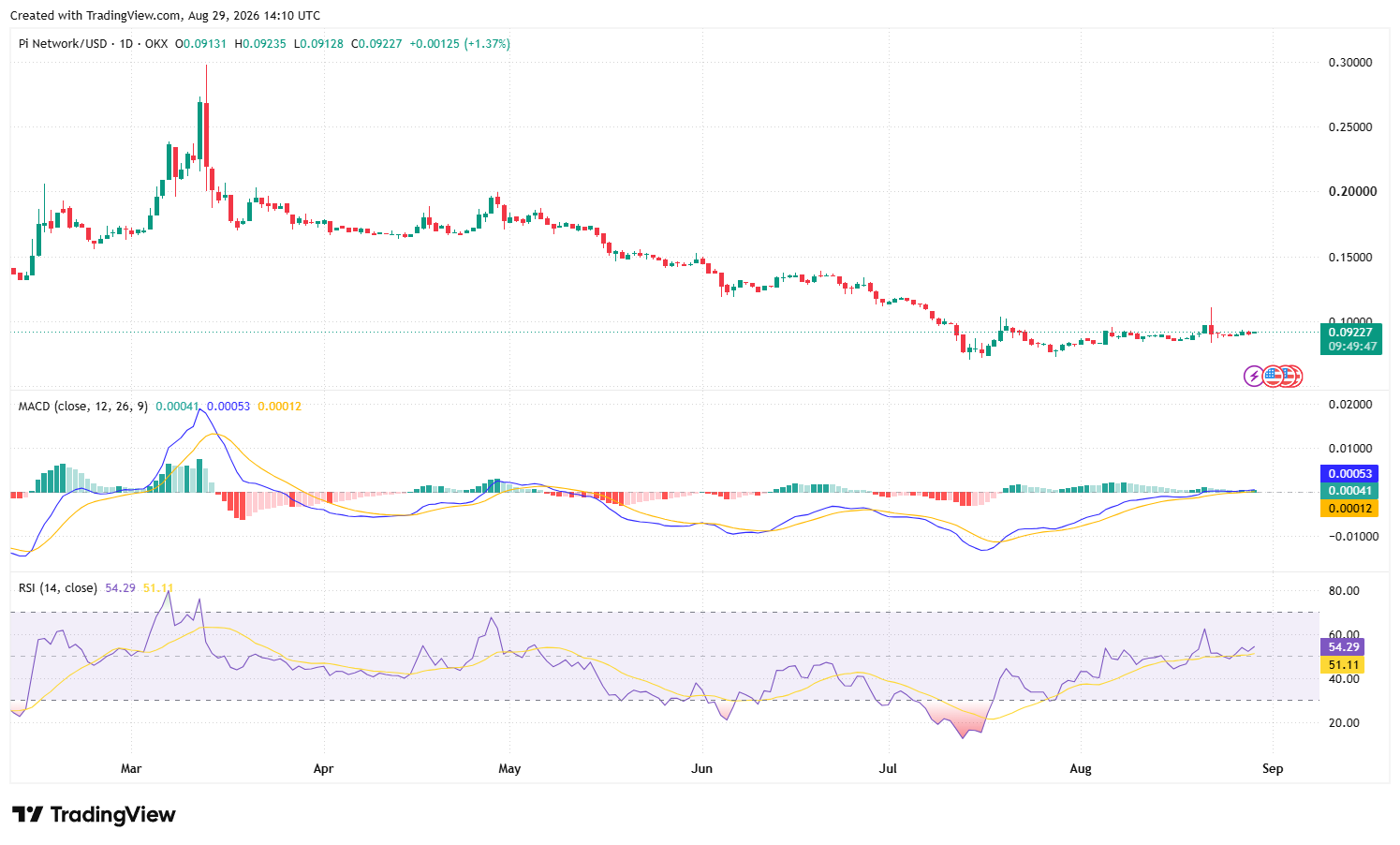
Near-term support for the PI token is identified between $0.087 and $0.088. A deeper pullback from current levels could expose the $0.085 mark, followed by the more significant $0.080 level. Should sellers manage to breach these zones, the broader base near $0.075 would become a critical area to watch. Maintaining the $0.09 level as consistent support is crucial for the Pi Network price to remain positioned for its initial resistance test and to prevent a more pronounced downtrend.
Liquidity Challenges and Tokenomics Concerns
Liquidity remains a central and persistent challenge for the Pi Network price. Data tracked by CoinGecko indicated a 24-hour trading volume of approximately $5.40 million, representing a roughly 20% decrease from the previous day. While the token’s market capitalization was estimated near $1.02 billion, supported by an impressive 11 billion circulating PI tokens, these figures, despite their scale, highlight a significant disparity. Low trading turnover, particularly relative to the market capitalization, can amplify price swings, making the asset more susceptible to manipulation or volatile movements driven by relatively small trading volumes. This limited liquidity can deter institutional investors and make it challenging for larger buyers or sellers to execute orders without significantly impacting the price.
Adding to these concerns are the ongoing implications of token unlock schedules. New supply entering the market, particularly through periodic unlocks for early miners or contributors, can absorb existing buying interest, especially when spot trading activity is thin. This dynamic can create a ceiling for price appreciation, as fresh supply continuously enters the market, needing to be absorbed by new demand. Therefore, for the Pi Network price to achieve a durable move above the $0.0951 resistance, it requires not just a technical catalyst but also a substantial and sustained increase in trading volume. A breakout supported by rising turnover would significantly strengthen the case for a push towards $0.10 and potentially $0.11, indicating genuine market conviction rather than speculative volatility.
Outlook: Balancing Development with Participation
The current state of Pi coin price reflects a delicate balance between improving underlying development and restrained market participation. The impending Protocol 27 upgrade provides Pi Network with a well-defined catalyst, introducing critical enhancements for smart contracts, decentralized exchange tools, and innovative AI applications, thereby significantly broadening its utility potential. These technical advancements are crucial for attracting developers and fostering a robust ecosystem of dApps, which is essential for the network’s long-term viability.
However, price confirmation of these positive developments still heavily depends on the consistent behavior of market participants. Buyers must firmly defend the $0.09 support level and, critically, convert the $0.0951 resistance ceiling into a new support floor. The transition from an Enclosed Mainnet to an Open Mainnet, which would allow PI to be traded on external exchanges, remains the ultimate unlock for broader liquidity and market discovery. Until then, the project faces the dual challenge of continuously building out its technological infrastructure while simultaneously incentivizing greater user engagement and fostering a truly active and liquid ecosystem. The success of Protocol 27 will not only be measured by its technical implementation but, more importantly, by its ability to catalyze increased participation and transform speculative interest into tangible, utility-driven demand for the Pi Network.














