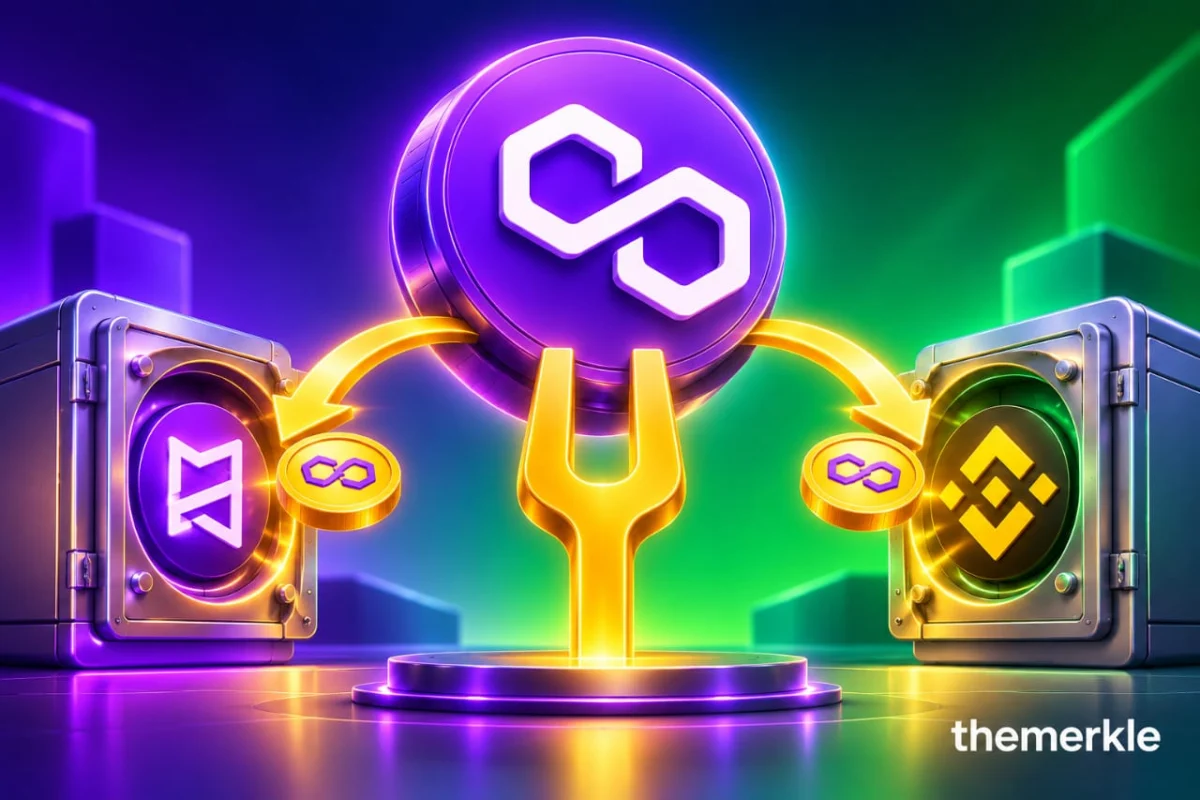
A Polygon governance proposal has been introduced, advocating for a hard fork of the blockchain to facilitate the recovery of 70.49 million POL tokens, valued at approximately $6.5 million, currently held in five blocked attacker addresses. These funds, linked to recent security incidents affecting decentralized prediction market Polymarket and leading cryptocurrency exchange Binance, are presently frozen on the Polygon PoS chain but cannot be returned to their rightful owners under the network’s existing architecture. The authors of the proposal, acknowledging the gravity of the action, have explicitly labeled it an "extreme measure," emphasizing that it should not be viewed as a template for future interventions. The initiative represents a critical juncture for Polygon’s decentralized governance, testing the community’s willingness to balance blockchain immutability with the pragmatic need for asset recovery in extraordinary circumstances. The proposal, which surfaced on November 4, was slated for discussion during the Polygon Protocol Governance Call on November 5 at 14:30 UTC, marking the initial step in a potentially transformative process for the Layer-2 network.
Background and Chronology of the Security Incidents
The genesis of this unprecedented proposal lies in two distinct yet related security incidents that occurred in quick succession. On October 29, the decentralized prediction market Polymarket experienced a security breach that resulted in a significant loss of native POL tokens. This was swiftly followed by a separate incident on October 30, affecting Binance, one of the world’s largest cryptocurrency exchanges. In both cases, stolen native POL tokens ultimately landed in specific attacker-controlled addresses on the Polygon Proof-of-Stake (PoS) chain.
Upon discovery of the breaches, both Polymarket and Binance promptly alerted the Polygon network. As an immediate protective measure, and at the explicit request of the victims, Polygon’s block producers took decisive action by adding these attacker addresses to the Bor transaction block list. Bor, which stands for "Borromean Ring," is Polygon’s block producer client, responsible for the execution of transactions and the creation of new blocks on the network’s EVM-compatible layer. This measure effectively froze the funds, preventing the attackers from moving the stolen assets any further. While this action successfully contained the immediate threat, it created a new challenge: the funds were trapped in a state of limbo, inaccessible to both the attackers and their rightful owners, necessitating a more comprehensive solution.
The Frozen Millions: A Deep Dive into the Affected Assets
The total value of the assets currently held in the five blocked addresses is approximately 70.49 million POL tokens. Based on the Polygon Improvement Proposal’s (PIP) reference price of $0.0924 per POL, this sum equates to roughly $6.5 million. It is important to note that cryptocurrency prices are highly volatile, and the real-time USD value may fluctuate. The proposal details the distribution of these frozen assets, identifying the specific victims and the addresses involved.
Of the total, approximately 23.86 million POL tokens are traceable back to the Polymarket incident. These funds are distributed across four distinct attacker-controlled addresses. The largest of these, identified as 0xe4C4C39C1733e1C7c06B79f97ED442B68Df41EC6, held a substantial 15,331,308.29 POL at mainnet block 96,399,251. Further analysis revealed that this primary address also transferred 3,282,275.71 POL to a secondary address in two separate native transfers on October 29, at 18:30:34 UTC and 18:35:59 UTC. The remaining Polymarket-linked funds are held in two other addresses, each containing approximately 4.3 million and 4.2 million POL, respectively. A fourth address, originally part of the Polymarket breach, now holds a negligible amount. Polymarket has publicly released its own post-mortem report on the incident, providing transparency and corroborating the on-chain data.
The larger portion of the frozen funds, approximately 46.63 million POL tokens, stems from the Binance incident. These tokens are concentrated in a single attacker-controlled address: 0x5227f603C1eE34CE3C06eFe6477003BDfCCB2f8c. The inflow path for these funds shows a Binance hot wallet sending 46,626,589.6 POL alongside 6,185,900.1 USDT to this address in block 96,406,484. A critical distinction here is that Tether, the issuer of USDT, was able to proactively freeze the stolen USDT tokens, rendering them immobile. This action effectively mitigated a significant portion of Binance’s loss, leaving the native POL tokens as the primary remaining asset at risk. The detailed on-chain traceability of these transactions, publicly inspectable via block explorers, forms a crucial pillar of the proposal’s legitimacy, demonstrating clear ownership and the path of the stolen funds.

Inadequacies of the Current Block List: Why a More Permanent Solution is Sought
While the immediate action of blocking the attacker addresses was effective in preventing further movement of the stolen POL, the proposal candidly highlights the significant limitations of this "stopgap" measure. The Bor transaction block list, as currently implemented, was not designed for long-term asset recovery and presents several technical and operational challenges that render it an unstable end state.
Firstly, the block list is static in nature. Each Polygon block producer client (Bor) reads its transaction block list only upon startup. This means that any update or modification to the list, such as adding or removing an address, necessitates a manual deployment of a new configuration and a subsequent restart or span rotation of the Bor client. This process is cumbersome, slow, and does not allow for dynamic, real-time adjustments, making it an inefficient defense against an active and persistent attacker.
Secondly, the entries on the block list have no automatic expiry. Once an address is added, it remains blocked indefinitely unless manually removed. This creates potential for long-term operational overhead and could lead to a bloated list over time, making maintenance increasingly complex.
Thirdly, and perhaps most critically, the filter’s coverage is not exhaustive. It only applies to outer senders and EIP-7702 authorities. This means it does not constitute a complete asset freeze. A sophisticated attacker, armed with sufficient technical knowledge and resources, might theoretically devise methods to bypass this partial filter, potentially through complex smart contract interactions or by leveraging obscure transaction types not covered by the existing mechanism.
Compounding these technical vulnerabilities is the demonstrated persistence and resourcefulness of the attacker. On October 30, a pending transaction with an unusually high fee of approximately 219,450 POL, equivalent to 10.45 POL per gas, was observed originating from one of the blocked addresses. This signals an active and determined attempt by the attacker to bypass the existing block. Furthermore, the proposal reveals a more alarming development: the attacker has reportedly contacted validators directly, offering cash incentives to help unblock their transactions. Such attempts at bribery pose a severe threat to the integrity and decentralization of the network, highlighting the precariousness of a defense reliant on human intervention and good faith. Polymarket’s proactive step of opening an on-chain recovery channel to the attacker via the SEAL Safe Harbor Recovery safe also yielded no response, underscoring the attacker’s unwillingness to return the funds voluntarily.
In light of these factors, the proposal argues convincingly that a defense mechanism dependent on every block producer manually restarting with an unmodified file, all while facing active bribery attempts, is fundamentally unstable and unsustainable. A more robust, programmatic solution is therefore deemed essential to permanently resolve the situation and recover the stolen assets.
The Proposed Hard Fork: Technical Implementation and Practicalities
The solution put forth in the Polygon Improvement Proposal (PIP) is a targeted hard fork, designed as a "narrow" and "surgical" intervention rather than a broad systemic change. The core mechanism involves a one-time state modification at a predefined activation block.

Specifically, at the start of this activation block, and crucially, before any transactions within that block are processed, the Polygon client software would execute a specific change: it would set the native POL balances of each of the five listed attacker addresses to zero. Simultaneously, an identical amount of POL would be credited to designated recovery addresses provided by Polymarket and Binance. This ensures that the total supply of POL tokens on the network remains unchanged, mitigating any inflationary or deflationary effects on the broader ecosystem. The scope of this intervention is also strictly limited; only native POL balances within the specified addresses are affected. Important components of the Polygon architecture, such as Heimdall (the consensus layer), the StakeManager contract (governing staking operations), and the bridge contracts (facilitating asset transfers between Polygon and other chains), are explicitly untouched, minimizing the risk of unintended consequences or systemic disruption.
However, implementing such a hard fork carries several practical consequences for the broader Polygon ecosystem. Because this change is a direct modification of the blockchain state rather than a standard transaction, external tools and services will need to adapt. Blockchain explorers, indexers, and accounting software that rebuild balances solely from transactional data will require special handling mechanisms to accurately reflect the new state. Without these updates, they would present an incorrect view of the affected addresses’ balances.
Crucially, the success of a hard fork hinges on widespread adoption by network participants. Nodes that do not upgrade their client software to the new version containing the hard fork logic will effectively follow a different chain from the activation block onwards. This could lead to a temporary chain split if a significant portion of the network fails to upgrade, though this risk is mitigated by the strong expectation of validator support. The proposal estimates a timeline of approximately two weeks following approval as a workable period for client development, rigorous testing, and a crucial rehearsal on the Amoy testnet (Polygon’s public test network). The authors express confidence that 70% to 80% of the network’s staked value will reach the required new version quickly after its release, which is essential for a smooth and uncontested transition. Finally, as an additional layer of security and accountability, each recovery address designated by Polymarket and Binance must formally prove control over its respective address before the activation of the hard fork.
Setting a Precedent: The "Extreme Action" Justification and its Caveats
The authors of the Polygon Improvement Proposal are acutely aware of the contentious nature of a hard fork to recover funds, an action that directly challenges the "code is law" ethos often associated with blockchain technology. To mitigate concerns about setting a dangerous precedent, they have meticulously laid out a stringent checklist of conditions that, in their view, collectively justify this "extreme action" as a rare exception.
These conditions are:
- Public Acknowledgment: The hacks are publicly acknowledged by the victims, Polymarket and Binance, adding a layer of transparency and credibility to the claims.
- Universal Blocking: Every block producer on the Polygon PoS network has already taken the initial step of blocking the attacker addresses, demonstrating a widespread consensus on the immediate threat and the legitimacy of the stolen funds.
- Meaningful Amount: The sum of 70.49 million POL, valued at approximately $6.5 million, is a substantial amount, distinguishing this incident from minor losses that might not warrant such an intervention.
- On-chain Traceability and Proposer Identity: The funds are clearly traceable on-chain to known victims, who are also the entities formally requesting the remedy. This provides irrefutable evidence of the theft and clear identification of the rightful owners.
- No Contested Claims: There are no known third parties with competing claims or disputes