The cryptocurrency market, known for its rapid ascents and equally swift reversals, has once again demonstrated its volatile nature through the recent performance of Pons, a token that briefly commanded over $1 million in daily revenue before witnessing a dramatic collapse to a mere fraction of that figure within a single month. This sharp downturn, evident across key operational metrics, casts a spotlight on the inherent fragilities within the bonding-curve launchpad model and the fierce competitive pressures in the nascent decentralized finance (DeFi) sector. An in-depth analysis of Pons’s own analytics dashboard on Dune reveals a trajectory that is less an isolated incident and more a cautionary tale of a business model grappling with market saturation, cooling demand, and the relentless arrival of well-resourced competitors.
The Meteoric Rise and Abrupt Fall: A Chronology of Pons
Pons launched on July 13, establishing itself as a new player in the increasingly crowded field of crypto launchpads. Its initial weeks were marked by an impressive growth trajectory, coinciding with a period of heightened activity on the underlying blockchain, here referred to as the "Robinhood Chain" – a rapidly expanding Layer-1 or Layer-2 network that became a focal point for new project deployments. The platform quickly capitalized on a market void created by the exit of a rival launchpad, Noxa, which ceased accepting new projects in July. This opportune moment allowed Pons to absorb displaced activity, cementing its position as a default venue for new token launches.
The project reached its zenith approximately six weeks post-launch, in late August. During this peak period, Pons recorded unprecedented daily metrics: daily tokens created soared to 36,449, daily trading volume approached an astounding $900 million, and daily revenue surpassed the $8 million mark. This period of intense activity also propelled the Pons token itself to an all-time high price of $0.97 on September 5, a remarkable achievement that reflected investor confidence fueled by the platform’s robust revenue generation and its strategic tokenomics.
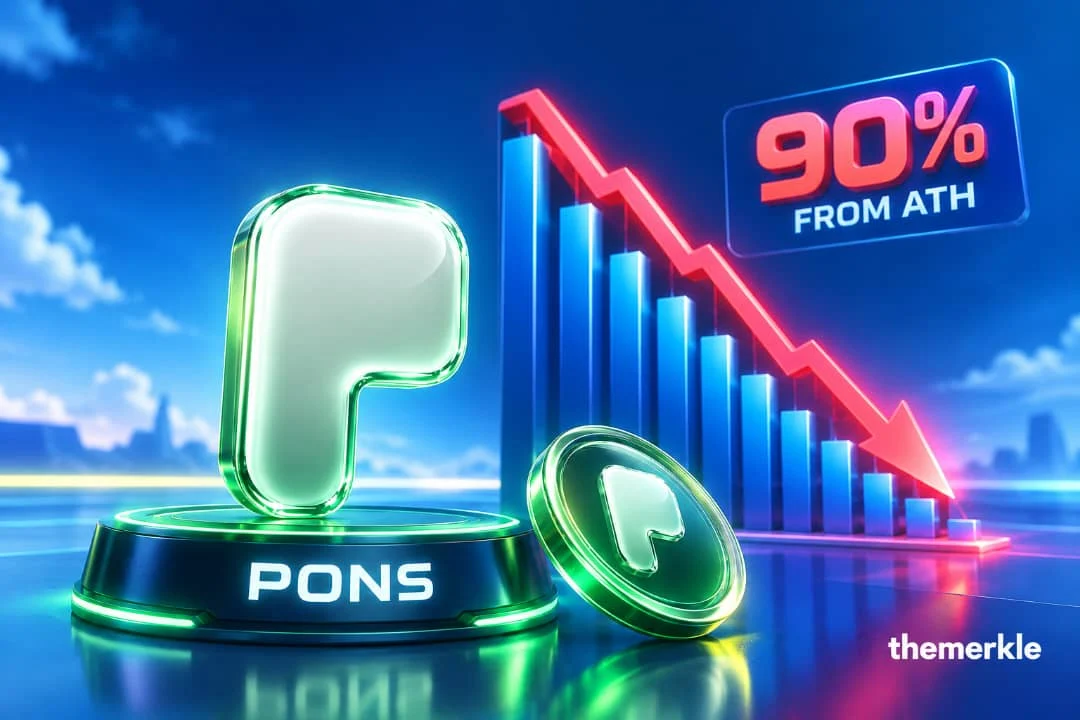
However, the euphoria proved to be short-lived. The very same week Pons hit its price peak, its underlying operational metrics were already exhibiting signs of severe strain. By early September, the platform’s daily tokens created had plummeted by nearly 80%, settling into a range of 6,000 to 7,600. Daily trading volume mirrored this decline, falling to between $100 million and $190 million—an 80-90% reduction from its peak. Most critically, daily revenue, the lifeblood of the protocol, collapsed from over $8 million to a mere $1 million to $2 million, representing a staggering 80-90% contraction. The protocol’s direct revenue, a darker shaded band in the analytics, shrank even faster proportionally, confirming a reported 90% drop from its all-time high. This synchronized decline across all core metrics—token creation, trading volume, and revenue—underscored a fundamental demand problem, impacting every facet of the Pons ecosystem.
Understanding the Core Business Model: Bonding-Curve Launchpads

To fully grasp the dynamics behind Pons’s performance, it is crucial to understand the mechanics of bonding-curve launchpads. These platforms facilitate the initial distribution and price discovery of new tokens through an automated market-making mechanism. Unlike traditional initial coin offerings (ICOs) or initial decentralized exchange offerings (IDOs) with fixed prices or auction models, bonding curves operate on a predefined mathematical formula. As more tokens are bought, their price increases along the curve; conversely, as tokens are sold, the price decreases. This mechanism provides continuous liquidity and instant price discovery from the moment of launch.
For platforms like Pons, revenue is primarily generated through transaction fees on these newly launched tokens. The higher the volume of new token creation and subsequent trading activity, the greater the revenue for the launchpad. This model is highly attractive in bull markets or periods of intense speculative interest, as it allows for rapid deployment of projects and immediate trading. However, its dependency on sustained high levels of new project launches and speculative trading activity also exposes it to significant vulnerabilities when market sentiment shifts or competition intensifies. The "Robinhood Chain’s" rapid growth provided a fertile ground for such a model, attracting a deluge of projects and eager investors, but this environment proved transient.
The Inevitable Arrival of Competition: Uniswap’s Disruptive Entry
One of the most immediate and impactful factors contributing to Pons’s decline was the swift arrival of formidable competition. In August, roughly a month after Pons’s launch, Uniswap, a titan in the decentralized exchange (DEX) space with immense brand recognition and an established user base, launched its own launchpad functionality on the Robinhood Chain. This move was particularly devastating because Uniswap managed to out-launch Pons on its very first day of operation, directly challenging Pons’s hard-won position as the default launch venue.
The incident starkly illustrates the delicate balance of loyalty and market share in the crypto ecosystem. Pons had diligently built its momentum over several weeks, benefiting from a temporary vacuum. However, the entry of a well-established player like Uniswap, leveraging its existing infrastructure and brand trust, was enough to immediately fragment the market and divert significant activity. This competitive pressure highlights a core vulnerability of launchpads: their "default venue" status is often fleeting, highly dependent on market conditions, and easily disrupted by larger entities with superior distribution channels and brand equity. The market, driven by efficiency and liquidity, demonstrates minimal loyalty to platforms that do not offer a distinct, unassailable advantage.
The "Graduation" Dilemma: A Measure of Real Value or Fleeting Hype?
A deeper dive into the operational metrics reveals another critical flaw in the launchpad ecosystem: the low "graduation" rate of projects. While Pons reported an astonishing lifetime launch count ranging from 124,000 to over 500,000 projects (depending on the source), a staggering reality emerges: only approximately 1% of these projects ever reached "graduation." Graduation, in this context, signifies that a token has cleared a predetermined liquidity threshold, enabling it to trade normally on the platform. Even more concerning, the platform’s own documentation reportedly indicates that graduation is not inherently a quality signal, further diminishing its perceived value.

This low graduation rate is not merely a statistical anomaly; it has profound implications for the launchpad’s long-term revenue sustainability. Revenue on a bonding-curve launchpad is predicated on continuous trading activity, both pre- and post-graduation. The dashboard’s data, showing a massive spike in daily token creation (36,449 tokens in a single day) that was not met with a proportional or lasting rise in revenue, directly supports this observation. Most of this frenetic activity produced only a burst of early trading fees, after which the projects often went dormant. This pattern is characteristic of a market fueled by "new-token mania"—a speculative frenzy where participants chase the next big thing, generating initial excitement and trading volume, but failing to sustain long-term engagement or build viable projects. When this mania cools, as it inevitably does, the revenue stream for platforms heavily reliant on such ephemeral activity dries up rapidly.
The Treasury and Burn Mechanic: A Double-Edged Sword
Pons implemented a common yet powerful tokenomic mechanism: a significant portion of its protocol fee revenue was allocated to a Treasury, which then executed buybacks and burns of the native PONS token. As of early September, this mechanism had resulted in the burning of approximately 288 million PONS tokens, representing about 29% of the total supply of one billion. This aggressive supply reduction strategy was a major catalyst for the PONS token’s ascent to its all-time high price of $0.97 on September 5. The narrative of increasing scarcity, driven by constant buybacks and burns, created strong upward price pressure, even as the underlying volume and revenue charts were already showing signs of decline from their late-August peaks.
However, this "flywheel" mechanism is inherently reliant on a steady and substantial flow of protocol revenue. When revenue slows down, the buyback engine decelerates proportionally. Less daily revenue translates to smaller buybacks, which in turn leads to a slower burn rate. This erosion of the scarcity narrative directly undermines the very factor that propelled the token’s price upwards. The interconnectedness of revenue and price support means that this mechanism cuts both ways, amplifying gains during periods of growth but accelerating declines when revenue falters. The sharp drop in protocol revenue, therefore, directly impacted the PONS token’s ability to maintain its price, leading to a swift correction.
Broader Implications for the Launchpad Ecosystem
The experience of Pons serves as a critical case study for the broader economics of bonding-curve launchpads and, by extension, the entire crypto launchpad sector. These platforms are demonstrably highly responsive to prevailing market narratives and the growth of specific blockchain ecosystems. The synchronized peaking of Pons’s token creation and volume charts with record activity on the Robinhood Chain highlights this direct correlation. When chain-wide activity experiences even a slight cooling, a launchpad that captures a percentage of that activity feels the impact immediately and disproportionately. All three core metrics—token creation, volume, and revenue—fall in lockstep, as vividly illustrated by the analytics dashboard.
This volatility underscores the speculative nature of many new token launches and the difficulty of building sustainable business models solely on the back of primary issuance and initial trading fees. The market’s "attention economy" dictates that platforms must constantly innovate and offer compelling value propositions beyond simply being a conduit for new tokens.

Furthermore, the valuation angle is worth noting. Even after the severe revenue decline, PONS was reportedly trading at a multiple of its trailing annualized protocol revenue that remained elevated compared to its closest peers. A 90% drop in daily revenue without a corresponding, equivalent drop in the token’s market capitalization would leave PONS looking significantly overvalued relative to its actual earnings. This disconnect between price and underlying revenue can lead to further downward pressure as investors re-evaluate the token’s fair value in light of reduced profitability.
Market Reactions and Future Outlook
The dramatic fall of Pons will undoubtedly trigger reassessments among investors and project developers alike. For investors, it reinforces the need for rigorous due diligence, moving beyond mere hype and scrutinizing the sustainability of a project’s underlying business model, its competitive moat, and the long-term viability of its tokenomics. For project developers considering launchpad options, it emphasizes the importance of choosing platforms that offer more than just initial liquidity—perhaps those with stronger community engagement, robust post-launch support, or innovative features that foster genuine project growth rather than just speculative trading.
From a regulatory perspective, such extreme volatility and the potential for rapid investor losses could attract increased scrutiny. Regulators globally are already grappling with how to classify and oversee various crypto assets and services, and the "new-token mania" facilitated by launchpads presents a complex challenge.
In conclusion, Pons’s journey from a revenue powerhouse to a shadow of its former self in a matter of weeks is a stark reminder of the inherent risks and rapid evolutionary pace of the cryptocurrency market. It highlights the critical importance of a robust competitive strategy, a sustainable value proposition beyond mere speculation, and resilience against market shifts for any project aiming for long-term success in this dynamic industry. The episode serves as a vital lesson, not just for Pons, but for the entire decentralized finance ecosystem, underscoring that even in the most innovative corners of finance, fundamental economic principles eventually prevail.