



The long-anticipated Ethereum Merge has fundamentally reshaped the cryptocurrency landscape, but for the global army of miners who once powered the second-largest blockchain, the transition has triggered a severe economic crisis. Following Ethereum’s successful migration from a Proof-of-Work (PoW) to a Proof-of-Stake (PoS) consensus mechanism, the sudden displacement of an immense amount of hashing power has caused mining profitability for virtually all other GPU-minable altcoins to crater. As thousands of miners migrate their hardware to alternative networks, the resulting explosion in network difficulty has rendered the act of mining commercially unviable for the average participant.
The Mechanics of the Post-Merge Migration
For years, Ethereum served as the primary ecosystem for GPU (Graphics Processing Unit) mining. Unlike Bitcoin, which transitioned to specialized ASIC (Application-Specific Integrated Circuit) hardware long ago, Ethereum remained accessible to miners using consumer-grade video cards. This created a massive global industry comprising both industrial-scale data centers and home-based hobbyists.
When the "Merge" occurred on September 15, 2022, Ethereum eliminated the need for miners entirely, replacing them with "validators" who secure the network by locking up (staking) ETH tokens. This transition effectively "fired" a workforce that controlled hundreds of terahashes of computing power. Deprived of their primary revenue stream, these miners faced a binary choice: liquidate their expensive hardware or point their machines toward other PoW blockchains such as Ethereum Classic (ETC), Ravencoin (RVN), Ergo (ERG), or Flux (FLUX).
The sheer scale of the Ethereum network meant that its hashrate was magnitudes larger than all other GPU-minable coins combined. When this massive wave of computing power "washed ashore" on smaller networks, it didn’t just increase competition; it overwhelmed them.
Analyzing the Cratered Profitability of Popular Altcoins
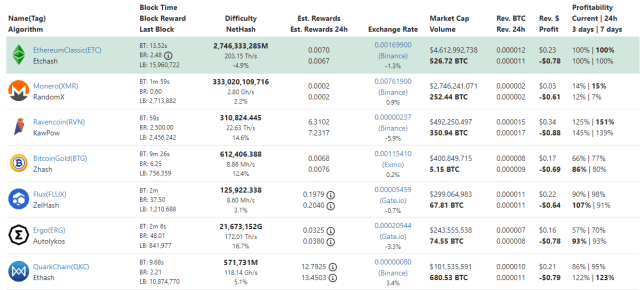
Data from cryptocurrency mining calculators, including industry-standard platforms like WhatToMine, paints a grim picture for the post-Merge mining economy. As of the latest market assessments, almost no popular PoW cryptocurrency currently offers positive returns when accounting for electricity costs.

Ethereum Classic (ETC), which was widely considered the most logical destination for former ETH miners due to its compatible hashing algorithm (Etchash), has seen its network difficulty skyrocket. Current data indicates that an average miner using a rig of three AMD RX 480 graphics cards—a once-standard setup—is generating a net profit of approximately -$0.78 per hour. This calculation assumes a relatively conservative electricity cost of $0.10 per kilowatt-hour (kWh).
Even those equipped with high-end, flagship hardware are not immune to the downturn. A miner utilizing the NVIDIA GeForce RTX 3090 Ti, one of the most powerful consumer GPUs on the market, is still seeing hourly profits in the negative, hovering around -$0.50. These figures suggest that unless a miner has access to near-free electricity or is "speculative mining" (holding coins in the hope of a massive future price increase), they are effectively paying the network to participate rather than earning an income.
The Role of Network Difficulty and Hashrate Saturation
To understand why profits have turned negative, one must look at the "difficulty adjustment" mechanism inherent in PoW blockchains. These networks are designed to produce blocks at a constant interval (e.g., every 13 seconds for Ethereum Classic). To maintain this schedule, the network automatically increases the mathematical difficulty of mining as more computing power (hashrate) joins the chain.
When the Merge occurred, the hashrate for Ethereum Classic surged by over 280% in a matter of hours. Because the price of the ETC token did not experience a corresponding 280% increase, the rewards distributed to miners became spread too thin. The "pie" remained the same size, but the number of people trying to eat a slice increased tenfold. This hashrate saturation has created a "race to the bottom" where only those with the most efficient hardware and the lowest possible energy overhead can survive.
A Timeline of the Ethereum Transition
The path to this mining crisis was paved over several years, characterized by multiple delays and technical milestones:
- December 2020: The Beacon Chain (the PoS layer) is launched, running in parallel with the original PoW Ethereum chain.
- August 2021: The London Hard Fork introduces EIP-1559, which begins burning a portion of miner fees, already signaling a squeeze on miner revenue.
- June 2022: The Sepolia and Ropsten testnets successfully complete their merges, proving the viability of the transition.
- August 2022: The "Difficulty Bomb" is delayed one last time to ensure a smooth transition, and the Terminal Total Difficulty (TTD) is set.
- September 15, 2022: The Merge is finalized at block 15,537,393. Ethereum mining officially ceases, and the "Great Migration" of hashrate begins.
- Post-Merge Week One: Hashrates on ETC, RVN, and ERGO hit all-time highs, while profitability indices across the board drop below the break-even point.
Industry Reactions and the Secondary Market Impact
The reaction from the mining community has been a mixture of resignation and strategic pivoting. Major industrial mining firms had already begun diversifying their operations months in advance. Some pivoted to high-performance computing (HPC) and artificial intelligence (AI) rendering, utilizing their GPU clusters for tasks other than blockchain verification.

However, for the small-to-medium-scale miner, the options are more limited. This has led to a significant influx of used graphics cards on secondary markets like eBay and StockX. Prices for GPUs, which were once inflated by thousands of dollars due to the mining boom, have plummeted to MSRP or below. While this is a boon for the PC gaming community, it represents a massive loss of capital for miners who purchased hardware at peak prices during the 2021 bull run.
Some mining advocates have attempted to keep the PoW dream alive on the Ethereum chain by "forking" the network. This resulted in the creation of EthereumPoW (ETHW). However, without the support of major decentralized finance (DeFi) protocols or stablecoin issuers like Tether (USDT) and Circle (USDC), these forked chains have struggled to maintain value, further contributing to the lack of profitability for those mining them.
Broader Implications for the Crypto Ecosystem
The death of profitable GPU mining on Ethereum has several long-term implications for the broader cryptocurrency industry:
1. Environmental Narrative: The most immediate impact is the reduction in global energy consumption. Ethereum’s transition to PoS is estimated to have reduced the network’s electricity usage by 99.95%. For institutional investors who are sensitive to Environmental, Social, and Governance (ESG) criteria, this makes Ethereum a much more attractive asset.
2. Security Centralization Concerns: Critics of Proof-of-Stake argue that it leads to centralization, as those with the most capital (the largest stakers) hold the most power. Conversely, Proof-of-Work enthusiasts argue that the "physical" cost of mining provides a more robust security model. With PoW mining now concentrated in a few smaller coins, the security of those coins is under scrutiny, as a sudden withdrawal of hashrate could make them vulnerable to 51% attacks.
3. The Search for the "Next Ethereum": The market is currently in a discovery phase. For a PoW coin to become profitable again, one of two things must happen: either a significant portion of the current hashrate must go offline (miners turning off their machines), or the price of an altcoin like ETC or Ravencoin must increase exponentially to match the current difficulty levels.
Future Outlook: Is GPU Mining Dead?
At the time of writing, the price of Ether (ETH) continues to experience volatility, trading around the $1,400 mark—a roughly 6% decline over the past week. This price action suggests that the "sell the news" event following the Merge, combined with broader macroeconomic pressures like rising interest rates and inflation, has suppressed the entire crypto market.
For the mining sector, the current period is being described by many as a "winter of Darwinian proportions." Only the most efficient operations—those located in regions with abundant stranded energy or government subsidies—are likely to survive. The era of the "home miner" making a passive income from a single gaming PC appears to have reached its conclusion.
While it is possible that a new Proof-of-Work project could emerge with a breakthrough use case or that an existing coin could see a massive speculative pump, the current data is undeniable. The "Merge" has not just changed Ethereum; it has effectively dismantled the economic foundation of the GPU mining industry. For now, the hardware that once secured billions of dollars in digital wealth is either gathering dust, being sold for parts, or running at a loss in hopes of a miracle.














