


The landscape of cryptocurrency mining underwent a seismic shift following the successful execution of the Ethereum Merge, an event that transitioned the world’s second-largest blockchain from a Proof-of-Work (PoW) consensus mechanism to Proof-of-Stake (PoS). While the transition was hailed as a monumental achievement for environmental sustainability—reducing the network’s energy consumption by more than 99.9%—it simultaneously triggered an existential crisis for the global community of GPU (Graphics Processing Unit) miners. Within hours of the Merge, the profitability of mining alternative PoW cryptocurrencies plummeted into negative territory, leaving millions of dollars’ worth of hardware effectively obsolete in the current market environment.
For years, Ethereum served as the primary sanctuary for GPU miners, offering a combination of high block rewards and a massive market capitalization that could absorb vast amounts of computational power. With the transition to PoS, Ethereum no longer requires miners to solve complex mathematical puzzles to secure the network; instead, validators stake ETH to participate in consensus. This shift abruptly displaced a hashrate that was estimated to be nearly 900 Terahashes per second (TH/s) prior to the upgrade. Consequently, a "Great Migration" began as miners sought refuge in "ASIC-resistant" altcoins such as Ethereum Classic (ETC), Ravencoin (RVN), Ergo (ERG), and Flux. However, the sheer volume of this displaced hashrate has overwhelmed these smaller networks, leading to a total collapse in mining economics.
The Mechanics of the Profitability Crater
The fundamental issue facing the mining industry is the relationship between hashrate, mining difficulty, and coin price. In a Proof-of-Work system, the network’s difficulty adjusts dynamically to ensure that blocks are produced at a consistent interval, regardless of how much computing power is directed at the chain. When the massive influx of former Ethereum miners flooded into smaller chains, the hashrate on those networks spiked to unprecedented levels.
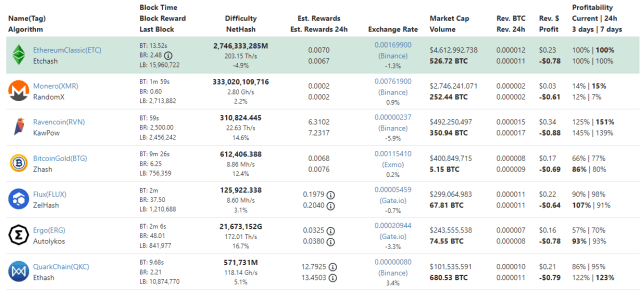
For example, Ethereum Classic (ETC) saw its hashrate surge from roughly 50 TH/s to over 200 TH/s in the immediate aftermath of the Merge. Because the market price of ETC did not experience a commensurate 400% increase, the rewards distributed to each individual miner were diluted. According to data from the mining profitability aggregator WhatToMine, the current daily returns for even the most efficient hardware are now lower than the cost of the electricity required to run them.

Calculations based on an average electricity cost of $0.10 per kilowatt-hour (kWh) reveal a grim reality. A setup utilizing three AMD Radeon RX 480 graphics cards—a once-standard mid-range mining rig—now nets a daily profit of approximately -$0.78 per hour. Even miners equipped with top-tier hardware, such as the NVIDIA GeForce RTX 3090 Ti, are finding themselves in the red, with estimated losses of roughly $0.50 per hour. These figures do not account for secondary costs such as cooling, maintenance, or the depreciation of the hardware itself, suggesting that the true losses for industrial-scale operations are likely even higher.
A Timeline of the Transition and Market Reaction
The road to this profitability collapse was paved over several years, but the final descent was rapid.
- The Beacon Chain Launch (December 2020): The introduction of the PoS layer of Ethereum marked the beginning of the end for ETH mining, though miners enjoyed record profits throughout 2021 as prices soared.
- The Bellatrix Upgrade (September 6, 2022): This final preparatory step signaled that the Merge was imminent, prompting some large-scale mining farms to begin liquidating their GPU inventories or testing alternative chains.
- The Merge Execution (September 15, 2022): At approximately 06:42 UTC, the Merge was completed. Within minutes, Ethereum’s hashrate dropped to zero, and the "hashrate overflow" began to hit other PoW networks.
- The Difficulty Adjustment (September 16–18, 2022): As the difficulty on networks like ETC and Ravencoin adjusted to the new, massive hashrate, mining rewards per unit of compute power fell by as much as 80-90%.
- The Current Stasis: The market has entered a period of "miner capitulation," where only those with near-zero electricity costs or those speculating on future price increases continue to operate.
Industry experts had long warned of this "Post-Merge Hangover." While proponents of Ethereum Classic argued that the chain would inherit Ethereum’s legacy, the economic reality is that ETC’s market cap—roughly $5 billion at the time of the Merge—is insufficient to support the $190 billion valuation’s worth of mining infrastructure that previously secured Ethereum.
Stakeholder Responses and Market Shifts
The reaction from the mining community has been a mixture of pragmatism and frustration. Major mining pools, such as Ethermine, the world’s largest Ethereum pool, chose not to support PoW forks and instead launched staking services. In an official statement, Ethermine noted that "the mining phase of Ethereum has come to an end," and encouraged users to transition to other chains or join their new staking pool.
Meanwhile, some miners attempted to resist the transition by supporting "ETHW" (Ethereum PoW), a hard fork of the Ethereum chain that intended to maintain the mining consensus. However, ETHW has struggled with technical glitches, a lack of ecosystem support, and a rapidly declining token value, further complicating the prospect of profitable mining.

Hardware manufacturers like NVIDIA and AMD are also feeling the ripple effects. For the first time in years, the secondary market is flooded with used GPUs, often sold at a fraction of their original MSRP. Gamers, who were priced out of the market for years by mining demand, are finally seeing relief, but the tech giants are facing a significant revenue shortfall as their "CMP" (Crypto Mining Processor) lines become redundant.
Broader Implications for the Future of PoW
The current state of negative profitability raises a critical question: Is GPU mining dead? In the short term, the answer appears to be a resounding yes for the vast majority of participants. For mining to become profitable again, one of two things must happen: either the market price of alternative PoW coins must increase by several hundred percent, or a significant portion of the global hashrate must go offline permanently, lowering the difficulty for those who remain.
There is also a growing discussion regarding "Proof of Useful Work" (PoUW). Some projects are exploring ways to utilize the immense computational power of GPUs for tasks other than hashing, such as AI model training, 3D rendering, or scientific simulations. Platforms like Flux and Render are at the forefront of this movement, aiming to provide a decentralized alternative to cloud providers like AWS. If these platforms can successfully monetize GPU compute for real-world applications, they may provide a lifeline for the millions of idle graphics cards currently gathering dust.
Technical Analysis of the "Death Spiral" Risk
The collapse in profitability also introduces security risks to smaller PoW chains. When mining becomes unprofitable, miners leave the network. If a significant percentage of the hashrate exits, the network’s total security (measured in the cost to perform a 51% attack) decreases. This creates a precarious situation:
- Miners leave due to low profits.
- The network becomes easier to attack.
- Exchanges and users lose confidence in the coin’s security.
- The coin price drops further, making mining even less profitable.
This "death spiral" is a major concern for chains like Ergo and Ravencoin. To combat this, some developers are looking into more aggressive difficulty adjustment algorithms that can respond faster to hashrate volatility.
Conclusion
The Ethereum Merge was a triumph of engineering, but for the mining sector, it was a "black swan" event that destroyed the most profitable avenue for GPU-based computation. As Ethereum Classic and its peers struggle to absorb the displaced hashrate, the industry is entering a period of painful consolidation.
Currently, the data from WhatToMine and other analytical tools paints a clear picture: the era of "easy" home mining is over. Unless there is a dramatic shift in the valuation of the remaining Proof-of-Work assets, the mining rigs that once powered the decentralized finance revolution on Ethereum may find their new home in the recycling bin or in the PCs of budget-conscious gamers. The crypto mining industry has been forced into a "survival of the fittest" scenario, where only those with the most efficient hardware and the lowest possible energy costs can hope to weather the storm. For the rest, the Merge was not just a network upgrade—it was the end of an era.














