
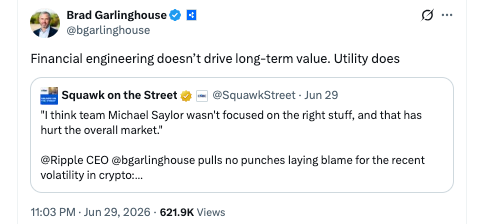
Ripple CEO Brad Garlinghouse has launched a pointed critique of Michael Saylor’s persistent and aggressive Bitcoin acquisition strategy, branding it as "financial engineering" that is detrimental to the long-term health of the cryptocurrency market. Garlinghouse’s remarks, disseminated via his X (formerly Twitter) account, come at a time when Bitcoin is experiencing significant price fluctuations, having recently dipped below the $58,000 mark after failing to maintain its hold above the crucial $60,000 support level. This downturn occurs despite substantial Bitcoin purchases by Saylor’s company, Strategy, in recent months, purchases that were intended to bolster the bullish narrative for the flagship cryptocurrency.
Garlinghouse’s commentary suggests that Saylor’s approach, which reportedly involves leveraged preferred-stock financing for Bitcoin acquisitions, is exacerbating market volatility rather than fostering sustainable growth. This sentiment aligns with a growing chorus of voices within the crypto industry who are urging Saylor to reconsider his high-stakes Bitcoin accumulation strategy. The Ripple CEO’s public statement not only questions the efficacy of Saylor’s methods but also implies that they are contributing to the current market pressures faced by Bitcoin and, by extension, the broader digital asset ecosystem.
The current market sentiment surrounding Bitcoin is characterized by bearish pressure, with analysts closely monitoring the ability of bulls to reclaim lost ground. The digital asset’s market capitalization, while still the largest among cryptocurrencies, is facing headwinds that could lead to further price declines if not effectively countered. This situation casts a shadow over Strategy’s massive Bitcoin holdings, which have grown to over 673,000 BTC, accumulated through a series of significant purchases, including a recent $116 million acquisition to kick off the new year.
Strategy’s Financial Maneuvers Under Scrutiny
Michael Saylor, the co-founder and executive chairman of Strategy, has long been an outspoken advocate for Bitcoin as a store of value and a hedge against inflation. His company has aggressively pursued a strategy of acquiring vast quantities of Bitcoin, often utilizing debt financing and equity offerings. This approach has positioned Strategy as one of the largest corporate holders of Bitcoin globally. However, critics argue that this strategy, while impressive in its scale, relies on complex financial instruments that amplify both gains and losses, thereby contributing to the inherent volatility of the cryptocurrency market.

Garlinghouse’s specific accusation of "financial engineering" points to the perceived artificiality of Saylor’s buying pressure. He suggests that instead of organic demand driving Bitcoin’s price, it is the financial machinations of companies like Strategy that are artificially propping up the market. This, according to Garlinghouse, is not conducive to long-term market stability or widespread adoption. The Ripple CEO’s perspective is that a healthy cryptocurrency market should be driven by genuine utility and widespread adoption, not by the leveraged bets of a few large entities.
The Broader Impact of Saylor’s Strategy
The implications of Strategy’s large-scale Bitcoin purchases extend beyond the company’s balance sheet. As a significant player in the market, Strategy’s actions can influence price discovery and market sentiment. When Strategy acquires Bitcoin, it creates demand, potentially driving up the price. Conversely, if Strategy were ever forced to sell its holdings due to financial pressures or a change in strategy, it could trigger significant downward price movements.
This is particularly concerning given the substantial liabilities that Strategy has reportedly accumulated to finance its Bitcoin acquisitions. Reports suggest that these liabilities now exceed $1 billion, stemming from equity offerings and debt instruments used to fund the purchases. The pressure to manage these financial obligations, especially in a volatile market, could lead to difficult decisions regarding its Bitcoin reserves.
A Shift in Narrative?
Adding another layer to the ongoing discussion, Saylor himself recently posted a tweet that appeared to signal a departure from his previously unwavering "never sell" stance. While not explicitly stating an intention to sell, the tweet alluded to the possibility of adjusting the company’s Bitcoin holdings under certain circumstances. This subtle shift in messaging, if it indicates a genuine change in policy, has been met with both skepticism and mockery from segments of the crypto community. Many X users have pointed out the perceived inconsistency with Saylor’s long-held maximalist Bitcoin advocacy, viewing it as a pragmatic, albeit late, recognition of the risks involved.
This perceived flip-flop has fueled discussions about the sustainability of Strategy’s Bitcoin-centric business model and its impact on the broader cryptocurrency landscape. The market’s reaction to such potential shifts in holdings by major players can be profound, underscoring the sensitivity of the crypto market to the actions of its largest stakeholders.
Counterarguments and Industry Reactions
While Garlinghouse’s criticism has resonated with some, it has also drawn fire from other corners of the crypto community. Supporters of Saylor’s strategy often point to the fact that his substantial Bitcoin holdings have helped to legitimize Bitcoin as an institutional asset class. They argue that Strategy’s consistent buying pressure has provided a degree of stability and a consistent bullish narrative, which is crucial for attracting further institutional investment.
However, critics, including Garlinghouse, argue that this stability is illusory and that the underlying financial engineering creates a fragile ecosystem. They contend that true long-term growth should stem from the adoption of blockchain technology and the development of decentralized applications, rather than from speculative asset accumulation.
The XRP Factor and Industry Rivalries
It is also noteworthy that Garlinghouse, as CEO of Ripple, is a direct competitor to Bitcoin in certain aspects, particularly in the realm of payment solutions. Ripple’s XRP token, while facing its own set of challenges and regulatory hurdles, aims to facilitate cross-border payments. Therefore, Garlinghouse’s critique of Bitcoin’s dominance and volatility could be seen, in part, as an attempt to highlight the perceived weaknesses of Bitcoin and, by extension, promote the advantages of alternative digital assets and payment networks.
The criticism leveled at Garlinghouse by some X users highlights this underlying industry dynamic. These users have reminded the Ripple CEO that XRP itself has experienced significant price declines and faces its own criticisms regarding centralization and adoption. This exchange underscores the inherent rivalries and differing strategic visions within the rapidly evolving cryptocurrency space.
Bitcoin’s Current Market Position
As of the latest reports, Bitcoin is trading in a precarious position, struggling to regain its footing above the $58,000 level. The cryptocurrency has been unable to sustain rallies above the $60,000 psychological barrier, indicating a prevailing bearish sentiment. This comes after a period of significant growth and renewed institutional interest, fueled in part by the approval of spot Bitcoin ETFs in the United States earlier this year.

The recent price action suggests that the market may be re-evaluating the sustainability of the current price levels, especially in light of macroeconomic factors and the ongoing debate about the intrinsic value and long-term prospects of digital assets. The ability of Bitcoin to overcome current resistance levels will be crucial in determining its trajectory in the coming weeks and months.
The Path Forward for Strategy and the Crypto Market
Michael Saylor and Strategy face a critical juncture. The company’s massive Bitcoin holdings represent both its greatest asset and its most significant liability. The company’s future success will depend on its ability to navigate the volatile cryptocurrency market, manage its substantial debt obligations, and adapt its strategy in response to evolving market conditions and regulatory landscapes.
The debate initiated by Brad Garlinghouse’s comments highlights a fundamental tension within the cryptocurrency industry: the balance between aggressive asset accumulation and sustainable, utility-driven growth. As the market matures, the efficacy of different strategies will be put to the test, and the long-term impact of approaches like Saylor’s will become increasingly clear. The coming months will likely be a period of intense scrutiny for Strategy and a crucial test for the resilience and adaptability of the broader cryptocurrency ecosystem.