


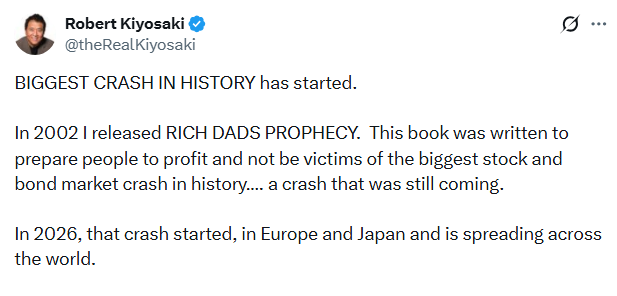
Capital markets may face a period of significant volatility and potential distress, according to a stark warning issued by Robert Kiyosaki, a globally recognized authority on personal finance and investing. In a recent public statement, the acclaimed author of "Rich Dad Poor Dad" expressed his conviction that a substantial financial crash is on the horizon, impacting both bond and stock markets, with potentially devastating consequences if not proactively addressed. This forecast arrives as data indicates a burgeoning interest in Spot Bitcoin Exchange-Traded Funds (ETFs), a trend Kiyosaki highlighted within his broader economic outlook.
The Looming Specter of a Global Financial Crisis
Kiyosaki’s latest pronouncements build upon earlier concerns he voiced regarding the stability of global financial systems. He articulated that the beginnings of a major market downturn in stocks and bonds have already commenced, with its most profound effects anticipated to manifest over the course of the coming year. He posited that the economic contraction, which he believes has already begun in earnest in 2026, is exhibiting early signs in key international markets. Specifically, he pointed to financial markets in Japan and Europe as indicators of a widening recessionary trend that is progressively permeating the global economy.
This sentiment echoes prophecies Kiyosaki made in his 2002 book, "Rich Dad’s Prophecy," where he presciently warned of a severe slump in stock and bond markets. His recent commentary suggests that the conditions he foresaw are now materializing in 2026, with the potential for a cascading global impact. Several complex factors, he identified, are converging to fuel this impending economic storm. These include the speculative frenzy surrounding Artificial Intelligence (AI), escalating geopolitical tensions in the Middle East, the persistent rise in government debt levels across major economies, and the demographic shift of the Baby Boomer generation entering retirement, which could place additional strain on pension systems and consumer spending.
Analyzing the Contributing Factors to Economic Downturn
The confluence of these macroeconomic and geopolitical forces creates a volatile environment for investors. The AI craze, while promising technological advancement, has also fueled significant speculative investment, potentially inflating asset bubbles that are susceptible to sharp corrections. Simultaneously, ongoing conflicts and instability in regions like the Middle East disrupt global supply chains, increase energy prices, and heighten economic uncertainty, leading to a risk-off sentiment among investors.
The substantial accumulation of government debt by nations worldwide presents a long-term challenge. As interest rates rise, servicing this debt becomes increasingly expensive, potentially diverting funds from essential public services and economic stimulus. This can lead to fiscal austerity measures or further rounds of quantitative easing, both of which carry their own economic risks. Furthermore, the aging global population, characterized by the Baby Boomer generation’s transition into retirement, is a significant demographic trend. This shift can lead to reduced labor force participation, increased demand for healthcare and social security, and a potential decrease in aggregate demand, all of which can impact economic growth and market performance.
Kiyosaki’s warning specifically targets investors holding retirement savings in accounts such as 401(k)s, Individual Retirement Arrangements (IRAs), Superannuation funds in Australia, and Registered Retirement Savings Plans (RRSPs) in Canada. He drew a historical parallel to the Great Depression, a period of profound economic hardship that spanned from 1929 to 1954. During that era, the stock market crash in the United States precipitated a global economic catastrophe, leading to widespread unemployment and financial ruin for many.
However, Kiyosaki also highlighted that periods of severe economic distress can present unique opportunities for those who are adequately prepared. He noted that even amidst the devastation of the Great Depression, notable figures such as the Kennedy family, Walter Chrysler, and William Boeing were able to significantly expand their wealth. This historical context underscores his belief that strategic preparation and investment in robust assets can not only mitigate losses but also foster wealth accumulation during challenging economic times.
Bitcoin and ETFs: A Potential Haven Amidst Uncertainty?
In light of the anticipated economic turbulence, Kiyosaki has consistently advocated for specific asset classes as crucial components of a recession-resilient investment strategy. He prominently features gold, silver, and Bitcoin, alongside profitable real estate and private businesses, as key instruments he personally utilizes to safeguard his financial well-being against economic downturns.
His commentary arrives at a pivotal moment for Bitcoin and its related financial products. Spot Bitcoin ETFs have recently experienced a resurgence in investor interest, coinciding with rising market and monetary risks globally. Data from financial markets indicates that Bitcoin-focused ETFs are demonstrating considerable traction within the broader ETF landscape, signaling their growing importance as an investment vehicle for a diverse range of investors. This trend is particularly noteworthy as these ETFs offer a regulated and accessible way for traditional investors to gain exposure to Bitcoin without the complexities of direct digital asset ownership.
Market analysis suggests that this heightened demand for Bitcoin and Bitcoin-related investments is partly driven by what is known as the "debasement trade." This phenomenon occurs when governments resort to printing excessive amounts of money to finance deficits or stimulate their economies. Such actions can lead to the erosion of the purchasing power of fiat currencies, prompting investors to seek alternative assets that are perceived to retain or increase their value. Gold and Bitcoin, with their limited supply characteristics, are often seen as potential hedges against such currency debasement.
The Growing Significance of Bitcoin ETFs
The approval and subsequent performance of Spot Bitcoin ETFs in the United States have been a significant development in the cryptocurrency market. Since their launch in early 2024, these ETFs have attracted substantial inflows, demonstrating a clear demand from institutional and retail investors seeking exposure to the digital asset. The continuous inflows into these ETFs, despite market volatility, suggest a growing conviction among a segment of investors that Bitcoin can serve as a valuable asset within a diversified portfolio.
The narrative surrounding Bitcoin’s role as a potential inflation hedge and a store of value has been amplified by the current macroeconomic climate. With persistent concerns about inflation and the potential for further monetary easing by central banks, assets like Bitcoin are being re-evaluated. The growing adoption of Bitcoin ETFs by established financial institutions further legitimizes the asset class and makes it more accessible to a wider audience.
However, it is crucial to acknowledge the inherent volatility and speculative nature of Bitcoin. While its proponents tout its potential as a digital gold and a hedge against currency debasement, its price can experience dramatic fluctuations. The long-term implications of widespread adoption of Bitcoin ETFs are still unfolding, and their impact on the broader financial markets remains a subject of ongoing analysis and debate among economists and financial analysts.
Broader Implications for Investors and Financial Markets
Kiyosaki’s warnings, coupled with the increasing interest in Bitcoin ETFs, paint a complex picture for the future of capital markets. Investors are faced with the dual challenge of navigating potential economic downturns while also exploring new asset classes and investment vehicles. The traditional dichotomy between stocks, bonds, and real estate is expanding to include digital assets, presenting both opportunities and risks.
The potential for a significant market correction necessitates a review of investment strategies. Diversification across asset classes, including tangible assets like gold and potentially digital assets like Bitcoin, may become increasingly important. Furthermore, a focus on assets with intrinsic value, such as profitable businesses and well-located real estate, could provide a degree of resilience.
The increasing integration of Bitcoin into the traditional financial system through ETFs raises questions about its future correlation with traditional markets. As more institutional capital flows into Bitcoin via these regulated products, its price discovery mechanisms may evolve, potentially influencing its volatility and its role as a diversification tool.
Ultimately, Robert Kiyosaki’s cautionary message serves as a reminder of the cyclical nature of financial markets and the importance of being prepared for various economic scenarios. While the exact timing and magnitude of any potential downturn remain uncertain, the underlying factors he identifies suggest a period of heightened risk and potential transformation in the global financial landscape. The growing role of assets like Bitcoin, facilitated by products such as Spot Bitcoin ETFs, will undoubtedly be a significant aspect of this evolving economic environment, offering both a potential hedge against traditional market risks and a new frontier for investment. The coming years will likely reveal the true resilience and long-term viability of these emerging financial trends amidst the backdrop of global economic pressures.














