


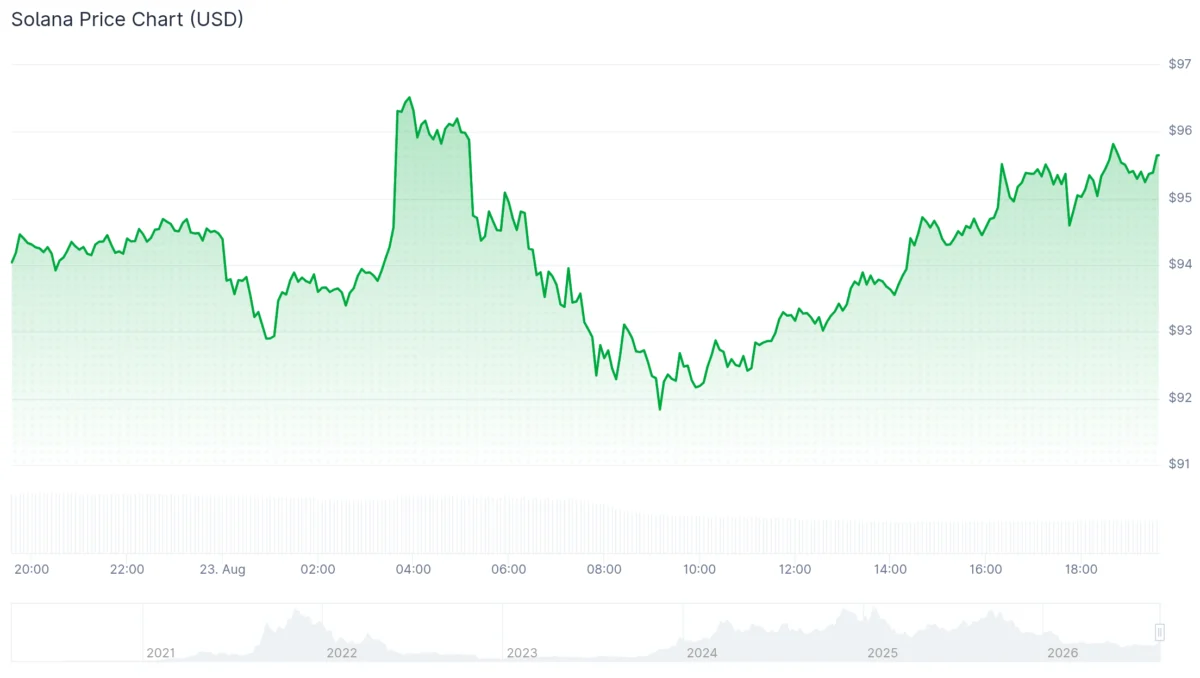
Solana (SOL) has recently traded near the $95 mark, marking a significant recovery of approximately 26% over the past week after rebounding from the $60 region. This technical resurgence is strongly bolstered by fresh data indicating the network’s increasing strength in the nascent, yet rapidly growing, sector of tokenized real-world assets (RWAs), particularly tokenized stocks within decentralized finance (DeFi). According to comprehensive data compiled by Token Terminal, Solana currently holds a commanding $75.4 million in related DeFi deposits, which accounts for an impressive 64.5% of the entire tracked market for tokenized stocks. This positions Solana notably ahead of major competitors such as Ethereum, BNB Chain, and Base, signaling a potential shift in the landscape of on-chain financial instruments. Despite this fundamental strength, SOL faces immediate technical resistance around the $99 to $100 psychological level. However, the robust on-chain activity provides a compelling fundamental signal for traders, complementing the current technical rebound. The price level of $95.13 now serves as a crucial immediate support, distinguishing between a period of healthy consolidation and the potential for a deeper pullback in the upcoming trading sessions.
The Ascendance of Tokenized Stocks on Solana
The recent surge in tokenized stock deposits on Solana extends beyond mere issuance, indicating a significant evolution in their utility within the DeFi ecosystem. These digital representations of traditional securities are increasingly being deployed in lending protocols, liquidity pools, and as collateral across various decentralized applications. This shift is critically important as it enhances the fungibility and utility of these assets, making them more attractive to holders who can actively leverage them within DeFi rather than simply holding them. Solana’s underlying technological architecture—characterized by its remarkably low transaction fees and exceptionally fast settlement times—provides an ideal environment for this type of frequent transfer, enabling smaller position sizes and facilitating continuous, high-frequency trading strategies. These operational efficiencies give Solana a distinct competitive advantage in handling the granular and rapid transactions often associated with stock trading.
The broader real-world asset (RWA) market further reinforces Solana’s growing prominence. Over the 30-day period concluding on August 19, Solana attracted a substantial $263 million in new capital inflows. In stark contrast, Ethereum experienced outflows totaling $337 million during the identical timeframe. This creates a remarkable $600 million swing in capital allocation between the two leading smart contract platforms, underscoring a potential re-evaluation by investors and projects regarding where they choose to deploy their RWA initiatives. While these figures do not definitively prove a direct migration of assets from Ethereum to Solana, they certainly highlight a significant divergence in investor sentiment and capital allocation trends, indicating a growing preference for Solana’s ecosystem in this specific domain.
Solana’s RWA Ecosystem Expansion and Market Share Dynamics
Solana’s total value locked (TVL) in its RWA ecosystem has demonstrated impressive growth, reaching $3.8 billion by August 19 and subsequently crossing the $4 billion mark just four days later. While Ethereum still maintains a significantly larger base with approximately $17.2 billion in RWA value, Solana’s growth trajectory is far more aggressive. Over the 30-day period, Solana’s RWA ecosystem expanded by a robust 10.6%, dramatically outpacing Ethereum’s comparatively modest 1.3% increase. This rapid expansion in RWA value fundamentally strengthens the long-term Solana price prediction, suggesting a growing utility and adoption of the network, even if it does not directly guarantee immediate token appreciation due to other market dynamics.

A notable driver of this RWA growth on Solana has been the increasing adoption of tokenized Treasuries. The value of these tokenized government bonds on Solana surged by 16.1% to reach $1.2 billion during the same period. Tokenized Treasury products are particularly significant as they offer a stable, low-risk asset class that can serve multiple critical functions for institutional players. They act as efficient cash-management instruments, providing yield on idle capital, and also serve as highly liquid collateral in various DeFi lending and borrowing protocols. The development of a deeper and more robust pool of these tokenized Treasuries on Solana is likely to attract larger institutional transactions and significantly enhance the network’s appeal to traditional asset managers seeking to bridge conventional finance with the decentralized world.
Dominance in On-Chain Equity DEX Activity
Beyond just deposits, Solana has also established a dominant position in the trading of tokenized stocks. During the second quarter, tokenized stocks generated an impressive $5.8 billion in spot DEX (decentralized exchange) volume globally. Of this substantial volume, Solana handled approximately 95% of all global on-chain equity DEX activity. This overwhelming concentration of activity on Solana unequivocally supports the network’s competitive positioning as the premier blockchain for trading tokenized securities. Its high throughput and low latency are perfectly suited for the demands of active trading. However, it is crucial to note that while this high level of activity underscores network utility, it does not automatically translate into direct financial benefits for SOL token holders. The relationship between network activity and token value is complex and depends on various factors, including tokenomics and market demand.
Solana’s Tokenomics: A Critical Examination
A key consideration for the long-term valuation of SOL is its tokenomics. The protocol currently burns approximately 650 SOL daily through transaction fees, a mechanism designed to create deflationary pressure. However, this burn rate is significantly outpaced by the issuance of nearly 60,000 new SOL tokens daily. This means that fee destruction currently offsets only about 1% of the new supply entering the market. Furthermore, Solana operates without a fixed supply ceiling, implying that the total supply of SOL can continue to increase over time. Consequently, while the growing use of tokenized assets on the network is a strong fundamental indicator, it may not immediately create the kind of scarcity-driven demand that would lead to sustained token appreciation if the rate of new issuance continues to vastly exceed the burn rate. The Solana price prediction, therefore, remains heavily dependent on whether overall market demand can consistently absorb this expanding supply of SOL tokens. This balance between utility, issuance, and demand will be a critical factor in determining its future price trajectory.
SOL Price Charts and Key Fibonacci Levels
From a technical analysis perspective, the SOL price is currently trading near the 23.6% Fibonacci retracement level, positioned at $95.13. According to analysis by market commentators such as More Crypto Online, the current price structure appears to be a fourth-wave correction, following a significant advance that originated from the upper $70s region. Maintaining above this $95.13 level would be crucial for preserving the short-term bullish count, although the possibility of the correction extending further cannot be entirely ruled out.
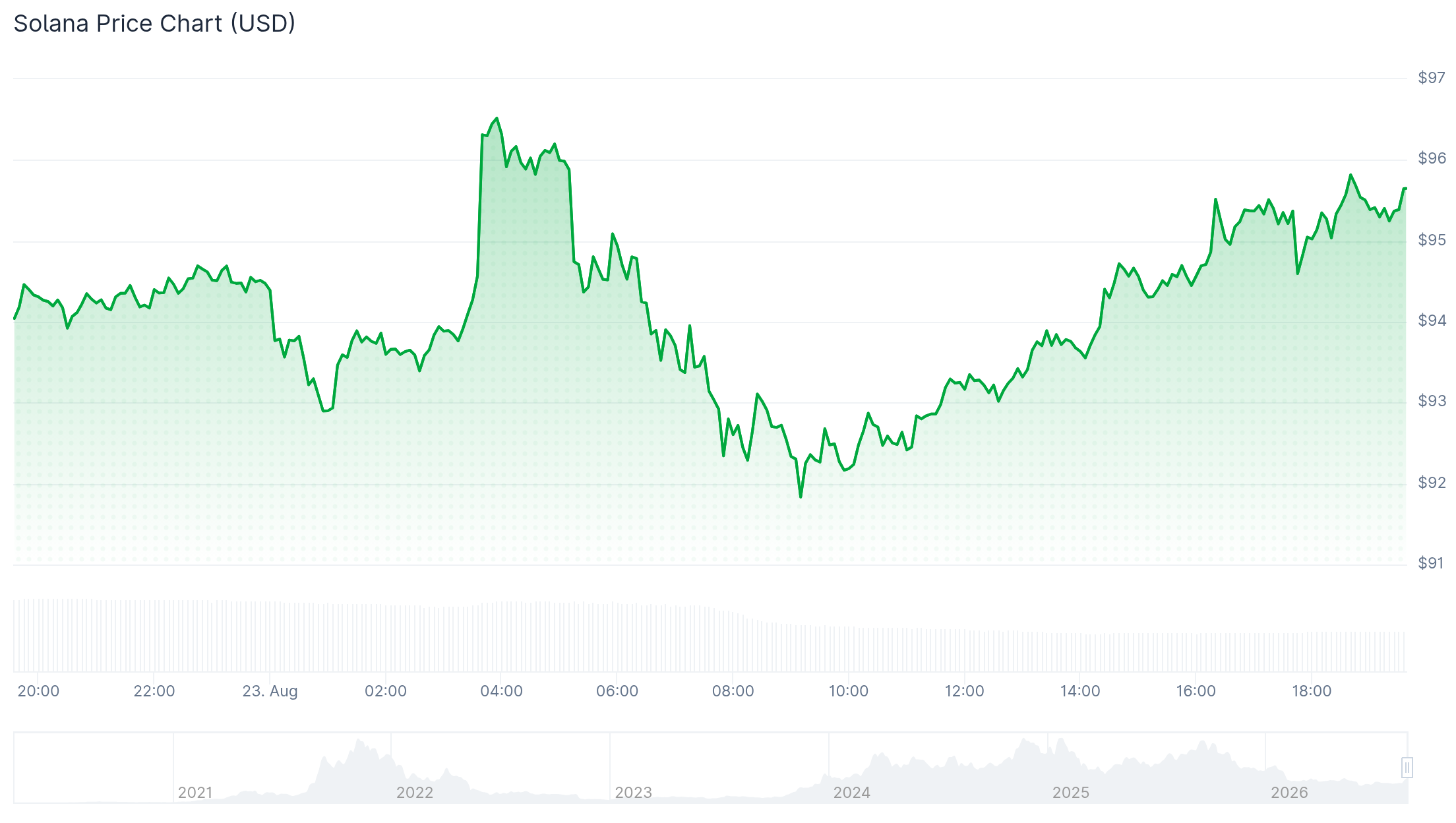
A decisive break below the $95.13 support could expose the next key Fibonacci level, the 38.2% retracement at $90.69. Should selling pressure intensify, the 50% level at $87.26 would form the subsequent major support zone. These price points delineate a wider area where active buyers might step in to defend the recent rebound and prevent a deeper capitulation. Losing these critical support levels would undoubtedly weaken the immediate Solana price prediction, significantly increasing the downside risk and potentially signaling a more prolonged period of correction.
Conversely, the immediate upside test for SOL lies between the $99 and $100 range. A sustained and convincing move above this resistance zone would indicate that buyers have successfully absorbed the recent pullback and are regaining control. More Crypto Online’s analysis maps a potential fifth-wave advance, with targets ranging from $114 to $116. However, this bullish target remains conditional on the current support levels holding firm and the identified resistance levels being decisively breached.
Looking at a broader recovery scenario, analysis from Rod’s weekly chart presents a more expansive outlook. This perspective treats the significant fall from the 2025 highs as a completed A-B-C correction, with its low point established near the $60 region. Under this Elliott Wave count, the SOL price could potentially form higher lows in the coming weeks and months before targeting an ambitious range of $160 to $180. For this long-term bullish scenario to materialize, SOL must first reclaim the $100 psychological barrier and then successfully navigate through the more substantial resistance zone between $120 and $140.
It is imperative for traders to recognize that Elliott Wave counts are dynamic and can change when new price data alters the underlying patterns. Therefore, the immediate Solana price prediction for both short-term and long-term charts faces specific invalidation levels. Traders are closely monitoring the $95.13 and $100 levels for short-term confirmation of market direction. Rod’s weekly setup utilizes the recent $60-area correction low as its critical invalidation level, a break below which would negate the broader recovery scenario.
Broader Context: Solana’s Journey and Future Implications
Solana’s journey in the blockchain space has been marked by both rapid innovation and significant challenges. Initially hailed as an "Ethereum killer" due to its high transaction throughput and low fees, Solana has worked to carve out its own niche, particularly in areas requiring high performance, such as DeFi, NFTs, and now, tokenized RWAs. Its architecture, which employs a unique Proof-of-History (PoH) consensus mechanism alongside Proof-of-Stake (PoS), allows for incredibly fast block finality, making it ideal for applications that demand near-instantaneous transactions.
The increasing institutional interest in tokenized assets, particularly tokenized Treasuries and stocks, represents a significant opportunity for Solana. Traditional financial institutions are actively exploring how blockchain technology can enhance efficiency, transparency, and liquidity in existing markets. Solana’s demonstrated capability to handle a large volume of these tokenized assets, coupled with its cost-effectiveness, positions it as a front-runner for bridging traditional finance with the decentralized world. This institutional adoption could lead to substantial capital inflows and further validate Solana’s underlying technology.

However, Solana also faces significant competition and challenges. Ethereum, with its vast developer ecosystem and planned upgrades (such as sharding and Layer-2 scaling solutions), continues to be a formidable competitor. Other high-throughput chains are also vying for market share in the RWA space. Moreover, Solana has historically faced issues with network stability, experiencing several notable outages that have raised concerns about its reliability and centralization. Addressing these concerns and continually improving network resilience will be crucial for sustained growth and institutional confidence. The regulatory landscape for tokenized securities is also evolving rapidly, and compliance will be a key factor for any blockchain aiming for widespread adoption in this sector.
Conclusion: A Dual Narrative of Technical Recovery and Fundamental Strength
In conclusion, Solana is currently navigating a compelling dual narrative: a strong technical recovery in its SOL token price, supported by encouraging chart patterns, and a robust fundamental strengthening derived from its leadership in the tokenized stock and broader RWA markets. The significant market share in tokenized stock DeFi deposits and the impressive growth rates of its RWA ecosystem underscore Solana’s growing utility and attractiveness for innovative financial applications. Its technological advantages, particularly low fees and high speed, position it favorably for the future of on-chain finance.
Nevertheless, the long-term sustainability of SOL’s price appreciation will hinge on its tokenomics, specifically the balance between new issuance and token burning. While network activity is booming, a clearer path for this utility to translate into direct scarcity for the SOL token would further solidify its investment case. As traders and investors monitor key technical levels for immediate price action, the underlying fundamental developments in real-world asset tokenization offer a strong, long-term thesis for Solana’s continued relevance and potential growth within the evolving blockchain landscape. The ability of the Solana ecosystem to maintain its competitive edge, enhance network stability, and navigate regulatory complexities will ultimately determine its trajectory in the years to come.














