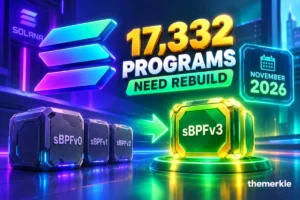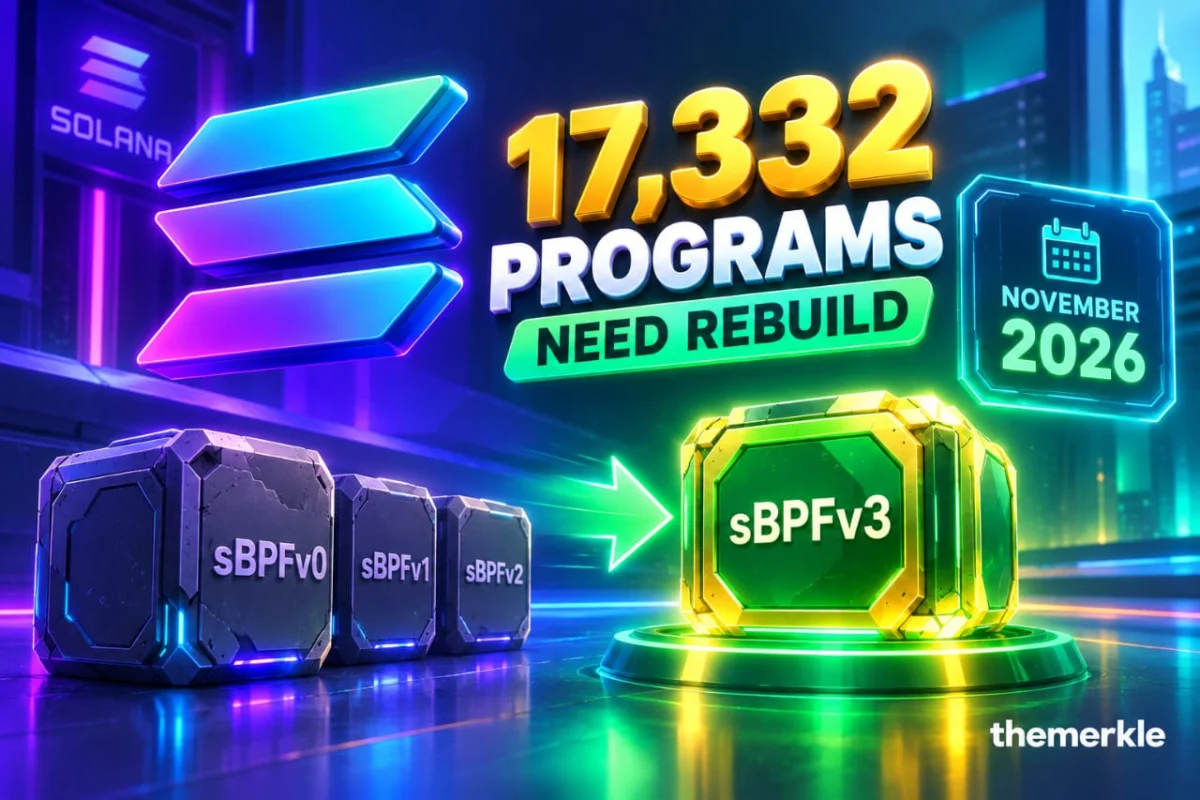
The Solana blockchain ecosystem is gearing up for a significant architectural shift with the impending activation of the sBPFv3 program standard. This critical upgrade, slated for full enforcement with the Agave 4.4 network release in November 2026, mandates that all new program deployments, upgrades, and finalizations must adhere to the sBPFv3 format. While existing on-chain programs will continue to function without interruption, developers who fail to migrate their build processes to target sBPFv3 will be unable to deploy critical fixes, new features, or perform any updates to their applications after the deadline. This presents a considerable challenge, as a substantial portion of the network’s upgradable programs, numbering 17,332, currently utilize older formats, predominantly v0, highlighting a readiness gap that the ecosystem must address proactively.
The transition to sBPFv3 is not merely a technical formality but a strategic move by Solana to enhance network security, optimize performance, and ensure future compatibility for its burgeoning decentralized application (dApp) ecosystem. The current situation, where developers installing the Solana CLI version recommended by older migration guides might still produce sBPFv0 programs by default, underscores the urgency for developers to review and update their build pipelines. Without the explicit --arch v3 flag or an updated toolchain, projects risk being locked out of critical update pathways, potentially jeopardizing the stability and evolution of their on-chain applications.
The Mandate for Modernization: sBPFv3 Explained
Solana’s architecture leverages a custom version of the Berkeley Packet Filter (BPF) runtime, known as sBPF, to execute on-chain programs. This sandboxed execution environment is central to Solana’s high-throughput capabilities, enabling efficient and secure processing of transactions. The evolution from sBPFv0, v1, and v2 to sBPFv3 represents a continuous effort to refine this core component, introducing several key improvements designed to benefit the entire network.
sBPFv3 brings forth advancements in several critical areas. Firstly, it enhances security by incorporating stricter validation rules and more robust isolation mechanisms, reducing the attack surface for malicious code. Secondly, it offers performance optimizations, allowing programs to execute more efficiently and potentially consume less computational resources (gas), leading to lower transaction costs for users and improved overall network throughput. Thirdly, sBPFv3 is designed with future extensibility in mind, paving the way for more sophisticated on-chain functionalities and easier integration with upcoming Solana runtime features. This standardization simplifies the development landscape, as it allows core contributors to focus on a single, optimized execution environment rather than maintaining compatibility with multiple legacy versions. The network upgrade tracker succinctly describes the change as deployment formats going "4 → 1," signifying a streamlining and consolidation of supported program versions.
A Critical Deadline: November 2026 and Agave 4.4
The official timeline for this transition is clearly laid out in Solana’s network upgrade tracker, which lists "sBPFv3 Programs" under the Agave 4.4 release, anticipated for November 2026. The specific rules governing this change are detailed in Solana Improvement Document (SIMD) 0500, titled "Disable deployment of SBPF-v0, -v1 and -v2." SIMDs are formal proposals for changes to the Solana protocol, similar to Ethereum Improvement Proposals (EIPs), and undergo community review before implementation.
Once the feature gate associated with SIMD-0500 activates, Solana validators will be configured to reject certain loader-v3 operations if the program attempting the operation is built for sBPFv0, v1, or v2. These critical blocked operations include:
Deploy: Preventing the deployment of entirely new programs using older formats.Upgrade: The most impactful, as it stops any updates to existing upgradable programs.SetBufferAuthority: Restricting changes to buffer ownership.SetUpgradeAuthority: Preventing changes to the entity authorized to upgrade a program.Close: Though less common for active programs, this also falls under the restriction.
Crucially, other operations such as InitializeBuffer, Write, ExtendProgram, and Close for operations not tied to an upgrade or deployment will remain unaffected. More importantly, programs already deployed and running on-chain will continue to execute without disruption. Users interacting with these dApps will experience no immediate change. However, for developers, any attempt to deploy or upgrade an outdated program will result in a clear error message: "Detected sbpf_version required by the executable which are not enabled."
The underlying code for this feature is already integrated into the Solana codebase. The Agave 4.4.0 release candidate, tagged on October 26, includes the disable_sbpf_v0_v1_v2_deployment feature, identified by the unique key B8JJXCy5amZyWG9r7EnUYLwzXSXTxG7GZ1qZ1qggo83g. As of recent checks, Solana’s official page indicates that this feature has not yet been activated on testnet, and no specific date for its devnet activation has been provided. This phased rollout allows developers ample time to adapt and test their programs in a simulated environment before the mainnet enforcement.
The Scale of the Challenge: 17,332 Programs at Risk
The scope of this migration is substantial. SIMD-0500 itself includes a comprehensive count of mainnet programs categorized by their sBPF format, compiled using Blueshift’s program-sync tool. The data reveals a stark reality:

- Finalized Programs (unaffected): A significant number of programs are already finalized, meaning they cannot be upgraded. These programs are not impacted by the sBPFv3 mandate, as their code is immutable.
- Upgradable Programs (affected): 17,332 programs on mainnet are currently upgradable.
- sBPFv0: A staggering 99.7% of these upgradable programs are built using the oldest format, sBPFv0.
- sBPFv1/v2/v3: Only a negligible fraction (less than 0.3%) utilize v1, v2, or already conform to v3.
This data underscores that nearly every upgradable program on Solana will require a rebuild to target sBPFv3 before its next update. For development teams, this means allocating resources, potentially adjusting build pipelines, and thoroughly testing their applications well in advance of the November 2026 deadline. The long-term goal, as articulated in SIMD-0500, is to gradually reduce the number of old-format programs, which will "eventually allow us to deprecate the execution of these SBPF versions." While the SIMD explicitly states that execution of older versions will remain supported for now, Agave does contain a disable_sbpf_v0_execution feature from an older SIMD-0161. In the 4.4 release, this feature currently uses a placeholder test key, meaning it cannot yet be activated on mainnet, but it signals the ultimate direction of the network towards a more unified and modern execution environment.
The Toolchain Conundrum: Understanding Default Builds
One of the most critical aspects of this migration lies in the behavior of the cargo-build-sbf tool, which serves as the compiler wrapper for virtually all Solana program builds. The historical evolution of this tool’s default build target is central to the current readiness gap.
According to its repository, cargo-build-sbf only changed its default build target to sBPFv3 with the introduction of the 4.4 toolchain. Before this, even relatively recent versions would default to sBPFv0. This creates a significant "gotcha" for developers. For instance, Solana’s own migration guide previously recommended installing Solana CLI v4.3.0. When using this toolchain, a standard cargo build-sbf command, executed without any additional flags, would still produce an sBPFv0 program. This explains why the migration guide’s instructions for native Rust, Pinocchio, and Quasar projects explicitly included the --arch v3 flag.
The implication is profound: a development team that diligently upgrades its Solana CLI to a version like 4.3.0 but maintains its existing build scripts without adding the --arch v3 flag will unknowingly continue to produce sBPFv0 programs. They would only discover this incompatibility when their next deployment or upgrade attempt fails, potentially during a critical bug fix or feature release.
The default target only shifts to sBPFv3 with the 4.4 toolchain. Agave 4.4.0-rc.1 was tagged on October 26, indicating that the 4.4 toolchain is still in its release candidate phase. Until it achieves stable release status and becomes widely adopted, the safest and most prudent approach for developers is to explicitly set the --arch v3 flag in their build commands to ensure compliance.
Framework Readiness: A Deep Dive into Ecosystem Tools
The broader Solana development ecosystem, encompassing popular frameworks and tools, has been adapting to the sBPFv3 mandate. While many tools now support sBPFv3, the method of activating this support varies, often requiring explicit configuration.
-
Anchor: As one of the most widely used frameworks for Solana development, Anchor has demonstrated proactive readiness. Anchor 1.2.0, released on September 4, introduced the necessary
--archand--tools-versionflags to theanchor buildcommand. Critically, its CLI also setsDEFAULT_BUILD_ARCHto "v3," making it the most prepared of the major frameworks in terms of default behavior. This means developers using Anchor 1.2.0 or later are less likely to encounter the default-to-v0 issue. Anchor also released maintenance versions 0.30.2, 0.31.2, and 0.32.2 simultaneously on September 14, allowing projects on older major versions to still meet Solana’s minimum requirements without a full major version upgrade. Anchor 2.0 is also progressing through release candidates, with rc.2 tagged on October 12. -
Pinocchio: The minimum version for sBPFv3 compatibility for Pinocchio projects is v0.10, released on January 5. However, teams upgrading to v0.11 (released April 8) should be aware of a separate, significant change: v0.11 altered the program entrypoint signature, which may necessitate code modifications in addition to a rebuild. Similar to other frameworks, Pinocchio builds still require the
--arch v3flag to be explicitly set when using the 4.3 toolchain. -
Native Rust: For projects developed using native Rust without a higher-level framework, developers must ensure they are using
solana-programversion 2.3.0 or later. Furthermore, the explicit--arch v3flag is essential during the build process to target sBPFv3. -
Quasar: Projects utilizing the Quasar framework need to be on version v0.1.0 or later. Like native Rust and Pinocchio, Quasar builds also require the
--arch v3flag to be set explicitly.
-
solana-verify: The
solana-verifiable-buildtool is crucial for ensuring the integrity and transparency of on-chain programs. Version v0.5.2, shipped on September 21, incorporated "agave 4.2/4.3 Dockerfiles and SBPFv3 toolchain pins." Its latest build image is based on Agave 4.3.0. However, for verified builds, the--arch v3flag still needs to be passed through viacargo-build-sbf-args:--cargo-build-sbf-args="--arch v3". A specific nuance for projects not directly dependent onsolana-program(such as some Pinocchio programs) is the requirement to declare their CLI version inCargo.toml. This ensures thesolana-verifytool selects the correct Docker image for the build environment. Any discrepancy between a team’s local build settings and its verification build settings will result in a hash mismatch, invalidating the verifiable build.
In summary, while the major frameworks and tools have introduced support for sBPFv3, the onus remains on developers to ensure their configurations are correct. With the notable exception of Anchor 1.2 and later, most build pathways will only target v3 if developers manually set the required flag.
Broader Implications: What Happens to Unprepared Projects?
The impact of missing the sBPFv3 migration deadline is primarily on the development and maintenance teams rather than on end-users or the immediate functionality of deployed dApps.
For Users: There will be no immediate disruption. A program built for sBPFv0, v1, or v2 that is already on-chain will continue to execute normally. Users can interact with its accounts, tokens, and integrations as before. The benefits of sBPFv3, such as potential performance gains or enhanced security, will accrue over time as more programs migrate, making the network more robust as a whole.
For Development Teams: The consequences are direct and potentially severe. After the feature gate activates, an upgradable program that has not been rebuilt to target sBPFv3 will be effectively frozen. It cannot be upgraded to fix bugs, introduce new features, or patch security vulnerabilities. It also cannot be finalized, which is a process to remove its upgrade authority. While its upgrade authority will technically still exist, and buffer operations might still be possible, the network will simply refuse the final step of the upgrade or finalization process. This means that if a critical bug is discovered after November 2026, the team will first have to undertake the sBPFv3 migration process – updating dependencies, adjusting build scripts, and thoroughly testing – before they can even begin to deploy the bug fix. This could transform a routine patch into a high-pressure, time-sensitive incident with cascading effects on user trust and dApp functionality.
For the Ecosystem and Testing: SIMD-0500 also points to a less visible, but equally important, implication for the broader ecosystem. Testing frameworks and local development environments (e.g., local validator setups, mock programs) will need to be adapted. They will either require mechanisms to deactivate the sBPFv3 enforcement feature during testing of older formats or implement bypasses for the entire deployment process. This means that teams relying on local test environments should anticipate updates and potential changes to their testing workflows to maintain compatibility and accurate simulations.
Strategic Imperatives for Developers: A Pre-Activation Checklist
Given the November 2026 deadline, development teams have a window of opportunity to prepare their Solana programs for the sBPFv3 mandate. Proactive migration is not just recommended; it’s essential to avoid operational bottlenecks and ensure the continuous evolution of dApps. Based on Solana’s official guidance and toolchain behavior, the following checklist outlines the critical steps:
- Update Solana CLI: Install Solana CLI version 4.4.0 or later once it reaches stable release. If sticking with an earlier version (e.g., 4.3.0), ensure that all build commands explicitly include
--arch v3. - Update Frameworks and Dependencies: Upgrade development frameworks like Anchor, Pinocchio, Native Rust’s
solana-program, and Quasar to their minimum sBPFv3-compatible versions (e.g., Anchor 1.2.0+, Pinocchio v0.10+,solana-program2.3.0+, Quasar v0.1.0+). Pay close attention to any breaking changes or required code modifications, especially for Pinocchio v0.11’s entrypoint signature change. - Modify Build Scripts: Review and modify all
cargo build-sbfcommands within your project’s build scripts (e.g.,Cargo.toml,Makefile, CI/CD pipelines) to explicitly include the--arch v3flag. If using a framework like Anchor that defaults to v3, verify that this behavior is active. - Test Thoroughly on Devnet/Testnet: Deploy and rigorously test your sBPFv3-built programs on Solana’s devnet and testnet environments. This includes testing all core functionalities, upgrades, and interactions with other programs to ensure full compatibility and stability.
- Update Verifiable Build Processes: If using
solana-verify, upgrade to v0.5.2 or later. Ensure the--cargo-build-sbf-args="--arch v3"flag is correctly passed. For projects not usingsolana-program, explicitly declare the CLI version inCargo.tomlto maintain hash consistency between local and verified builds. - Review Local Development and Testing Environments: Anticipate updates to local validators and testing frameworks. Plan for adapting your local testing setup to either handle sBPFv3 programs natively or to bypass the enforcement feature for legacy tests.
The Anza migration guide provides further detailed steps and best practices for this transition. The optimal time to undertake this rebuild is not when an urgent fix is needed, but proactively, allowing ample time for testing and refinement without the pressure of an impending incident.
The Long-Term Vision: A More Robust Solana
The sBPFv3 mandate is a testament to Solana’s commitment to continuous improvement and its vision for a robust, secure, and performant blockchain. By standardizing on a modern program execution environment, Solana is laying the groundwork for future innovations. This move will enable core developers to introduce further optimizations to the runtime, enhance security features, and streamline the development experience without the burden of maintaining backward compatibility with multiple legacy sBPF versions.
Ultimately, the phased deprecation of older sBPF formats, culminating in the potential eventual deprecation of their execution, will lead to a leaner, more efficient, and more secure network. While the migration presents an immediate task for development teams, the long-term benefits for the entire Solana ecosystem—from improved dApp performance to a more resilient underlying infrastructure—far outweigh the temporary challenges. It represents a maturation of the Solana protocol, ensuring its continued competitiveness and scalability in the rapidly evolving landscape of decentralized technologies.