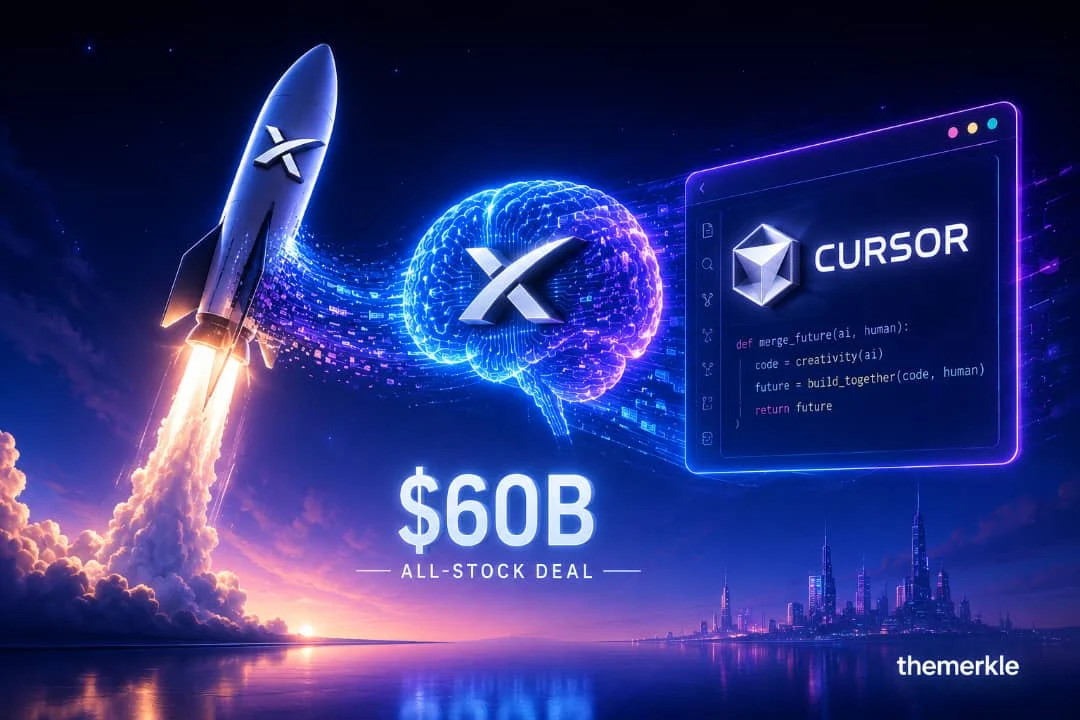
Days after successfully completing the largest initial public offering in history, SpaceX has made another monumental announcement, exercising its option to acquire Cursor, the world’s fastest-growing AI coding tool, in an all-stock transaction valued at an unprecedented $60 billion. This acquisition marks the largest software deal ever recorded, underscoring SpaceX’s aggressive expansion into artificial intelligence and its ambition to construct the globe’s most advanced and useful AI models.
The acquisition was formally disclosed via an official regulatory filing and subsequently confirmed by the SpaceX team. This strategic move lands at a time when SpaceX is already setting new benchmarks across its diverse ventures, from space exploration and satellite internet to advanced AI development. Cursor, developed by Anysphere, has rapidly distinguished itself in the burgeoning AI developer tools market. Boasting over one million paying customers, the company has achieved more than $2 billion in annualized revenue and projects reaching $6 billion by the close of 2026. The $60 billion valuation represents a substantial multiple—20 to 30 times Cursor’s current revenue—a figure that analysts suggest reflects not merely its present performance but the immense future potential and strategic value perceived by SpaceX.
The deal, which is subject to standard regulatory approvals, is anticipated to close in the third quarter of 2026. What adds a significant layer of strategic foresight to this announcement is the revelation that the two entities have not waited for the formal closing to initiate collaboration. For several months, a joint team, operating under the provisional designation of SpaceXAI, has been actively training a sophisticated AI model alongside Cursor’s development teams. This co-developed model is slated for imminent release, integrated into both Cursor’s platform and SpaceX’s own Grok Build, signaling a deep pre-acquisition integration and a clear operational synergy.
The Largest Software Acquisition in History: A Deeper Dive into the $60 Billion Valuation
The staggering $60 billion price tag for Cursor demands a pause for reflection. This figure unequivocally surpasses every previous record for a software acquisition. For context, some of the largest software deals in recent memory include Microsoft’s acquisition of Nuance Communications for $19.7 billion in 2021, Salesforce’s purchase of Slack for $27.7 billion in 2020, and Broadcom’s acquisition of VMware for $69 billion in 2022, though VMware also included significant hardware and virtualization assets. Cursor’s valuation, purely for a software tool, establishes a new high-water mark. What makes this even more remarkable is that the acquiring entity, SpaceX, is not a legacy tech giant with decades of accumulated balance sheet strength. Instead, it is a company that only made its public market debut a mere four days prior to this announcement, having raised an astounding $75 billion in its IPO.
The all-stock structure of the transaction means that Cursor shareholders will not be liquidating their holdings for cash but will instead become significant shareholders in SpaceX. Specifically, every Cursor share will convert into SpaceX Class A common stock at closing, based on the volume-weighted average closing price of SPCX at that time. This structure inextricably links the financial fortunes of Cursor’s founders, employees, and early investors to the ongoing public market performance of SpaceX, which has reportedly been robust since its IPO. At the $60 billion valuation, the acquisition represents an approximate 3.4% dilution of SpaceX’s equity based on its IPO valuation. While significant, this dilution is not considered prohibitive for a company that just raised $75 billion and is trading comfortably above its initial public offering price, indicating strong investor confidence.
Furthermore, the acquisition agreement includes a notable termination fee structure. Should the deal fail to close for any reason, SpaceX has committed to pay Cursor $1.5 billion in cash and provide $8.5 billion worth of computing resources. This $10 billion walk-away cost is a potent signal of the strategic importance SpaceX places on this acquisition. It not only highlights the financial commitment but also, crucially, underscores the profound value of Cursor gaining access to SpaceX’s formidable computing infrastructure, a critical resource for the AI coding startup’s ambitious development roadmap.
Contextualizing the Megadeal: SpaceX’s Strategic Pivot into AI Supremacy
SpaceX’s foray into the high-stakes world of artificial intelligence has been a calculated and aggressive one. While primarily known for its groundbreaking achievements in rocketry and satellite internet (Starlink), the company has been systematically building a robust AI ecosystem. A pivotal moment in this strategy occurred in February 2026, when xAI, the AI research company founded by Elon Musk, was formally merged into SpaceX. This integration brought the Grok AI business, known for its conversational AI models, and the Colossus supercomputing infrastructure in Memphis directly under the SpaceX umbrella. Colossus, with its massive GPU clusters, represents one of the largest AI supercomputing facilities globally, designed to power advanced AI model training.
The acquisition of Cursor is a direct and impactful move to fortify SpaceX’s burgeoning AI capabilities, positioning it for more aggressive competition with established AI powerhouses like OpenAI (developers of ChatGPT and Codex/Copilot) and Anthropic (known for Claude), both of which have their own formidable AI coding products or significant partnerships in the space. While Grok has made strides in general-purpose AI, it has, until now, largely struggled to establish a dominant developer-facing product layer. Cursor fills this void perfectly, providing SpaceX with a direct conduit to the professional developer community.
The pre-deal integration, evidenced by the months-long joint model training between SpaceXAI and the Cursor team, is perhaps the clearest indicator of the profound strategic fit. This collaboration, predating the formal acquisition announcement, suggests that the merger is not merely a financial gamble but an operational conviction that these two product stacks are inherently synergistic. The joint development of AI models that will ship simultaneously in both Cursor and Grok Build implies a unified vision and a streamlined approach to bringing advanced AI coding tools to market.
Cursor’s Meteoric Rise: A Deep Dive into "Vibe Coding" and Developer Adoption
Cursor is far from being just "another AI tool." It has been credited with sparking an entirely new category within software development known as "vibe coding." This concept refers to a paradigm shift in how developers interact with AI, moving beyond simple autocomplete or code generation to a more intuitive, collaborative, and almost symbiotic relationship where the AI understands the developer’s intent and context, enabling a more fluid and efficient creative process. This approach has resonated deeply within the developer community, leading to rapid and widespread adoption.
Founded in 2022, Cursor’s growth trajectory has been nothing short of explosive. Achieving one million paying customers and an annualized revenue of $2 billion within such a short timeframe is an unprecedented feat in the software industry, making almost every other startup’s growth appear comparatively slow. This rapid ascent is a testament to the product’s efficacy, user experience, and its ability to solve critical pain points for professional developers. Its platform has become an indispensable daily tool for a significant portion of the global developer workforce, streamlining workflows, accelerating development cycles, and enhancing code quality.
The key to Cursor’s success lies in its advanced AI models, which are trained on vast datasets of code, documentation, and development practices. These models enable Cursor to offer intelligent suggestions, generate complex code snippets, debug errors, refactor code, and even answer natural language queries about codebases. For many developers, Cursor has transitioned from a helpful utility to an essential extension of their development environment, fundamentally altering their productivity and approach to software creation.
Market Reactions, Analyst Perspectives, and Broader Financial Implications
The announcement of the Cursor acquisition has sent ripples throughout the tech and financial markets. While SpaceX’s IPO was a record-setter, this follow-up acquisition further solidifies its position as a major player in the global technology landscape, not just a space company.
Financial analysts are dissecting the $60 billion valuation, with many concluding that it reflects a forward-looking assessment of Cursor’s potential rather than its current financial metrics. The 20-30x revenue multiple is aggressive, even for high-growth SaaS companies, but it aligns with the valuations seen in other rapidly expanding AI sectors where the total addressable market is perceived as immense. The all-stock nature of the deal mitigates immediate cash outflow for SpaceX, leveraging its newly public equity as currency. This strategy is common among high-growth companies looking to preserve cash for operations and further investment while still pursuing strategic acquisitions.
The dilution for existing SpaceX shareholders, while manageable, will be a point of discussion. However, the perceived strategic value of Cursor, particularly its ability to accelerate SpaceX’s AI ambitions and solidify its developer ecosystem, is likely to outweigh concerns about short-term dilution for many investors. The $10 billion termination fee structure is also a significant financial commitment, indicating the high stakes and confidence SpaceX has in the deal’s ultimate completion. This fee acts as both a deterrent for Cursor to seek alternative offers and a strong signal to the market about the seriousness of SpaceX’s intent.
Regulatory Hurdles and the Integration Roadmap
The acquisition, like all transactions of this magnitude, is subject to regulatory approval. Antitrust authorities in various jurisdictions will scrutinize the deal to ensure it does not create an anti-competitive environment or unduly concentrate market power. Given the nascent and highly competitive nature of the AI market, and the relatively distinct operations of SpaceX (space/connectivity) and Cursor (AI coding tools), widespread regulatory resistance is not immediately anticipated, but thorough reviews are standard. The expected closing in Q3 2026 allows ample time for these regulatory processes to unfold.
Operationally, the integration roadmap is already underway, as evidenced by the joint AI model training. This proactive approach suggests that SpaceX and Cursor leadership have a clear vision for how to merge their technologies and teams seamlessly. Post-closing, the immediate focus will likely be on fully integrating Cursor’s developer platform with Grok AI, leveraging Colossus’s computing power to accelerate Cursor’s model development, and cross-pollinating talent and expertise. The goal will be to create a unified, superior AI coding experience that benefits from the collective strengths of both entities.
The Broader Vision: SpaceX’s Unprecedented Vertical Integration Strategy
Stepping back, the Cursor acquisition reveals a grander, highly ambitious vertical integration strategy being pursued by SpaceX, unlike anything seen in modern corporate history. With this deal, pending regulatory approval, SpaceX would command:
- Rockets and Launch Services: Through its core space transportation business.
- Global Satellite Connectivity: Via the vast Starlink constellation.
- Advanced AI Models: Through xAI and the Grok platform.
- Hyperscale AI Computing Infrastructure: With the Colossus supercomputing facilities.
- The World’s Leading AI Coding Tool: Now, potentially, Cursor, which serves as the interface for developers to build the next generation of software.
This interconnected infrastructure creates a powerful feedback loop. Starlink provides global connectivity essential for distributing AI services. SpaceX’s rockets launch the satellites. Colossus trains the AI models. Grok offers generalized AI capabilities. And Cursor provides the critical tool for developers to harness these AI models to build new applications, potentially even for SpaceX’s own internal development needs, creating a self-reinforcing ecosystem.
For Cursor specifically, joining SpaceX addresses its single biggest constraint: access to compute resources. The company had previously indicated that its ambitions to train more sophisticated AI models were hampered by a shortage of high-performance computing. Through xAI and Colossus, Cursor gains virtually limitless access to one of the largest and most advanced AI supercomputing facilities in existence, effectively removing the bottleneck for its future growth and innovation. This access will enable Cursor to accelerate its research, develop more powerful and nuanced AI models, and maintain its leadership position in the rapidly evolving AI coding landscape.
Impact on the Developer Ecosystem and the Future of AI
The implications of this acquisition for the developer ecosystem are profound. The integration of Cursor with SpaceX’s vast resources, particularly its compute power and AI talent, is likely to accelerate the pace of innovation in AI-assisted coding. Developers can anticipate even more powerful, intuitive, and integrated tools that will further enhance productivity and potentially lower the barrier to entry for software development. This could lead to a new era of "hyper-productive" developers, capable of creating complex applications with unprecedented speed and efficiency.
For competitors like OpenAI and Anthropic, this deal intensifies the race to dominate the AI developer tool space. SpaceX, now armed with Cursor, presents a formidable challenge, combining deep AI research with a widely adopted product and unparalleled infrastructure. The battle for developer mindshare and market dominance in AI coding is now more competitive than ever.
Ultimately, SpaceX’s acquisition of Cursor is more than just a financial transaction; it is a strategic maneuver that redefines the company’s scope and ambition. It signals a future where SpaceX is not merely a space and internet provider but a foundational layer of the global AI infrastructure, influencing how software is built, how AI is developed, and ultimately, how humanity interacts with technology on a planetary scale. The next few years will undoubtedly reveal the full extent of this audacious vision.