While Sub-Saharan Africa remains the world’s smallest cryptocurrency market by total value, it has officially claimed the title of the fastest-growing crypto economy, expanding by 13.4% to reach a total value of $101 billion between July 1, 2025, and June 30, 2026. This surge, led primarily by South Africa and Nigeria, highlights a profound shift in the region’s financial landscape, where digital assets are no longer viewed merely as speculative investments but as essential tools for navigating systemic inefficiencies in traditional banking and cross-border commerce.

The rapid adoption across the continent is fueled by a pragmatic necessity: the persistent struggle for individuals and businesses to access affordable and reliable financial services. In a region where traditional cross-border payments are often slow and prohibitively expensive, cryptocurrency—and specifically stablecoins—offers a frictionless alternative for managing personal finances and settling international business transactions. This evolution marks a transition from "blockchain for the sake of technology" to "blockchain for the sake of utility," focusing on innovations that reduce friction in existing financial activities.
The Regional Powerhouses: South Africa and Nigeria
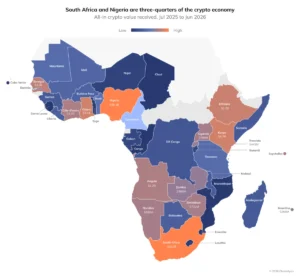
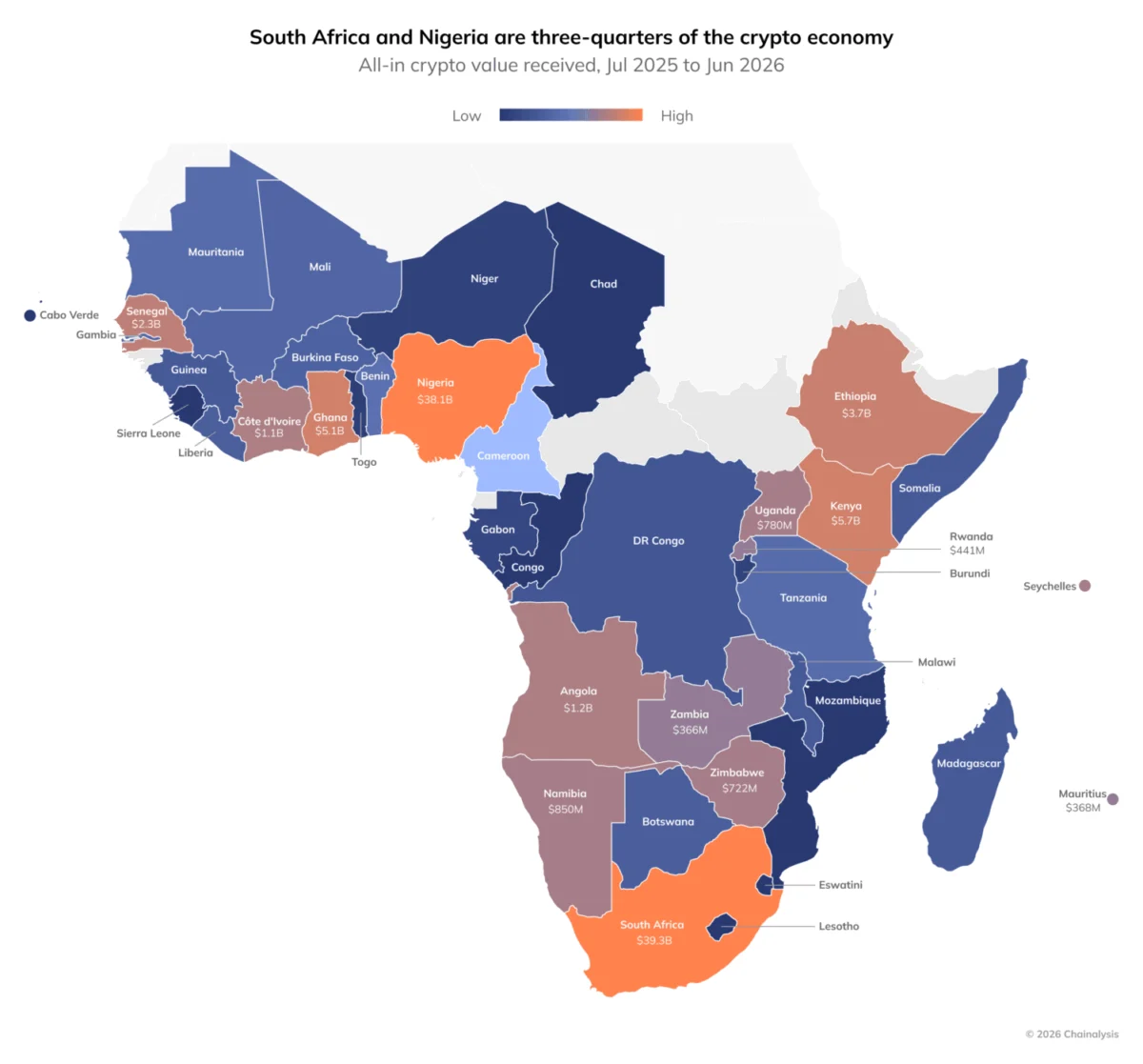
South Africa and Nigeria continue to dominate the Sub-Saharan crypto landscape, collectively accounting for more than 75% of all regional activity. However, the two nations are moving along diverging trajectories. South Africa’s crypto economy reached $39.3 billion during the reporting period, representing a staggering 52% year-over-year growth. This expansion occurred despite a global bear market, driven by a broad-based increase across all measured categories, particularly in cross-border peer-to-peer (P2P) stablecoin flows and service-related transactions.

In contrast, Nigeria’s crypto economy, while nearly as large at $38.1 billion, saw a slight decline of 3% year-over-year. While centralized exchange (CEX) activity in Nigeria grew, it was offset by a significant 45% drop in decentralized exchange (DEX) activity and a 17% decline in cross-border P2P flows. Despite this minor contraction in volume, Nigeria remains a global leader in grassroots adoption, ranking third on the global index. The decline in certain sectors is largely attributed to a tightening regulatory environment and a shift toward domestic platforms following tensions between the Nigerian government and international exchanges.
Other markets in the region are also showing significant, albeit volatile, growth. Ghana’s crypto economy grew by 80% to reach $5.1 billion, while Senegal experienced a massive 215% surge to $2.3 billion, primarily fueled by strong growth in centralized exchanges. Conversely, Ethiopia recorded an 8% decline to $3.7 billion, reflecting a drop in DEX activity. These varying outcomes underscore the uneven pace of adoption and the sensitivity of smaller markets to local regulatory shifts.

A Global Leader in Self-Custody and Personal Wallets
One of the most striking findings in the recent data is the outsized role of personal wallets in Sub-Saharan Africa. Personal wallets accounted for 32.3% of the total value received in the region—the highest share of any region globally. This suggests that African users are increasingly prioritizing self-custody over reliance on centralized intermediaries.
The preference for personal wallets is deeply tied to the region’s unique regulatory and infrastructure challenges. In Nigeria, for example, a history of restrictions on banks serving crypto exchanges (which lasted from 2021 to 2023) and ongoing legal tensions with major international platforms have pushed users toward self-custody to avoid potential market disruptions or the freezing of assets. Cross-border P2P transfers remain the primary driver of this activity, accounting for over 70% of the value received in personal wallets.

The Stablecoin Revolution: Displacing Bitcoin for Utility
The most significant qualitative shift in the Sub-Saharan crypto market is the meteoric rise of stablecoins. Between 2022 and 2026, the value of stablecoins received through P2P channels multiplied more than sixfold, jumping from $2.3 billion to $14.6 billion. During the same period, the value of Bitcoin received in the region plummeted by 60%, from $36 billion to $14.6 billion.
This shift indicates that stablecoins have become the preferred asset for practical use cases. In a region where local currencies are frequently subject to high inflation and volatility, stablecoins provide a way for individuals and businesses to hold value in U.S. dollars without the need for a traditional foreign-currency bank account. Furthermore, stablecoins have surpassed Bitcoin as the primary asset for remittances. Stablecoin remittance value doubled year-over-year to $492 million, while Bitcoin-based remittances remained stagnant.

Philip Kwaw Sebuabe, Head of the Virtual Assets Department at the Bank of Ghana, noted that stablecoins are increasingly used for cross-border payments and remittance settlements because they allow for the transfer of value outside of conventional banking hours. Unlike traditional banks, which are constrained by weekends and holidays, stablecoin transactions operate 24/7, providing a level of liquidity and speed that is essential for international commerce.
Expanding Crypto Corridors and Business Integration
Crypto is increasingly serving as the "connective tissue" for intra-African trade. Traditional intra-African payments are notoriously inefficient; only a small percentage of these payments are cleared within the continent, leading to high annual losses due to currency conversion fees and regulatory hurdles.

To bypass these frictions, businesses are turning to crypto payment corridors. The number of active intra-regional corridors nearly doubled during the reporting period, from 80 to 152. Total transaction volume in these corridors more than tripled, reaching $116.5 million. This growth suggests that crypto is helping to connect consumers and businesses in markets where conventional financial infrastructure is either absent or too expensive.
In South Africa, this transition is visible at the retail level. The country has developed a robust "real-world" crypto economy where digital assets are used for everyday purchases. Partnerships between payment platforms like Scan to Pay and MoneyBadger have enabled South Africans to use Bitcoin at nearly 700,000 merchant locations. Analysis of these transactions shows that they are not just large institutional moves; nearly half of the payments were under $13, indicating that crypto is becoming a part of daily spending habits for items as simple as groceries or coffee.

The Role of the Diaspora and Global Remittance Inflows
Remittances are a lifeline for Sub-Saharan Africa, accounting for more than 20% of the GDP in countries like Lesotho and The Gambia. However, the World Bank reports that sending money to the region is more expensive than anywhere else in the world, with an average cost of 7.9% for a $200 transfer.
Cryptocurrency is effectively disrupting this high-cost model. Crypto-remittance inflows from Western nations reached $888 million during the report period, a 36% increase. North America led these flows, contributing $645 million, followed by Australia and New Zealand, where inflows nearly tripled. Interestingly, Western Europe lagged significantly behind. Despite hosting 64% of Sub-Saharan Africa-born residents in the analyzed countries, it accounted for only 10% of crypto remittances. This disparity suggests that the maturity of local crypto markets in the "sending" country plays a massive role in whether the diaspora adopts digital assets for financial support.

Regulatory Evolution: The Critical Enabler
As the crypto economy matures, regulation has become the defining factor for future growth. Throughout 2025 and 2026, several African nations moved to formalize their digital asset frameworks:
- Nigeria: In July 2026, President Tinubu signed an Executive Order on Virtual Asset Coordination, establishing a council to harmonize regulations across the Central Bank and the SEC. New rules include higher capital requirements for exchanges, aimed at creating a more stable, albeit more exclusive, domestic market.
- South Africa: The National Treasury and the Reserve Bank (SARB) are currently refining a Crypto Asset Manual for Cross-Border activities. While initial drafts faced backlash for being too restrictive on offshore movements, the government is now moving toward a framework that balances capital flow management with innovation.
- Ghana and Kenya: Both nations passed dedicated virtual asset laws in 2025, providing the legal clarity needed for financial institutions to begin experimenting with stablecoin settlement models.
Implications and Future Outlook
The data from the 2025-2026 period makes it clear that Sub-Saharan Africa is no longer just a "frontier" for cryptocurrency; it is a laboratory for real-world utility. The region’s growth is not driven by hype or the "get rich quick" mentality often seen in Western markets, but by a fundamental need for better financial tools.

The transition from Bitcoin to stablecoins, the rise of self-custody, and the doubling of intra-regional business corridors all point to a future where digital assets are integrated into the broader financial infrastructure. However, the next phase of growth will depend on how effectively these digital systems can interface with traditional banking. As noted by Gillian Darko of Yellow Card, the ultimate success of stablecoins will rely on their integration with existing banking systems to connect digital transactions with traditional savings and investment vehicles.
If the current trajectory continues, Sub-Saharan Africa may well become the first region where cryptocurrency is a mainstream component of the daily financial life of its citizens, fundamentally altering the economic landscape of the continent.