The digital asset landscape in Eastern Asia has emerged as a complex mosaic of regulatory experimentation, retail enthusiasm, and institutional settlement, reflecting a region where diverse economic objectives are reshaping the global crypto economy. Between July 2025 and June 2026, the region navigated a period of modest overall contraction—aligning with broader global market trends—yet this cooling effect was far from uniform. While some sectors retrenched, others experienced explosive growth. Institutional platforms in Hong Kong saw an 87% surge in inflows, Japanese retail users migrated toward decentralized exchanges (DEXs) at record rates, and South Korea solidified its position as the regional leader, driven by a $449 billion economy fueled by a massive pivot into artificial intelligence (AI)-related crypto assets.

The Regional Leader: South Korea’s Retail Powerhouse and the AI Pivot
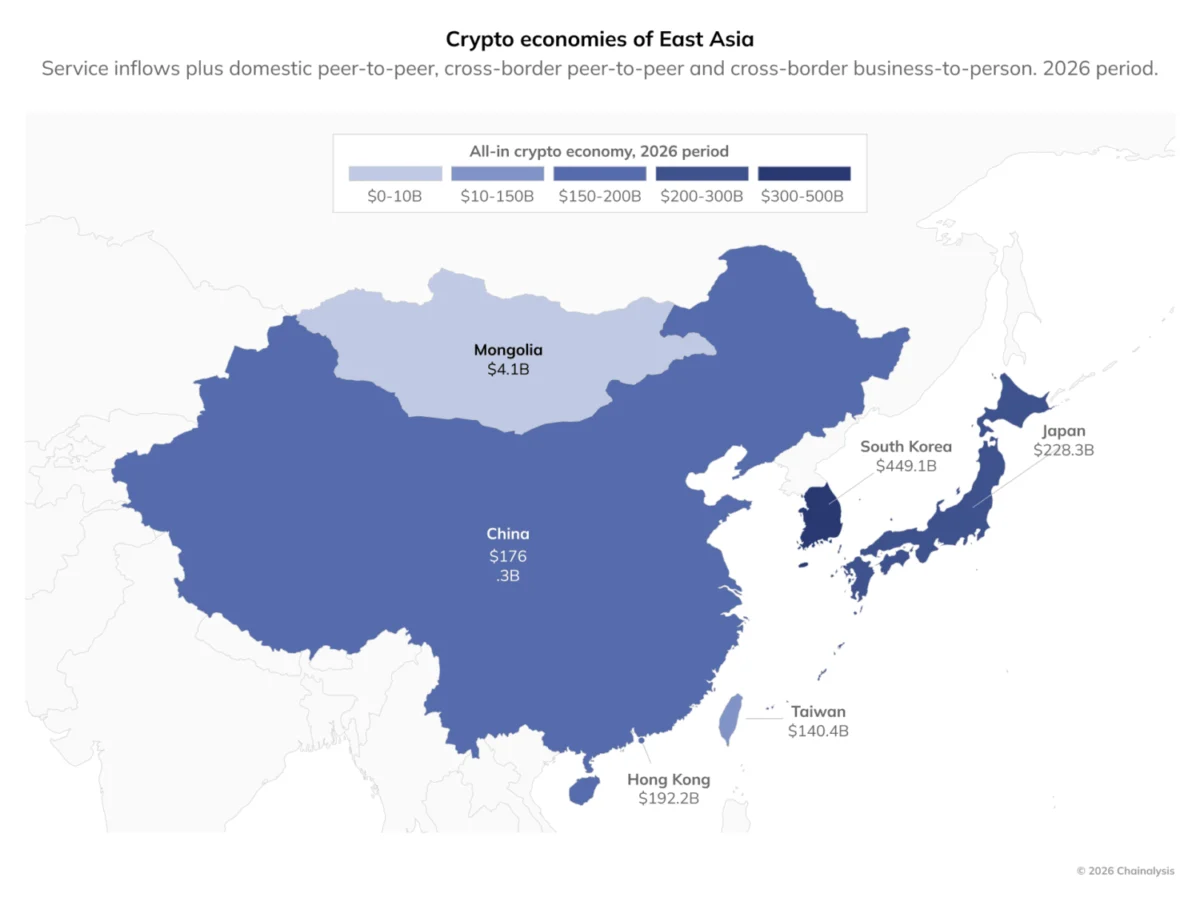
South Korea remains the cornerstone of the East Asian crypto market, ranking fifth globally in grassroots adoption. During the reporting period ending in June 2026, the nation’s crypto economy grew by 12.3%, reaching a total valuation of $449 billion. This growth was propelled by a 16.3% expansion in the exchange ecosystem, a feat achieved despite a global environment characterized by cautious sentiment.
The defining characteristic of the South Korean market is its "retail-driven" nature. Unlike Western markets where institutional hedge funds often lead the charge, South Korea’s activity is dominated by individual investors seeking high-risk, high-reward opportunities. Francis Kang, executive director of Korea Blockchain Week, notes that this retail dominance is currently in a state of evolution, moving from speculative "meme" trading toward more sophisticated thematic plays.

The most significant of these plays has been the "AI trade." South Korea’s mainstream equity market is heavily influenced by SK Hynix, a global leader in high-bandwidth memory chips essential for AI data centers. This national focus on AI infrastructure has bled into the crypto sector. By June 2026, AI-linked cryptocurrencies—digital assets associated with AI-focused projects or decentralized computing infrastructure—became the most popular thematic investment category in the country. Won-denominated trading volume for AI tokens was 19.5 times higher than the equivalent rate for the Japanese yen.
Specific tokens driving this volume included Worldcoin (WLD), which saw $7.41 billion in volume, followed by newcomers like SAHARA ($3.2 billion) and VIRTUAL ($2.7 billion). This intensity suggests that Korean retail traders are moving through technological narratives faster and with more capital than any other market measured globally.

Regulatory Shifting Sands: South Korea’s 2027 Outlook
While retail thrives, South Korean financial institutions remain in what experts call "preparatory mode." Legislative roadblocks have historically prevented major banks and securities firms from scaling crypto payments or investment products. However, a significant shift occurred in February 2026 when the government began easing a long-standing ban on corporate crypto trading.
Industry observers are now looking toward 2027 as a pivotal year. A 22% tax on crypto profits is scheduled to take effect in January 2027. If implemented, this could dampen retail enthusiasm while simultaneously providing the legal framework necessary for institutional entry. Jinhyeong Jo, a senior examiner at Korea’s Financial Intelligence Unit, suggests that the National Assembly’s upcoming discussions will determine whether the market shifts from a retail-heavy speculative hub to a balanced institutional-retail ecosystem.

Hong Kong: The Institutional Settlement Layer of Asia
While South Korea captures the retail spotlight, Hong Kong has successfully branded itself as the region’s institutional headquarters. With a $192 billion crypto economy, the city-state has utilized regulatory clarity to attract high-value participants. Institutional platforms—including over-the-counter (OTC) desks, custody providers, and prime brokerages—now account for 16% of Hong Kong’s service inflows. This is nearly triple the institutional share of any of its regional neighbors.
The Hong Kong government’s strategic "Five-Year Plan" has identified stablecoins, tokenized finance, and central bank digital currencies (CBDCs) as the pillars of its future financial architecture. By issuing stablecoin licenses in early 2026, Hong Kong provided the "regulatory moat" that traditional financial firms require to participate.

The data reveals a stark contrast in capital flow patterns. Between mid-2022 and mid-2026, cumulative net business-to-business (B2B) inflows reached $17.4 billion. During this same period, non-B2B channels—such as unregulated private wallets—showed consistently negative net flows. This indicates that capital is not merely passing through Hong Kong; it is settling within the regulated perimeter. As SB Seker, Head of APAC at Binance, observed, Hong Kong has proven that financial innovation and strict oversight can advance in parallel.
Japan’s Sophisticated Consumer Market and DeFi Migration
Japan’s $228 billion crypto economy presents a unique paradox. While often viewed as a conservative market dominated by large banks and SBI Group subsidiaries, it possesses one of the most sophisticated retail trader populations in the world. This is most evident in the rise of decentralized exchanges (DEXs), which now command a 34.5% market share in Japan—the highest in the region for any country with a mature centralized exchange sector.

Japanese traders have increasingly moved toward "perps" (perpetual futures) and on-chain hedging. Taishi Sato, CEO of DeFimans, attributes this to a population well-versed in foreign exchange (FX) trading. These "FX veterans" use venues like Hyperliquid to manage macro exposure, treating crypto as an extension of their broader equity and currency portfolios.
Despite this sophistication, growth has been hampered by a punitive tax regime, with marginal rates reaching as high as 55% during the 2026 study period. However, a wave of tax reforms that advanced in July 2026 is expected to lower these rates to approximately 20% for eligible gains. This change, combined with the introduction of yen-denominated stablecoins like JPYC and SBI’s JPYSC, is expected to catalyze a retail resurgence in 2027.

Mainland China: The Peer-to-Peer "Shadow" Economy
Mainland China remains the most enigmatic market in East Asia. Despite an official ban on crypto services, the domestic economy is estimated at a minimum of $176 billion. Unlike its neighbors, China’s market is almost entirely peer-to-peer (P2P), with P2P flows accounting for 59.1% of the total economy—a 3.5-fold increase in share over the previous year.
The surge in P2P activity appears to be a direct reaction to domestic policy shifts, specifically the expansion of the Social Credit System in March 2025. As the system integrated more deeply with banking compliance, individuals blacklisted or seeking to avoid heightened financial monitoring turned to stablecoins as a parallel financial rail.

Data shows that from March 2025 onward, domestic stablecoin payments saw 13 consecutive months of month-over-month growth. Perhaps more telling is the "velocity of money" metric. China turns over its self-custodied stablecoin holdings at a rate of 33.2 times per year—more than triple the global average of 9.3 times. This suggests that stablecoins in China are being used as active working capital for commerce rather than as a passive store of value. Users are transacting in small to mid-sized amounts ($100 to $10,000) at high frequencies, indicating a functional, albeit underground, payment ecosystem.
A Comparative Timeline of Regulatory Milestones (2024–2026)
To understand the current state of the East Asian market, one must look at the sequence of regulatory events that shaped participant behavior:

- Q1 2025: China updates its Social Credit System, leading to an immediate and sustained uptick in P2P stablecoin transfers as a censorship-resistant alternative.
- February 2025: Hong Kong’s Financial Services Commission announces a roadmap for corporate crypto participation, signaling the city’s intent to become an institutional hub.
- October 2025: Launch of JPYC, the first major yen-denominated stablecoin, providing a bridge between traditional Japanese finance and DeFi.
- February 2026: The South Korean government begins easing the ban on corporate crypto trading, initiating "preparatory mode" for major banks.
- June 2026: AI-crypto assets reach peak volume in South Korea, coinciding with the global boom in AI infrastructure equities.
- July 2026: Japan advances major tax reforms, moving toward a 20% flat tax on crypto gains, setting the stage for 2027 growth.
Implications for the Global Crypto Ecosystem
The divergence within East Asia offers a masterclass in the effects of different regulatory philosophies. China’s prohibitionist stance did not eliminate the market but instead forced it into a highly efficient, high-velocity P2P network. In contrast, the "supervised access" models of Hong Kong and Japan are successfully drawing institutional capital into the light, though they face the challenge of keeping retail participants engaged under strict tax and compliance burdens.
The region’s "institutional firepower," as Daniel Kim of Tiger Research describes it, is now undeniable. Hong Kong has successfully positioned itself as the settlement layer for cross-border institutional trades, while South Korea has demonstrated that retail markets can provide immense liquidity when aligned with broader technological trends like AI.

As we move toward 2027, the primary question for East Asia is whether these disparate environments will begin to converge. If South Korea successfully integrates institutions and Japan eases retail friction through tax reform, the region could move from a collection of "standalone hubs" to a unified engine for global digital asset adoption. For now, East Asia remains the world’s most diverse crypto economy—a region where stablecoins act as working capital in the West, institutional settlement tools in the South, and speculative vehicles in the North.