The decentralized finance ecosystem is currently grappling with a sophisticated shift in cybercriminal tactics as attackers increasingly bypass high-profile, open-source protocols to target unverified and closed-source smart contracts. For years, the blockchain security community has debated whether open-sourcing code acts as a deterrent or a roadmap for malicious actors. While the vast majority of major DeFi protocols choose transparency by verifying their source code on block explorers like Etherscan, a growing subset of developers has opted for "security through obscurity." Recent data suggests this strategy is failing spectacularly, as enterprising hackers utilize advanced decompilation tools and artificial intelligence to reverse-engineer hidden logic, leading to the theft of tens of millions of dollars in the first half of 2026.
According to a comprehensive analysis of on-chain activity, attackers successfully siphoned $36.7 million from just four major exploits involving unverified smart contracts over the past six months. While this figure represents a fraction of the $1 billion lost across the broader DeFi landscape during the same period, it signals a dangerous trend. The exploits demonstrate that attackers are no longer deterred by the absence of human-readable Solidity code. Instead, they are methodically hunting for "dark" contracts—those that manage significant user funds but have never had their implementation details made public. This systematic approach suggests that the technical barrier to reverse-engineering Ethereum Virtual Machine (EVM) bytecode has dropped significantly, turning closed-source deployments into high-value targets for specialized exploitation.
The Anatomy of the 2026 Unverified Contract Exploits
The data identifies four primary protocols that fell victim to this trend between January and May 2026. In each instance, the vulnerability existed within the protocol’s own core code, which remained unverified on relevant block explorers at the time of the breach. This allowed the bugs to sit dormant, often for years, until an attacker took the time to decompile the bytecode and identify the logical flaws.
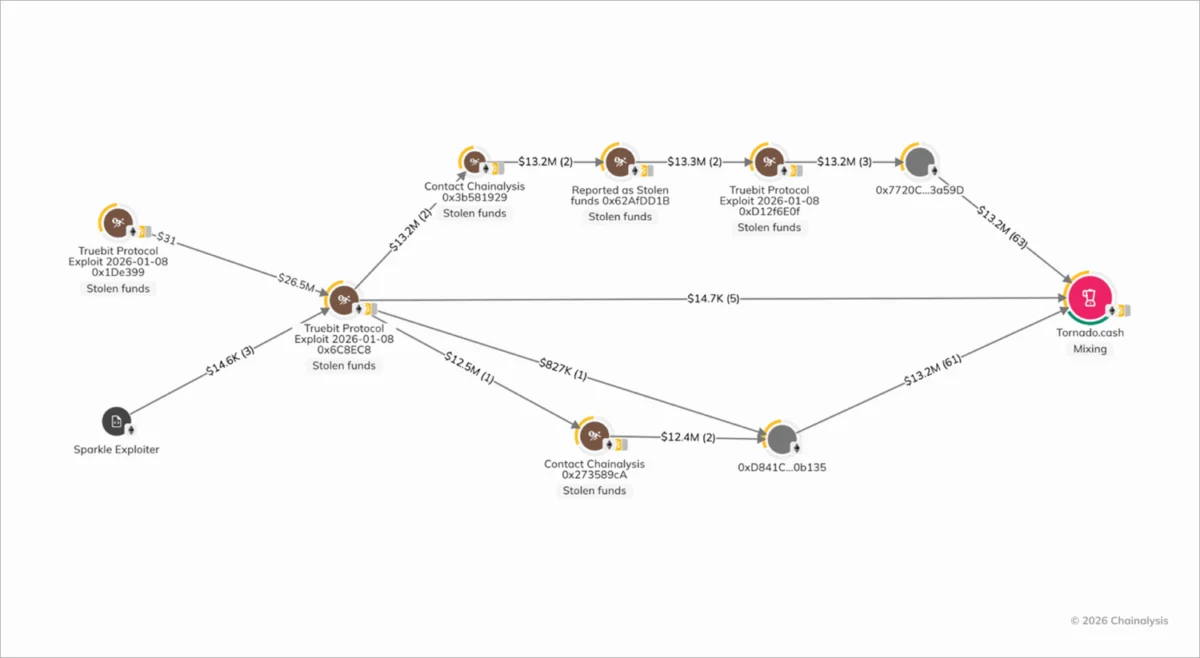
The most significant loss occurred on January 8, 2026, when Truebit, a long-standing tokenized asset protocol, was drained of $26.2 million. The vulnerability was traced back to a contract that had been deployed on the Ethereum mainnet since 2021. Despite its age and the volume of assets it managed, the implementation had never been verified on Etherscan. The attacker identified an integer overflow vulnerability within the getPurchasePrice() function, which governed the protocol’s bonding curve. Because the contract was written in an older version of Solidity (v0.5.3) that lacked automatic overflow protections, the attacker was able to input extremely large values that caused the calculation to wrap around to near-zero. This allowed the perpetrator to mint hundreds of millions of TRU tokens for a negligible cost before burning them back into the protocol for $26.2 million worth of ETH.

Later that month, on January 25, Aperture Finance suffered a $3.2 million exploit due to an input validation bypass. The vulnerability allowed the attacker to manipulate transferFrom calls within an unverified contract. By the time the spring of 2026 arrived, the trend had accelerated. On May 5, the Ekubo protocol lost $1.4 million when a callback function failed to properly verify the identity of a payer—a flaw that was hidden within unverified bytecode. Just two days later, on May 7, Trusted Volumes was hit for $5.9 million through an access control flaw in its RFQ (Request for Quote) swap proxy. These events highlight a consistent pattern: the lack of public code did not prevent the exploit; it only prevented the community and white-hat researchers from identifying and fixing the bugs before they were weaponized.
The Rise of Systematic Hunting and AI-Assisted Exploitation
The shift toward targeting unverified contracts is not accidental. On-chain forensics reveal that the actors behind these breaches are often "systematic hunters." In the case of the Truebit exploit, the attacker’s wallet address was linked to a previous, smaller hack of the Sparkle protocol just twelve days earlier, which yielded 5 ETH. This suggests a "leveling up" process, where attackers test their decompilation and exploitation scripts on smaller targets before moving to multi-million dollar "dark" contracts.
Several factors have converged to make unverified contracts more attractive to hackers than their open-source counterparts. First, the development of sophisticated EVM decompilers has made it possible to turn raw bytecode into readable, albeit complex, pseudo-code. While this output is less intuitive than original Solidity source code, it is more than sufficient for an experienced auditor—or a motivated thief—to map out a contract’s logic.
Second, the emergence of Large Language Models (LLMs) and specialized AI agents has revolutionized the scanning process. Research conducted by Anthropic in 2025 and early 2026 demonstrated that AI agents can autonomously identify vulnerabilities in smart contracts, even those deployed after the models’ training data cutoff. When these AI tools are applied to decompiled bytecode, they can scan thousands of unverified contracts across multiple chains simultaneously, flagging common patterns like integer overflows or missing access controls that human eyes might miss.
Furthermore, the competitive landscape of DeFi security plays a role. Verified contracts are constantly scanned by thousands of "white-hat" bots and bug bounty hunters. An unverified contract, however, is often ignored by the legitimate security community because it is difficult to audit. This creates a "blind spot" where a protocol may operate for years without a single security researcher looking at its code, leaving the door wide open for a "black-hat" actor who is willing to do the work of decompilation.

Technical Analysis: Why Obscurity is No Longer a Shield
The core of the issue lies in the nature of the Ethereum Virtual Machine. Every contract deployed to an EVM-compatible chain (including Ethereum, Base, Arbitrum, and BNB Chain) exists as bytecode. Verification is simply the process of proving that a specific set of Solidity source code compiles into that exact bytecode. When a developer chooses not to verify, they aren’t actually "hiding" the logic from the network; they are merely making it harder for humans to read.
The exploits of early 2026 prove that "harder to read" is no longer a sufficient defense. For instance, the Trusted Volumes exploit involved a proxy contract. In the DeFi world, proxies are often used to make contracts upgradeable. Frequently, the "proxy" shell is verified, but the "implementation" contract—where the actual logic and fund management reside—is left unverified. Attackers have learned to look past the verified shell to find the hidden implementation, which often contains the actual vulnerabilities.
The implications for the broader ecosystem are profound. As automated tooling lowers the cost of finding vulnerabilities, the time-to-exploit for a buggy contract is shrinking. In previous years, a bug might sit undiscovered for the life of a protocol. In 2026, the combination of pipeline-driven scanning and AI-assisted analysis means that any contract holding significant value is likely being probed by automated systems on a near-constant basis.
Industry Reactions and the Call for "Radical Transparency"
The fallout from these exploits has sparked a heated debate among DeFi developers and security auditors. Following the Trusted Volumes hack, prominent developers, including Yearn.finance’s banteg, took to social media to highlight the risks of unverified code. The consensus among security experts is shifting: source code verification must be viewed as a non-negotiable security primitive, rather than an optional feature.
"If a contract handles user money and isn’t verified, it should be treated as a critical risk by every user and every aggregator," noted one security researcher in the wake of the Ekubo exploit. Many in the industry are calling for DeFi aggregators and front-end interfaces to implement "warning labels" for any interaction involving unverified implementation contracts.

In response to the trend, security firms are advocating for a four-pillar approach to protocol safety:
- Universal Verification: Protocols must verify every contract, including all implementation logic behind proxies and legacy contracts that may still hold funds.
- Production-Ready Audits: Security reviews must be conducted on the final bytecode as it exists on the mainnet, ensuring that no "last-minute" changes or deployment errors introduced vulnerabilities.
- Inclusive Bug Bounties: Bug bounty programs should explicitly cover unverified and legacy contracts to incentivize white-hat researchers to perform the difficult work of decompilation.
- Real-Time On-Chain Monitoring: Since exploits now unfold in the span of a few blocks, protocols must employ automated threat detection tools. Systems like Chainalysis Hexagate are becoming essential, as they can identify anomalous transaction patterns—such as the massive minting of tokens in the Truebit case—and trigger an emergency pause before funds are fully drained.
The Future of Smart Contract Security
As we look toward the remainder of 2026 and into 2027, the convergence of AI and blockchain technology suggests that the "arms race" between attackers and defenders will only intensify. The recent WIRED investigation into automated software supply chain attacks on GitHub mirrors the patterns now seen on-chain. In both cases, automation has significantly lowered the "cost per attack," allowing malicious actors to cast a much wider net.
The "Hidden Code Crisis" serves as a stark reminder that the fundamental ethos of blockchain—transparency—is also its greatest security feature. By attempting to hide code, developers do not protect their users; they merely deprive them of the collective protection of the global security community. In an era where machines can read bytecode as easily as humans read Solidity, the only true defense is rigorous, public, and continuously monitored code.
For DeFi users, the lesson is equally clear. The presence of a "verified" checkmark on a block explorer is not just a technical detail; it is a prerequisite for trust. As the industry matures, the protocols that survive will be those that embrace radical transparency, acknowledging that in the world of decentralized finance, there is no such thing as a secret once it is written to the blockchain. The $36.7 million lost in early 2026 is a expensive tuition fee for a lesson the industry must learn: obscurity is not security, and the "dark" corners of the blockchain are exactly where the predators are most likely to strike.