The pattern is stark and stubbornly persistent within the cryptocurrency ecosystem: nearly every significant crypto hack concludes with stolen funds embarking on a complex journey across multiple blockchain networks before ultimately dissolving into the anonymity of a crypto mixer, most frequently Tornado Cash. This week provided yet another vivid, real-time illustration of this established playbook, as the address definitively linked to the recent Triple-A exploiter funneled millions directly into the crypto industry’s most infamous laundering tool. This occurred despite years of concerted efforts by the U.S. government to dismantle or effectively shut down the service. For observers of the digital asset space, this recurring scenario, while perhaps no longer surprising in its occurrence, still prompts reflection on the speed and deliberate nature of these illicit financial maneuvers.
A Fresh Deposit Reignites An Old Question of Enforcement
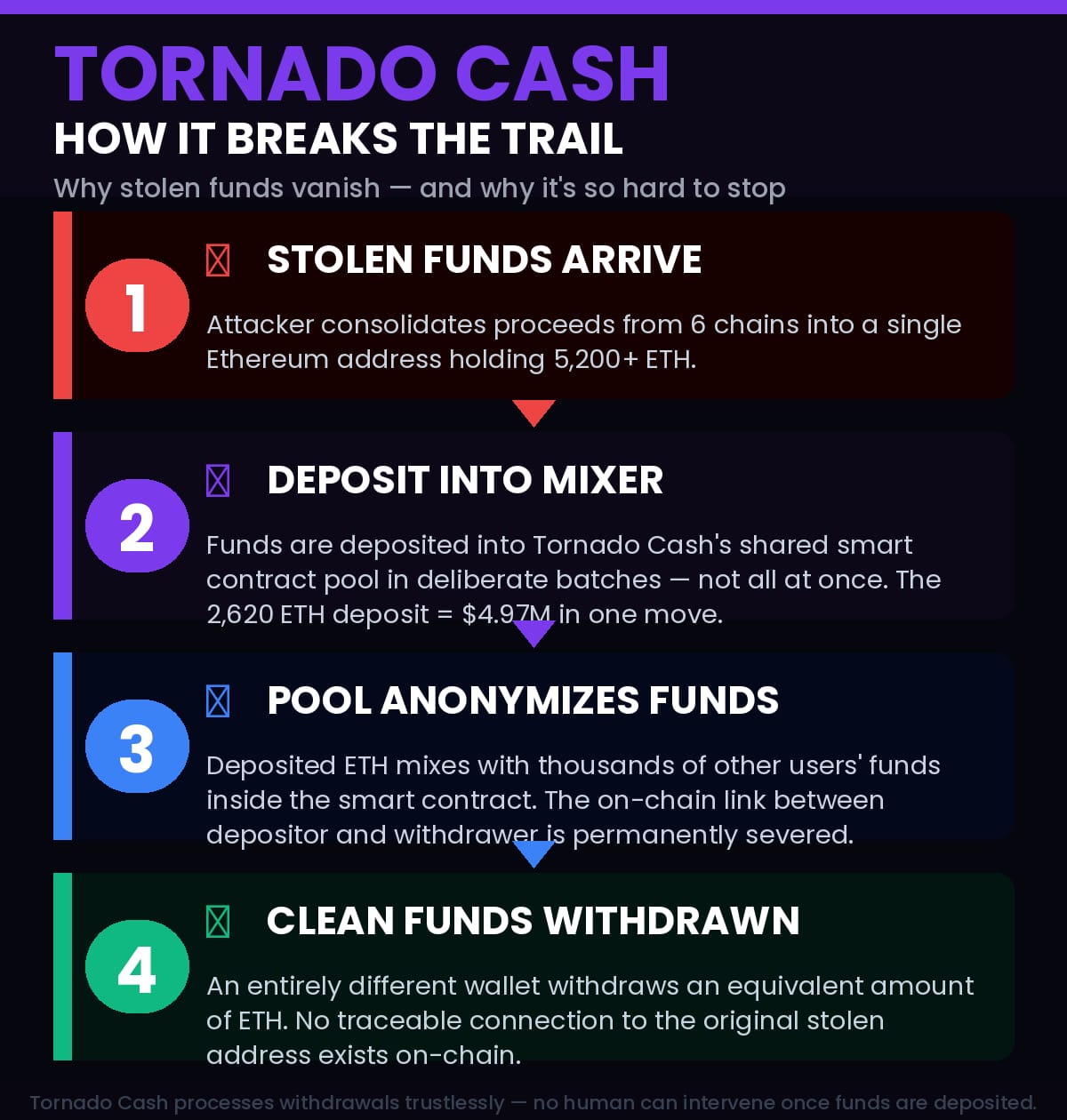
The latest instance of this familiar sequence was prominently flagged by blockchain security firm PeckShield. Their on-chain analysis revealed that the address identified as belonging to the Triple-A exploiter deposited 2,620 ETH, valued at approximately $4.97 million at the time of the transaction, directly into Tornado Cash. This particular deposit is significant not only for its substantial monetary value but also for its timing. It transpired barely two weeks after the initial breach, indicating a calculated, rather than panicked, approach to asset obfuscation. The attacker’s choice to move funds through the mixer in batches, rather than in a single, large transaction, further underscores the deliberate, process-driven nature of this laundering operation. This methodical approach suggests an understanding of on-chain forensics and an attempt to complicate tracing efforts by staggering withdrawals and potentially varying amounts, a common tactic employed by sophisticated actors.
This recent influx of illicit funds into Tornado Cash immediately reignites critical questions surrounding the efficacy of existing regulatory frameworks and the persistent challenges faced by law enforcement agencies in combating crypto-enabled financial crime. It highlights a fundamental tension between the principles of decentralization and privacy, which are core tenets of many blockchain technologies, and the imperative to prevent their exploitation for illicit purposes. The sheer volume of funds consistently flowing through such mixers necessitates a deeper examination of the technological and legal landscapes that permit their continued operation.
Inside the Multi-Chain Triple-A Hack: A Case Study in Modern Exploitation

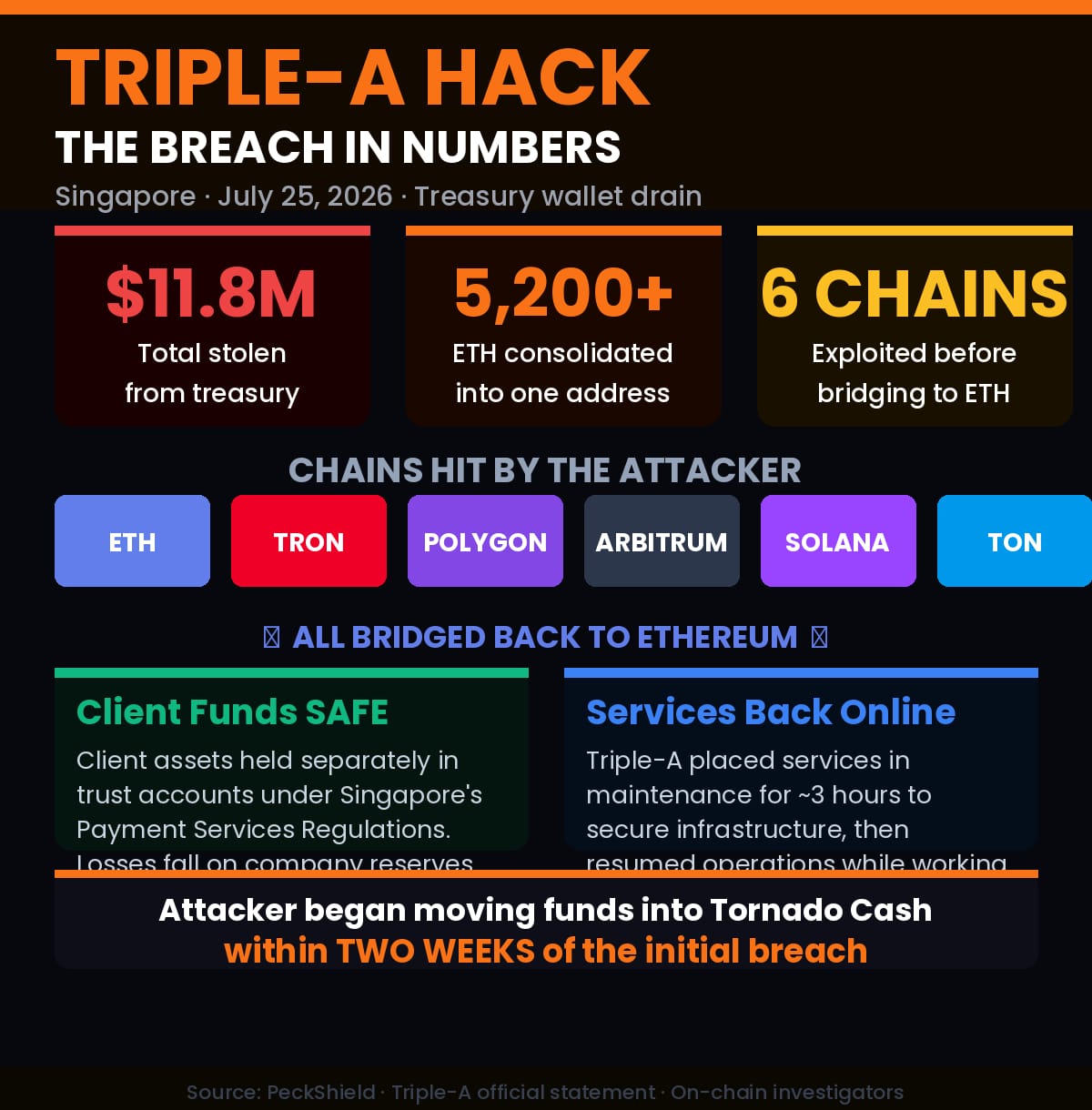
To fully appreciate the implications of this latest Tornado Cash deposit, it is crucial to understand the preceding events that impacted Triple-A. Triple-A, a Singapore-based fiat-to-crypto payment gateway, experienced an unauthorized drain of its treasury wallets on July 25, 2026. The initial estimates of losses stood at approximately $9.3 million, but as on-chain investigators meticulously tracked additional outflows over the subsequent days, the total climbed to roughly $11.8 million. This particular exploit demonstrated a sophisticated understanding of cross-chain asset management, as the attacker systematically pulled funds from a genuinely wide spectrum of chains. Wallets on Ethereum, TRON, Polygon, Arbitrum, Solana, and The Open Network (TON) were targeted, showcasing the attacker’s ability to navigate and consolidate assets across diverse blockchain ecosystems. Following these multi-chain withdrawals, the attacker then meticulously bridged all the stolen proceeds back to Ethereum, consolidating them into a single address that ultimately held more than 5,200 ETH. This consolidation phase is a critical step in preparing funds for a mixer, as it simplifies the subsequent laundering process.
Triple-A swiftly acknowledged the breach, issuing a public statement through its newsroom. Their official communication was precise, emphasizing that client funds remained unaffected. The company clarified that client assets are held separately in trust accounts with independent custodians, in strict adherence to Singapore’s stringent Payment Services Regulations. This critical distinction meant that the financial losses were absorbed by the company’s own operational reserves, rather than impacting user balances. The incident was specifically confined to wallets operated by Triple A Technologies Pte. Ltd., their Singaporean entity, with no other Triple-A entities reporting any compromise. In the immediate aftermath, Triple-A temporarily placed its services into maintenance mode for approximately three hours to secure its infrastructure and prevent further unauthorized access. The company has since confirmed its active collaboration with a consortium of internal and external cybersecurity experts, blockchain forensics specialists, and the Singapore Police Force, all working in concert to trace and potentially recover the stolen assets. This multi-faceted response underscores the severity of the incident and the complex nature of post-breach investigations in the crypto space.
The Mechanics of a Tornado Cash Laundering Run: Decentralization as an Obstacle
The operational efficacy of Tornado Cash, and indeed other decentralized mixers, often eludes a comprehensive understanding among the general public. It is not a centralized entity like a traditional exchange or a bank that can be readily frozen or shut down by a single authority. Instead, Tornado Cash operates as a decentralized, non-custodial smart contract system. Users deposit cryptocurrency into a shared, anonymous pool, and after a variable period, they can withdraw an equivalent amount from a completely different address. The crucial innovation here is that this process effectively severs the on-chain link between the original sender and the ultimate recipient, thereby making it exceedingly difficult for forensic analysts to trace the flow of funds. This inherent anonymity is precisely why the tool appeals equally to individuals seeking legitimate privacy for their financial transactions and to malicious actors aiming to obscure the origins of stolen funds. The protocol itself, being code-based and permissionless, does not discriminate between these user types, a neutrality that forms the bedrock of its regulatory challenge.
For an individual or group in possession of freshly stolen assets, say $10 million in cryptocurrency, the appeal of a service like Tornado Cash is self-evident. Centralized cryptocurrency exchanges, by design and regulatory mandate, can freeze suspicious accounts, flag large deposits, and are legally obligated to cooperate with law enforcement agencies, including responding to subpoenas and information requests. A decentralized mixer, conversely, cannot be subpoenaed in the traditional sense. Its underlying code, once deployed, continues to execute on thousands of distributed nodes across the globe, irrespective of any actions taken against specific websites, developers, or even alleged facilitators. This fundamental structural difference – the immutable and autonomous nature of smart contracts versus the centralized control of traditional financial intermediaries – is precisely why attackers have consistently relied on such tools for years. The Triple-A exploiter, in choosing this well-worn path, is not innovating but rather leveraging a proven, resilient method for laundering illicit proceeds.
Historical Context: Tornado Cash and the Turbulent Regulatory Landscape
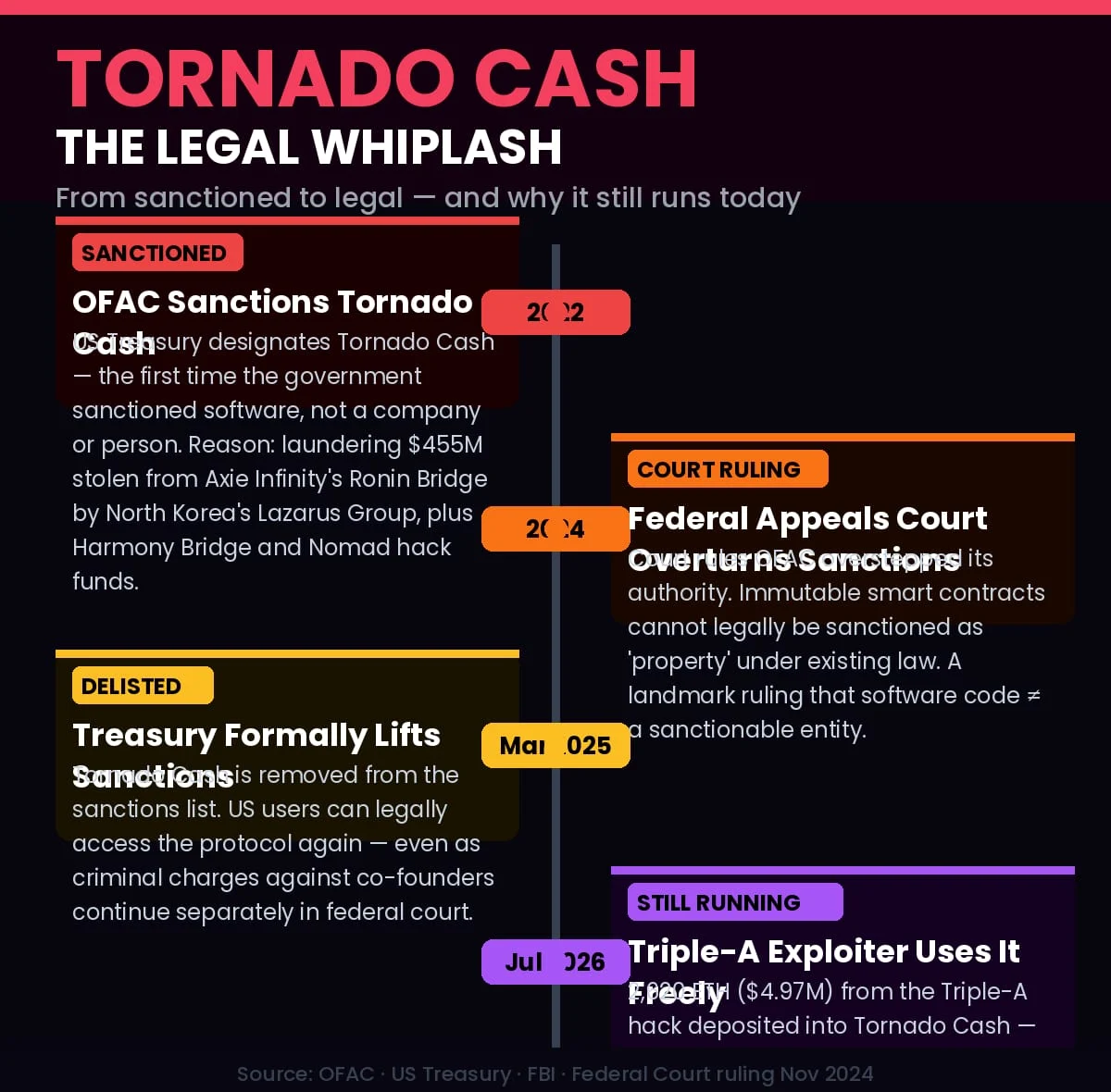
Tornado Cash’s protracted and often turbulent relationship with U.S. regulators provides crucial context for understanding its continued availability as a laundering option. The Treasury Department’s Office of Foreign Assets Control (OFAC) initially sanctioned Tornado Cash in August 2022. This unprecedented action was taken due to the protocol’s significant role in laundering over $455 million stolen from Axie Infinity’s Ronin Bridge by the notorious North Korean state-sponsored hacking group, Lazarus Group, in addition to funds from other high-profile exploits such as the Harmony Bridge and Nomad hacks. This marked a historic moment: it was the first time the U.S. government had ever sanctioned a piece of software — a set of smart contracts — rather than a specific company, individual, or physical entity. This regulatory precedent was widely seen as a significant escalation in the government’s efforts to combat illicit finance in the digital asset space.
However, this sanction did not withstand legal challenges in the long term. A federal appeals court, in a landmark ruling in November 2024, determined that OFAC had overstepped its statutory authority by sanctioning a decentralized protocol rather than identifiable persons or entities. This legal setback forced the Treasury to formally lift the sanctions on Tornado Cash in March 2025. This reversal effectively restored legal access to the protocol for U.S. users, even as separate criminal charges against its co-founders continued to progress in federal court, highlighting the complex and often contradictory nature of regulating decentralized technologies. This legal whiplash is a profoundly important contextual factor, as it largely explains why the tool remains fully operational and accessible to anyone, including sophisticated hackers, seeking to obscure the origins of stolen funds in 2026. The lifting of sanctions created a regulatory void that continues to be exploited.
Broader Landscape of Crypto Crime: The Persistent Challenge of Tracing and Recovery
The Triple-A incident and the subsequent use of Tornado Cash are not isolated events but rather symptomatic of a larger, systemic challenge within the rapidly evolving digital asset landscape. According to reports from blockchain analytics firms like Chainalysis and Elliptic, billions of dollars are stolen from cryptocurrency platforms annually. In 2023 alone, Chainalysis reported that illicit addresses received $24.2 billion, with a significant portion of this attributed to hacks and scams. Mixers like Tornado Cash play a critical role in this illicit financial ecosystem, having laundered an estimated 20-30% of all illicit funds in some periods. The volume of funds flowing through these services underscores their importance to criminal operations.
The advent of cross-chain bridges and multi-chain protocols, while beneficial for interoperability and user experience, has inadvertently created new vectors for attack and complicated the task of forensic analysis. Attackers can now exploit vulnerabilities on one chain, rapidly transfer funds to another, and then consolidate them on a third before employing mixers. This multi-layered approach makes traditional linear tracing methods less effective and demands increasingly sophisticated tools and techniques from blockchain security firms and law enforcement. The sheer scale and complexity of these operations necessitate a global, coordinated response that often struggles to keep pace with the rapid innovation in illicit finance.
Challenges for Law Enforcement and Industry: A Cat-and-Mouse Game
The ongoing availability and utilization of services like Tornado Cash present formidable challenges for law enforcement agencies worldwide. While traditional financial systems have established robust Anti-Money Laundering (AML) and Know Your Customer (KYC) regulations, the decentralized nature of crypto mixers bypasses these controls. This makes it exceedingly difficult to identify the individuals behind illicit transactions, collect evidence for prosecution, and ultimately recover stolen assets. Even with advanced blockchain tracing capabilities, once funds enter a mixer, the trail often goes cold, rendering asset recovery nearly impossible.
The cryptocurrency industry itself is grappling with this issue. While many legitimate platforms implement stringent compliance measures, the open-source and permissionless nature of decentralized protocols means that they can be used for any purpose. This has led to an ongoing debate within the crypto community about the balance between privacy and accountability. Some argue for stricter controls and the development of privacy-enhancing technologies that incorporate compliance features, while others champion absolute decentralization and user privacy as fundamental rights, even if they can be abused. This philosophical divide complicates efforts to forge a unified industry response.
Implications for DeFi Security and Future Regulation
The persistent use of Tornado Cash by exploiters, as demonstrated by the Triple-A hack, carries significant implications for the future of decentralized finance (DeFi) security and regulatory approaches. Firstly, it highlights the urgent need for continuous innovation in blockchain security. Projects must invest heavily in comprehensive audits, bug bounty programs, and real-time monitoring to prevent exploits in the first place. Secondly, it underscores the limitations of current regulatory frameworks when confronted with truly decentralized, code-based protocols. The legal precedent set by the lifting of Tornado Cash sanctions suggests that traditional enforcement mechanisms designed for centralized entities may not be applicable or effective for all aspects of the Web3 landscape.
This situation calls for a nuanced approach to regulation that acknowledges the unique characteristics of blockchain technology while simultaneously addressing the undeniable risks of illicit finance. Future regulatory strategies may need to focus on points of interaction between the centralized and decentralized worlds, such as on-ramps and off-ramps from fiat currency, or on fostering greater cooperation among international law enforcement agencies and blockchain analytics firms. Without a more effective mechanism to deter and prevent the laundering of stolen funds through such tools, the cycle of exploits, disappearances, and economic losses is likely to continue, eroding trust in the broader digital asset ecosystem. The Triple-A hack serves as a stark reminder that while the technology evolves rapidly, the fundamental challenges of security and accountability remain constant.