Bitcoin, the vanguard of the cryptocurrency market, is once again at a pivotal juncture, presenting prospective investors with the perennial dilemma of when to enter. As of the latest reporting, Bitcoin is trading in the vicinity of $61.8k. This comes after a significant price retracement last week that flirted with the crucial long-term support level of $60,000, a threshold that has historically acted as a psychological and technical barrier. For a considerable segment of potential buyers, those who have been patiently awaiting a substantial bearish movement to strategically accumulate, this current price action has engendered a state of indecision. The core of their quandary lies in determining whether to make an immediate purchase or to hold out for a further decline, with some speculating about a potential drop to $50,000 or even lower. However, the market’s inherent unpredictability means there is no definitive assurance that such a pronounced bearish trajectory will materialize, thereby intensifying the psychological intrigue surrounding this market phase.
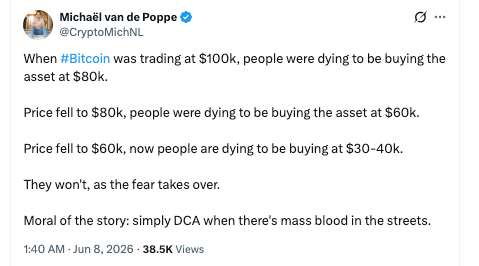
This prevailing sentiment was articulately summarized by Michael Van de Poppe, a respected analyst in the cryptocurrency space, through a recent post on the social media platform X. His commentary highlighted a recurring pattern of investor behavior observed across different market cycles. Van de Poppe’s remarks echoed sentiments that were prevalent approximately a year ago, when Bitcoin was comfortably positioned above the $100,000 resistance level. At that time, a significant number of individuals who had missed out on the anticipated bull run of 2024-2025 expressed their regret and voiced an intention to invest once Bitcoin retraced to the $80,000 mark. Now, with the price substantially below that previous benchmark, the anticipated buying momentum has yet to materialize with the expected force. Many of these same individuals appear to be maintaining their hesitant stance, holding out for an even more significant price drop, a strategy that could potentially lead them to miss out on another investment opportunity, much like in previous cycles.
The Psychology of Missed Opportunities
The pattern of hesitation and delayed entry during periods of market correction is not an anomaly confined to the current Bitcoin cycle. Historical data from previous Bitcoin market cycles reveals a strikingly similar behavioral dynamic. In 2018, for instance, many investors who had vowed to acquire Bitcoin once it breached the $10,000 mark found themselves unable to commit capital even when the price plummeted to as low as $3,200. This psychological barrier persisted through the 2022 bear market as well, where similar hesitations were observed. In retrospect, the periods of maximum market distress, characterized by widespread capitulation and negative sentiment, often presented the most potent opportunities for long-term asset accumulation. Yet, during these critical junctures, retail investor participation frequently waned. In contrast, institutional investors and seasoned market participants have often employed strategies such as Dollar Cost Averaging (DCA) during these "bloody" market phases, effectively transforming volatility into a tool for strategic acquisition.
The efficacy of strategies like DCA lies in their ability to mitigate the emotional impact of market fluctuations. By investing a fixed amount of money at regular intervals, regardless of the asset’s price, investors can acquire more units when prices are low and fewer when prices are high, thereby achieving a lower average cost basis over time. This disciplined approach allows investors to leverage market volatility as an advantage rather than succumbing to it as a detriment. The inherent difficulty in accurately predicting the precise bottom of any market, particularly in the highly volatile cryptocurrency sector, underscores the value of such systematic investment strategies. The current market presents a broad range of potential support levels, with estimates varying significantly, from $30,000 to $60,000. As the price of cryptocurrencies continues to fluctuate, these perceived support levels can shift, contributing to investor confusion and paralysis. In such an environment, maintaining investor discipline becomes paramount to capitalizing on the potential opportunities presented by market downturns.
Bitcoin’s Recent Price Action: A Detailed Chronology
To fully understand the current market sentiment, it is crucial to examine the recent price trajectory of Bitcoin. The cryptocurrency experienced a significant surge in late 2023 and early 2024, driven by a confluence of factors including the anticipation and subsequent approval of spot Bitcoin Exchange-Traded Funds (ETFs) in the United States. This led to Bitcoin reaching all-time highs in March 2024, briefly touching above $73,000.
Following this peak, the market entered a consolidation phase. For several weeks, Bitcoin traded within a relatively tight range, with investors reassessing the market’s direction. The approval of spot Bitcoin ETFs was a landmark event, opening the doors for institutional capital and a broader range of retail investors to gain exposure to Bitcoin without directly holding the cryptocurrency. This influx of investment initially fueled the upward momentum.

However, by May 2024, a discernible shift in market sentiment began to emerge. Profit-taking among early investors, coupled with macroeconomic uncertainties, including inflation concerns and interest rate policies from central banks, started to exert downward pressure on Bitcoin’s price. The market experienced several sharp corrections, with significant drops occurring over short periods.
One such notable correction took place in the week leading up to the current reporting. Bitcoin’s price fell from a weekly high of approximately $67,000 down to a low of around $60,000, testing the critical psychological and technical support level. This decline was met with a mixture of concern and anticipation. While some investors feared a deeper descent into a bear market, others saw this as a potential "buy the dip" opportunity.
The current trading price of $61.8k represents a slight recovery from the recent lows, but it still remains significantly below the all-time highs. This trading range has created a period of heightened uncertainty, where the market is caught between the optimism of potential future gains and the fear of further price depreciation. The debate among investors is no longer about whether Bitcoin will reach new highs, but rather about the extent of any potential correction and the optimal entry points during this period of volatility.
Supporting Data and Market Indicators
Analysis of on-chain data and market indicators provides further context to the current investor sentiment. Metrics such as the Net Unrealized Profit/Loss (NUPL) ratio, which measures the overall profit or loss of all Bitcoin holders, can indicate whether the market is in a state of euphoria or capitulation. During periods of extreme optimism, NUPL tends to be high, suggesting that most holders are in profit. Conversely, a low NUPL, especially when in negative territory, can signal widespread losses and a potential bottoming of the market.
Current NUPL readings, while not at extreme capitulation levels, suggest that a significant portion of recent buyers may be underwater or experiencing unrealized losses. This can contribute to increased selling pressure if prices decline further, as these holders may be more inclined to exit their positions to cut losses.
Furthermore, the movement of Bitcoin on exchanges provides insights into investor behavior. An increase in Bitcoin balances on exchanges can indicate that investors are moving their holdings to exchanges, potentially to sell. Conversely, a decrease in exchange balances suggests that investors are withdrawing Bitcoin to hold it long-term, often in cold storage, indicating a belief in future price appreciation. Recent data shows a fluctuating trend in exchange balances, reflecting the ongoing debate between short-term traders and long-term holders.
The performance of Bitcoin relative to traditional assets also plays a role. In times of macroeconomic uncertainty, investors often flock to perceived safe-haven assets. While Bitcoin has been touted as a digital gold, its correlation with risk assets like technology stocks can increase during periods of market stress, making it susceptible to broader market sell-offs. The current inflationary environment and the cautious stance of central banks regarding interest rate cuts contribute to this broader market sentiment, indirectly impacting Bitcoin’s price.
Expert and Industry Reactions
The current market dynamic has drawn commentary from various figures within the crypto industry. Beyond Michael Van de Poppe, other analysts have weighed in on the potential direction of Bitcoin. Some prominent figures continue to advocate for a long-term bullish outlook, emphasizing the structural changes in the market, such as the increasing adoption of Bitcoin by institutions and the upcoming halving event’s impact on supply. They often point to historical patterns where significant corrections have preceded major bull runs.
However, a more cautious perspective is also prevalent. Some analysts highlight the potential for extended periods of sideways trading or further downside pressure, citing macroeconomic headwinds and the possibility of regulatory developments that could impact the crypto market. The debate often centers on whether the current market is in a healthy correction phase within a larger bull market or if it is signaling the beginning of a more prolonged bear cycle.
The institutional adoption narrative remains a key talking point. The continued inflows into spot Bitcoin ETFs are viewed by many as a strong indicator of sustained institutional interest. However, the pace of these inflows can fluctuate, and significant outflows could signal a shift in institutional sentiment. The ongoing dialogue surrounding potential interest rate cuts by the U.S. Federal Reserve also remains a critical factor, as lower interest rates typically make riskier assets like cryptocurrencies more attractive.
Broader Impact and Implications
The current price action and the psychological dynamics at play have significant implications for the broader cryptocurrency market. Bitcoin’s price movements often dictate the direction of altcoins, which are generally more volatile. If Bitcoin continues to struggle to regain upward momentum or experiences a significant decline, it could trigger a cascade of selling across the altcoin market, potentially leading to substantial losses for many investors.
The ongoing indecision among retail investors also has broader economic implications. For individuals who have been waiting to enter the market, prolonged hesitation can lead to missed opportunities, especially if Bitcoin eventually embarks on another significant upward trajectory. This can create a sense of FOMO (Fear Of Missing Out) and lead to impulsive buying decisions at inflated prices, a pattern that has historically led to investor losses.
The concept of "never buy the dip" becoming a self-fulfilling prophecy for many is a critical takeaway. When fear dictates investment decisions, individuals tend to sell during downturns and only consider buying when prices are already high, thereby consistently entering the market at suboptimal points. This behavior contrasts sharply with the strategies employed by seasoned investors who leverage periods of market fear to accumulate assets at lower prices.
The long-term implications of this cycle of hesitation are significant for the maturation of the cryptocurrency market. A more widespread adoption of disciplined investment strategies, such as DCA, and a greater understanding of market psychology could lead to more stable and sustainable growth for digital assets. However, as long as fear remains a dominant emotion in investment decisions, the pattern of missed opportunities is likely to persist, shaping the entry points for a generation of crypto investors. The market continues to evolve, and the current juncture serves as a critical case study in the enduring power of human psychology over rational investment strategy.