For years, the crypto industry’s narrative of "record highs" was almost exclusively tethered to price fluctuations, driven largely by speculative fervor and market sentiment. However, a profound and structural transformation has been quietly unfolding beneath the surface, far from the sensational headlines of memecoins and ETF flows. This shift signifies the maturation of the digital asset space into an ecosystem where tokens increasingly function as revenue-sharing instruments, aligning the interests of protocols with their holders in a manner reminiscent of traditional finance’s dividend-paying stocks.
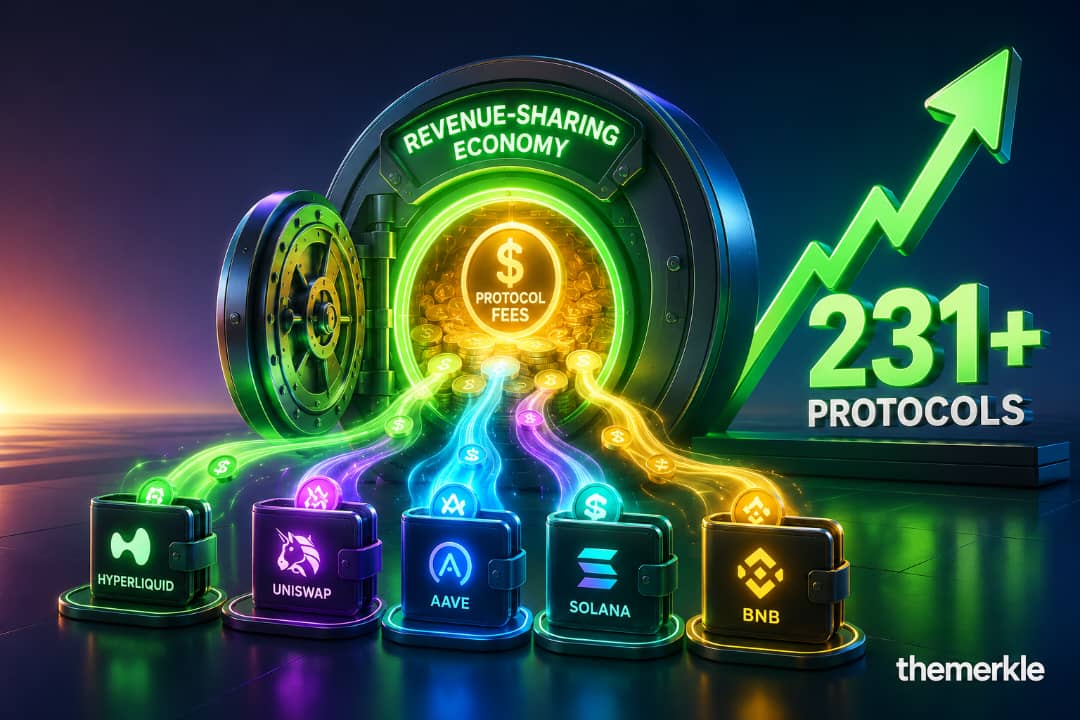
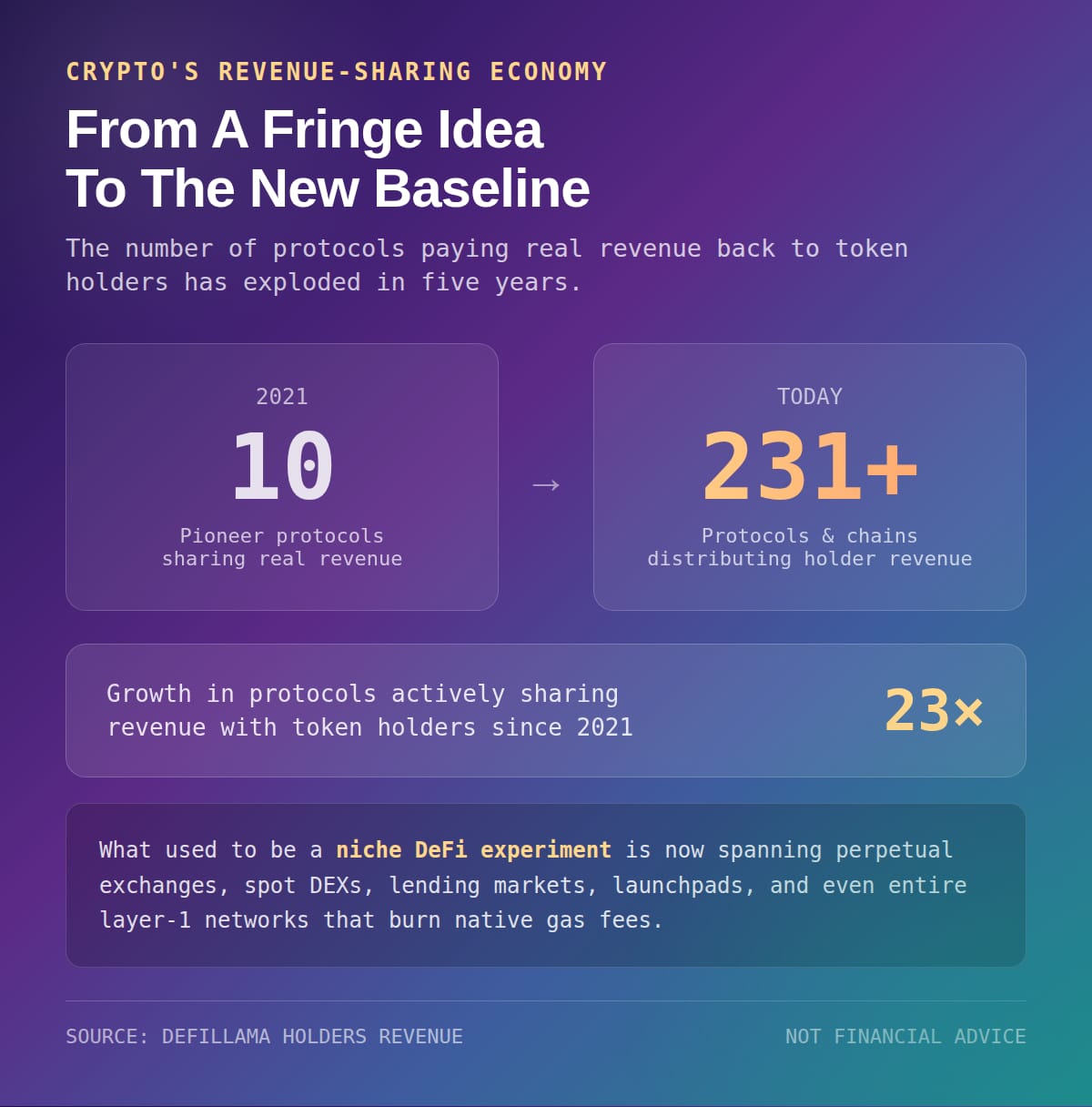
This is not merely a transient trend but a fundamental re-engineering of tokenomics. Five years ago, the concept of a crypto protocol actively distributing its earnings to token holders was a nascent idea, embraced by only a handful of experimental projects. Today, that number has surged past 231, and the momentum shows no signs of abating. This represents a significant evolution from the early days when holding a token primarily granted governance rights or served as a speculative bet on future adoption, often leaving a gaping chasm between a protocol’s financial success and the tangible benefits for its supporters.
From Speculation to Sustained Value: The Genesis of Crypto’s Dividend Machine
The historical challenge within the crypto economy has been the disconnect between a protocol’s operational revenue and the value accrual for its native token holders. While protocols generated fees from transactions, lending, or trading, these earnings often flowed into project treasuries, development teams, or liquidity providers, with little direct benefit for the broader token-holding community. This structural problem fueled a cycle of pure speculation, where token prices were divorced from underlying economic activity, making long-term investment difficult to justify on fundamental grounds.
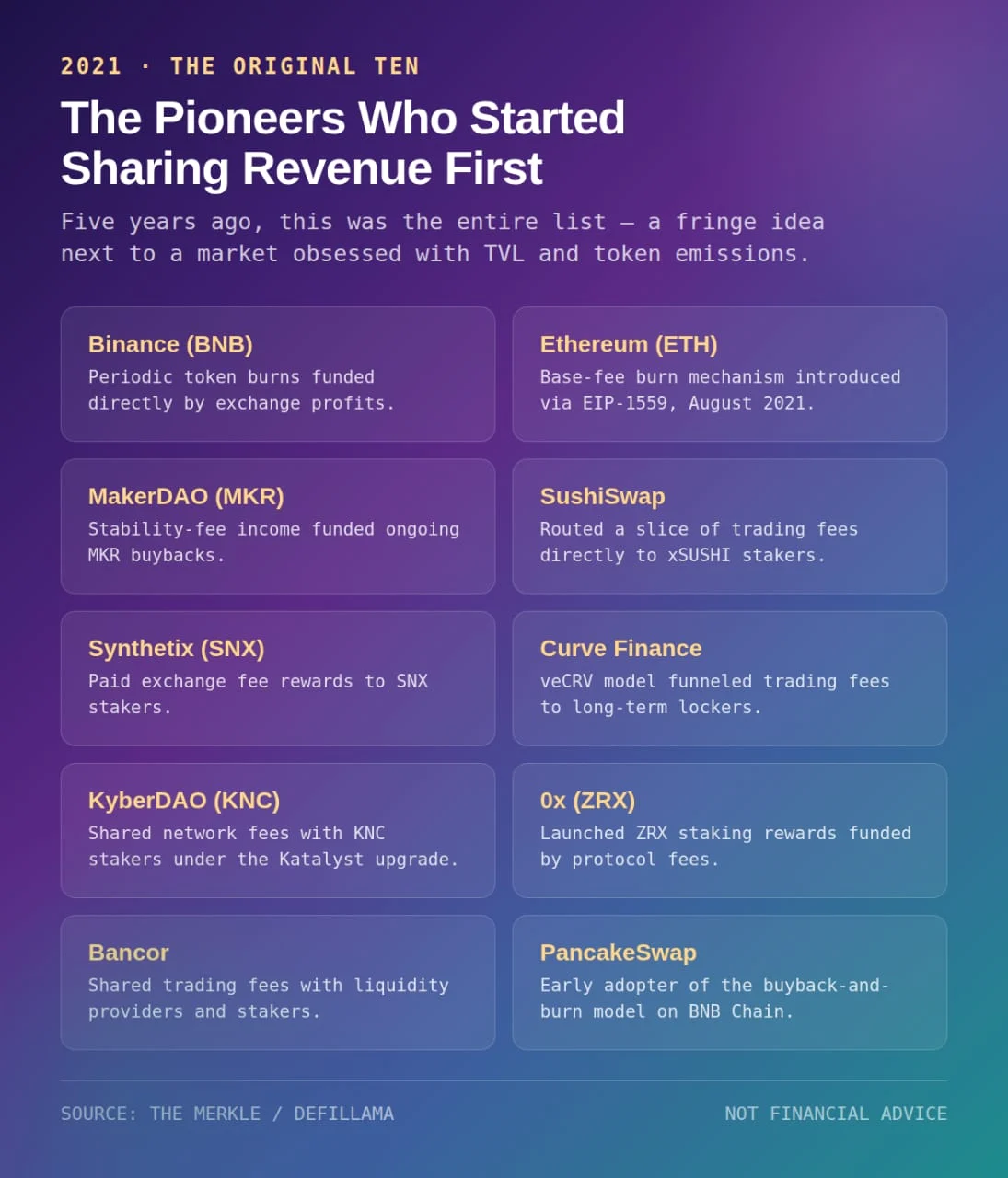
The turning point began around 2021, when a pioneering group of protocols started to experiment with mechanisms designed to channel a portion of their earnings back to token holders. These early innovators laid the groundwork for what is now becoming a standard design choice for new projects entering the market. On-chain analytics platforms, such as DeFiLlama’s Holders Revenue dashboard, have become crucial tools for tracking this evolution, cataloging dozens of protocols and even entire blockchain networks that now route earnings to their communities through various methods, including token buybacks, strategic burns, or direct staking payouts.
The Early Architects: Ten Protocols That Paved the Way in 2021
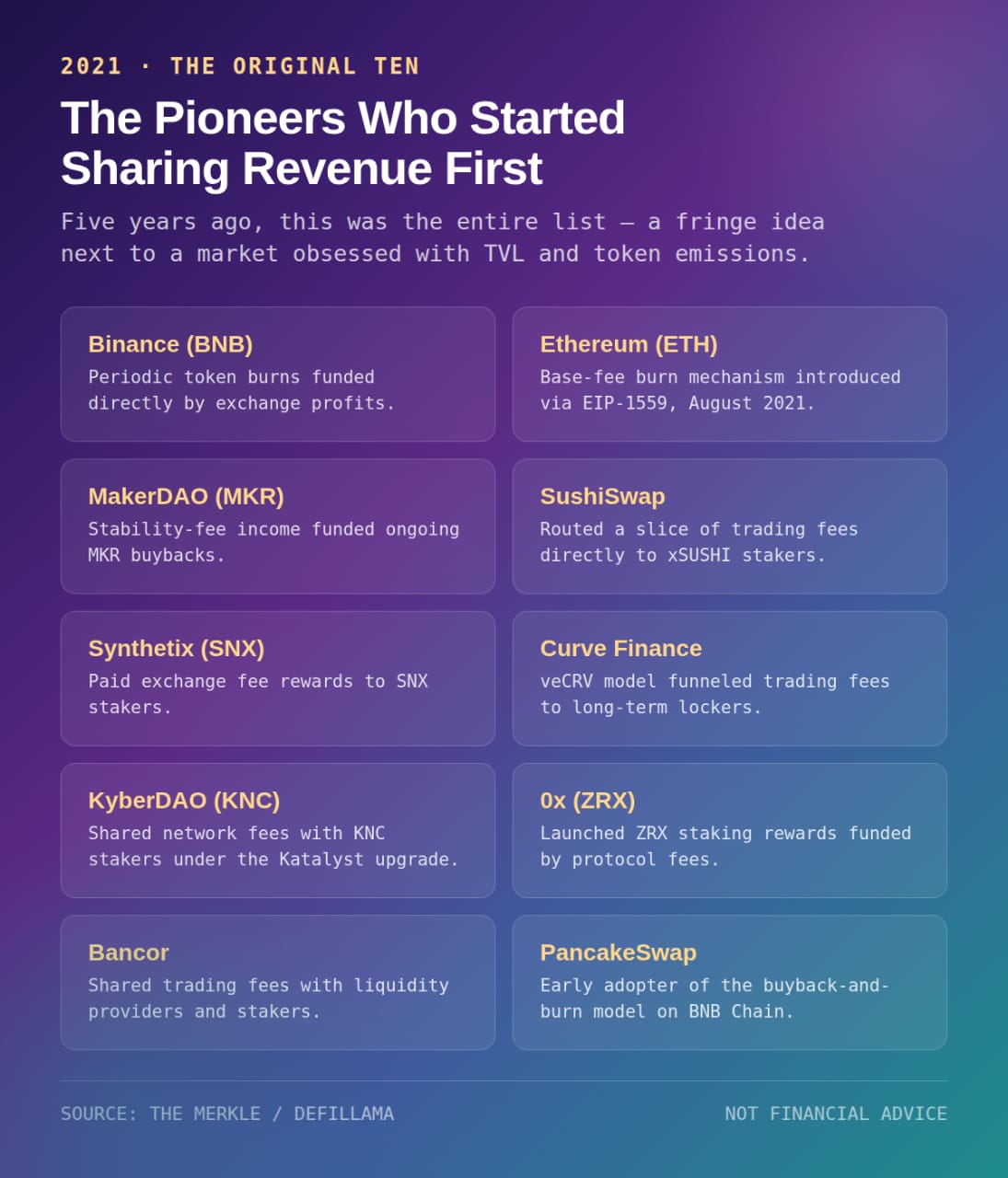
The initial cohort of revenue-sharing protocols, though small, was instrumental in demonstrating the viability and benefits of such models. Their diverse approaches set the template for future innovation:
- Binance (BNB): As one of the largest cryptocurrency exchanges, Binance had already implemented a periodic token burn mechanism for its BNB token, funded directly by a portion of the exchange’s profits. This reduced the supply of BNB, theoretically increasing its value for holders.
- Ethereum (ETH): The EIP-1559 upgrade in August 2021 introduced a base fee burn mechanism for every transaction on the Ethereum network. While not a direct dividend, this deflationary pressure reduces the supply of ETH, creating a form of value accrual for holders by making the asset scarcer.
- MakerDAO (MKR): The decentralized autonomous organization behind the Dai stablecoin, MakerDAO, began using stability fee income from its lending operations to fund MKR token buybacks. These purchased tokens were then often burned or used to replenish the protocol’s buffer, directly benefiting MKR holders.
- SushiSwap (xSUSHI): This decentralized exchange (DEX) routed a percentage of its trading fees to users who staked their SUSHI tokens to receive xSUSHI. This provided a direct yield to active participants.
- Synthetix (SNX): A decentralized synthetic asset protocol, Synthetix distributed exchange fee rewards to SNX stakers. Stakers played a crucial role in collateralizing the synthetic assets, and in return, earned a share of the protocol’s revenue.
- Curve Finance (veCRV): Curve, a DEX optimized for stablecoin swaps, introduced its innovative veCRV (vote-escrowed CRV) model. Users who locked their CRV tokens for extended periods received veCRV, granting them boosted liquidity provider rewards and a share of trading fees, incentivizing long-term commitment.
- KyberDAO (KNC): Under its Katalyst upgrade, KyberDAO enabled KNC stakers to earn a share of network fees generated from its liquidity protocol, further aligning the interests of stakers with the network’s success.
- 0x (ZRX): The 0x protocol, which facilitates decentralized exchange, launched ZRX staking rewards funded by protocol fees, allowing token holders to earn from the network’s activity.
- Bancor (BNT): This liquidity protocol shared trading fees with its liquidity providers and stakers, creating an ecosystem where active participation was directly rewarded with a share of the platform’s revenue.
- PancakeSwap (CAKE): An early and prominent DEX on the BNB Chain, PancakeSwap adopted a buyback-and-burn model for its CAKE token, similar to Binance, reducing supply and enhancing value for holders.
At the time, these ten protocols represented a fringe idea, contrasting sharply with a market largely fixated on metrics like Total Value Locked (TVL) and speculative token emissions. The prevailing sentiment was that crypto tokens derived value from network effect, future utility, or sheer hype, rather than tangible financial distributions.
Explosive Growth: From Niche Feature to Industry Standard
Fast forward to today, and what was once a niche experiment has become a defining characteristic of a maturing crypto market. The count of protocols and chains actively distributing revenue to holders has exploded, now exceeding 231. This diverse group spans a wide array of categories, including perpetual decentralized exchanges, spot DEXs, lending markets, launchpads, and even foundational layer-1 blockchain networks that burn a portion of their native gas fees.
This rapid expansion can be attributed to several factors. Firstly, the "imitation game" played a significant role. Once the initial pioneers demonstrated that fee-funded buybacks and direct distributions could effectively support token prices, attract sticky, long-term holders, and foster robust communities, competitors across virtually every DeFi vertical raced to integrate similar models. This created a competitive environment where revenue sharing rapidly transitioned from a differentiator to a baseline expectation—table stakes for any token aspiring to be taken seriously by investors who increasingly scrutinize financial statements and balance sheets.
Secondly, the infrastructure to track and implement these mechanisms has become more sophisticated. Tools like DeFiLlama’s Holders Revenue dashboard provide transparency and data, allowing investors to identify and evaluate protocols based on their actual economic activity and distribution policies. This enhanced transparency further encourages protocols to adopt more sustainable and holder-friendly tokenomics.
The Modern Landscape: New Leaders and Diversified Mechanisms
The protocols leading the holder-revenue rankings today reflect the evolution and diversification of the crypto space. While some of the pioneers remain relevant, new entrants and established players adopting these models have reshaped the leaderboard:
- Hyperliquid: This perpetual exchange currently stands out by funneling an astonishing 99% of its trading fees into an Assistance Fund, which continuously buys back its HYPE token. This aggressive buyback mechanism creates constant demand for the token, directly tying its value to the protocol’s trading volume.
- Uniswap (UNI): After years of intense governance debates, Uniswap, the largest decentralized exchange by volume, activated its long-anticipated fee switch in December 2025. This allows a portion of swap fees to be used for UNI buybacks and burns, signaling a major shift for a protocol that historically prioritized liquidity providers and developers over direct token holder revenue. This move alone is poised to significantly impact the perception of DEX tokens.
- Chainlink (LINK): Beyond its core oracle services, Chainlink now funds LINK buybacks from both on-chain and off-chain revenue streams, further integrating its token’s value with the utility and adoption of its decentralized oracle network.
- Aerodrome (veAERO): A leading DEX on Base, Aerodrome distributes the entirety of its trading fees to veAERO voters, incentivizing active participation in governance and long-term staking.
- Jupiter (JUP): The prominent Solana-based DEX aggregator routes half of its platform revenue into JUP token buybacks, demonstrating a clear commitment to sharing its success with its community.
- PancakeSwap (CAKE): Continuing its pioneering efforts, PancakeSwap has evolved its model, running several parallel CAKE burn mechanisms across its diverse product suite, ensuring continuous value accrual for its token holders.
Furthermore, entire layer-1 blockchains have joined this trend. Solana, Tron, and BNB Chain now burn a portion of their network fees. While these are not direct "dividends" in the traditional sense, these burn mechanisms reduce the circulating supply of their native assets (SOL, TRX, BNB), effectively turning them into holder-revenue instruments by enhancing their scarcity and long-term value proposition. This demonstrates a broader acceptance of value accrual mechanisms at the foundational layer of the crypto stack.
Driving Forces: Regulatory Clarity and Maturing Investor Demands
Several critical factors have converged to accelerate this shift. A significant catalyst has been a more nuanced and, in some respects, friendlier regulatory stance towards digital assets in jurisdictions like the United States. For years, crypto project teams harbored deep anxieties about implementing structures that resembled dividends, fearing that such distributions could cause their tokens to be classified as unregistered securities under the Howey Test. This regulatory uncertainty often pushed projects towards governance-only tokens or purely speculative models to avoid potential legal repercussions.
However, as the regulatory landscape slowly begins to offer more clarity, and with high-profile lawsuits challenging previous classifications, the industry’s apprehension has somewhat eased. Bitwise Chief Investment Officer Matt Hougan articulated this sentiment directly, positing that crypto valuations outside of Bitcoin could "double or more" as protocols increasingly link revenue generation to token value. He highlighted projects like Hyperliquid, Uniswap, Aave, and Pump.fun as early movers embracing this paradigm. This perceived shift in regulatory risk perception has empowered projects to design tokenomics that are more financially sound and attractive to long-term investors.
The growing sophistication of crypto investors is another key driver. The initial waves of crypto adoption were often characterized by retail investors seeking quick gains based on hype. However, the market has matured, attracting institutional capital and more seasoned investors who demand tangible value propositions. These investors are accustomed to evaluating assets based on fundamentals, cash flow, and robust business models. As such, projects that offer clear revenue-sharing mechanisms inherently become more appealing, as they provide a more traditional and understandable framework for valuation.
Even protocols that initially resisted the trend are now adapting. Aave Labs, for instance, a project that for years staunchly maintained its AAVE token as primarily a governance instrument, recently proposed sharing revenue generated outside its core lending protocol with AAVE holders. This notable concession underscores the growing pressure and recognition within the industry that sustainable value accrual for token holders is paramount for long-term success and competitiveness.
Implications for the Digital Asset Ecosystem
This structural shift towards a revenue-sharing economy carries profound implications for all participants in the digital asset ecosystem:
- For Token Holders: The days of blindly speculating on future adoption are giving way to a more informed investment landscape. Token holders are increasingly becoming akin to shareholders, with an expectation of tangible returns tied to the protocol’s performance. This necessitates a shift in due diligence, moving beyond superficial metrics like Total Value Locked (TVL) or social media hype, to a deeper analysis of a protocol’s revenue streams, distribution mechanics, and tokenomics. The focus will increasingly be on metrics like Price-to-Earnings (P/E) ratios, yield percentages, and the sustainability of revenue generation.
- For Protocols and Developers: The pressure to build sustainable business models and generate real revenue is intensifying. Protocols can no longer rely solely on token emissions to incentivize participation; they must demonstrate a clear path to profitability and value accrual for their tokens. This fosters greater accountability and incentivizes innovation that generates actual economic activity. It also creates a powerful mechanism for community alignment, as token holders become direct beneficiaries of the protocol’s success, encouraging active participation and long-term commitment.
- For the Industry as a Whole: This trend marks a significant step in the maturation of crypto as an asset class. By integrating revenue-sharing mechanisms, crypto assets begin to bridge the gap with traditional financial instruments, offering more familiar valuation frameworks for institutional investors. This could lead to greater mainstream acceptance and capital inflow, further legitimizing the industry. However, it also introduces new complexities for regulators, who will need to distinguish between various revenue-sharing models and their implications for securities classification. The industry is moving towards a more "grown-up conversation," where financial fundamentals and sustainable economics are as crucial as technological innovation.
Navigating the New Paradigm: Cautions and Considerations
While the direction of travel is unmistakable and overwhelmingly positive, it is crucial to approach this new paradigm with informed caution. Not every token with a buyback or burn mechanism inherently deserves a premium valuation. As research from Castle Labs and others has highlighted, there can be a significant difference between "headline revenue" reported by a protocol and the "actual tokenholder cash flow." Many of the 231-plus protocols may distribute relatively modest sums, and the underlying business model generating that revenue must be robust and sustainable.
Investors must conduct thorough due diligence, scrutinizing the specifics of how revenue is generated, the transparency of the distribution mechanism, the magnitude of the distributions, and the overall tokenomics (including potential dilution from new emissions). Factors like the protocol’s competitive landscape, technological moat, user adoption, and governance structure remain critical. Fees, distribution mechanics, and potential dilution are becoming as important to crypto research as Annual Percentage Yield (APY) once was, if not more so.
In conclusion, the silent rise of crypto’s revenue-sharing economy represents a monumental shift away from pure speculation towards tangible, fundamentally-backed value. This structural change, driven by pioneering protocols, competitive pressures, and evolving regulatory and investor landscapes, is reshaping how serious investors evaluate digital assets. For an industry often accused of manufacturing value out of thin air, this move towards demonstrable economic alignment with token holders is perhaps the most compelling evidence yet of its journey towards maturity and long-term viability.
Disclosure: This is not trading or investment advice. Always do your research before buying any cryptocurrency or investing in any services.
Follow us on Twitter @themerklehash to stay updated with the latest Crypto, NFT, AI, Cybersecurity, and Metaverse news!