The dramatic implosion of the Terra ecosystem in May 2022 stands as one of the most cataclysmic events in cryptocurrency history, wiping out an estimated $60 billion in market value and triggering a contagion that reverberated across the digital asset landscape. Beyond the staggering financial losses, the collapse offered a stark illustration of the intricate interplay between market fundamentals, the inherent fragility of novel financial mechanisms, and the profound psychological biases that can derail even seasoned investors. While the immediate aftermath focused on the mechanics of the algorithmic stablecoin TerraUSD (UST) and its sister token LUNA, a deeper analysis reveals how human decision-making, often clouded by cognitive biases like the sunk cost fallacy and loss aversion, compelled many to ride their investments to near-zero, rather than cut losses.
The Genesis of an Algorithmic Ambition: Understanding Terra and UST
To comprehend the scale of the collapse, it is crucial to understand the architecture of the Terra ecosystem. Launched by Terraform Labs, co-founded by Do Kwon and Daniel Shin, Terra aimed to build a decentralized financial infrastructure centered around its algorithmic stablecoin, TerraUSD (UST). Unlike collateralized stablecoins such as Tether (USDT) or USD Coin (USDC), which maintain their peg to the U.S. dollar through reserves of fiat currency or other assets, UST relied on a complex algorithmic relationship with its volatile counterpart, LUNA.
The core mechanism was designed to maintain UST’s $1 peg through an arbitrage opportunity. If UST traded below $1, users could burn UST to mint $1 worth of LUNA, thereby reducing UST supply and theoretically pushing its price back up. Conversely, if UST traded above $1, users could burn LUNA to mint UST, increasing supply and bringing the price down. LUNA’s value was directly tied to the demand for UST, and as UST’s adoption grew, particularly through the Anchor Protocol, LUNA’s market capitalization soared, reaching an all-time high of over $40 billion in April 2022. The Anchor Protocol, a decentralized savings platform, played a pivotal role by offering attractive annual percentage yields (APYs) of around 20% on UST deposits, drawing billions of dollars into the ecosystem and fueling demand for UST and, by extension, LUNA. This high yield, however, was widely scrutinized by financial experts as unsustainable, a red flag that, in hindsight, pointed to the inherent risks.
The Unraveling: A Chronology of Catastrophe
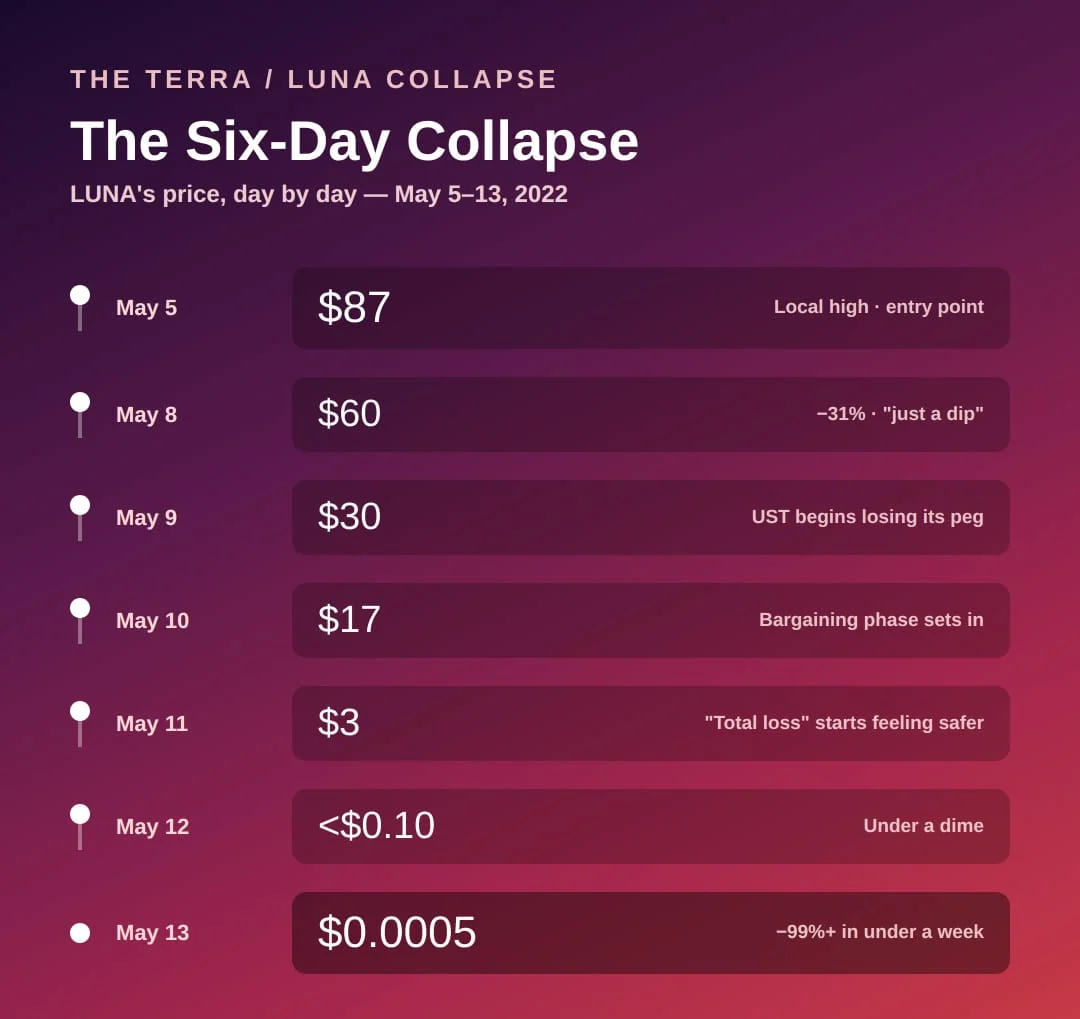
The six days in May 2022 that witnessed Terra’s demise began subtly before escalating into a full-blown market panic.
- Early May 2022: Terra (LUNA) was trading robustly, often above $80, and its market capitalization was among the top ten cryptocurrencies. UST had become a dominant algorithmic stablecoin, with its market cap exceeding $18 billion.
- May 7-8, 2022: The first cracks appeared. Large withdrawals of UST, totaling hundreds of millions of dollars, began from the Anchor Protocol. Simultaneously, a series of large UST sell orders hit decentralized exchanges, causing UST to briefly de-peg from the dollar, dipping to around $0.98. While a slight de-peg was not unheard of for algorithmic stablecoins, the scale and suddenness of these transactions raised alarms.
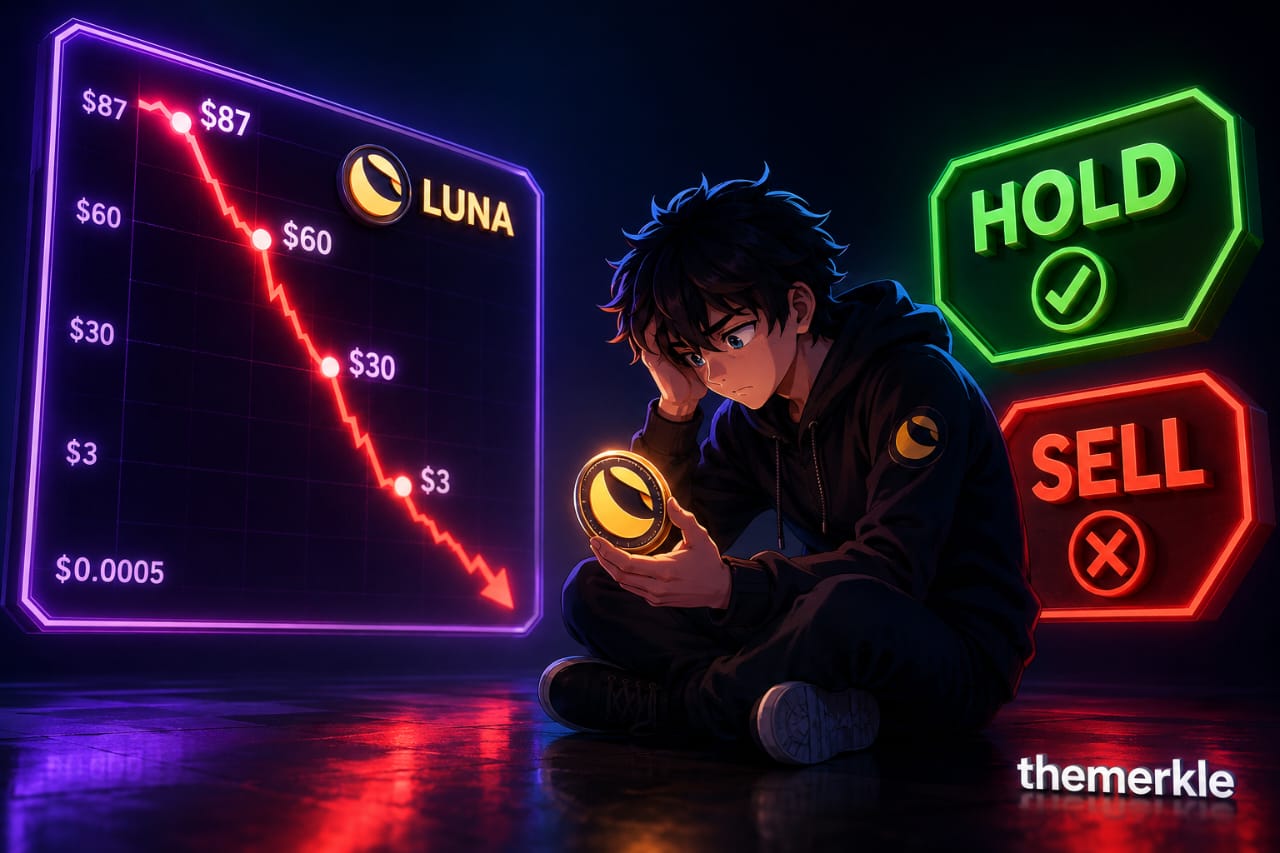
- May 9, 2022: Panic set in. As UST struggled to regain its peg, hovering between $0.95 and $0.90, the algorithmic mechanism kicked into overdrive. To restore the peg, the protocol began minting massive amounts of LUNA, flooding the market with new supply. This led to a precipitous drop in LUNA’s price, falling from approximately $60 to around $30 within hours. The Luna Foundation Guard (LFG), established to defend the UST peg with a reserve of Bitcoin and other assets, deployed billions of dollars worth of Bitcoin in a desperate attempt to stabilize UST. However, the selling pressure was overwhelming, and the LFG’s reserves were rapidly depleted.
- May 10, 2022: The death spiral accelerated. With LFG’s reserves dwindling and UST failing to recover its peg, LUNA’s price continued its freefall, dropping to approximately $17. The core design flaw became horrifyingly apparent: as UST demand evaporated and LUNA was minted en masse to compensate, LUNA’s supply surged exponentially, while its demand plummeted, creating a vicious cycle.
- May 11, 2022: LUNA’s value collapsed to approximately $3. Major cryptocurrency exchanges began to delist LUNA and UST trading pairs, further exacerbating the liquidity crisis and preventing any meaningful recovery.
- May 12, 2022: The token that had once commanded nearly $100 per unit was trading for mere pennies, less than a dime. The circulating supply of LUNA, which was initially around 350 million tokens, ballooned to several trillion in a matter of days.
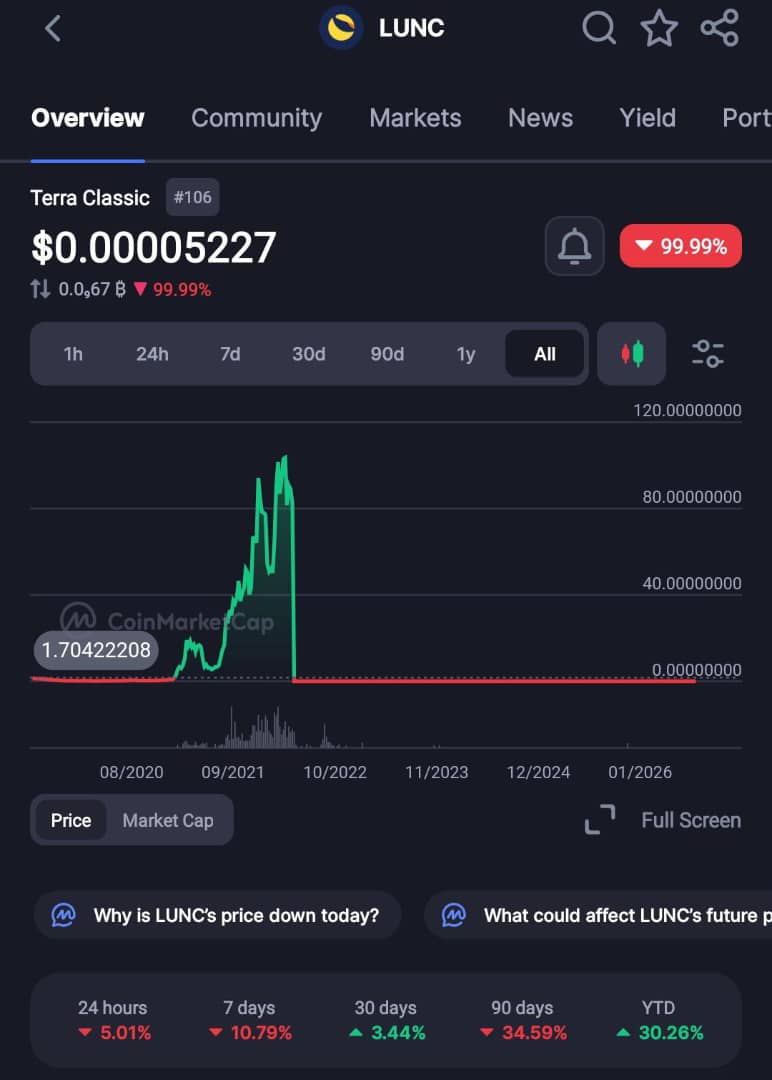
- May 13, 2022: LUNA’s price effectively hit zero, trading for fractions of a cent ($0.0005), rendering investments worthless. The Terra ecosystem, once valued in the tens of billions, lay in ruins.
The Psychology of Holding to Zero: A Case Study in Cognitive Biases
Amidst this market chaos, millions of investors found themselves paralyzed, watching their portfolios evaporate. The personal account of an investor who bought LUNA at $87 and held it through its descent to near-zero provides a powerful illustration of well-documented cognitive biases at play. This experience, shared by countless others, offers invaluable insights into the psychological traps that can override rational financial decision-making during a crisis.
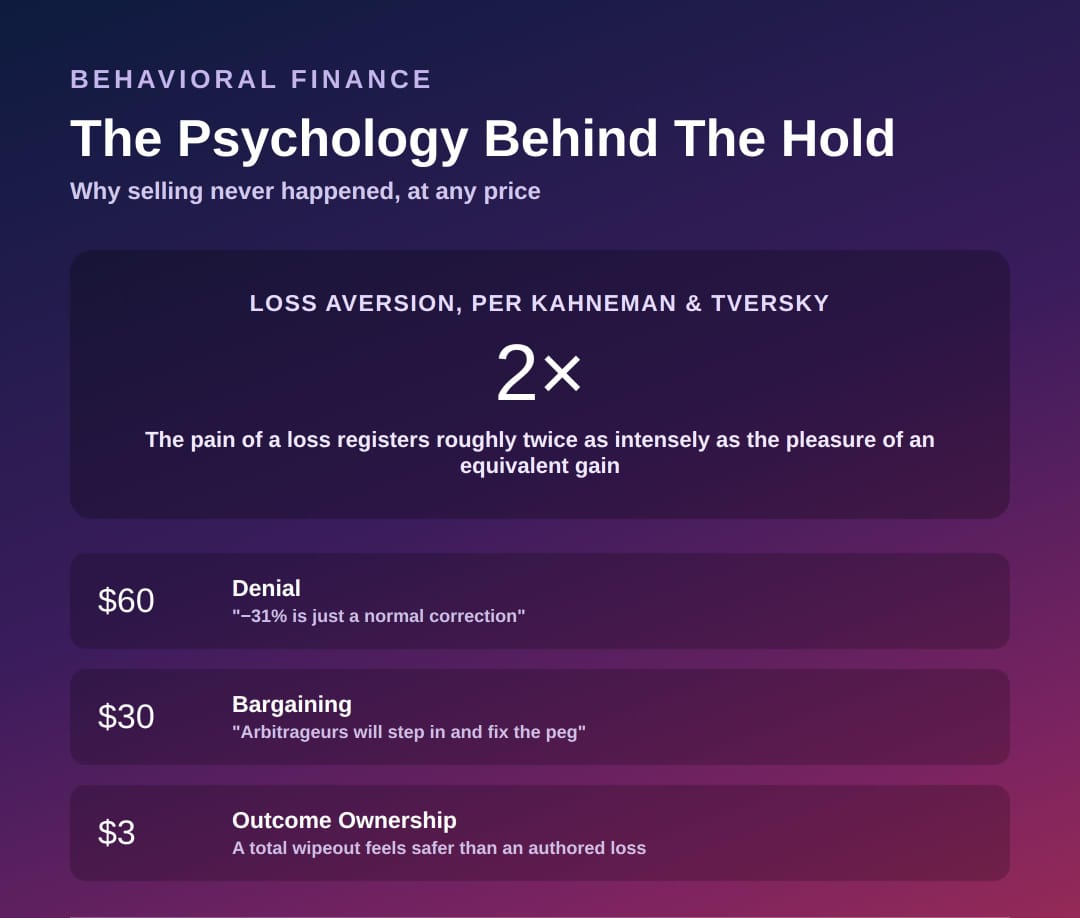
- The Sunk Cost Fallacy: This pervasive bias describes the tendency to continue investing resources (time, money, effort) into a failing endeavor simply because of what has already been invested, rather than focusing on future prospects. For LUNA holders, the initial investment at $87 created an anchor. Selling at $60, $30, or even $3 meant acknowledging that the initial decision was flawed. The cognitive dissonance of admitting a mistake often feels more painful than the potential future loss. Instead, investors clung to the hope of a rebound, rationalizing their inaction as "patience" or "conviction."
- Loss Aversion: Pioneered by behavioral economists Daniel Kahneman and Amos Tversky, loss aversion posits that the psychological pain of a loss is roughly twice as intense as the pleasure of an equivalent gain. Selling LUNA at a 31% loss (at $60) was not merely a mathematical calculation of capital reduction; it was the active realization of a painful financial event. Holding, conversely, allowed the investor to delay this psychological pain, maintaining a state of hopeful denial, even as the asset continued to plummet. The "paper loss" felt less real, less definitive, than a "realized loss."
- The Bargaining Phase Masquerading as Analysis: As LUNA’s price continued to fall, many investors entered a "bargaining phase," where genuine analysis became indistinguishable from self-deception. Thoughts like "the depeg is temporary," "arbitrageurs will fix it," or "a token backed by a foundation can’t go to zero" became prevalent. These were not logical market assessments but rather psychological defenses, prayers dressed in market jargon, designed to justify inaction and postpone the inevitable. The qualities of disciplined investing—holding through volatility, resisting panic—were hijacked and misdirected towards a terminally ill asset.
- Outcome Ownership and Externalization of Blame: Perhaps the most counterintuitive psychological phenomenon observed was the preference for a total loss over a partial, self-authored one. As LUNA approached $3, a complete wipeout began to feel, perversely, "safer." A total loss could be attributed to a "market catastrophe," a "villain," or a "systemic failure," thereby externalizing the blame. It became an event that "happened to" the investor, rather than a direct consequence of their own decision. In contrast, selling at $3, only for the coin to potentially bounce (even fractionally), would have been a personal decision, a "story about my own bad judgment." This desire to avoid owning a "bad decision" led many to hold until literally nothing was left, a phenomenon psychologists refer to as outcome ownership. The collective suffering of a market collapse felt more bearable than the individual regret of a voluntary, albeit necessary, capitulation.
Regulatory Aftershocks and Legal Accountability
The Terra-LUNA collapse sent shockwaves through the global financial regulatory landscape, intensifying calls for stricter oversight of the nascent cryptocurrency industry, particularly stablecoins. Regulators worldwide cited the event as a prime example of the extreme risks associated with unregulated digital assets and algorithmic models.
- Increased Scrutiny: The U.S. Treasury Secretary Janet Yellen, among other global financial leaders, immediately highlighted the need for comprehensive stablecoin regulation. The collapse fueled debates on whether stablecoins should be subject to traditional banking regulations, requiring them to hold equivalent reserves and undergo regular audits.
- Contagion Effect: The Terra implosion was not an isolated incident. Its collapse contributed significantly to a broader crypto market downturn, often referred to as "crypto winter." The failure of Terra created liquidity crises for several prominent crypto lending platforms and hedge funds, including Celsius Network and Three Arrows Capital (3AC), both of which had significant exposure to Terra and subsequently filed for bankruptcy, leading to further investor losses. This demonstrated the interconnectedness and systemic risks within the crypto ecosystem.
The legal fallout from the Terra collapse has been extensive, culminating in the apprehension and sentencing of Terraform Labs co-founder Do Kwon.
- Do Kwon’s Flight and Arrest: Following the collapse, Do Kwon became a central figure in international law enforcement efforts. After reportedly leaving South Korea for Singapore, he disappeared from public view. In March 2023, Kwon was arrested in Montenegro while attempting to travel with a falsified passport. This marked the beginning of a complex legal battle involving extradition requests from both the United States and South Korea, each seeking to prosecute him for his role in the Terra crisis.
- Extradition and Prosecution: After months of legal proceedings and appeals in Montenegro, Kwon was eventually extradited to the United States in late 2024. In August 2025, he pleaded guilty to two counts of fraud tied to the Terra collapse, acknowledging his role in misleading investors about the stability and reliability of the UST stablecoin and the LUNA token.
- Sentencing: On December 11, 2025, a federal judge in the U.S. District Court for the Southern District of New York sentenced Do Kwon to 15 years in prison. This sentence surpassed the 12 years prosecutors had initially requested, with the judge characterizing the fraud as one of the most damaging in the history of federal prosecutions, underscoring the severe impact on countless victims. The U.S. Attorney’s Office for the Southern District of New York officially documented the sentencing, emphasizing the scale of the $40 billion fraud. Kwon still faces potential separate prosecution in South Korea once his U.S. sentence concludes, highlighting the international scope of the legal ramifications.
Enduring Lessons for the Cryptocurrency Landscape
The Terra-LUNA saga serves as a permanent scar on the nascent cryptocurrency industry, but also as an invaluable, albeit painful, lesson. For investors, the paramount takeaway is the critical distinction between a "math problem" and an "identity problem" when confronting a bleeding position. The moment an investment loss starts to feel like a personal failing or a challenge to one’s judgment, rather than a purely financial calculation, is precisely when objective reasoning becomes most compromised.
A falling asset operates without emotional attachment; it does not acknowledge an investor’s entry price or reward emotional consistency. The seductive allure of the sunk cost fallacy often manifests not as fear, but as a deceptive sense of conviction, patience, or strategic foresight. This illusion leads investors to believe that admitting a mistake now would be worse than enduring a total loss later. This psychological trap, felt as true in the moment, invariably leads to the same outcome: the number hitting zero, leaving nothing left to bargain with.
The Terra collapse underscored the imperative for robust risk management, diversification, and a deep understanding of the underlying technology and economics of any investment. It catalyzed a global conversation about the necessity of regulatory frameworks for digital assets, particularly stablecoins, to protect consumers and maintain financial stability. Ultimately, the LUNA implosion remains a stark reminder that while technological innovation in finance can be transformative, it must be tempered by sound economic principles, transparent risk disclosure, and a vigilant awareness of human psychology’s powerful, often irrational, influence on market behavior. The collective memory of this collapse continues to shape investor behavior and regulatory approaches, pushing the industry toward greater maturity and accountability.