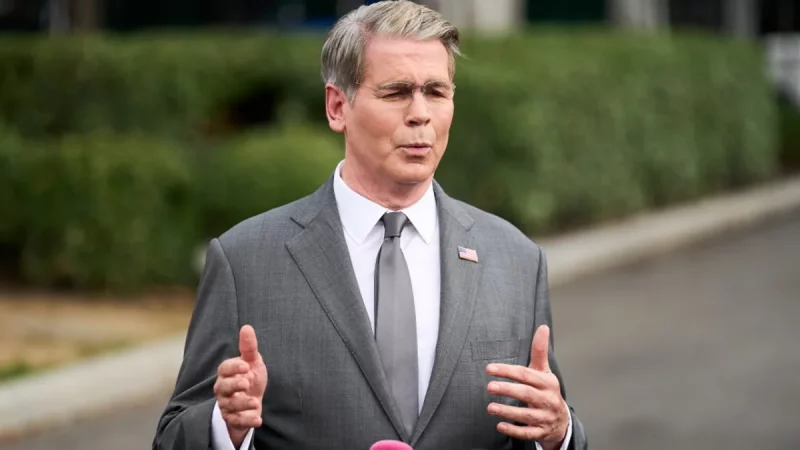
The administration of President Donald Trump is reportedly considering a significant restructuring of its technology and economic policy framework by appointing Treasury Secretary Scott Bessent to a dual role as the nation’s "AI Czar." According to reports from Semafor, citing three individuals familiar with the internal deliberations, Bessent has emerged as the frontrunner for this newly envisioned position, which would centralize the administration’s approach to artificial intelligence across economic, diplomatic, and national security domains. While the appointment has not been finalized, the move signals a strategic shift in how the White House intends to manage the rapid advancement of generative AI and its implications for global power dynamics.
White House spokesperson Kush Desai has characterized these reports as speculative, noting that official personnel decisions are only confirmed once formally announced by the administration. However, the increasing visibility of Bessent in high-level AI discussions suggests that his influence extends well beyond traditional fiscal policy. This week, Bessent engaged in high-stakes negotiations with Chinese Vice Premier He Lifeng, focusing specifically on the governance of artificial intelligence. These talks serve as a precursor to the scheduled meeting between President Trump and Chinese President Xi Jinping on September 24, where AI is expected to be a cornerstone of the diplomatic agenda.
The Strategic Necessity of an AI Czar
The concept of an "AI Czar" reflects the growing consensus within Washington that artificial intelligence is no longer merely a niche sector of the tech industry but a foundational element of national power. The role is expected to serve as a bridge between various government agencies, including the Department of Commerce, the Department of Defense, and the State Department, ensuring a unified strategy regarding AI development, regulation, and international competition.
Bessent’s potential appointment comes at a time when the United States is locked in a complex technological rivalry with China. The Biden administration previously implemented stringent export controls on advanced semiconductors and AI hardware, a policy the Trump administration appears poised to refine or expand. By placing the Treasury Secretary at the helm of AI policy, the administration highlights the inextricable link between technological supremacy and economic stability.
Under the proposed framework, the AI Czar would likely oversee the implementation of national standards for AI safety, coordinate federal investment in domestic research and development, and lead international negotiations regarding the ethical use of autonomous systems. The integration of this role into the Treasury Department suggests that the administration views AI primarily through the lens of market competitiveness and financial security.
US-China AI Diplomacy and the Notification Mechanism
One of the most critical aspects of Bessent’s recent activity involves direct engagement with Chinese leadership. In his discussions with Vice Premier He Lifeng, Bessent explored the establishment of a formal bilateral dialogue on AI safety and security. A primary objective of these talks is the creation of a "notification mechanism" for incidents involving artificial intelligence that could pose significant national security risks.
This mechanism is envisioned as a digital-age version of the Cold War-era "hotline," designed to prevent accidental escalation resulting from AI-driven misunderstandings. As AI becomes more integrated into military command-and-control systems and critical infrastructure, the risk of a "flash war" triggered by algorithmic errors or autonomous miscalculations has become a top priority for global security experts. Bessent indicated that both the U.S. and China intend to continue these discussions, reflecting a rare area of potential cooperation in an otherwise strained relationship.
The proposed dialogue would also cover the prevention of AI-facilitated cyberattacks and the mitigation of risks associated with "frontier models"—the most advanced AI systems capable of complex reasoning. By leading these talks, Bessent is positioning himself as a diplomat capable of navigating the "tech-tensions" that define modern US-China relations.
Philosophy of Accountability: Humans Over Algorithms
A defining feature of Bessent’s approach to AI policy is his stance on legal and ethical responsibility. In recent public statements and internal policy discussions, Bessent has argued forcefully that the legal burden for the actions of AI systems must remain with humans and corporations. He has rejected the notion of "algorithmic personhood" or the shifting of liability to the technology itself.
This perspective is crucial for the future of AI regulation in the United States. If Bessent’s philosophy becomes official policy, it would mean that companies deploying AI tools—whether for automated trading in financial markets, medical diagnostics, or autonomous vehicles—would be held strictly liable for any harm or systemic failures caused by those tools. This approach aims to incentivize rigorous internal testing and safety protocols, ensuring that the drive for innovation does not outpace the necessity for public safety.
"We cannot allow a situation where ‘the computer made me do it’ becomes a valid legal defense for corporate negligence or systemic risk," Bessent has reportedly emphasized in policy briefings. This stance contrasts with some sectors of the tech industry that have sought liability protections similar to Section 230 of the Communications Decency Act, which shields internet platforms from responsibility for user-generated content.
The Contenders: A Competitive Field for AI Leadership
While Bessent is the leading candidate, he is not the only high-profile figure under consideration for the AI Czar position. The administration is also evaluating Michael Kratsios and Scott Kupor for the role.
Michael Kratsios served as the Chief Technology Officer of the United States during Trump’s first term and currently leads the White House Office of Science and Technology Policy (OSTP). Kratsios is widely credited with launching the "American AI Initiative" in 2019, which prioritized federal funding for AI research. His deep institutional knowledge and existing relationships within the tech sector make him a formidable candidate.
Scott Kupor, the Director of the Office of Personnel Management and a former managing partner at the venture capital firm Andreessen Horowitz, brings a private-sector perspective to the table. Kupor’s expertise in the economics of innovation and the scaling of tech startups aligns with the administration’s goal of maintaining American dominance in the global AI market.
The decision to potentially select Bessent over these tech-focused candidates suggests that President Trump may prefer a "heavy hitter" with broad economic and international authority to manage the AI portfolio. Furthermore, the administration has indicated that holding the AI position would not necessarily require Bessent to vacate his post at the Treasury. Trump has a history of assigning cabinet officials additional policy coordination roles, a practice intended to streamline decision-making and reduce bureaucratic friction.
Economic Implications and Market Impact
The potential appointment of a Treasury-led AI Czar has significant implications for Wall Street and the broader economy. AI has become the primary driver of market valuations for the "Magnificent Seven" tech giants and a central theme in capital expenditure forecasts for the coming decade.
According to data from the Bureau of Economic Analysis and private sector analysts, the AI industry is projected to contribute trillions of dollars to global GDP by 2030. However, this growth is contingent on a stable regulatory environment and the continued flow of high-end semiconductors. An AI Czar within the Treasury Department would be uniquely positioned to align tax incentives, trade tariffs, and investment restrictions to support domestic AI manufacturing and deployment.
Furthermore, Bessent’s background in finance—having previously managed the Key Square Group and worked as a chief investment officer for Soros Fund Management—gives him a sophisticated understanding of how AI will transform financial services. From algorithmic trading to credit scoring and fraud detection, the Treasury’s oversight of AI will be critical in maintaining the integrity of the U.S. financial system.
Chronology of Recent AI Policy Developments
The move toward an AI Czar is the culmination of several months of accelerating policy activity:
- June 2024: The administration begins an internal review of existing AI executive orders, seeking to prioritize "innovation-friendly" deregulation while strengthening national security protections.
- August 2024: Scott Bessent is tasked with leading a preliminary task force on the economic impact of automation, signaling his growing influence in the tech space.
- September 15, 2024: Bessent meets with Chinese Vice Premier He Lifeng in Beijing. The two-day summit focuses on macroeconomic stability and the governance of emerging technologies.
- September 20, 2024: Reports emerge via Semafor that Bessent is the top choice for the AI Czar role, despite official White House denials of a finalized decision.
- September 24, 2024 (Scheduled): President Trump and President Xi Jinping are set to meet at the White House. AI safety and the notification mechanism for autonomous incidents are high on the agenda.
Analysis: A New Era of Technocratic Governance
The elevation of the Treasury Secretary to a role involving AI oversight represents a new era of technocratic governance. In previous decades, technology policy was often treated as a secondary concern, relegated to specialized agencies with limited political capital. Today, the convergence of AI, finance, and geopolitics has made tech policy synonymous with national strategy.
By potentially appointing Bessent, the Trump administration is betting that the challenges posed by AI—such as job displacement, data privacy, and the weaponization of deepfakes—are best addressed through an economic and diplomatic lens. This approach acknowledges that the "AI race" is as much about capital allocation and international alliances as it is about lines of code.
However, critics argue that a Treasury-led approach might prioritize market gains over ethical considerations or civil liberties. There are also concerns regarding the "over-centralization" of power, as the dual role would give Bessent unprecedented influence over both the nation’s purse strings and its most transformative technology.
Conclusion and Future Outlook
As the September 24 summit approaches, the focus remains on whether the United States and China can find common ground on AI safety. The potential appointment of Scott Bessent as AI Czar would provide a clear signal to both domestic stakeholders and international rivals that the U.S. is centralizing its command structure to meet the AI challenge.
Whether Bessent ultimately takes the title or the administration opts for a different structural arrangement, the trajectory is clear: the integration of artificial intelligence into the highest levels of government policy is no longer a distant possibility, but a current reality. The decisions made in the coming weeks will likely set the tone for the global AI landscape for years to come, defining how nations compete, how corporations are held accountable, and how the world navigates the risks of an increasingly autonomous future.