


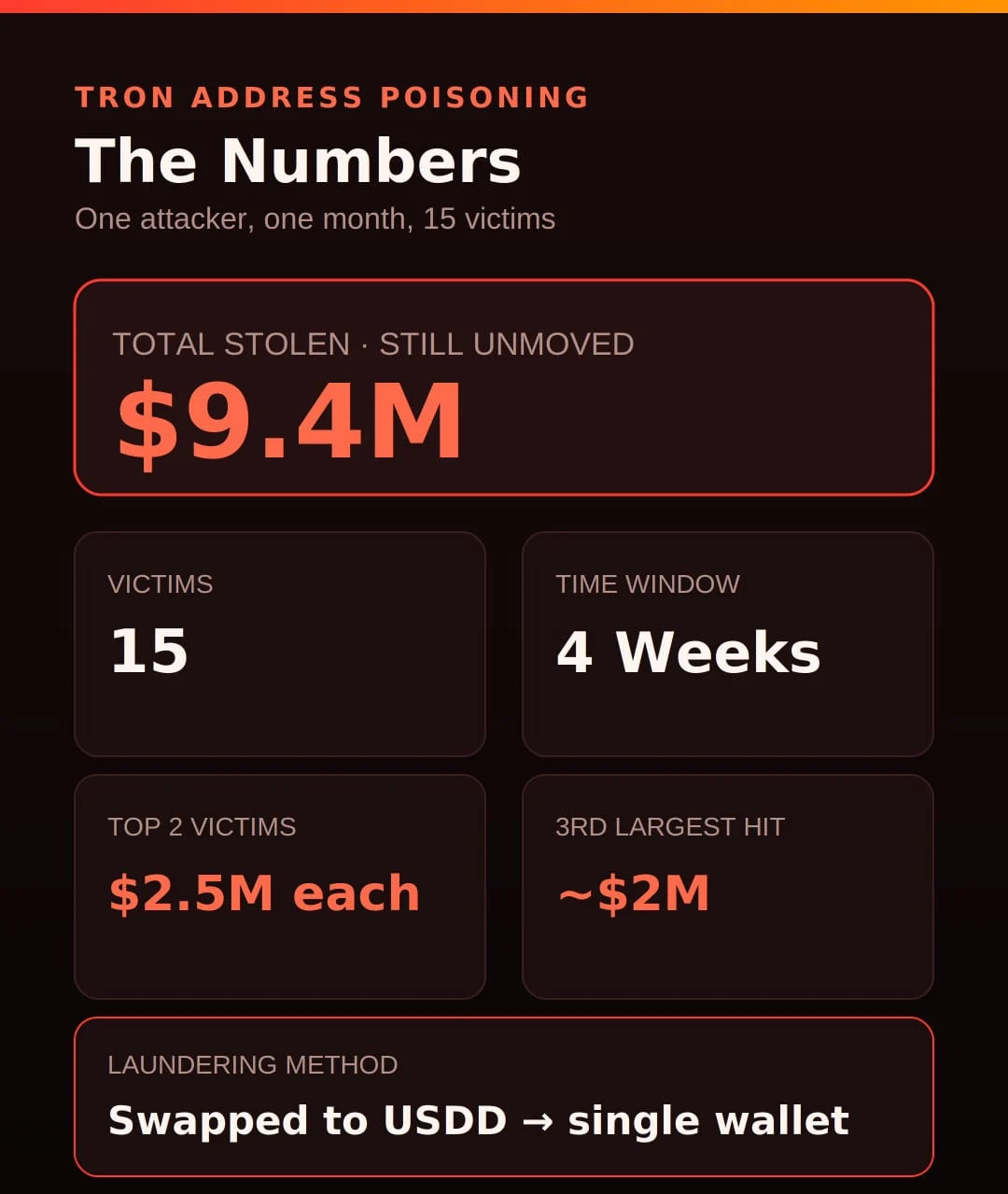
A chilling sense of unease permeates the cryptocurrency community as a single Tron wallet address continues to hold a staggering $9.4 million, seemingly impervious to the usual mechanisms designed to disrupt illicit financial flows. This significant sum, consolidated from the wallets of fifteen distinct victims over a mere four-week period, represents a sophisticated and consistent application of the "address poisoning" scam. The funds, converted into USDD, Tron’s native decentralized stablecoin, sit in plain sight on the blockchain, presenting both a tantalizing target for recovery efforts and a stark reminder of the digital assets’ inherent immutability and the evolving tactics of cybercriminals.
The Unsettling Silence: A $9.4 Million Mystery Unfolds
The peculiar dread that accompanies observing a substantial sum of stolen cryptocurrency lying dormant in a public wallet address is palpable. Unlike many high-profile crypto thefts that involve rapid layering through mixers, cross-chain bridges, or decentralized exchanges within hours of the incident, the $9.4 million amassed by this particular attacker has remained static for approximately a month. This unusual inactivity, defying the typical urgency of money laundering in the crypto sphere, suggests either an extreme confidence on the part of the perpetrator that no immediate freeze or law enforcement action is imminent, or a calculated strategy to allow initial scrutiny to subside before initiating the next phase of obfuscation. For the fifteen individuals whose digital wealth vanished, the sight of their stolen funds consolidated and untouched is a constant, agonizing presence on the public ledger.
Four Weeks of Calculated Deception: A Chronology of Losses
According to meticulous on-chain analysis shared by the prominent blockchain investigator, Specter, this calculated campaign of financial deception unfolded systematically over the past four weeks. Beginning approximately a month ago, the attacker initiated a series of targeted operations, preying on unsuspecting users within the Tron ecosystem. The pattern observed by Specter indicates a sustained, repeated operation rather than a series of opportunistic, isolated incidents. This consistency in execution, targeting a rotating cast of victims with the same trick within a compressed timeframe, points to a highly organized and methodical approach.
- Early Stages (Week 1-2): The initial phase likely involved the attacker identifying potential targets and executing the "poisoning" step – sending minuscule, near-worthless transactions to their wallets from carefully crafted addresses. These addresses were designed to mimic legitimate counterparty addresses previously interacted with by the victims, often matching the first and last few characters, a common visual deception technique.
- Escalation and Execution (Week 2-4): As the poisoned addresses lay dormant in victims’ transaction histories, the attacker awaited the opportune moment. Over the subsequent weeks, victims, needing to send funds to their genuine counterparties, inadvertently copied the poisoned addresses from their transaction logs instead of manually verifying or using pre-saved, verified contacts. The irreversible nature of blockchain transactions ensured that once confirmed, the funds were irretrievably diverted to the attacker’s control.
- Consolidation and Conversion: Immediately upon each successful theft, the stolen assets were systematically converted into USDD, Tron’s native decentralized stablecoin. This conversion likely served two purposes: to standardize the stolen assets into a less volatile form and to consolidate them efficiently into a single address.
Anatomy of the Losses: Scale and Consistency

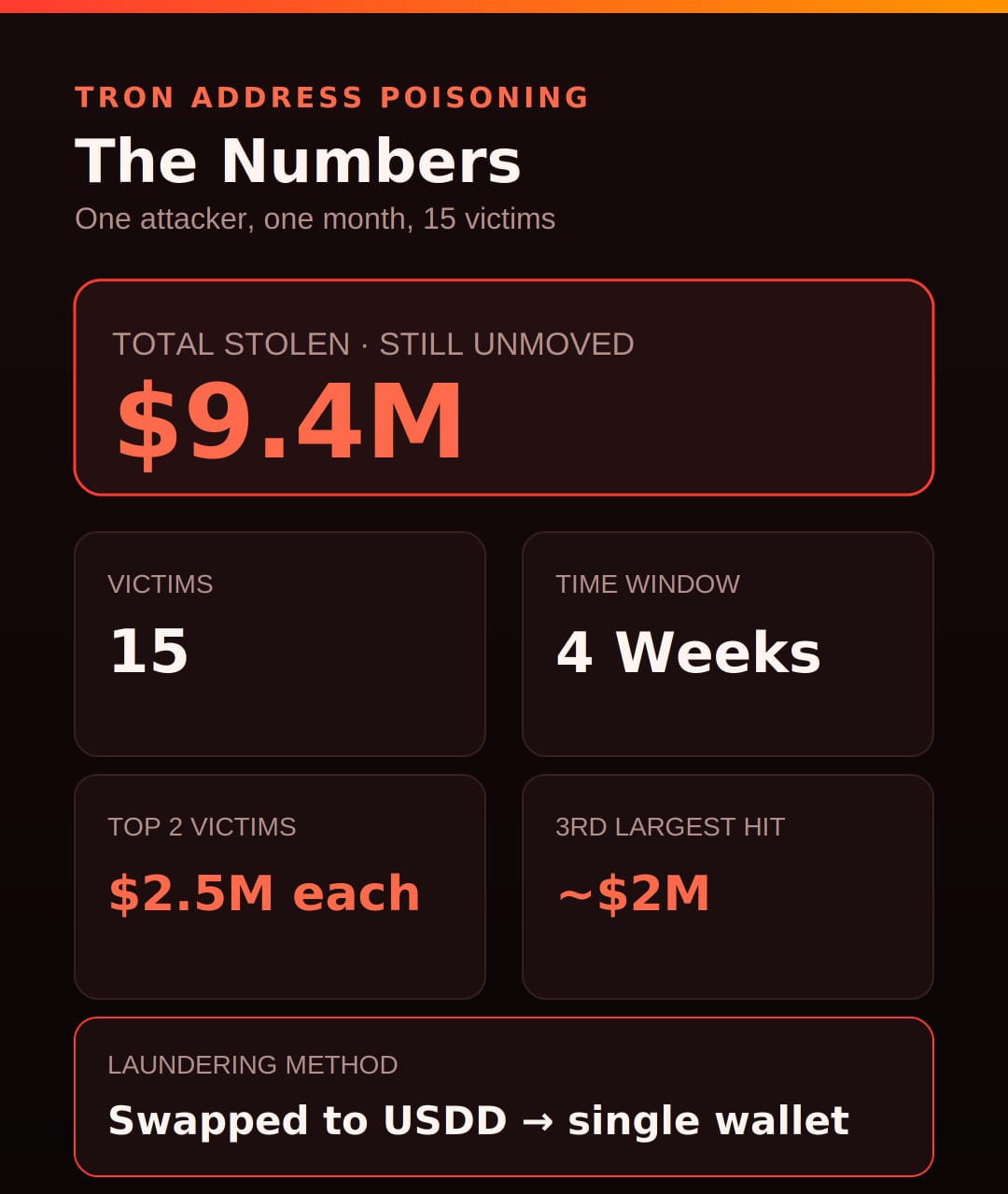
The financial toll of this operation is substantial, with the combined losses reaching $9.4 million across fifteen victims. The distribution of these losses highlights the attacker’s success in targeting individuals with considerable holdings. The two largest victims alone accounted for a staggering $2.5 million each, representing over half of the total stolen amount. Another significant target lost approximately $2 million in a single incident. This consistency in achieving large-scale thefts, repeatedly hitting targets for multi-million dollar sums, underscores the effectiveness of the address poisoning technique when executed with precision and patience. It dispels the notion of this being merely a lucky strike against a careless individual; rather, it paints a picture of a well-resourced and persistent threat actor.
The Modus Operandi: Deceptively Simple ‘Address Poisoning’
Address poisoning, while yielding substantial returns for this attacker, is remarkably low-tech when compared to the complex smart contract exploits or sophisticated phishing campaigns that often dominate cryptocurrency headlines. It does not involve breaching smart contract vulnerabilities, stealing private keys through brute force, or tricking users into revealing seed phrases. Instead, it leverages a fundamental human oversight and the way many users interact with blockchain explorers and wallet interfaces.
The mechanism is deceptively straightforward:
- Reconnaissance: The attacker first identifies a target and analyzes their transaction history to pinpoint frequently used addresses, particularly those involved in large transfers.
- Impersonation: The attacker then generates a new wallet address that closely mimics a legitimate, frequently used address from the victim’s past transactions. This is often achieved by creating an address that shares the same initial and final few characters as the legitimate one. For instance, if the legitimate address is
TXy...zAB, the attacker might generateTXx...yAB. The intermediate characters will differ, but the visual similarity is often enough to fool a cursory glance. - The "Dust" Transaction: A tiny, often near-worthless amount of cryptocurrency (known as "dust") is sent from this impersonating address to the victim’s wallet. This transaction has no financial value to the victim, but its purpose is crucial: it inserts the poisoned address into the victim’s recent transaction history.
- The Waiting Game: The attacker waits. The poisoned address now sits quietly among legitimate transactions in the victim’s wallet activity log.
- The Fatal Copy-Paste: The trap springs when the victim next needs to send funds to their real, trusted counterparty. Instead of manually typing the full address, or using a pre-saved, verified contact, they navigate to their transaction history and, in a moment of haste or inattention, copy the visually similar poisoned address instead of the genuine one.
- Irreversible Loss: Because blockchain transactions are irreversible by design, once the victim confirms the transfer to the poisoned address, the funds are immediately sent to the attacker. There is no central authority like a bank to call for a chargeback, and no "undo" button.
Why Tron is a Fertile Ground for Address Poisoning
The Tron network has historically been a particularly common battleground for this style of attack, a factor that contributed to the success of this $9.4 million operation. Several characteristics make it attractive to attackers:
- High USDT Volume: Tron processes an overwhelming majority of global Tether (USDT) volume. USDT, as the most widely used stablecoin, is frequently transferred for trading, remittances, and various other financial activities. This high volume of transactions creates a larger pool of potential victims and more opportunities for attackers to insert their poisoned addresses into active transaction histories.
- Low Transaction Fees: Transaction fees on the Tron network are notoriously cheap, often costing fractions of a cent. This low cost enables an attacker to "blast" poisoned dust transactions to thousands of wallets without incurring significant overhead. The economic viability of spreading these traps far and wide makes Tron an efficient platform for such large-scale poisoning campaigns.
- Rapid Transaction Confirmation: Tron’s Delegated Proof-of-Stake (DPoS) consensus mechanism allows for fast transaction finality, meaning dust transactions appear quickly in a victim’s history, and illicit transfers are confirmed almost instantly, reducing the window for detection or intervention.
The Digital Hoard: Tracing the Stolen Funds
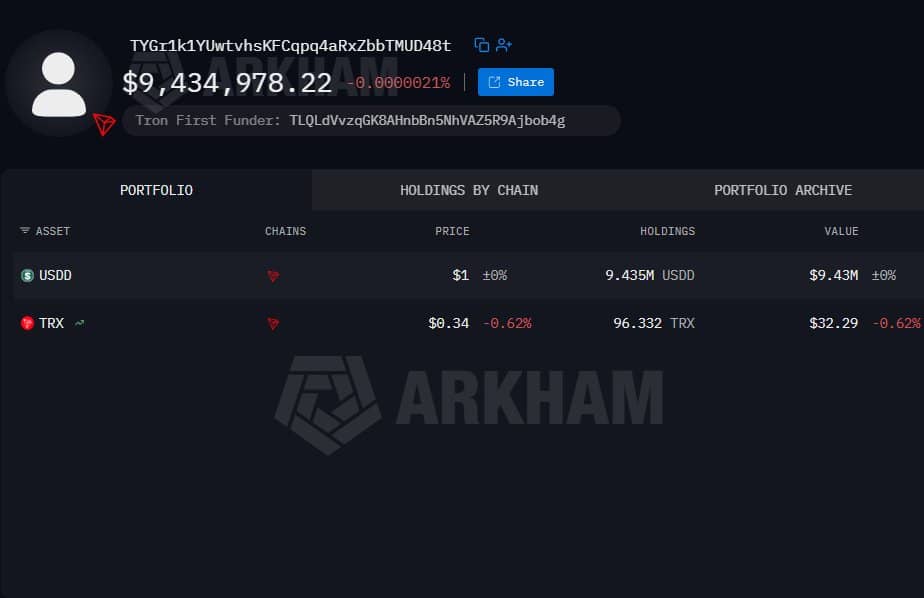
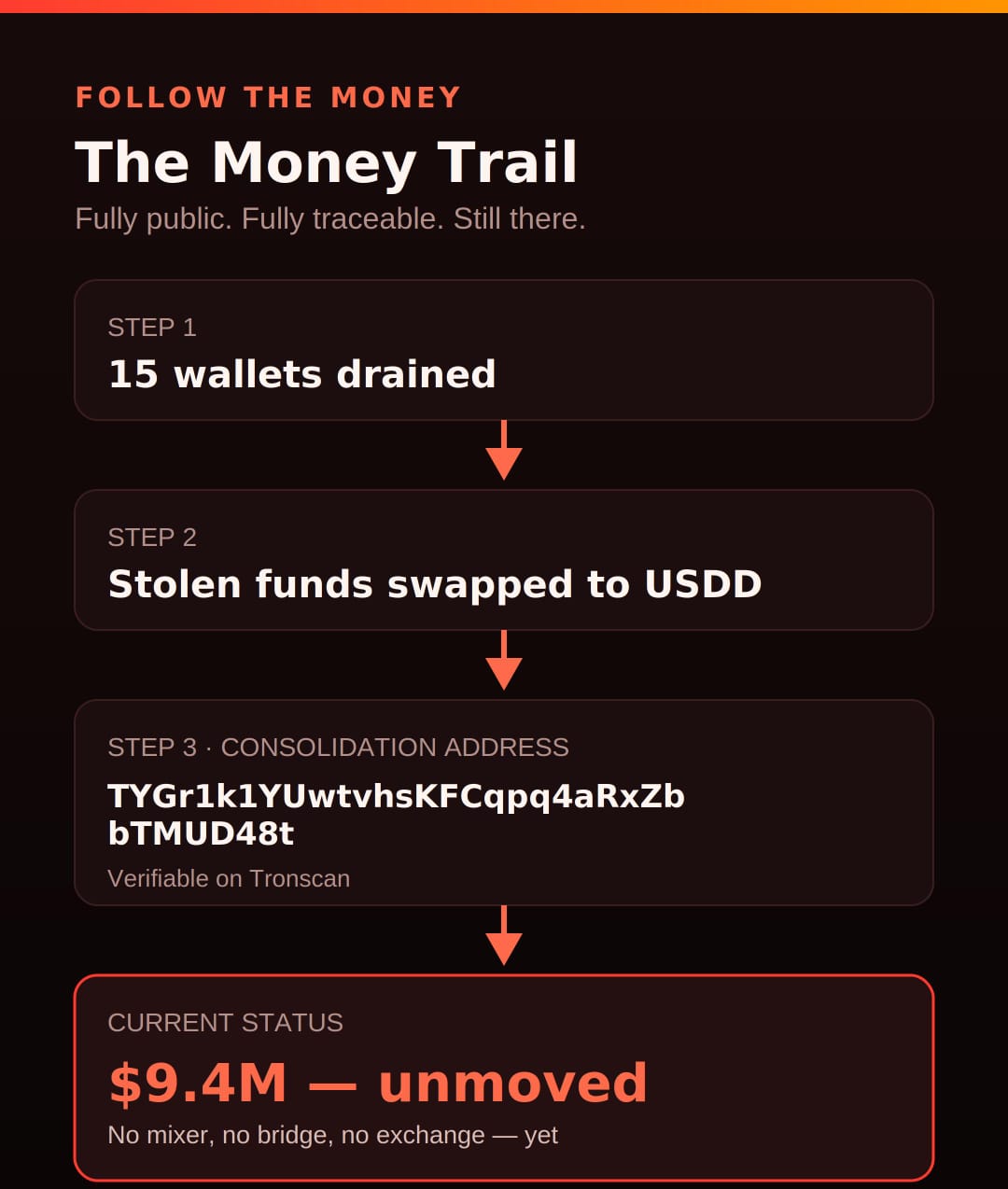
Once each theft occurred, the funds followed an identical and highly systematic pattern. The stolen assets were immediately swapped into USDD, Tron’s native decentralized stablecoin. This conversion provides stability for the stolen funds, shielding them from the volatility inherent in other cryptocurrencies. Subsequently, all converted funds were funneled into a single consolidation address: TYGr1k1YUwtvhsKFCqpq4aRxZbbTMUD48t.
This address is publicly viewable on Tron’s official block explorer, Tronscan, which independently confirms the scale and history of inbound transactions. As of the most recent reporting, the entire $9.4 million remains sitting in this address, unmoved and unlaundered through any further sophisticated means. This behavior is highly unusual for large-scale crypto thefts, which typically see rapid layering through mixers, cross-chain bridges, or decentralized exchanges within hours or days to obscure the trail. The month-long static balance suggests a deliberate pause, potentially indicating:
- Extreme Confidence: The attacker may believe they are beyond the reach of law enforcement or recovery efforts.
- Strategic Waiting: They might be waiting for the initial wave of scrutiny to die down, or for market conditions to become more favorable for a large-scale liquidation or laundering operation.
- Operational Constraints: Less likely, but possible, could be a lack of immediate channels for off-ramping such a significant sum without drawing further attention.
The public nature of the funds, however, cuts both ways. While it makes the attacker’s current holdings transparent, it also means that blockchain investigators, exchanges, and analytics firms can monitor the address in real-time for any sign of movement towards an exchange or mixing service—the critical moment where potential recovery or freezing actions become theoretically possible.
Broader Context: The Evolving Landscape of Crypto Scams
Address poisoning, while relatively simple in execution, represents a significant segment of the broader landscape of cryptocurrency fraud. Unlike direct hacks that exploit technical vulnerabilities in smart contracts or systems (e.g., the Poly Network hack or the Ronin Bridge exploit), address poisoning falls under the umbrella of social engineering attacks, similar to phishing or romance scams. These attacks prey on human factors like inattention, trust, and cognitive biases rather than purely technical flaws.
The current Tron case is notable not just for the aggregate sum, but for the consistency and volume of victims. While individual losses from address poisoning have made headlines before—including a widely reported case late last year where a single trader lost nearly $50 million in one mistaken transfer on the Ethereum network—this Tron incident stands out for its methodical, multi-victim approach over a concentrated period. This pattern strongly points to an organized, repeatable operation rather than an opportunistic one-off, signifying a professionalization of this particular scam vector. It also raises an uncomfortable question: how many more potential victims have already had their wallets "poisoned" and are simply one copy-paste error away from a devastating loss?
The Human Cost and Investigative Challenges
For the fifteen victims, the financial impact of losing millions of dollars is immense, but the psychological toll can be equally devastating. The feeling of helplessness, of knowing their funds are visible but inaccessible, contributes to a deep sense of betrayal and vulnerability. Unlike traditional banking where recourse mechanisms exist, the immutable nature of blockchain transactions means that once funds are transferred and confirmed, reversal is impossible without the recipient’s cooperation.
This immutability, while a core tenet of blockchain technology, presents significant challenges for investigators and law enforcement. Tracing funds on a public ledger is one thing; identifying the real-world identity of the perpetrator behind a pseudonymous address and compelling recovery is another entirely. International cooperation is often required, and the legal frameworks surrounding cryptocurrency theft are still evolving, leading to complex jurisdictional issues. Blockchain analytics firms like Specter play a crucial role in providing the on-chain intelligence necessary for potential recovery efforts, but their work is often just the first step in a long and arduous process.
Industry Response and the Call for Enhanced Wallet Security
The recurring theme across nearly every documented address poisoning case, including this recent Tron incident, is that the technology to prevent such attacks already exists and simply isn’t deployed widely enough across the ecosystem. The onus cannot solely be placed on individual users to exercise extreme vigilance in an environment where a single mismatched character can lead to financial ruin.
Wallet interfaces and block explorers have a critical role to play in mitigating this threat. Proposed and partially implemented solutions include:
- Visual Flags for Look-Alike Addresses: Wallets could employ algorithms to detect addresses in a user’s transaction history that are visually similar to legitimate, frequently used contacts and flag them prominently with warnings.
- Confirmation Warnings for Unused Addresses: Before confirming a transfer to an address that the user has never interacted with before (or an address that has been recently generated and only received dust transactions), the wallet could issue a strong, explicit warning, requiring extra confirmation steps.
- Hiding Zero-Value Dust Transactions: Some wallets and explorers have begun to filter out or hide zero-value dust transactions from the main transaction history view, relegating them to a "spam" or "hidden" section. This simple UI/UX change dramatically reduces the attacker’s ability to insert poisoned addresses into the visible history.
- Address Book Integration: Encouraging and facilitating the use of a robust, verified address book where users can save and label trusted addresses would further reduce reliance on copying from recent history.
While some advanced wallets and block explorers have started rolling out these kinds of warnings and features, adoption across the broader cryptocurrency ecosystem, and specifically within the Tron network, remains inconsistent. This $9.4 million case serves as a direct and compelling argument for why this adoption needs to accelerate significantly. When an attacker’s entire strategy depends on a victim’s eyes skipping past a few mismatched characters, the most effective fix isn’t merely asking millions of users to become more careful; it’s building interfaces that make the mistake structurally harder to make in the first place. Industry bodies, wallet providers, and blockchain foundations are increasingly facing calls to prioritize these user-centric security enhancements to protect the integrity and trustworthiness of the decentralized finance space.
Implications for Trust and Regulation
The consistency and scale of this address poisoning operation on Tron carry broader implications for user trust in decentralized finance and the potential for increased regulatory scrutiny. Incidents like these erode confidence, particularly among new users or those less familiar with the nuances of blockchain security. The narrative that "you are your own bank" often comes with the unspoken caveat that "you are also your own security department," a burden many users are ill-equipped to bear.
Regulators globally are already grappling with how to oversee the rapidly expanding crypto market. A sustained pattern of easily preventable scams, especially those that leverage basic human error, could intensify calls for mandatory security standards for wallet providers and exchanges. This would shift some of the responsibility from individual users to the platforms that facilitate their interaction with digital assets, potentially leading to more stringent compliance requirements and a more regulated environment for crypto services.
The Road Ahead: A Waiting Game
For now, the $9.4 million sits untouched at a fully public, fully traceable address. This transparency is a double-edged sword. On one hand, it provides investigators, exchanges, and blockchain analytics firms with real-time visibility, allowing them to monitor for any signs of movement towards an exchange or mixing service—the critical juncture where recovery or freezing becomes at least theoretically possible through coordinated efforts. On the other hand, the attacker is fully aware of this scrutiny and has seemingly opted for patience over speed, a strategy that complicates immediate intervention.
Whether this patience will eventually run out before a concerted effort can be mobilized to act on the funds remains the open question hanging over this case. It is a stark reminder for the fifteen individuals who have lost their savings, and indeed for the entire cryptocurrency community, of how little margin for error a single copied address actually leaves in the immutable world of blockchain transactions. The incident underscores the ongoing battle between ingenious attackers and the imperative for the crypto ecosystem to build more resilient, user-friendly security infrastructure.














