


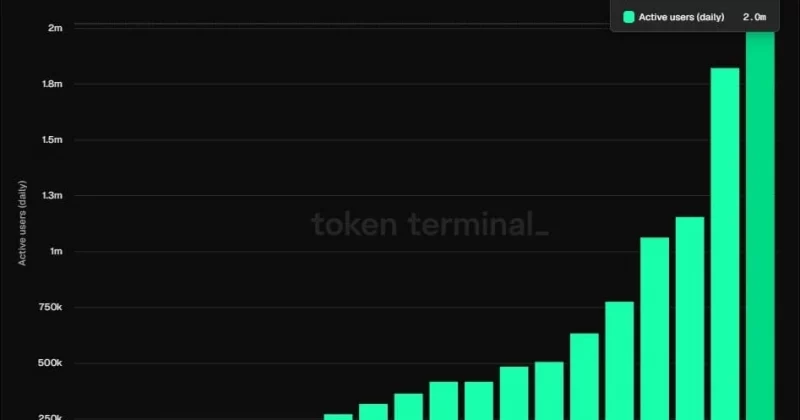
Tron has achieved a significant milestone, surpassing the 4 million daily active user (DAU) threshold and overtaking Solana as the leading major blockchain network. This remarkable growth is not fueled by the speculative fervor of decentralized finance (DeFi) or the explosive popularity of non-fungible tokens (NFTs), but rather by the pervasive adoption of stablecoins, with Tether’s USDT being the primary driver. This shift underscores a fundamental change in user engagement on blockchain networks, highlighting the critical role of stable, dollar-pegged assets in facilitating everyday transactions and cross-border commerce.
The Stablecoin Engine Powers Tron’s Ascent
The data reveals a dramatic acceleration in Tron’s user base. In the fourth quarter of 2025, the network averaged approximately 2.8 million DAUs, trailing closely behind Solana’s 2.9 million. Within a few months, by February 2026, Tron’s DAU had climbed to around 3.2 million. The latest figures, exceeding 4 million DAUs, represent a sustained and substantial surge, positioning Tron at the forefront of blockchain network activity.
This user growth is inextricably linked to the massive volume of USDT transactions on the Tron network. Daily USDT transfer volumes frequently surpass $20 billion, a staggering figure that speaks to the network’s utility as a global payment rail. As of May 2025, the circulating supply of USDT on Tron had already exceeded $75 billion, constituting more than half of Tether’s total global supply. This concentration of Tether’s stablecoin on Tron highlights the network’s dominance in facilitating dollar-denominated transactions within the digital asset ecosystem.
Beyond stablecoin activity, Tron’s underlying infrastructure is handling an immense volume of transactions. The network processes over 8 million daily transactions, a testament to its high throughput capabilities. Furthermore, Tron has cultivated a vast user base, accumulating more than 306 million total user accounts since its inception. This extensive reach suggests a broad adoption of the network, not just for a specific use case, but as a foundational layer for a diverse range of digital activities.
The Strategic Advantage of Stablecoins in User Acquisition
The success of Tron in attracting and retaining users through stablecoins offers a compelling contrast to the more volatile growth patterns often seen with DeFi and NFT-centric blockchains. While speculative trading and digital collectible markets can generate significant bursts of activity, they are often susceptible to market sentiment and can lead to transient user engagement. Stablecoins, on the other hand, offer a stable medium of exchange, making them ideal for everyday transactions, remittances, and cross-border payments.
Tron’s founding principles, established in 2017 by Justin Sun with its mainnet launching in 2018, were centered on achieving high throughput and minimizing transaction fees. These foundational design choices have proven to be instrumental in its ability to support the massive scale of stablecoin operations. Low fees and efficient processing are critical for making microtransactions and frequent transfers economically viable, a necessity for any network aiming to compete in the global payments space.
The strategic integration and promotion of USDT on the Tron network have evidently resonated with users seeking a reliable and cost-effective way to move value across borders or engage in digital commerce. This focus on utility rather than pure speculation has created a more robust and sustainable user base, less prone to the boom-and-bust cycles that can affect other blockchain ecosystems.
Implications for Investors and the Broader Blockchain Landscape
The current trajectory of Tron presents both significant opportunities and inherent risks for investors and the broader blockchain ecosystem. The network’s transaction volume is not merely a reflection of speculative interest but is fundamentally tied to global remittance flows and cross-border commerce. This underlying utility provides a strong, baseline demand for the network’s native token, TRX. TRX is required to pay transaction fees and to participate in the network’s governance, creating a direct economic incentive for users and stakeholders to hold and utilize the token.
However, the overwhelming reliance on a single asset, USDT, for Tron’s user growth introduces a critical point of concentration risk. The network’s activity is overwhelmingly dependent on the continued dominance and stability of Tether. Any significant disruption to USDT’s operations or its market position could pose an existential threat to Tron’s current user engagement levels.
Potential scenarios that could impact this dynamic include:
- Regulatory Scrutiny of Tether: Increased regulatory pressure on Tether, or unforeseen legal challenges, could lead to a loss of confidence in USDT, prompting users to seek alternative stablecoins.
- Competition from Other Stablecoins: While USDT is currently dominant on Tron, a rival stablecoin, such as USD Coin (USDC), could gain significant traction on the network. If USDC were to offer compelling advantages in terms of stability, accessibility, or perceived regulatory compliance, it could siphon off market share from USDT on Tron, impacting user numbers.
- Technological or Operational Issues: Any major technical failure or operational disruption within Tether’s infrastructure could have a ripple effect on Tron’s user activity.
The implications for investors are clear: while the current growth is impressive, a thorough understanding of the risks associated with this concentration is paramount. Diversification of stablecoin usage on Tron, or the emergence of competing stablecoin ecosystems, could mitigate this risk in the future. For the broader blockchain landscape, Tron’s success with stablecoins serves as a powerful case study, demonstrating that the most sustainable user growth may come from providing practical, everyday financial utility rather than solely from speculative applications.
A Chronology of Tron’s Ascendancy
The journey of Tron from a nascent blockchain to a leading network is a story of strategic development and market adaptation.
- 2017: Tron is founded by Justin Sun, envisioning a decentralized internet and a platform for content sharing.
- 2018: The Tron mainnet is launched, laying the technical foundation for the network’s operations. Early focus is placed on scalability and low transaction costs.
- Late 2025 (Q4): Tron averages approximately 2.8 million daily active users, positioning itself as a strong contender alongside Solana.
- Early 2026 (February): Tron’s DAU count increases to around 3.2 million, signaling a consistent upward trend.
- Mid-2026 (May): USDT circulating supply on Tron surpasses $75 billion, representing over half of Tether’s total supply. Daily USDT transfer volumes frequently exceed $20 billion.
- Current Reporting Period: Tron officially crosses the 4 million daily active user threshold, officially claiming the top spot among major blockchain networks, surpassing Solana. The network consistently processes over 8 million daily transactions and has amassed over 306 million total user accounts.
This timeline highlights a period of rapid and sustained growth, particularly in the latter half of 2025 and early 2026, directly correlating with the surging adoption of USDT on the platform.
Supporting Data and Network Metrics
The robust performance of Tron is underpinned by several key metrics:
- Daily Active Users (DAU): Exceeding 4 million, a significant increase from previous quarters.
- Daily Transactions: Averaging over 8 million, demonstrating high network activity.
- Total User Accounts: Surpassing 306 million, indicating a broad and established user base.
- USDT Circulating Supply on Tron: Over $75 billion as of May 2025, highlighting the network’s central role in the stablecoin market.
- Daily USDT Transfer Volume: Frequently exceeding $20 billion, underscoring its utility as a payment rail.
- Transaction Fees: Consistently low, a key factor enabling high transaction volumes.
- Network Throughput: High capacity to handle a large number of transactions per second, crucial for stablecoin operations.
These figures collectively paint a picture of a highly utilized and efficient blockchain network that has successfully leveraged stablecoins to drive mainstream adoption.
Broader Impact and Future Outlook
Tron’s achievement has significant implications for the blockchain industry. It challenges the prevailing narrative that user growth is primarily driven by speculative assets like cryptocurrencies or digital collectibles. Instead, it demonstrates the power of utility-focused applications, particularly in the realm of payments and cross-border transfers, powered by stablecoins.
The success of Tron with USDT could encourage other blockchain networks to focus on developing robust infrastructure and fostering partnerships that facilitate stablecoin adoption. It also highlights the increasing interconnectedness of traditional finance with the digital asset space, as stablecoins act as a bridge between the two.
For investors, this shift suggests that networks with strong utility, low fees, and a focus on facilitating real-world economic activity may offer more sustainable growth prospects than those reliant on speculative trends. However, the concentration risk associated with USDT cannot be overstated. The future success of Tron will likely depend on its ability to maintain the stability and trust in USDT, or to diversify its stablecoin offerings and expand its utility beyond stablecoin transfers. The ongoing evolution of regulatory frameworks for stablecoins will also play a crucial role in shaping the long-term prospects of networks like Tron. The blockchain industry is watching closely to see if Tron’s stablecoin-driven model can maintain its momentum and set a new precedent for user acquisition and sustained network activity.














