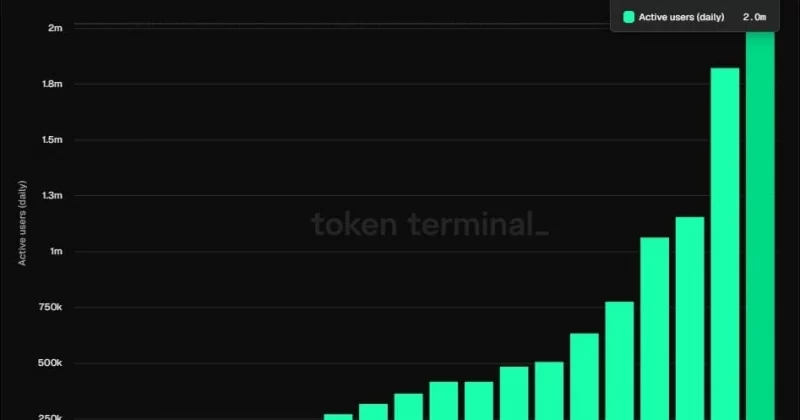
Tron has achieved a significant milestone, surpassing the 4 million daily active user (DAU) threshold and outranking major blockchain networks, including Solana, for the top spot. This remarkable growth, however, is not fueled by the speculative frenzy of Decentralized Finance (DeFi) or the ephemeral allure of Non-Fungible Tokens (NFTs). Instead, the engine behind Tron’s ascent is the robust and consistent demand for stablecoins, with Tether (USDT) standing as the undisputed primary driver.
The Unstoppable Momentum of Stablecoin Transactions
The fourth quarter of 2025 marked a period of intense competition between Tron and Solana in terms of daily active users. During this period, Tron averaged approximately 2.8 million DAU, placing it just shy of Solana’s 2.9 million users. This close race was a precursor to a dramatic shift. By February 2026, Tron’s DAU had climbed to an impressive 3.2 million, a solid increase that signaled a growing user base. The network’s latest figures, however, reveal a seismic leap, clearing the 4 million DAU mark and solidifying its position as the leading blockchain network by this critical metric.
The sheer volume of stablecoin activity on Tron is staggering. USDT transfer volumes on the network frequently surpass $20 billion on a daily basis. This sustained high transaction throughput underscores the network’s capacity and its appeal to users engaged in frequent, high-value transfers. By May 2025, the circulating supply of USDT on the Tron network had already exceeded an astounding $75 billion. This figure represents a significant portion, more than half, of Tether’s total global supply, highlighting Tron’s indispensable role in the stablecoin ecosystem.
Beyond stablecoin dominance, Tron’s overall transaction volume paints a picture of a highly active network. The blockchain processes over 8 million daily transactions, a testament to its efficiency and scalability. Furthermore, the network has cultivated a vast user base, amassing more than 306 million total user accounts since its inception, indicating widespread adoption and integration into various digital economies.
Stablecoins as the Foundation for Sustainable User Growth
The genesis of Tron dates back to 2017, founded by the visionary entrepreneur Justin Sun. The network’s mainnet officially launched in 2018, with an ambitious vision to decentralize the internet. From its earliest stages, Tron’s architectural design prioritized two fundamental pillars: high throughput and remarkably low transaction fees. This technical foundation proved to be exceptionally well-suited for facilitating high-volume stablecoin transfers, a use case that has increasingly become the bedrock of blockchain network activity.
While other blockchains often experience volatile surges in user activity driven by speculative assets like cryptocurrencies or the speculative booms in the NFT market, Tron’s growth trajectory appears to be more structurally sound. The consistent demand for stablecoins, particularly for cross-border remittances, international commerce, and as a reliable store of value in volatile markets, provides a steady and growing user base. This consistent demand is less susceptible to the boom-and-bust cycles that often characterize other blockchain ecosystems.
The appeal of stablecoins lies in their inherent stability. Unlike volatile cryptocurrencies, stablecoins are pegged to a specific asset, typically a fiat currency like the US dollar. This stability makes them ideal for everyday transactions, international money transfers, and as a safe haven for capital within the crypto ecosystem. Tron’s low fees and high transaction speeds make it an exceptionally attractive platform for executing these stablecoin-based operations efficiently and cost-effectively.
Implications for Investors and the Broader Ecosystem
The substantial and sustained transaction volume on Tron has significant implications for investors and the broader blockchain landscape. Tron’s transaction activity is not merely speculative; it is structurally tied to global remittance flows and the burgeoning field of cross-border commerce. As businesses and individuals increasingly seek efficient and affordable ways to transfer value across borders, Tron’s infrastructure is well-positioned to capture a significant share of this market.
The native cryptocurrency of the Tron network, TRX, plays a crucial role in its ecosystem. TRX is required to pay for transaction fees, ensuring that users engaging with the network contribute to its operational costs. Furthermore, TRX holders can participate in the network’s governance, allowing them to vote on proposals and influence the future direction of the Tron blockchain. This intrinsic utility of TRX adds a layer of demand that is directly linked to the network’s overall activity.
However, this reliance on a single asset, USDT, also presents a notable risk factor. The concentration of network activity around a dominant stablecoin like USDT creates a potential vulnerability. Any significant disruption to USDT’s stability, regulatory challenges faced by Tether, or a substantial shift in market preference towards competing stablecoins like USDC gaining significant traction on Tron could pose an existential threat to the network’s current user numbers and transaction volumes.
For instance, if Tether were to face severe regulatory scrutiny, leading to a loss of confidence or a de-pegging event, it could trigger a mass exodus of users from Tron. Similarly, if a rival stablecoin issuer were to aggressively pursue partnerships and offer superior incentives on Tron, it could siphon off a substantial portion of USDT’s user base. This highlights the importance of diversification and resilience within the blockchain ecosystem.
A Closer Look at Tron’s Growth Trajectory
To further contextualize Tron’s remarkable achievement, it is useful to examine its historical growth and the underlying technological advancements that have facilitated this expansion.
Early Development and Focus (2017-2019):
Founded by Justin Sun, Tron’s initial vision was to build a decentralized entertainment and content-sharing platform. However, the technical capabilities of the network, particularly its ability to handle a high volume of transactions at low costs, quickly became apparent as a significant advantage for broader blockchain applications. The launch of the TRC-20 token standard in 2018, which is compatible with Ethereum’s ERC-20 standard, was a pivotal moment, enabling developers to easily deploy stablecoins and other tokens on the Tron network.
The Rise of Stablecoins on Tron (2020-2023):
During this period, the global demand for stablecoins began to surge, driven by increased institutional adoption, the growth of DeFi, and the need for a stable medium of exchange within the crypto markets. Tron’s low fees and high transaction speeds made it an ideal platform for issuers like Tether to deploy their USDT stablecoin. The network’s ability to process thousands of transactions per second without significant congestion or exorbitant fees made it a preferred choice for users looking to move large sums of money quickly and affordably. This era saw a gradual but steady increase in USDT’s presence on Tron.
Accelerated Growth and Market Leadership (2024-Present):
The period leading up to and including the current reporting timeframe has witnessed an exponential acceleration in Tron’s user growth. The data indicating a climb from 2.8 million DAU in Q4 2025 to over 4 million DAU by early 2026 underscores this rapid expansion. This surge is directly attributable to the network’s established infrastructure for stablecoin transactions and the increasing reliance of global users on USDT for remittances, trading, and as a digital store of value. The sheer volume of USDT transfers, often exceeding $20 billion daily, speaks to the network’s robustness and its critical role in the global digital economy.
Official Stance and Future Outlook
While specific official statements from Tron Foundation representatives directly addressing this DAU milestone are not publicly available in the provided text, the underlying strategy of prioritizing low fees and high throughput has been a consistent message from the project’s leadership since its inception. Justin Sun, the founder, has consistently emphasized Tron’s scalability and cost-effectiveness as key differentiators in the competitive blockchain landscape.
The continued success of Tron hinges on several factors. Firstly, maintaining its technological edge in terms of transaction speed and cost is paramount. As other networks evolve and introduce new scaling solutions, Tron must continue to innovate to retain its competitive advantage. Secondly, the stability and continued adoption of USDT are crucial. Any regulatory headwinds or competitive pressures on Tether could significantly impact Tron’s user base.
Looking ahead, Tron’s ability to diversify its use cases beyond stablecoin dominance could further solidify its long-term growth prospects. While stablecoins have proven to be an effective engine for user acquisition, fostering innovation in areas like DeFi, NFTs, and decentralized applications (dApps) could create a more resilient and multifaceted ecosystem. The network’s vast user base and high transaction volume provide a strong foundation for attracting developers and users to these emerging areas.
Broader Impact on the Blockchain Industry
Tron’s ascent to the top of blockchain networks by daily active users, driven by stablecoins, has several broader implications for the entire blockchain industry:
- Validation of Stablecoin Utility: This development unequivocally validates the critical role of stablecoins in mainstream blockchain adoption. It demonstrates that stablecoins, rather than speculative assets, can be the primary catalyst for attracting and retaining a massive user base.
- Competitive Landscape Shift: The shift in leadership from Solana to Tron signifies a dynamic and evolving competitive landscape. It highlights that technical innovation alone is not always the sole determinant of success; strategic focus on specific, high-demand use cases can yield significant results.
- Focus on Infrastructure for Real-World Use Cases: Tron’s success underscores the importance of building robust and efficient infrastructure capable of supporting real-world financial applications, such as remittances and cross-border commerce. This focus on utility is crucial for the long-term legitimacy and adoption of blockchain technology.
- Potential for Regulatory Scrutiny: The immense volume of USDT on Tron, while a testament to its success, also places both Tron and Tether under a microscope. Increased activity often attracts greater regulatory attention, which could lead to new compliance requirements or challenges for both entities.
- Diversification Imperative: The risk of over-reliance on a single asset, as highlighted by Tron’s dependence on USDT, serves as a cautionary tale for other blockchain networks. A diversified ecosystem with multiple strong use cases and assets is generally more resilient to market fluctuations and external pressures.
In conclusion, Tron’s achievement of surpassing 4 million daily active users, largely propelled by the ubiquitous presence of USDT, marks a pivotal moment in the blockchain industry. It underscores the power of stablecoins as a driver of mainstream adoption and highlights Tron’s strategic advantage in providing a low-cost, high-throughput platform for these essential financial tools. While the network’s future success will depend on its ability to maintain this momentum and navigate potential risks, its current position as the leading blockchain network by DAU is a significant testament to its engineering and market strategy.