


Despite a slight dip from its recent all-time high, Tron’s stablecoin ecosystem continues to demonstrate robust growth and strategic evolution, maintaining its formidable position within the global digital asset market. The network’s total stablecoin market capitalization, predominantly driven by Tether (USDT), recorded a minor contraction this past week, yet simultaneous integrations of new, sophisticated financial instruments signal a deliberate move towards broadening its utility beyond traditional low-cost remittances. This nuanced performance underscores a period of consolidation and strategic diversification for Tron, rather than a decline in its stablecoin ambition.
Data from DefiLlama’s live Tron stablecoin dashboard indicates that the total stablecoin market cap on the network currently stands at $93.583 billion. This figure represents a marginal decrease of $218.74 million, or 0.23%, over the past seven days, and a 0.09% dip within the last 24 hours. While these short-term metrics might suggest a pause in Tron’s otherwise consistent upward trajectory, a broader perspective reveals sustained momentum, with a 2.3% gain recorded over the last 30 days. This indicates that the network’s stablecoin supply peaked around its recent all-time high of approximately $94.27 billion in early September, subsequently experiencing a modest rebalancing without eroding the broader monthly growth. Such fluctuations are not uncommon in dynamic financial markets and should be interpreted within the context of a network actively expanding its offerings.
Tron’s Dominant Position in the Stablecoin Landscape
Tron has solidified its status as a cornerstone of the global stablecoin market, particularly for USDT. According to TRON DAO’s reporting on Token Terminal data, the network closed Q2 2026 with approximately $89.2 billion in stablecoin supply, marking a 4.1% increase quarter-over-quarter. This impressive figure translates to roughly 28.7% of the entire global stablecoin market, establishing Tron as a critical infrastructure layer for digital dollar transactions worldwide.
The overwhelming concentration of USDT on Tron is a defining characteristic of its stablecoin narrative. DefiLlama’s dominance figure shows USDT alone accounting for nearly 98% (97.97%) of all stablecoins on the network. This high concentration is not merely a statistical anomaly but a testament to Tron’s successful catering to a specific market demand. The network’s architecture, characterized by low transaction fees and high throughput, has made it an ideal platform for the rapid and economical transfer of digital dollars, especially appealing to users in emerging markets, remittance corridors, and over-the-counter (OTC) trading desks where cost efficiency is paramount. While this dominance by a single asset presents a certain level of concentration risk, it also highlights the network’s unparalleled efficiency in facilitating USDT transfers, a core value proposition that has driven its exponential growth.

Strategic Expansion: Beyond Pure Payments
The recent slight pullback in stablecoin supply should be viewed alongside two significant integrations that signal a strategic pivot for Tron. These developments indicate a conscious effort to diversify the network’s utility beyond its established role as a cheap and fast settlement layer for stablecoins, venturing into more sophisticated financial applications like yield generation and multi-collateral stablecoin support.
Ethena Integration: Ushering in Yield-Bearing Digital Dollars
A pivotal development occurred on September 11, when TRON DAO and Ethena Labs jointly announced the launch of Ethena’s USDe and its yield-bearing counterpart, sUSDe, on the Tron network. This integration was facilitated through Stargate Finance, a prominent cross-chain bridge, marking a significant step for Tron’s ecosystem.
Ethena’s USDe is a synthetic dollar protocol designed to provide a crypto-native, scalable stablecoin that is not reliant on traditional banking infrastructure. It maintains its peg through a delta-neutral hedging strategy, utilizing staked Ethereum (stETH) as collateral and shorting equivalent ETH positions to offset price volatility. The yield-bearing version, sUSDe, allows holders to earn returns generated from Ethena’s delta-hedging strategies, which typically involve a combination of staking rewards from underlying assets and funding rates from perpetual futures markets.
The introduction of USDe and sUSDe to Tron is genuinely transformative. Historically, USDT on Tron has been primarily a tool for settlement and remittances – a means to move money efficiently without necessarily aiming for capital growth. USDe and sUSDe, by contrast, are fundamentally designed to generate yield for their holders. This move indicates Tron’s strategic intent to layer a "savings and yield" use case on top of its existing dominance in "pure payments." Furthermore, the planned integrations of USDe and sUSDe into prominent Tron ecosystem decentralized applications (dApps) like JustLend DAO and SUN.io over the coming weeks will embed these yield-generating assets directly into the network’s lending and liquidity protocols, opening new avenues for passive income for Tron users. This initiative signals a mature network seeking to attract a broader demographic of users and capital, including those seeking yield opportunities within the DeFi space.

Ducat Partnership: Bridging Bitcoin-Backed Liquidity
Just two days before the recent data analysis, on September 17, another significant partnership was unveiled: Ducat announced its integration with Tron. This collaboration aims to expand stablecoin utility by connecting Ducat’s Bitcoin-backed financial infrastructure to Tron’s high-efficiency rails.
Ducat’s unique approach involves its UNIT stablecoin, which remains issued and collateralized directly against Bitcoin on the Bitcoin network itself. To enable utility within the Tron ecosystem, a wrapped TRC-20 representation, wUNIT, is created. This wUNIT can then move onto Tron, where it is specifically designed to settle against the deep USDT liquidity already present on the network. Users gain the flexibility to hold wUNIT directly or swap it for USDT through dedicated liquidity pools, effectively allowing Bitcoin-backed value to seamlessly interact with Tron’s dollar-denominated liquidity.
This integration is notable because it is not merely Tron absorbing another dollar-pegged stablecoin issuer. Instead, Tron is positioning itself as a settlement layer of choice for a completely different collateral base – Bitcoin. This allows Bitcoin-backed assets to access dollar liquidity and the speed of Tron transactions without compromising the native chain’s security model. It represents a sophisticated move to attract capital and utility from the broader crypto ecosystem, particularly from the Bitcoin community, by offering a bridge to high-liquidity, low-cost settlement environments. This diversification of collateral types underpins a vision where Tron can host a variety of digital dollars, each backed by distinct assets and serving different risk profiles and use cases.
Competitive Dynamics: The Widening Gap with Ethereum
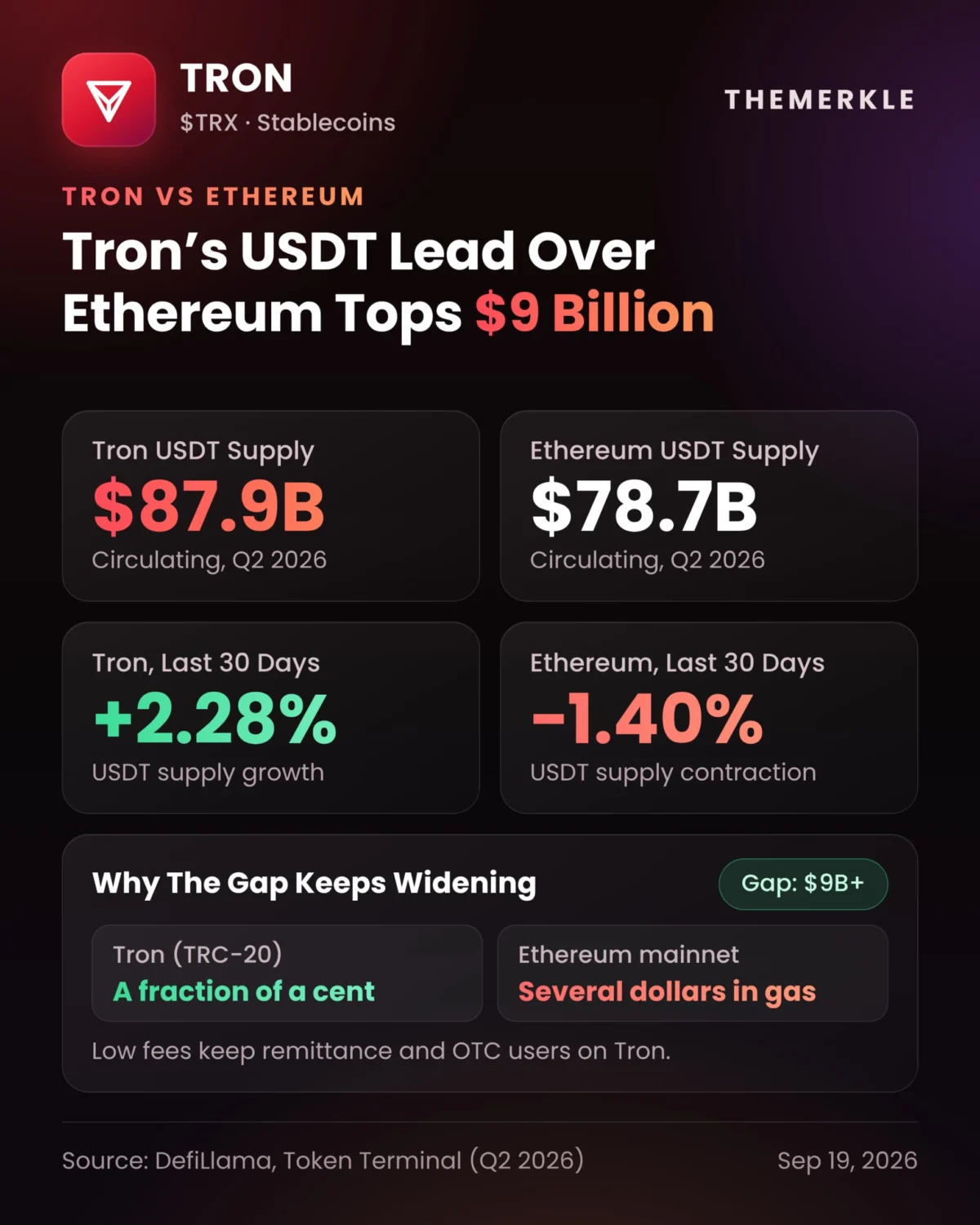
Tron’s strategic maneuvers and inherent efficiencies have allowed it to consistently widen its lead over Ethereum in terms of USDT supply. This trend continued over the past month, with Tron’s USDT supply growing by 2.28% over 30 days, while Ethereum’s contracted by 1.40% during the same period. As of Q2 2026 figures, Tron hosted $87.9 billion in circulating USDT, significantly outpacing Ethereum’s $78.7 billion, creating a gap of more than $9 billion.

The primary reason for this divergence is not enigmatic; it is fundamentally mechanical and economic. Sending USDT on Tron’s TRC-20 standard typically incurs transaction fees of a fraction of a cent. In stark contrast, the same transfer on the Ethereum mainnet can cost several dollars in gas fees, depending on network congestion and demand. For the vast majority of users engaged in high-volume, low-value transactions – such as those in remittance corridors, OTC trading, or everyday transactions in emerging markets – this cost difference is not a trivial rounding error. It is the decisive factor influencing their choice of network. Tron’s ability to provide a cost-effective and rapid transaction environment has cemented its position as the preferred network for the mass adoption of stablecoin transfers, especially in regions where even minor transaction fees can significantly impact financial accessibility.
Historical Context and Tron’s Stablecoin Journey
Tron’s journey to stablecoin dominance began with a clear vision from its founder, Justin Sun, to create an internet infrastructure that supports decentralized applications and, crucially, efficient digital payments. Recognizing the burgeoning demand for stable, dollar-pegged cryptocurrencies, Tron strategically embraced Tether’s USDT. The TRC-20 standard for USDT was launched, offering a compelling alternative to Ethereum’s ERC-20, particularly in terms of speed and cost.
This move was a game-changer. By offering ultra-low transaction fees and high transaction throughput, Tron quickly became the go-to network for users and businesses prioritizing efficiency over decentralization depth or complex DeFi ecosystems. Its focus on practical utility for real-world transactions, especially in regions with volatile local currencies or limited access to traditional banking, resonated deeply. This early strategic alignment with USDT, coupled with continuous efforts to optimize network performance, laid the groundwork for Tron’s current market leadership. The network effectively capitalized on the "digital dollar" phenomenon, becoming the underlying rails for a significant portion of global stablecoin flow.
Broader Market Perspective and Future Outlook
Tron’s current activities reflect broader trends in the stablecoin market, which is constantly seeking innovation in yield generation, collateral diversification, and transactional efficiency. The integration of Ethena’s USDe and Ducat’s wUNIT demonstrates Tron’s proactive approach to adapt to these evolving demands. By offering yield-bearing stablecoins, Tron can attract a segment of users who are not just looking to transfer value but also to grow it. Similarly, by facilitating Bitcoin-backed stablecoins, Tron taps into the immense liquidity and security associated with Bitcoin, potentially drawing new capital and use cases from the largest cryptocurrency ecosystem.

While the overwhelming dominance of USDT on Tron has been its strength, it also presents a concentration risk. Diversifying the types of stablecoins and their collateral bases reduces this risk and broadens the network’s appeal. It signifies a maturation of Tron’s ecosystem, moving beyond a single-asset, single-use-case model to a multi-faceted financial platform. This strategic evolution could allow Tron to capture a larger share of the overall digital asset market, potentially attracting more developers, dApps, and institutional interest.
However, challenges remain. The stablecoin market is under increasing regulatory scrutiny worldwide, and any changes in global or regional stablecoin regulations could impact Tron’s ecosystem. Competition from other Layer 1 and Layer 2 solutions, which are also continually improving their stablecoin offerings and reducing transaction costs, will persist. Moreover, the long-term success of these new integrations will depend on their adoption rates and the ability of Tron’s underlying infrastructure to support more complex financial instruments seamlessly.
Conclusion
This past week’s data, characterized by a slight dip from a record high, should not overshadow the profound strategic shifts occurring within Tron’s stablecoin ecosystem. While the raw supply number experienced a minor fluctuation, the simultaneous integration of Ethena’s yield-bearing USDe and Ducat’s Bitcoin-backed wUNIT represents a pivotal moment. These developments signal Tron’s ambition to transcend its role as merely the cheapest conduit for dollar transfers. Instead, it is actively laying the groundwork to become a sophisticated hub where diverse types of digital dollars, collateralized by various assets and offering different financial utilities, can coexist, interact, and settle against each other.
The question moving forward is whether this strategic diversification will significantly alter Tron’s impressive growth trajectory or primarily serve to add variety around the edges of its already dominant USDT base. Regardless, these moves underscore Tron’s proactive efforts to evolve and maintain its relevance in the ever-changing landscape of digital finance, positioning itself for continued leadership in the stablecoin sector.














