Despite a consistent narrative of unbridled expansion throughout the year, Tron’s stablecoin ecosystem recently registered a slight dip in its total market capitalization, moving just off its all-time high. This minor fluctuation, however, belies a significant strategic shift underway, marked by two crucial integrations designed to broaden the network’s utility beyond its established dominance in low-cost dollar transfers. With a current stablecoin market cap standing at $93.583 billion, a marginal decrease of $218.74 million (0.23%) over the past seven days and 0.09% in the last 24 hours, the network simultaneously logged a 2.3% gain over the past 30 days, indicating that the recent dip is a minor correction within a broader upward trend. This nuanced picture reveals a network that, while consolidating recent gains, is actively laying the groundwork for a more diversified future by welcoming yield-bearing and Bitcoin-backed digital assets.
The Enduring Dominance and Recent Fluctuations
Tron has solidified its position as a global powerhouse in the stablecoin landscape, largely driven by the adoption of Tether’s USDT. For much of the year, the growth of stablecoins on Tron has been a predictable and robust story, with the network consistently breaking new records. The recent data, as reported by DefiLlama’s live Tron stablecoin dashboard, shows the total stablecoin market cap on the network at $93.583 billion. This figure represents a slight retreat from its recent all-time high, which approached $94.27 billion in early September. While a short-term dip might prompt a superficial assessment of a slowdown, a deeper analysis suggests it is a normal market adjustment following a period of rapid expansion, rather than a reversal of the overarching growth trajectory. The 2.3% gain over the last 30 days provides crucial context, illustrating that the minor weekly contraction is a consolidation phase after a month of significant advancement.
This short-term fluctuation does not detract from Tron’s formidable market share. According to TRON DAO’s own reporting on Token Terminal data, the network concluded Q2 2026 with approximately $89.2 billion in stablecoin supply, marking a substantial 4.1% increase quarter-over-quarter. This performance granted Tron an impressive 28.7% of the entire global stablecoin market, underscoring its pivotal role in the digital asset space. A critical aspect of Tron’s stablecoin narrative, highlighted by DefiLlama’s dominance figures, is the overwhelming concentration of USDT, which accounts for nearly 98% (97.97%) of all stablecoins on the network. This near-monopoly by USDT emphasizes that Tron’s stablecoin success is, at its core, a testament to its efficiency as a rails for Tether, with other stablecoins making up only a fractional portion of the total. This concentration, while a strength in terms of liquidity and adoption for USDT, also presents a strategic imperative for diversification, which the latest integrations aim to address.
Tron’s Strategic Evolution: Beyond Pure Payments
The recent integrations signify a deliberate move by Tron to expand its utility beyond merely serving as a fast and inexpensive settlement layer for USDT. Traditionally, Tron’s appeal for stablecoin users has been its efficiency for remittances and large-volume transfers, particularly in emerging markets where transaction costs are a critical factor. The introduction of yield-bearing and Bitcoin-backed stablecoins indicates a strategic pivot towards attracting a broader spectrum of users and capital, including those seeking yield generation and diversified collateral options.

-
Ethena Labs Introduces Yield-Bearing USDe and sUSDe
A significant development in this strategic evolution occurred on September 11, with a joint announcement from TRON DAO and Ethena Labs. This collaboration brought Ethena’s USDe, a synthetic dollar, and its yield-bearing counterpart, sUSDe, to the Tron network. These assets were bridged onto Tron via Stargate Finance, a critical piece of infrastructure enabling cross-chain liquidity.
The introduction of USDe and sUSDe is particularly noteworthy because these assets represent a fundamental departure from the typical use case of USDT on Tron. While USDT on Tron has primarily served as a mechanism for cheap, fast dollar transfers, catering to users who need to move money efficiently, USDe and sUSDe are engineered with a distinct purpose: to generate yield for their holders. Ethena’s synthetic dollar protocol aims to provide a stable, scalable, and censorship-resistant digital asset that is collateralized by delta-hedged derivatives of staked Ethereum (ETH). This mechanism allows sUSDe holders to earn a yield, derived from the underlying staking rewards and perpetual futures funding rates.
For Tron, this integration signals a conscious effort to layer a "savings and yield" use case on top of its existing "pure payments" dominance. The move suggests an ambition to attract users who are not just looking to transfer funds but also to grow their digital assets. The announced future integrations into prominent Tron-based decentralized finance (DeFi) protocols, JustLend DAO and SUN.io, are crucial to this strategy. These integrations will enable USDe and sUSDe to be utilized within Tron’s vibrant DeFi ecosystem, offering new avenues for lending, borrowing, and liquidity provision, thereby deepening their utility and adoption within the network. This development positions Tron to compete more directly with other chains that offer sophisticated DeFi opportunities, attracting a different cohort of users and expanding its overall financial utility.
-
Ducat Connects Bitcoin-Backed Stablecoins to Tron’s Rails
Adding another layer to Tron’s diversification strategy, Ducat announced its integration with the Tron network on September 17. This partnership aims to expand stablecoin utility by connecting Bitcoin-backed financial infrastructure to Tron’s high-speed rails. The mechanics of this integration are distinct from a typical stablecoin bridge. Ducat’s native stablecoin, UNIT, remains issued and collateralized against Bitcoin directly on the Bitcoin network itself. However, a TRC-20 representation of UNIT, known as wUNIT, is introduced onto Tron.
The primary purpose of wUNIT on Tron is to facilitate settlement against the deep USDT liquidity already present on the network. This innovative approach allows users to leverage Tron’s efficiency and cost-effectiveness for dollar-denominated transactions while maintaining the underlying collateralization on the Bitcoin network. Users have the flexibility to hold wUNIT directly or to swap it for USDT through dedicated liquidity pools established on Tron.

This integration is significant because it is not merely Tron absorbing another dollar-pegged stablecoin issuer. Instead, it positions Tron as a preferred settlement layer for a completely different collateral base—Bitcoin. It allows assets collateralized by Bitcoin to access the vast dollar liquidity and transaction efficiency of the Tron ecosystem without requiring them to abandon Bitcoin’s native chain security model. This move effectively bridges two distinct blockchain paradigms, offering Bitcoin holders a novel way to interact with dollar liquidity and DeFi applications on Tron. It underscores Tron’s ambition to become a versatile financial hub, capable of facilitating interactions between various digital asset classes and their underlying collateral mechanisms. By attracting Bitcoin-backed stablecoins, Tron taps into a massive pool of capital and a user base that prioritizes the security and decentralization associated with Bitcoin.
The Widening Chasm with Ethereum
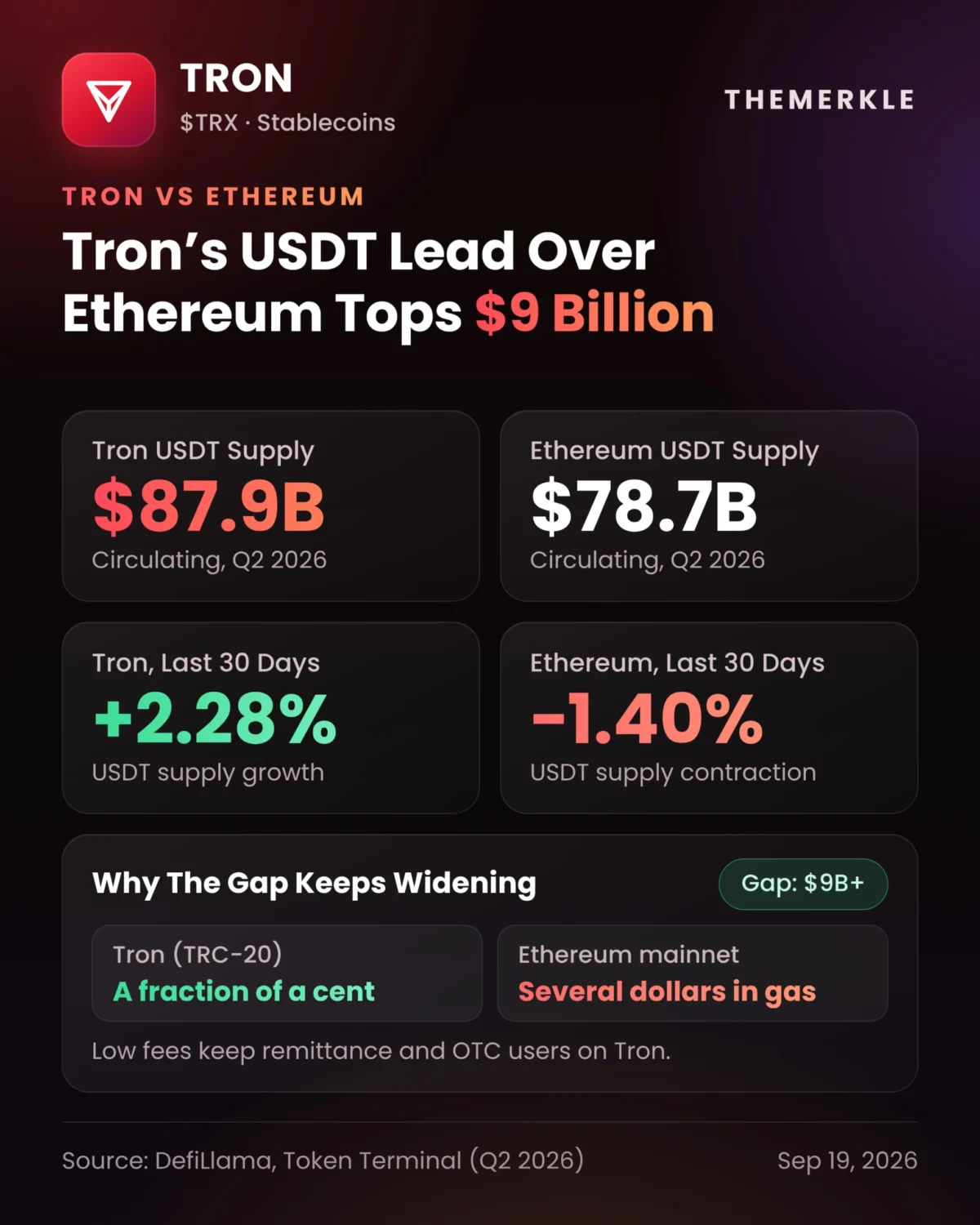
The competitive landscape for stablecoins continues to see Tron strengthen its lead over Ethereum, particularly in USDT supply. This trend has been consistent, and the past month further exacerbated the gap. Over the last 30 days, Tron’s USDT supply experienced a robust 2.28% growth, while Ethereum’s USDT supply contracted by 1.40% during the same period.
As of the Q2 2026 figures, Tron hosted an impressive $87.9 billion in circulating USDT, significantly outpacing Ethereum’s $78.7 billion. This represents a substantial gap of over $9 billion, a testament to Tron’s sustained appeal as the preferred network for Tether’s dominant stablecoin. The reasons for this widening disparity are primarily mechanical and economic, rather than mysterious.
The fundamental advantage Tron offers lies in its transaction costs. Sending USDT on Tron, utilizing its TRC-20 standard, typically costs only a fraction of a cent. In stark contrast, performing the same transfer on the Ethereum mainnet can incur several dollars in gas fees, with costs fluctuating significantly based on network congestion. This cost differential is not a minor inconvenience for many users; for the remittance corridors, over-the-counter (OTC) desks, and everyday users in emerging markets that constitute a significant portion of Tron’s stablecoin activity, it is often the deciding factor in their choice of blockchain. In regions where even a few dollars in transaction fees can represent a considerable percentage of the transferred amount, Tron’s efficiency provides an invaluable service. This economic incentive has been a powerful driver of adoption, consolidating Tron’s position as the go-to network for practical, high-volume stablecoin transactions. The continuous growth of USDT on Tron, even as Ethereum’s contracts, highlights the enduring power of economic efficiency in driving real-world utility and adoption in the blockchain space.
Broader Market Context and Tron’s Position
Stablecoins have emerged as a cornerstone of the broader cryptocurrency market, serving as crucial bridges between traditional finance and the decentralized world. They offer price stability, enabling users to store value without the volatility inherent in most cryptocurrencies, and facilitate efficient trading, lending, and remittance services. Tron’s rise to prominence in this sector is a direct result of its architectural design—a high-throughput, low-latency, and low-cost blockchain perfectly suited for the rapid movement of stable assets.

Tron’s unique value proposition, centered on affordability and speed, has allowed it to carve out a distinct niche, particularly appealing to users in developing economies where traditional banking infrastructure may be less efficient or more expensive. The network’s success with USDT has established a robust foundation, providing ample liquidity and a proven track record for stablecoin transfers.
However, the stablecoin market is not without its challenges. Regulatory scrutiny globally is intensifying, with governments and financial authorities seeking to impose stricter oversight on stablecoin issuers and platforms. This environment necessitates robust compliance frameworks and transparency from networks hosting these assets. Furthermore, competition from other layer-1 blockchains and emerging layer-2 solutions, all vying for stablecoin market share, remains fierce. Chains like Solana, Polygon, and Avalanche, alongside new entrants, are constantly innovating to offer competitive transaction costs and developer-friendly environments.
Tron’s recent diversification strategy, incorporating yield-bearing USDe and Bitcoin-backed wUNIT, can be seen as a proactive measure to address these evolving market dynamics. By expanding the types of stablecoins and use cases available on its network, Tron aims to future-proof its ecosystem, reduce its sole reliance on USDT for growth, and attract a more diverse range of institutional and retail participants. This move positions Tron not just as a transactional backbone but as a more comprehensive financial platform capable of supporting varied investment and asset management strategies within the digital realm.
Strategic Outlook and Future Trajectory
In synthesizing the current state of Tron’s stablecoin ecosystem, it becomes evident that the recent, minor dip in market capitalization is far less indicative of its long-term trajectory than the strategic diversification efforts underway. While the raw supply number experienced a slight tick downward, the simultaneous landing of two significant integrations—Ethena’s yield-bearing synthetic dollar (USDe and sUSDe) and Ducat’s Bitcoin-collateralized stablecoin (wUNIT)—represents a profound expansion of Tron’s role beyond simple USDT transfers.
Historically, Tron’s stablecoin narrative has been overwhelmingly about providing the cheapest and fastest rails for moving a dollar digitally. This core utility has been incredibly successful, cementing its status as a critical infrastructure layer for global remittances and digital commerce. However, the recent developments signal a sophisticated evolution. Tron is actively transforming into a multi-faceted platform where various types of dollar-denominated assets, backed by entirely different collateral bases and offering diverse functionalities, can not only coexist but also seamlessly settle against each other.
The introduction of USDe and sUSDe taps into the growing demand for yield in the DeFi space, potentially attracting capital that seeks passive income opportunities. Meanwhile, the integration of Ducat’s wUNIT provides a unique gateway for Bitcoin holders to access Tron’s liquidity and efficiency without relinquishing the security model of their native chain. This dual approach indicates a strategic vision to broaden Tron’s appeal beyond its established user base, drawing in investors and users with different risk appetites and financial objectives.

The critical question moving forward will be whether this diversification meaningfully alters Tron’s impressive growth trajectory or if it primarily serves to add variety around the edges of its already dominant USDT base. The success of these new integrations will depend on their adoption rates, the liquidity they can attract, and their ability to create new, compelling use cases within the Tron ecosystem. Over the coming monthly reports, observers will closely monitor the impact of these strategic moves on Tron’s overall market share, user engagement, and its continued competitive standing against other major blockchain networks. This strategic pivot suggests Tron is not resting on its laurels but is actively building a more robust, versatile, and resilient stablecoin ecosystem for the future.
Disclosure: This is not trading or investment advice. Always do your research before buying any cryptocurrency or investing in any services.
Follow us on Twitter @themerklehash to stay updated with the latest Crypto, NFT, AI, Cybersecurity, and Metaverse news!