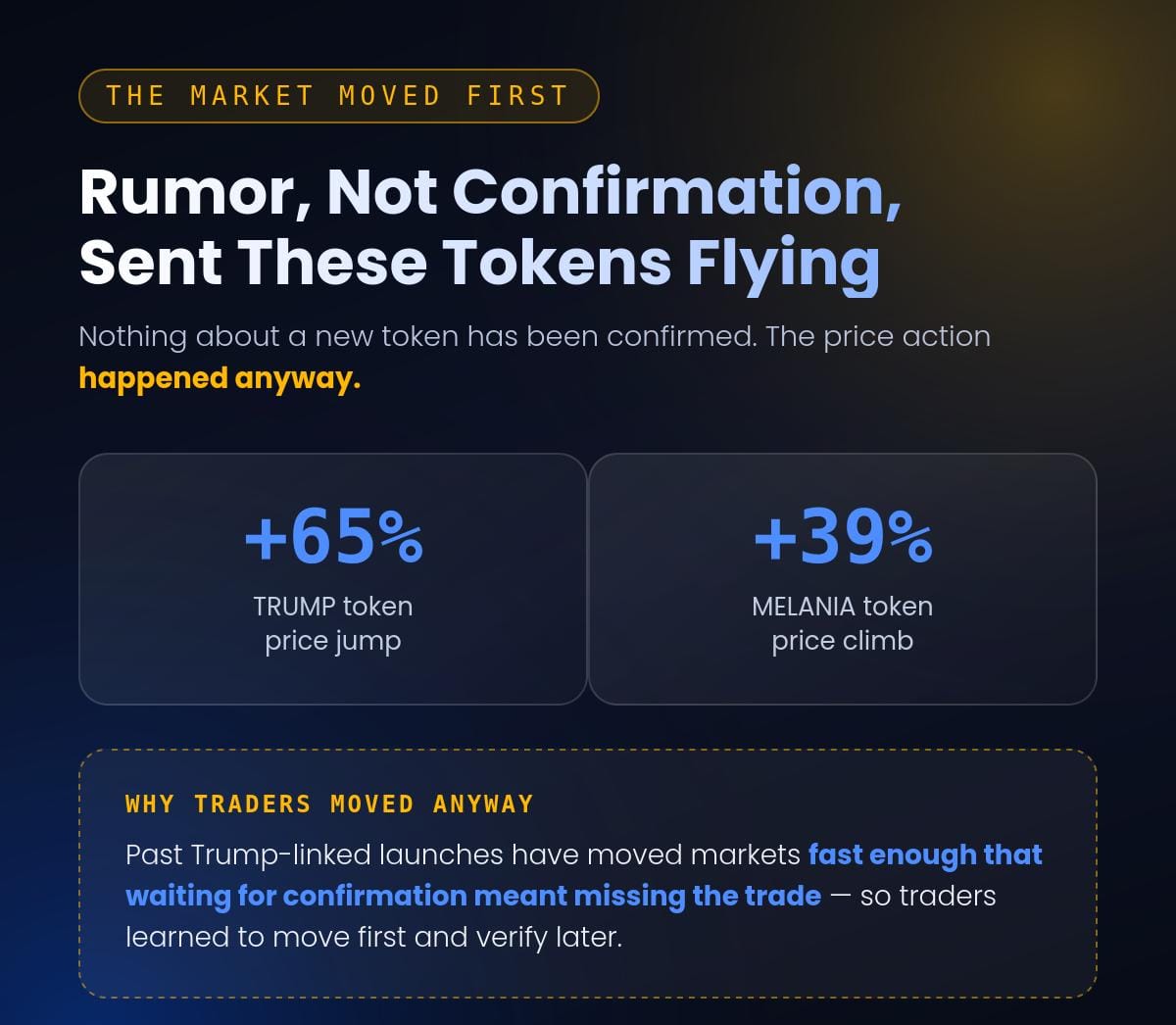
The current wave of speculation originated with unverified reports suggesting former President Donald Trump might be preparing to launch a new digital token. Unlike previous ventures or existing memecoin infrastructures, this latest rumor points to a potential deployment on the Robinhood Chain, a relatively nascent platform aiming to democratize access to decentralized finance. The mere whisper of such a possibility sent immediate and tangible ripples through the cryptocurrency market. Existing Trump-themed tokens, such as $TRUMP and $MELANIA, experienced significant price surges, climbing by as much as 65% and 39% respectively. This swift market reaction underscores a critical pattern among traders in this niche: a learned propensity to act first and seek verification later. The historical volatility associated with past Trump-linked launches has conditioned participants to believe that delaying action for confirmation often means forfeiting substantial trading opportunities.
The Enduring Phenomenon of Political Memecoins
The emergence and sustained interest in political memecoins, particularly those associated with Donald Trump, represent a unique intersection of pop culture, political engagement, and speculative finance within the broader cryptocurrency landscape. These tokens often derive their value not from underlying utility or technological innovation, but from community sentiment, social media virality, and the speculative fervor surrounding public figures. Donald Trump, a figure known for his strong brand and passionate base, has proven to be a particularly fertile ground for such digital assets.
A History of Speculation and Digital Engagements
Before the current Robinhood Chain speculation, the crypto world had already witnessed several instances of Trump-related digital ventures. Beyond memecoins like $TRUMP (often referred to by its full name, MAGA), the former President has launched official NFT collections, such as the "Trump Digital Trading Cards," which sold out rapidly and generated considerable secondary market activity. These previous successes, whether officially endorsed or merely adjacent, have fueled a culture of anticipation and speculation around any new digital asset that might bear a connection to him or his family. The market’s readiness to react to unconfirmed rumors stems directly from this established history, where even indirect links have, at times, translated into substantial gains for early movers. This background context is crucial for understanding why a mere rumor, devoid of official confirmation, can still provoke such significant market shifts.
The Genesis of the Latest Rumor: Robinhood Chain’s Moment
The pivot to Robinhood Chain for this latest speculative wave adds a new layer of intrigue and potential impact. Robinhood Chain, built on optimism’s OP Stack, is a Layer 2 scaling solution designed to offer lower transaction costs and faster processing times compared to the Ethereum mainnet. Its association with Robinhood, a popular retail trading platform, implies a potential for broader accessibility and integration with a user base already familiar with traditional and crypto markets. This combination makes it an attractive, albeit unconfirmed, choice for a high-profile token launch.
Robinhood Chain: A New Frontier for Political Crypto?
The very mention of Robinhood Chain as the potential host for a Trump-adjacent token introduces several factors into the narrative. For one, it represents a departure from the more established memecoin ecosystems like Solana, where the existing $TRUMP token resides. This shift could signal an attempt to tap into a new user base or leverage the specific technological advantages offered by a Layer 2 solution. The promise of reduced gas fees and increased transaction throughput could make a new token more accessible to a broader demographic of retail investors, aligning with the populist appeal often associated with political memecoins. However, it also means navigating a newer, less battle-tested environment, which can carry its own set of risks and uncertainties for both developers and investors. The original article linked to information about Robinhood Chain’s growing stablecoin presence, indicating a platform with increasing liquidity and adoption, making it a plausible, if not yet confirmed, location for such a high-profile (and potentially controversial) token launch.
Market Frenzy: Unconfirmed News Drives Price Action
The immediate and substantial market reaction to the Robinhood Chain rumor was a textbook example of how speculation can override fundamental analysis in the highly volatile cryptocurrency sector. The $TRUMP token, which had been trading around a certain baseline, saw its value soar by 65%, while $MELANIA experienced a 39% increase. These are not minor fluctuations but significant rallies driven purely by the prospect of a new, potentially endorsed, token from the Trump family.
The "Move First, Verify Later" Mentality
This trading behavior highlights a specific market psychology prevalent in the memecoin space: the fear of missing out (FOMO). Traders, recalling past instances where early involvement in a Trump-linked crypto asset led to substantial profits, are incentivized to jump in at the first sign of a rumor. The speed at which these tokens move means that waiting for official confirmation often translates to buying at significantly higher prices or missing the opportunity entirely. This creates a self-fulfilling prophecy: the rumor itself drives demand, which pushes prices up, validating the "move first" strategy for those who profited. However, it also creates an extremely high-risk environment, as the underlying legitimacy of the rumor remains unverified, and price pumps can quickly turn into dumps if the speculation proves false. The liquidity and trading volume for these tokens can increase dramatically during such periods, attracting both genuine speculators and opportunistic manipulators.
Deep Dive into On-Chain Activity: What the Blockchain Reveals
Moving beyond mere whispers, the core of the current speculation rests on specific, observable on-chain activity. While this activity provides tangible data, its interpretation remains ambiguous, underscoring the complexity of discerning truth from rumor in the decentralized world.
Tracing the Mysterious Wallet
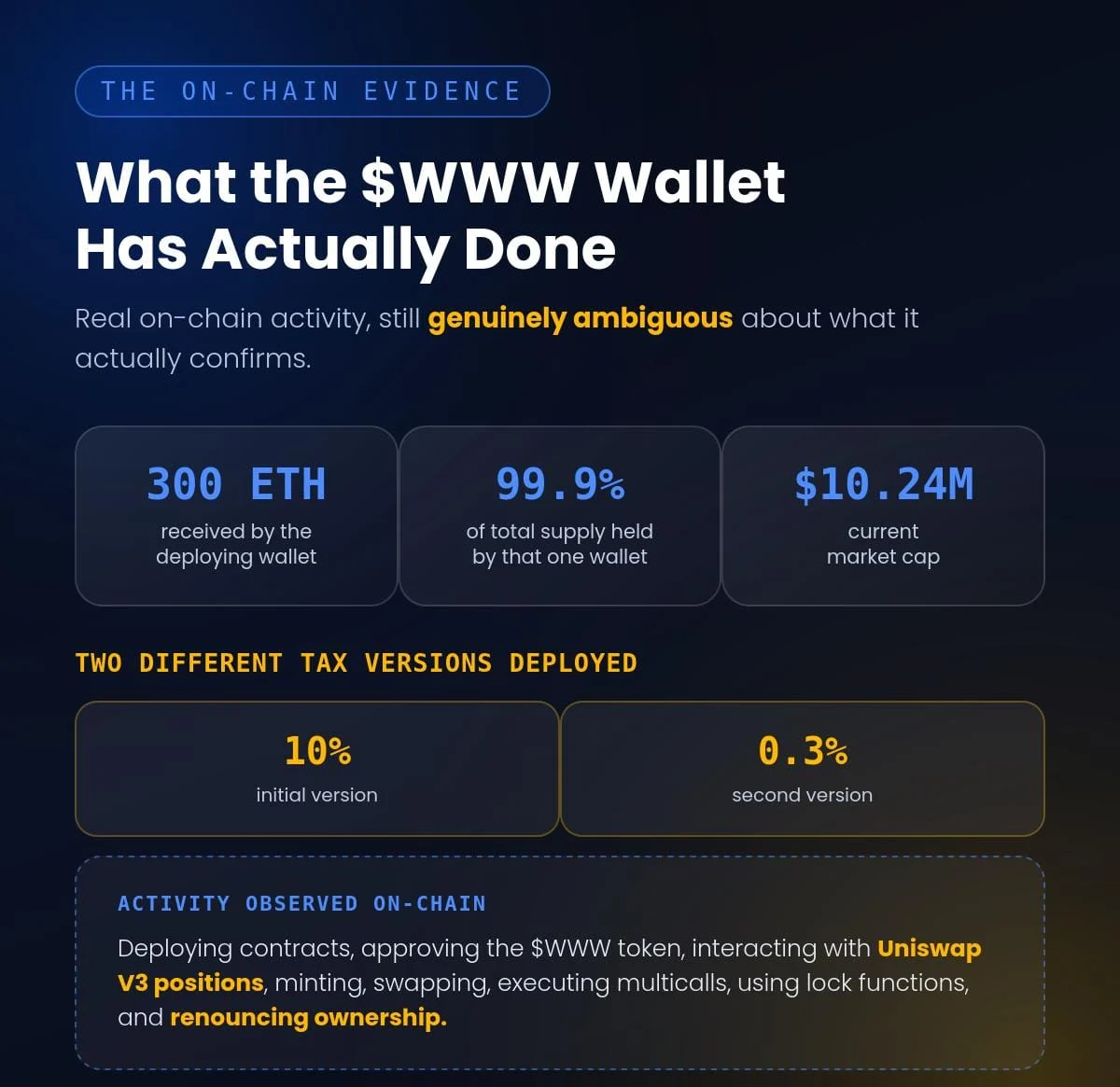
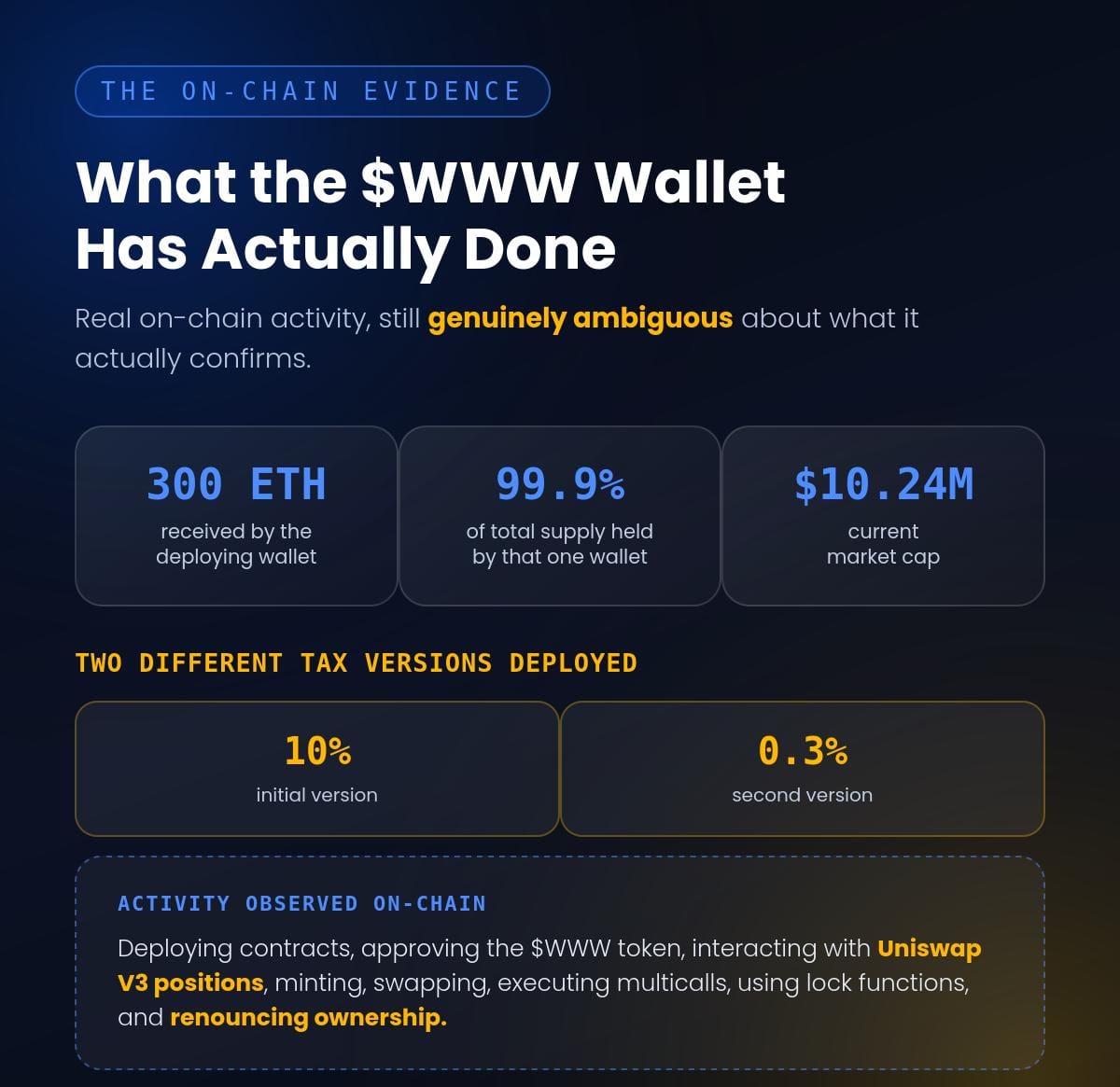
The story begins with a newly created wallet on the Robinhood Chain, identified by the address 0x41a21AC1cB40888Ce81B72c3970C1778Dd04ecc. This wallet received a significant sum of 290 ETH, a common starting point for developers preparing to deploy and test new smart contracts. Subsequent analysis suggests this wallet has been engaged in activities consistent with the development and testing of a token specifically designed around the Trump family, with an apparent ticker of $WWW, or "Truth Coin."
The deploying wallet has exhibited a wide range of sophisticated on-chain actions:
- Deploying Contracts: The initial step for any new token or decentralized application.
- Approving the $WWW Token: Essential for interacting with the newly created token.
- Interacting with Uniswap V3 Positions: This indicates preparations for providing liquidity, a crucial step before a token can be openly traded. Uniswap V3 offers concentrated liquidity, allowing for more capital-efficient trading.
- Minting and Swapping: These actions are standard for testing token functionality and supply distribution.
- Executing Multicalls: Batching multiple transactions into one, often used for efficiency in contract interactions or complex deployments.
- Using Lock Functions: Could be related to locking liquidity, team tokens, or vesting schedules, common practices to instill investor confidence or manage supply.
- Renouncing Ownership: In some cases, developers renounce ownership of a contract to make it immutable and decentralized, signaling security to investors. However, the article doesn’t explicitly state if ownership was renounced for $WWW, only that the wallet was capable of such actions.
- Moving ETH Around: Standard operational funding for gas fees and other transactional costs.
The Ambiguous Nature of "$WWW" (Truth Coin)
The token in question, referred to as $WWW or "Truth Coin," currently lacks trading liquidity. This is a crucial detail: despite the market cap appearing to sit around $10.24 million, and the deployer wallet controlling an overwhelming 99.9% of the entire supply, no one can actually buy or sell this token on the open market yet. This indicates an unfinished state, consistent with a testing phase rather than a public launch.
Further complicating the picture are the observed "two different tax versions" of the token. An initial version reportedly carried a 10% tax on transactions, while a second version reduced this to just 0.3%. Developers often test different tax structures to fine-tune tokenomics, manage liquidity, or implement anti-bot measures. A higher tax can deter rapid selling, while a lower tax encourages more frequent trading. The presence of these varying tax rates reinforces the idea of an experimental or developmental phase, where parameters are being adjusted before a final version is presented.
Crucial Inconsistencies and Developer Test Patterns
Perhaps the most critical aspect of this entire saga lies in the discrepancies and patterns that strongly suggest an unfinished, rather than a polished, institutional-grade launch. These details, often overlooked in the rush of speculative trading, are paramount for informed analysis.
Metadata Mismatch: A Key Red Flag
A primary inconsistency centers on the token’s identification across different platforms. While social media threads and rumor mills refer to the token as "Truth Coin" or with the ticker $WWW, the official blockchain explorer for the Robinhood Chain labels the very same contract (0x848eca76fbdde0bd728ba73b0d60552b87d60ffd) as "Stub Token," with the ticker $STUB. This is not a minor detail; consistent metadata is fundamental for legitimate projects, especially those aspiring to high-profile status.
This discrepancy could stem from several technical possibilities:
- Stale Metadata: The explorer’s data might not have updated to reflect recent changes by the contract deployer.
- Indexing Problems: The blockchain explorer itself could be experiencing issues in correctly indexing and displaying the most current contract information.
- Proxy Contracts: The use of proxy contracts, a common pattern in smart contract development for upgradability, can sometimes complicate how tokens display across different platforms, as the "logic" contract might differ from the "proxy" contract that users interact with.
- Mistaken Identity: Crucially, it’s genuinely possible that the entire "Truth Coin" narrative currently circulating on social media has inadvertently attached itself to the wrong contract altogether, a common occurrence amidst the chaos of crypto rumors.
Each of these possibilities, while technical, points away from a clean, ready-for-prime-time launch. An official, high-profile token launch would typically ensure meticulous consistency across all public-facing identifiers.
The "Test Coin" Anomaly
Further solidifying the "testing" hypothesis, the same deploying wallet (0x41a21AC1cB40888Ce81B72c3970C1778Dd04ecc) also deployed a second contract: 0x7b21070dbB7EFded9f6BEc8Af7a65Ec28173577c. This contract is explicitly identified by Blockscout, a blockchain explorer, as "Test Coin," with the ticker $TEST. This deployment occurred on August 22, and precisely 1 billion $TEST tokens were minted directly to the deploying wallet in the same transaction. The existence of a contract explicitly labeled "Test Coin," alongside the massive self-minting, is a clear indicator of development activity. It’s a standard practice for developers to create test tokens and contracts to experiment with functionality, security, and integration before deploying a final, public version. Additionally, another wallet, 0x94B4e33571c2124c404fe349bd754f3e66Df94Cf, has been observed in this pattern, though its exact role remains undefined.
When these pieces of evidence are considered collectively—inconsistent naming, lack of liquidity, varying tax structures, and the explicit deployment of a "Test Coin"—the picture that emerges is one of a developer actively building and experimenting with blockchain infrastructure, rather than a project poised for an imminent, official public launch. The "messy, unfinished pattern" is characteristic of a development environment, not a polished product ready for market.
The Silence from Official Channels and the Precedent of Denials
In the realm of high-profile political tokens, official communication channels serve as the ultimate arbiters of legitimacy. The current absence of any definitive statement from Donald Trump or his associated entities is a critical piece of the puzzle.
Official Verification: The Unspoken Standard
For any new token to be genuinely connected to the existing Trump ecosystem, announcements would typically surface through established, verified channels. These include:
- GetTrumpMemes and gettrumpmemes.com: The official channels for the existing $TRUMP token.
- Donald Trump Jr.’s social media accounts: As a prominent figure and vocal supporter, his endorsement or denial would carry significant weight.
- Donald Trump’s own official communications: This could include statements from his campaign, press releases, or posts on his social media platforms.
- Truth Social directly: Trump’s own social media platform would be a natural venue for any official announcement regarding a new token.
- WLFI: This entity has previously engaged publicly to debunk fake Trump token rumors. A statement from WLFI, either confirming or denying the current rumor, would therefore be highly significant.
The lack of any such official communication, despite the widespread speculation and market reaction, strongly suggests that the rumor remains unconfirmed. It is important to recall a precedent from May 2024 (correcting the likely typo from "May 2025" in the original article), when rumors circulated about Truth Social preparing its own memecoin. At that time, Donald Trump Jr. personally denied the claims, demonstrating a willingness from the family to address and refute false speculation. The current silence, while not an explicit denial, underscores the unverified nature of the Robinhood Chain token rumor. Official parties may choose to remain silent for various reasons, including avoiding legitimizing a fraudulent project or simply not engaging with every piece of online speculation. However, for investors, this silence should be interpreted as a strong signal of caution.
Broader Implications: Risks, Regulation, and Investor Vigilance
The ongoing saga of Trump-adjacent token rumors on Robinhood Chain is more than just a fleeting crypto event; it highlights fundamental challenges and risks inherent in the rapidly evolving digital asset space.
Navigating the Regulatory Minefield
The potential for political figures to launch or endorse digital tokens raises significant regulatory questions. In the United States, the Securities and Exchange Commission (SEC) and the Commodity Futures Trading Commission (CFTC) have asserted jurisdiction over various digital assets. If a token were deemed a security, it would be subject to stringent disclosure requirements and investor protections. A direct endorsement by a prominent political figure could easily attract the attention of these regulatory bodies, potentially leading to enforcement actions or demands for compliance. The distinction between a "memecoin" and a "security" often hinges on the expectation of profit derived from the efforts of others. Any hint of official backing or a structured launch could tilt the balance towards classification as a security, creating a complex legal landscape for both the issuers and participants. This regulatory uncertainty adds a layer of risk for anyone considering involvement in such tokens, especially if they are perceived to be directly linked to political campaigns or figures.
Protecting Against Speculative Traps
The chaotic pattern described in the original article—hundreds of fake contract addresses flooding the market within minutes of a rumor—underscores the severe risks of fraud, rug pulls, and honeypots.
- Rug Pulls: Where developers abandon a project and abscond with investors’ funds, often after creating artificial hype and liquidity.
- Honeypots: Smart contracts designed to allow users to buy tokens but prevent them from selling, trapping their funds.
- Scam Tokens: Projects with no legitimate purpose beyond defrauding investors, often mimicking legitimate projects or leveraging trending narratives.
The very nature of unconfirmed rumors, coupled with the "move first, verify later" mentality, creates an ideal environment for these malicious actors. Retail investors, often driven by FOMO and lacking the technical expertise to analyze smart contracts or on-chain data, are particularly vulnerable. The current $WWW token, with its 99.9% supply controlled by the deployer and lack of trading liquidity, presents a scenario ripe for manipulation should it ever become tradable without proper decentralization and transparency.
The Call for Investor Vigilance
Given the genuine on-chain activity, it is justifiable for on-chain researchers to closely monitor the contract 0x848eca76fbdde0bd728ba73b0d60552b87d60ffd. However, for the broader investing public, this contract, and any other circulating under the $WWW or "Truth Coin" name, should be treated with extreme caution and regarded as "watch-only." There is simply insufficient evidence to confirm any official connection to Donald Trump or his family. The responsible approach mirrors that taken by seasoned on-chain analysts: refrain from transacting with this specific contract until unequivocal confirmation emerges from one of the legitimate, verified channels previously outlined, such as GetTrumpMemes, Truth Social, WLFI, or Robinhood’s own official accounts. Until such confirmation materializes, viewing this entire situation as an unconfirmed rumor, rather than a verifiable opportunity, remains the only reasonable and prudent course of action for safeguarding investments in the volatile crypto market.
Disclosure: This is not trading or investment advice. Always do your research before buying any cryptocurrency or investing in any services.
Follow us on Twitter @themerklehash to stay updated with the latest Crypto, NFT, AI, Cybersecurity, and Metaverse news!