Every time a Trump-adjacent token rumor starts circulating, the same chaotic pattern repeats: a wallet does something unusual, screenshots spread faster than verification can catch up, and within hours hundreds of fake contract addresses are competing for attention before anyone actually knows if there’s a real token at all. That cycle is playing out again right now, except this time it’s happening on a brand-new chain, and the stakes for getting it wrong are genuinely higher than usual. The confluence of political figures, decentralized finance, and the inherent volatility of meme coins creates a unique environment ripe for both immense profit and significant financial peril. Understanding the mechanics of these rumors, the immediate market reactions, and the granular details of the underlying blockchain data is crucial for anyone navigating this increasingly complex intersection.
The Anatomy of a Rumor: A Recurring Pattern in Crypto
The cryptocurrency market, particularly the segment dedicated to meme coins, has developed a distinct pattern of reacting to rumors surrounding high-profile figures, and few figures command as much attention as Donald Trump. This phenomenon is not new; over recent years, numerous tokens, some legitimate within their niche and many more outright scams, have leveraged Trump’s name, image, or political movement. The attraction stems from a passionate, engaged fanbase, a clear demographic, and a high level of media visibility, all of which can translate into rapid community growth and speculative trading volume.
The typical lifecycle of a Trump-adjacent token rumor begins with an obscure piece of information—often a screenshot of a transaction, a cryptic social media post, or an unverified report from a lesser-known outlet. This initial spark is then amplified through crypto Twitter and various Telegram and Discord channels, where the information is shared, debated, and often distorted. The lack of centralized authority in crypto, coupled with the rapid dissemination capabilities of social media, means that unverified claims can quickly gain traction, leading to what is often referred to as a "narrative-driven" market movement. For tokens associated with Donald Trump, this narrative is particularly potent, given the fervent loyalty of his supporters and the general public’s fascination with his every move.
Immediate Market Impact and Trader Psychology: The "Move First, Verify Later" Imperative
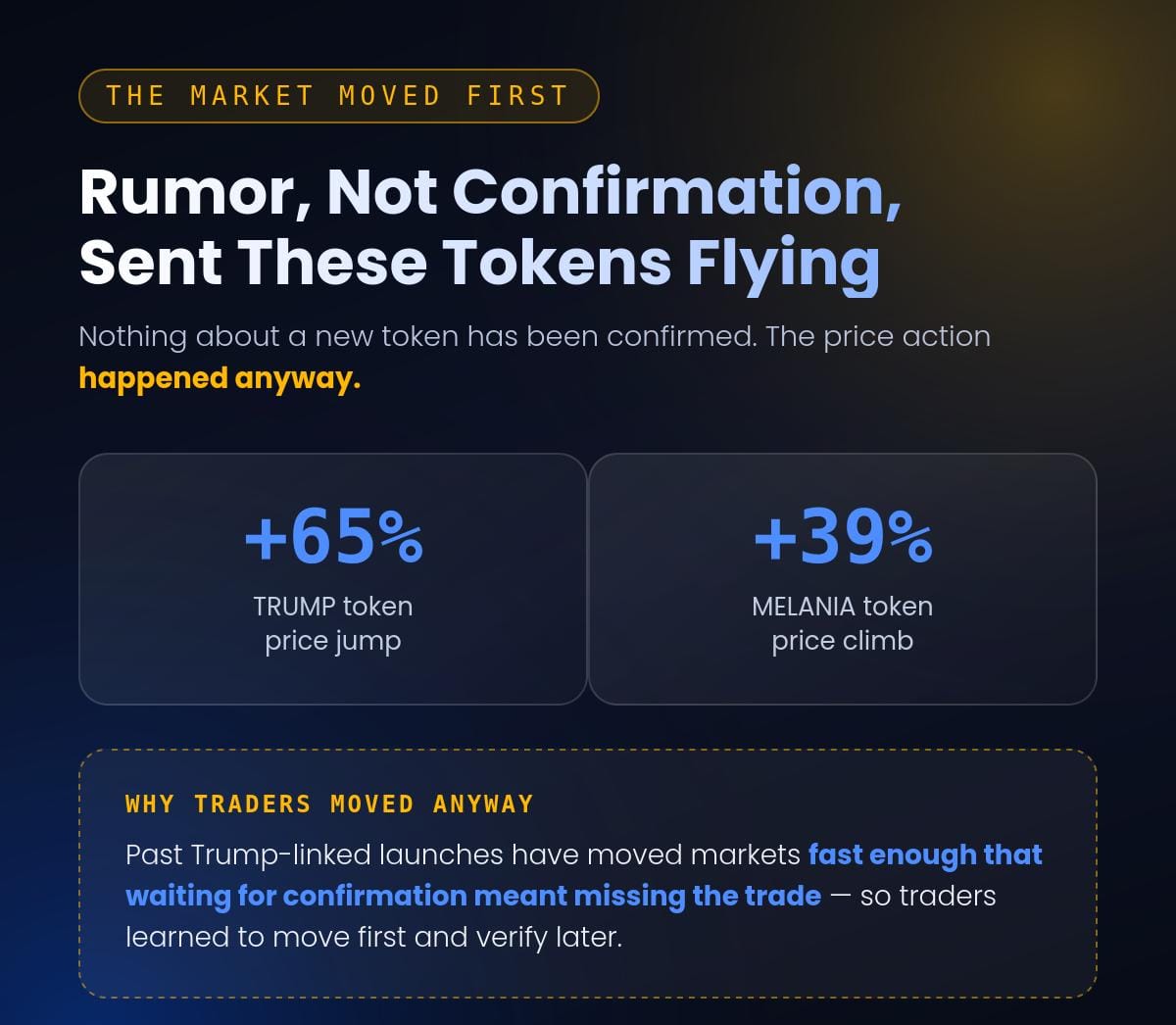
The current wave of speculation started with reports suggesting Donald Trump might be preparing to launch a new token, purportedly on Robinhood Chain, a departure from the existing infrastructure supporting other Trump-themed memecoins. The market reaction was immediate and pronounced, regardless of whether the underlying rumor holds any substance. For instance, the existing TRUMP token (MAGA) jumped by as much as 65%, while MELANIA, another related token, climbed 39%. These surges illustrate a critical aspect of trader psychology within this specific niche: the inclination to "move first and verify later."
This behavior is not irrational from a purely speculative standpoint. Past Trump-linked launches, both official and unofficial, have demonstrated the potential for explosive, rapid price appreciation. Waiting for official confirmation often means missing the most significant price pumps, leaving traders with the difficult choice between chasing the rally at higher risk or sitting out entirely. This creates a powerful feedback loop: rumors lead to price increases, which validate the "move first" strategy, which in turn reinforces the market’s sensitivity to future rumors. The fear of missing out (FOMO) becomes a dominant force, driving capital into assets based on speculation rather than confirmed fundamentals. For many participants, these tokens represent not just a financial play but also an expression of political alignment, further blurring the lines between investment and ideological support.
The Robinhood Chain Connection: A New Frontier for Political Speculation
A notable aspect of this latest rumor is the proposed platform: Robinhood Chain. While the original article links to a discussion about Robinhood Chain’s stablecoins, implying an established presence, the choice of a newer or less conventional chain for a high-profile token launch adds another layer of intrigue and potential complexity. Robinhood Chain, in this context, refers to an emerging blockchain platform that has seen significant growth, particularly in the stablecoin sector. Its growing liquidity and user base could make it an attractive, albeit perhaps less scrutinized, venue for new token deployments compared to more established chains like Ethereum or Solana.
The shift to a new chain could be interpreted in several ways: a desire for lower transaction fees, faster processing times, or perhaps an attempt to circumvent the existing ecosystem of Trump-themed tokens, thereby creating a "clean slate" for a genuinely official launch. However, it also introduces additional risks, including potential unfamiliarity for traders with the chain’s ecosystem, tools, and security protocols. For Robinhood Chain itself, being associated with such high-stakes, politically charged, and often controversial token launches could bring both increased attention and scrutiny, impacting its reputation and regulatory standing.
Where to Actually Watch for Real Confirmation: Official Channels and Past Precedents
Given the sheer volume of noise and misinformation that accompanies rumors of this nature, the more pragmatic question is not whether the rumor is true, but where a genuine signal would actually originate if it were. Establishing reliable sources is paramount for mitigating risk in such a volatile environment.
The existing, verified TRUMP token (MAGA) operates through its own official channels, primarily an account at GetTrumpMemes and an official website at gettrumpmemes.com. Its real contract resides on the Solana blockchain at the address 6p6xgHyF7AeE6TZkSmFsko444wqoP15icUSqi2jfGiPN. If any new token were to be genuinely connected to this existing ecosystem, these established channels would undoubtedly be the first place a legitimate announcement would surface. Any information not originating from these platforms regarding the TRUMP (MAGA) token should be treated with extreme skepticism.
Beyond the existing memecoin infrastructure, the more relevant channels to monitor for a potential Trump family token include direct communications from Donald Trump Jr., Donald Trump’s own official channels (such as press releases from his political organizations or statements via Truth Social), and Truth Social itself. It is crucial to remember that this is not the first instance of such rumors. In May 2025, for example, speculation arose that Truth Social was preparing its own memecoin, a rumor that Donald Trump Jr. personally denied at the time. This precedent underscores the importance of direct confirmation or denial from authorized individuals.
Furthermore, WLFI, a reputable entity often involved in addressing misinformation, is arguably one of the most important sources to watch. WLFI has previously responded publicly when fake Trump token rumors started circulating, often issuing clarifications or debunking false claims. Therefore, any statement from WLFI addressing this current rumor would carry significant weight, either confirming its legitimacy or shutting it down decisively. The absence of such a statement from these key channels should be a red flag for any trader considering engaging with the circulating tokens.
Unpacking the On-Chain Evidence: What We Know and What We Don’t
The narrative surrounding a potential new Trump token moved from pure rumor into the realm of tangible, albeit ambiguous, on-chain evidence when a newly created wallet on Robinhood Chain received 290 ETH. This wallet is now suspected of testing a token specifically designed around the Trump family, with the apparent ticker $WWW. This is where the story shifts from speculative chatter to verifiable blockchain activity, demanding a precise and cautious interpretation.
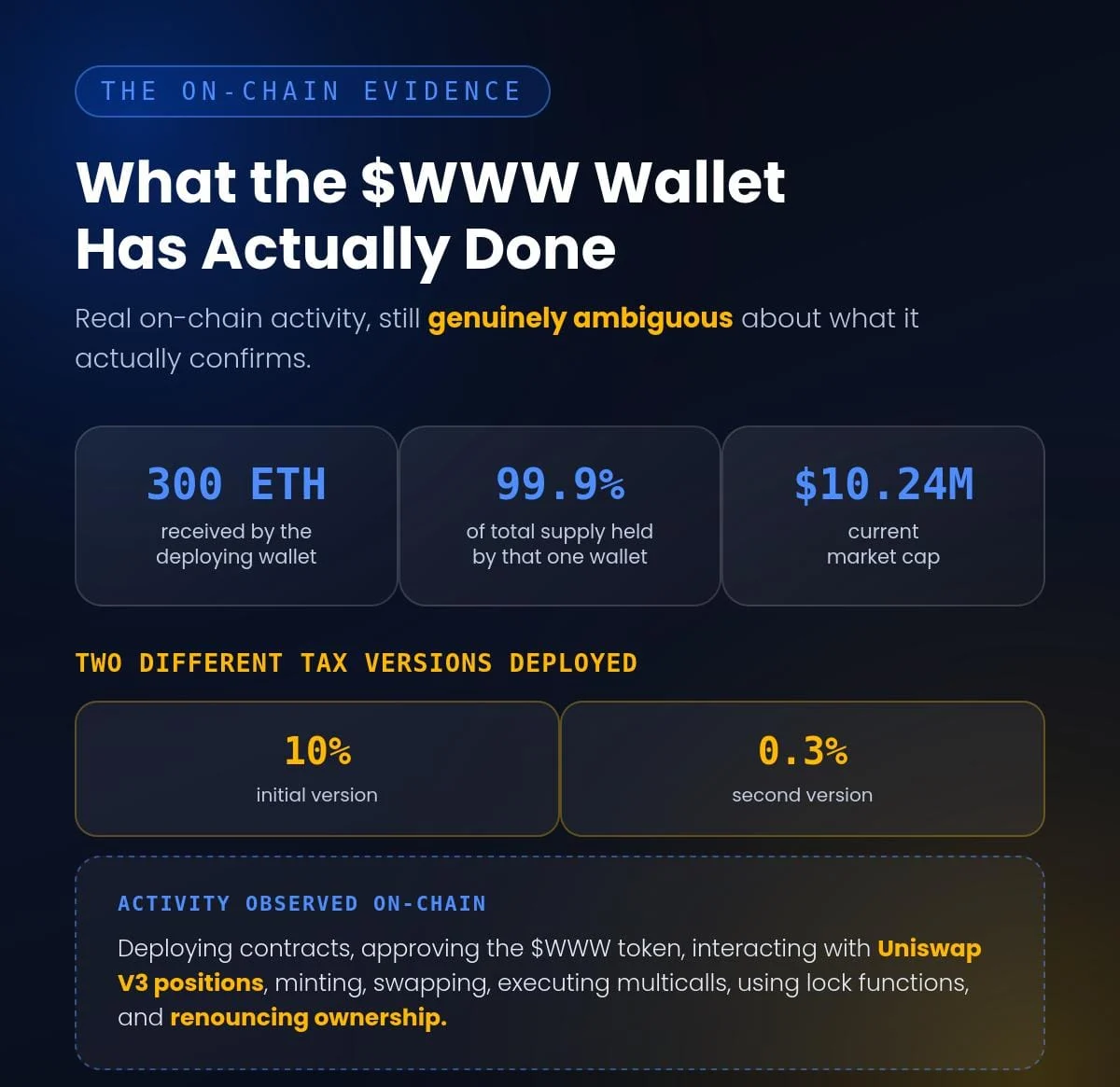
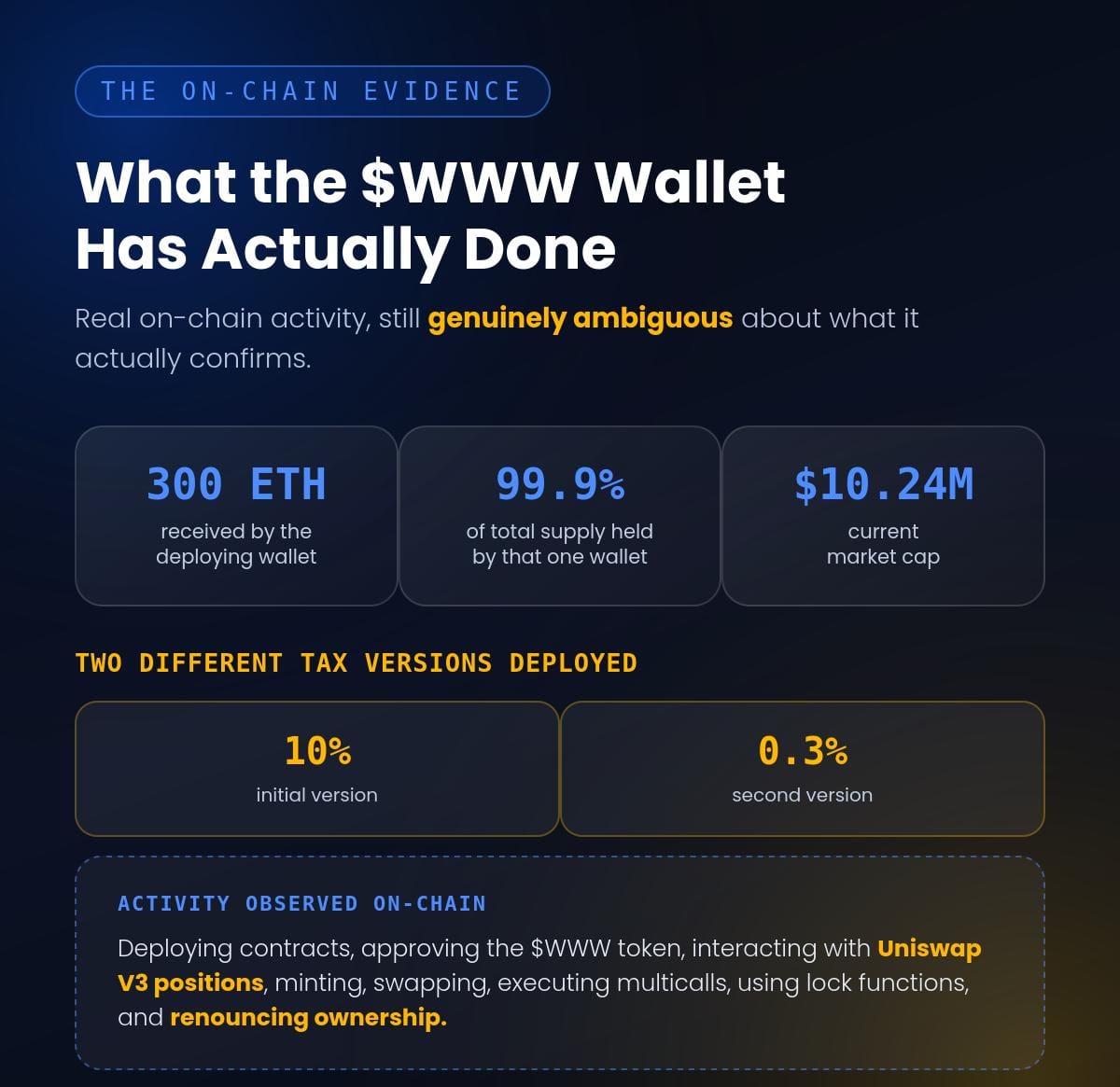
It is critical to be precise about what this activity actually shows. The token referred to as $WWW or "Truth Coin" currently has no trading liquidity, meaning it isn’t something anyone can actually buy or sell yet, regardless of the attention it’s generating. The deploying wallet, identified as 0x41a21AC1cB40888Ce81B72c3970C1778Dd04ecc, received 300 ETH and has demonstrated genuine activity. Its transaction history includes deploying contracts, approving the $WWW token, interacting with Uniswap V3 positions (a common decentralized exchange protocol), minting, swapping, executing multicalls, using lock functions, renouncing ownership, and moving ETH around. These actions collectively paint a picture of a developer actively working within the blockchain environment.
Further complicating the analysis, two different "tax versions" of the token have appeared. An initial version carried a 10% transaction tax, a common feature in meme coins to fund marketing or liquidity, while a second version carried a significantly lower tax of just 0.3%. The current market cap for this un-tradable asset is reportedly sitting around $10.24 million, with the deploying wallet controlling an overwhelming 99.9% of the entire supply. This near-total control by a single wallet is a strong indicator of an early-stage project, likely under development, rather than a publicly launched token with broad distribution. If this were a genuine public launch, a more diversified distribution and established liquidity pools would be expected.
The Crucial Discrepancies: Why Confirmation Remains Elusive
This is genuinely the most important part of the whole story, and it’s the part most rumor threads gloss over entirely. If this were already a clean, institutional-grade launch, one would expect the metadata across different blockchain explorers and infrastructure providers to line up consistently. Right now, it does not. On one side, the token is being widely referred to in social media narratives as "Truth Coin" or $WWW. However, on the official blockchain explorer, the very same contract is instead labeled "Stub Token," with the ticker STUB. This inconsistency is a significant red flag that cannot be ignored.
This discrepancy could mean several different things, and none of them are definitively confirmed. It could be stale metadata that simply hasn’t updated yet across all platforms, a common occurrence in the fast-paced blockchain world. It could be an indexing problem on the explorer’s end, where data is not being correctly interpreted or displayed. It could involve the use of proxy contracts, which are smart contracts that delegate calls to other contract implementations, complicating how the token displays across different platforms. Or, a genuinely possible scenario, the entire "Truth Coin" narrative currently circulating on social media could simply be attaching itself to the wrong contract altogether, a frequent tactic employed by scammers to capitalize on trending rumors. The fact that the official explorer identifies it as "Stub Token" strongly suggests that its intended purpose, at least initially, was for testing or placeholder functions, not as a public-facing "Truth Coin."
Signs of Development, Not Deployment: The "Test Coin" Clue
Adding to the picture of ongoing development rather than a public launch, the same deploying wallet also deployed a second contract, 0x7b21070dbB7EFded9f6BEc8Af7a65Ec28173577c, which Blockscout plainly identifies as "Test Coin," with the ticker TEST. This deployment occurred on August 22, with a substantial 1 billion TEST tokens minted directly to the deploying wallet in the same transaction. The explicit labeling as "Test Coin" leaves little room for ambiguity regarding its intended purpose. There’s also a separate wallet worth watching in this pattern, 0x94B4e33571c2124c404fe349bd754f3e66Df94Cf, though its specific role remains unclear for now, it could be another testing address or a placeholder for future functions.
The honest interpretation of all this activity, taken together, looks considerably more like a developer actively testing infrastructure and contract functionality than a finished, ready-to-launch public token. Contracts explicitly labeled "Test Coin" with tokens minted directly to the deployer, alongside inconsistent naming across different explorers for what is being rumored as a live asset, is exactly the kind of messy, unfinished pattern one would expect from someone building and testing a launch mechanism. This behavior is standard practice for smart contract development, where developers meticulously test various functionalities, tax mechanisms, and distribution models in a controlled environment before any public deployment. It is not indicative of a project poised for an imminent, widespread public offering.
Broader Market Implications and Regulatory Landscape
The recurring pattern of Trump-related token rumors and the immediate market reactions highlight several broader implications for the cryptocurrency market and its regulatory environment. Firstly, it underscores the vulnerability of retail investors to misinformation and the power of narrative in speculative markets. Without clear, verifiable information, individuals are often left to make decisions based on incomplete or misleading data, exposing them to significant financial risk. The rapid proliferation of fake contract addresses immediately following such rumors further exacerbates this problem, creating fertile ground for scams.
Secondly, the phenomenon challenges regulators who are already struggling to keep pace with the rapid evolution of decentralized finance. Political meme coins, by their very nature, often exist in a regulatory grey area, blurring the lines between political expression, financial speculation, and unregistered securities. The use of a public figure’s likeness, even without direct endorsement, raises questions about intellectual property, endorsement laws, and consumer protection. The involvement of new or less-established chains like Robinhood Chain further complicates oversight, as regulatory bodies might have less established frameworks for monitoring and enforcing rules on these platforms.
Finally, these events reflect the growing intersection of politics and digital assets. As cryptocurrency adoption expands, it becomes an increasingly attractive medium for political engagement, fundraising, and even as a tool for ideological expression. However, this convergence also brings with it the potential for manipulation, market distortion, and the weaponization of financial instruments for political ends. The ongoing saga of Trump-adjacent tokens serves as a stark reminder of these evolving dynamics and the imperative for both market participants and regulators to approach this space with heightened caution and diligence.
Navigating the Speculative Waters: A Prudent Approach
The contract currently circulating under the $WWW or "Truth Coin" name, specifically 0x848eca76fbdde0bd728ba73b0d60552b87d60ffd, should be treated the same way on-chain researchers tracking this situation are treating it: as watch-only, not something to act on. There is enough genuine on-chain activity here to justify paying close attention, given the potential for a legitimate development, but nowhere near enough evidence to actually confirm this is connected to Donald Trump or his family in any official capacity. The glaring inconsistencies in naming and the presence of explicit "Test Coin" deployments outweigh the speculative narrative.
Given how often fake contract addresses flood the market in the first minutes after a rumor like this starts spreading—often numbering in the hundreds—the responsible position is the same one on-chain researchers themselves are taking: stay away from actually transacting with this specific contract until there is real, undeniable confirmation from one of the legitimate channels worth watching. These include GetTrumpMemes (for existing tokens), Truth Social, direct statements from Donald Trump Jr. or Donald Trump’s official communications, WLFI, or Robinhood’s own official accounts (if the token were to be officially endorsed or launched on their platform).
Treating this entire situation as an unconfirmed rumor rather than an immediate opportunity is the only reasonable approach until something definitively changes. The lure of quick profits in the volatile world of meme coins can be powerful, but the risks associated with unverified information, potential scams, and premature market entry are equally substantial. Due diligence, critical thinking, and reliance on official sources remain the most potent defenses against the chaos and misinformation inherent in such speculative events.
Disclosure: This is not trading or investment advice. Always do your research before buying any cryptocurrency or investing in any services.
Follow us on Twitter @themerklehash to stay updated with the latest Crypto, NFT, AI, Cybersecurity, and Metaverse news!