


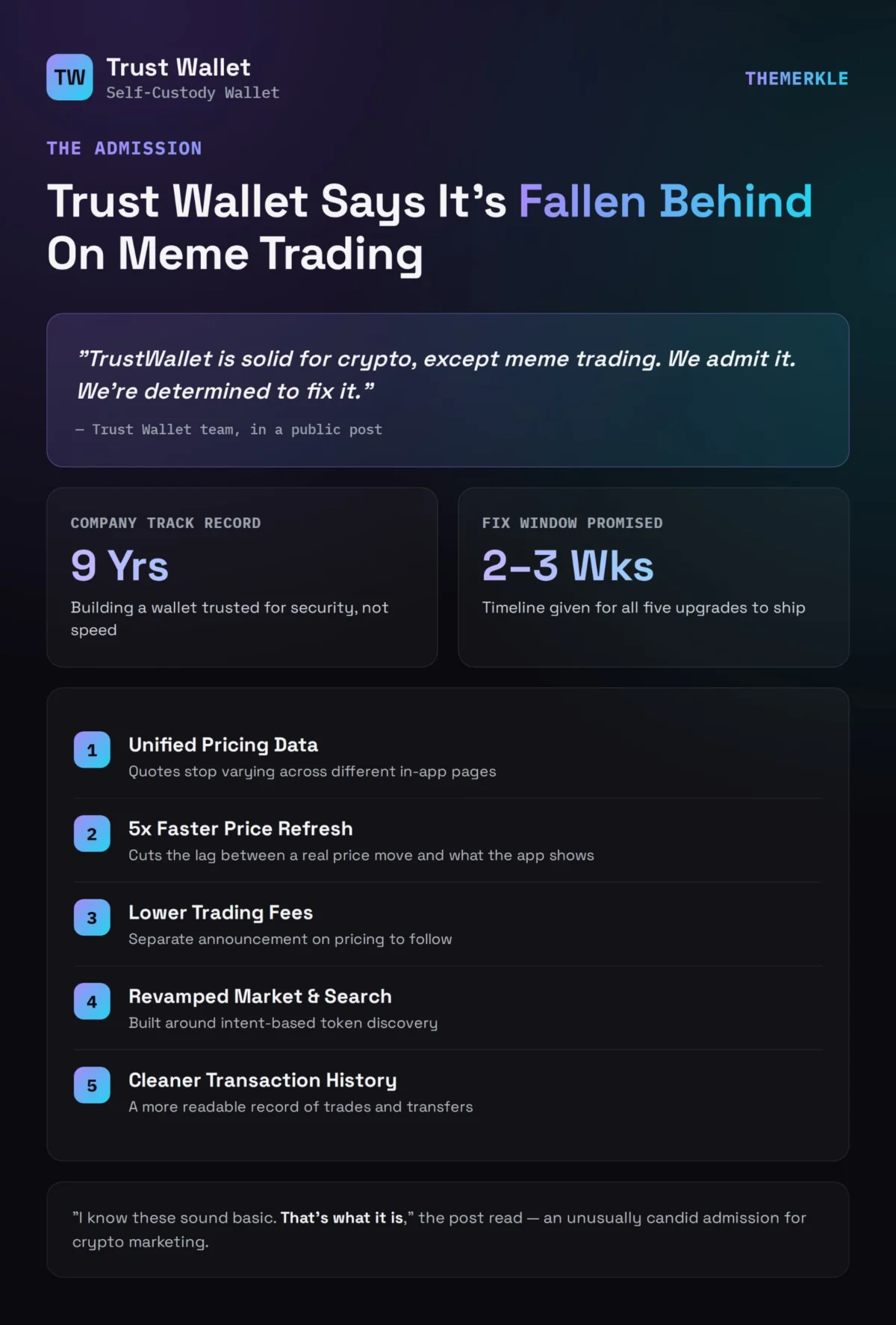
In a move diverging sharply from conventional industry practice, Trust Wallet, a stalwart in the cryptocurrency wallet ecosystem, has openly acknowledged a significant weakness in its product offering: its suboptimal performance in the fast-paced realm of meme coin trading. Rather than discreetly implementing patches and allowing routine changelogs to communicate updates, the nine-year-old platform opted for a direct and candid admission, signaling a notable shift in corporate transparency within the often-opaque crypto space. This public declaration not only highlights a critical area for improvement for one of the industry’s most widely used wallets but also underscores the increasing mainstream relevance of meme trading as a key driver of user engagement and product development in the digital asset sector.
Contextualizing the Admission: A Shift in Industry Norms
For nearly a decade, Trust Wallet has cultivated a reputation as a robust and reliable non-custodial crypto wallet, supporting a vast array of cryptocurrencies and serving millions of users worldwide. Its longevity and widespread adoption have cemented its status as a foundational tool for managing digital assets. Typically, software companies, particularly in a competitive and rapidly evolving sector like cryptocurrency, prefer to address product shortcomings internally, rolling out updates silently and presenting improvements as new features rather than rectifying acknowledged deficiencies. This standard approach minimizes negative perception and maintains a narrative of continuous innovation.
Trust Wallet’s decision to break this mold, however, is particularly noteworthy. It suggests a strategic recognition of an evolving user base and a candid assessment of market demands. The public statement, shared by a Trust Wallet team member, directly stated, "TrustWallet is solid for crypto, except meme trading. We admit it. We’re determined to fix it." This level of self-criticism is rare and indicates a profound understanding that ignoring a growing user expectation could jeopardize long-term loyalty, even for an established brand. The firm’s willingness to expose a "weak spot" could be interpreted as a calculated risk, aiming to build deeper trust through honesty and demonstrating a commitment to addressing user needs head-on, even if it means acknowledging past oversights.
The Specifics of Trust Wallet’s Self-Assessment and Remedial Plan
The core of Trust Wallet’s admission revolved around its underperformance in facilitating meme coin transactions, a segment of the market characterized by extreme volatility and the need for instantaneous data and execution. To rectify this, the company outlined five specific, yet fundamentally critical, upgrades slated for deployment within the next two to three weeks:

- Unified Pricing Data: Addressing inconsistencies where asset prices might vary across different sections of the wallet interface. This is crucial for traders who rely on accurate, real-time quotes.
- 5x Faster Price Refresh Rate: Significantly accelerating the rate at which price data updates, ensuring users have access to the most current market information, a vital element in fast-moving markets.
- Lower Trading Fees: A commitment to reducing transaction costs, with a separate announcement detailing the new fee structure expected soon. Competitive fees are a major draw for active traders.
- Revamped Market and Search Experience: An overhaul designed to offer more intent-based discovery, making it easier for users to find trending tokens and relevant market information.
- Cleaner, More Readable Transaction History: Improving the clarity and organization of past transactions, enhancing user experience and record-keeping.
What makes this list particularly compelling, as noted in the original assessment, is its lack of ostentation. These are not "flashy new features" but rather fundamental improvements addressing core functionalities that, ideally, should have been robust from the outset. The candid internal acknowledgment, "I know these sound basic. That’s what it is," further reinforces the transparency. In an industry often dominated by hype and grand announcements of nascent technologies, this pragmatic focus on core user experience represents a refreshing, albeit overdue, approach. It acknowledges that sometimes, the most impactful improvements are those that refine existing, essential services.
The High-Stakes World of Meme Coin Trading
To fully grasp the significance of Trust Wallet’s promised fixes, one must understand the unique demands of meme coin trading. Unlike long-term investments in established cryptocurrencies, meme tokens operate on a different paradigm, driven largely by community sentiment, viral trends, and rapid price swings. It is not uncommon for meme coins to experience price fluctuations of 30%, 50%, or even several hundred percent within minutes or hours of their launch or a viral social media mention.
In such an environment, speed and accuracy are paramount. A delay of even a few seconds in price refresh rates can mean the difference between substantial profit and significant loss. If a wallet displays inconsistent prices across different pages, a trader might execute an order based on stale or misleading data, leading to suboptimal entry or exit points. For example, watching a token "moon" on an external chart while the wallet app still shows an outdated, lower price can be incredibly frustrating and costly.
Moreover, discovery plays an equally critical role. Meme trading is fundamentally a race to identify and acquire promising tokens before mass adoption drives prices sky-high. A wallet’s "Market" or "Explore" tab that effectively surfaces genuinely relevant, intent-based results – perhaps trending tokens, newly launched projects, or assets gaining social media traction – offers an invaluable advantage to an active trader. Without robust discovery tools, users are forced to rely on external platforms, fragmenting their workflow and potentially slowing down critical decision-making processes. Therefore, the "un-glamorous" fixes Trust Wallet is pursuing are, in fact, foundational to competitive meme trading.
Competitive Landscape: How Rivals Have Excelled
Trust Wallet’s public admission implicitly acknowledges that its competitors have already capitalized on these very features, turning them into core selling points and capturing a significant share of the meme trading demographic. Examining the strategies of key players like Phantom, MetaMask, and Bitget Wallet provides crucial context.

Phantom Wallet: A Blueprint for Meme Trading Excellence
Phantom Wallet, particularly dominant within the Solana ecosystem, has built much of its reputation around a highly optimized experience for rapid trading, especially of meme coins. Its "Explore" tab is a prime example, designed to surface trending tokens in real-time, allowing users to see what other Phantom traders are actively buying or selling without ever leaving the application. This in-app social trading intelligence is a powerful discovery mechanism.
Furthermore, Phantom’s swap feature is engineered for predictability and efficiency, often applying a flat fee, typically around 0.85% regardless of trade size. This consistency makes cost analysis straightforward during high-pressure trading scenarios. Beyond basic swaps, Phantom has strategically invested in deeper trading infrastructure. Its integration with Hyperliquid enables "Phantom Perps," offering perpetual futures trading directly from the wallet. The introduction of "Phantom Terminal," an advanced desktop trading interface, provides professional-grade charting and tools for serious, high-frequency traders. For Solana-native meme trading, Phantom has evolved beyond a mere wallet; it functions more like a dedicated trading terminal seamlessly integrated with asset storage. This specialized focus has allowed it to carve out a dominant niche.
MetaMask’s Broad Appeal and Strategic Convenience
MetaMask, the most ubiquitous Ethereum-based wallet, approaches meme trading from a slightly different angle, prioritizing breadth and convenience over specialized, high-frequency tools. Its built-in swap feature aggregates quotes from multiple decentralized exchanges (DEXs) and market makers, aiming to find the most competitive routes for users. While charging a service fee of approximately 0.875%, its primary value proposition lies in its accessibility and integration across the Ethereum Virtual Machine (EVM) compatible ecosystem.
A notable feature is its "Gas Station," which allows users to pay network fees using the token they are swapping into, eliminating the need to hold separate ETH for gas – a genuine convenience for those frequently moving between various meme tokens without wanting to constantly top up their ETH balance. However, MetaMask’s "Discover" tab has historically leaned more towards NFTs and general dApp browsing rather than dedicated, real-time meme coin trending. Consequently, heavier traders often bypass MetaMask’s in-app swap for larger or more time-sensitive trades, opting to interact directly with DEXs like Uniswap or SushiSwap for greater control and potentially better rates. Its strength lies in its broad ecosystem support, not necessarily its hyper-optimized meme trading capabilities.
Bitget Wallet and the Multi-Chain Meme Frontier
Multi-chain competitors like Bitget Wallet have distinguished themselves by embracing the fragmented nature of the meme coin market. They have developed dedicated in-app "Meme" sections that track trending tokens across a vast network of over 100 supported blockchains. This multi-chain aggregation automatically finds the best available swap rates, irrespective of whether a trader is rotating capital between Solana, Base, Ethereum, or other meme-heavy ecosystems. This built-in, cross-chain meme discovery is a significant competitive advantage, directly addressing the challenge of identifying and trading viral assets across diverse blockchain environments. Trust Wallet’s revamped Market and Search tabs will need to genuinely compete with this level of comprehensive, cross-chain functionality once they are rolled out.
The Growing Mainstream Acceptance of Meme Coins
The fact that Trust Wallet, a general-purpose crypto wallet, is compelled to specifically address its meme trading deficiencies underscores a profound shift in the broader cryptocurrency landscape: meme coins are no longer a fringe phenomenon but a significant, mainstream segment driving substantial daily engagement and trading volume.

Initially dismissed as mere jokes or speculative fads, assets like Dogecoin and Shiba Inu paved the way, demonstrating the power of community, social media virality, and accessible price points to create massive market capitalizations. In recent years, the meme coin market has exploded, with new tokens launching almost daily across various blockchains, notably Solana and Base, often boasting market caps exceeding hundreds of millions or even billions of dollars. These assets have attracted a diverse range of participants, from seasoned traders seeking quick profits to new entrants drawn by the excitement and low barrier to entry.
This phenomenon has fundamentally altered user expectations for crypto wallets. What was once primarily a tool for secure storage and occasional transfers has evolved into a primary interface for active trading, yield generation, and dApp interaction. Users now expect their wallets to be intuitive trading terminals, capable of handling high-speed transactions, providing real-time data, and facilitating discovery across a multitude of chains. When a platform with Trust Wallet’s reach – serving tens of millions of users globally – acknowledges that its meme trading experience has fallen behind, it is a clear signal that these user expectations have solidified and can no longer be treated as an afterthought or an "edge case." The market demands efficiency, and wallets must adapt or risk losing their user base to more specialized platforms.
Implications for User Experience and Market Dynamics
Trust Wallet’s transparent admission carries several significant implications for its user base and the broader market. Firstly, for existing Trust Wallet users who engage in meme trading, this announcement validates their frustrations and offers a concrete timeline for improvement. It could reinforce loyalty for those who have remained with the wallet despite its shortcomings, demonstrating that their feedback is being heard and acted upon. Conversely, for users who may have migrated to competitors like Phantom or Bitget Wallet for a superior meme trading experience, these promised upgrades could serve as an incentive to reconsider Trust Wallet as their primary interface.
Secondly, this move will undoubtedly intensify competition within the crypto wallet sector. As meme trading continues to drive daily engagement and liquidity, other general-purpose wallets that have not prioritized these features may now feel pressure to accelerate their own development roadmaps. This could lead to a positive feedback loop of innovation, ultimately benefiting end-users through improved features, lower fees, and better overall trading experiences across the board.
Thirdly, the candid tone of Trust Wallet’s admission – "I’m still amazed by how many users and supporters stick with Trust Wallet even though we know it’s not perfect across every feature" – is a powerful statement. It acknowledges that brand loyalty, built on years of trust and security, can only sustain a product for so long if the actual utility for increasingly popular activities falls short. In an industry where trust is paramount, but features are fiercely competitive, this balance is critical. Trust Wallet appears to understand that while security and reliability are non-negotiable foundations, feature parity and excellence in key areas are now equally essential for retaining and growing its user base.
Anticipating the Rollout: What to Watch For

The real test for Trust Wallet will be in the execution. The company has committed to delivering all five major upgrades – unified pricing, 5x faster refresh rates, lower fees, enhanced discovery, and cleaner transaction history – within a tight two-to-three-week window. While these claims are easy to announce, delivering them effectively and consistently across a global user base, utilizing wildly different devices and operating on various blockchain networks, presents a considerable technical challenge.
Key indicators of success will include:
- Tangible Speed Improvements: Users will quickly notice if price refreshes are indeed 5x faster and if trade execution feels more responsive.
- Pricing Consistency: The elimination of discrepancies in price quotes across different wallet screens will be a clear sign of success for unified data.
- Fee Competitiveness: The "separate announcement" on lower trading fees will be closely scrutinized against competitors’ offerings.
- Discovery Efficacy: The revamped Market and Search experience must genuinely surface relevant, trending meme tokens in a user-friendly manner, rivaling or surpassing competitors’ dedicated sections.
- User Feedback and Reviews: Post-update sentiment on social media, forums, and app store reviews will provide immediate indications of user satisfaction.
If Trust Wallet successfully delivers on its promises, it could meaningfully close the feature gap with specialized wallets like Phantom and Bitget Wallet in the critical area of active meme trading. Crucially, it would achieve this without compromising its broader multi-chain support and the long-standing reputation for security and reliability it has built over nearly a decade. The coming weeks will be a pivotal period, demonstrating whether Trust Wallet can translate its candid self-assessment into tangible, impactful improvements for its millions of users.
Conclusion
In a market saturated with competitive products and vying for user attention, Trust Wallet’s decision to publicly admit its shortcomings in meme trading is more than just a product roadmap update; it is a strategic declaration. It signifies a mature understanding that the cryptocurrency landscape has evolved, and user expectations have shifted decisively towards sophisticated trading functionalities, even within general-purpose wallets. By saying "the quiet part out loud," Trust Wallet has not only set a new standard for transparency but also acknowledged that in the fierce competition for daily engagement, adapting to the demands of the mainstream meme trading phenomenon is no longer optional. It is an imperative for continued relevance and growth in the dynamic world of digital assets.
Disclosure: This is not trading or investment advice. Always do your research before buying any cryptocurrency or investing in any services.














