While the majority of large-cap cryptocurrency assets experienced a period of sideways consolidation throughout July, patiently awaiting the next market catalyst, Uniswap, the leading decentralized exchange (DEX), forged its own path. The protocol’s native token, UNI, emerged as a standout performer, registering a significant price surge directly following a series of verifiable on-chain governance outcomes. This clear correlation between protocol development and market reaction provides a compelling case study in the evolving landscape of decentralized finance (DeFi) and tokenomics.
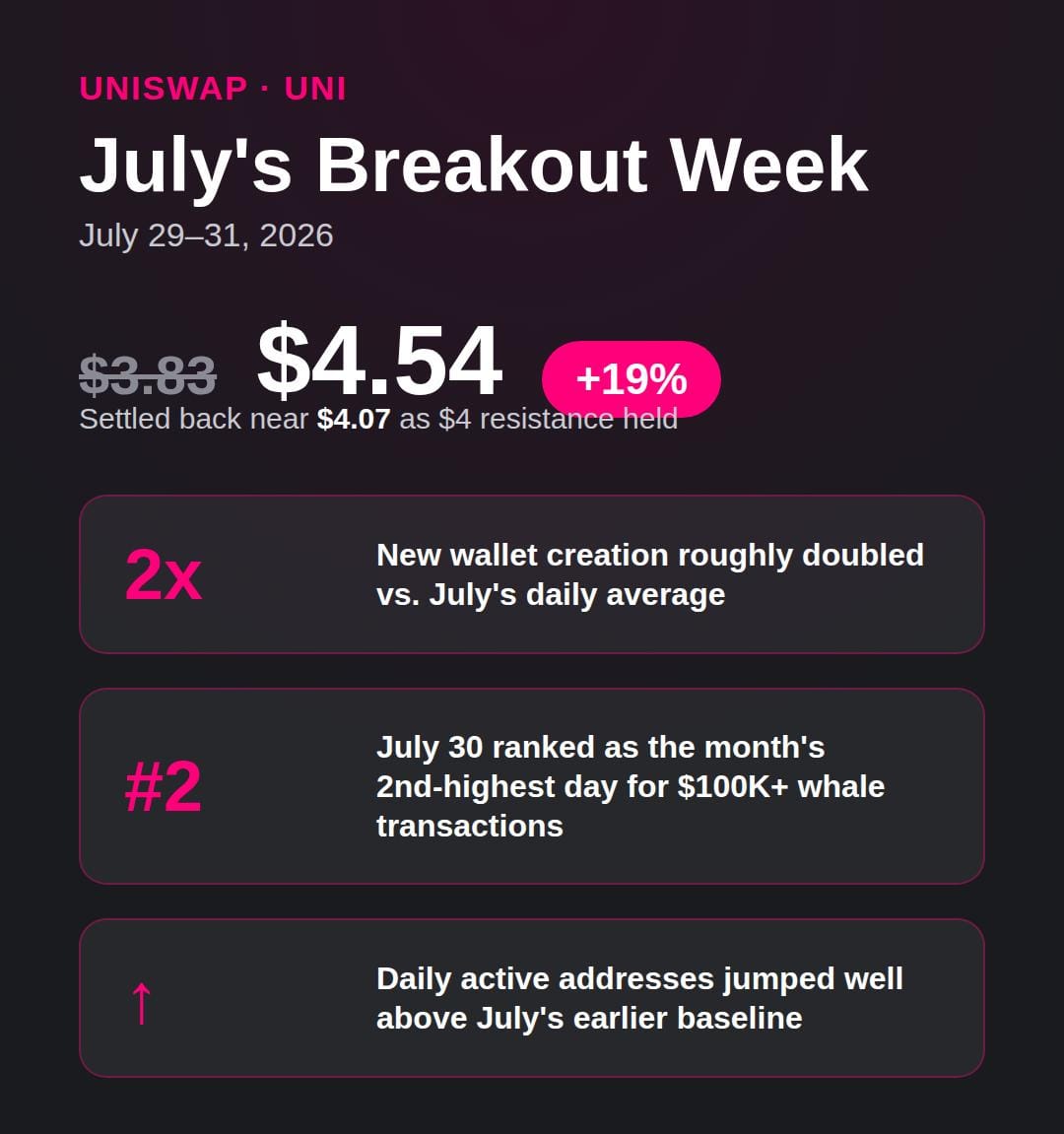
The UNI token saw a robust upward trajectory, climbing approximately 19% in just three days, from $3.83 to $4.54 between July 29 and 31, before moderating its gains to settle near $4.07. This price action was not isolated market noise but coincided precisely with a dramatic increase in key on-chain metrics. Over the same brief window, new wallet creation for UNI roughly doubled compared to July’s earlier daily average, large-holder transactions exceeding $100,000 spiked to their second-highest single-day count of the month on July 30, and daily active addresses surged well above their prior baseline for the month. This confluence of events points to a direct investor response to concrete, documented protocol enhancements rather than speculative fervor.
The Genesis of Protocol Fees: A Historical Context
To fully appreciate the significance of Uniswap’s July achievements, it is crucial to understand the long-standing debate surrounding protocol fees within the DeFi ecosystem. Uniswap, as an automated market maker (AMM) and the largest DEX by trading volume, has always been central to the decentralized finance narrative. However, its governance token, UNI, primarily offered voting rights without a direct mechanism for economic value accrual from the protocol’s vast trading activity. This "fee switch" — the ability to direct a portion of trading fees to the protocol treasury or token holders — has been a hotly contested topic for years.
Initially, Uniswap’s design included a dormant "protocol fee switch" that could, in theory, redirect a percentage of liquidity provider (LP) fees to UNI holders. However, activating this switch was fraught with complexities, primarily regulatory concerns. Directly distributing protocol revenue to token holders could potentially classify UNI as a security in various jurisdictions, a legal minefield many DeFi projects have sought to avoid. This regulatory ambiguity kept the fee switch dormant, leading to persistent discussions within the Uniswap decentralized autonomous organization (DAO) about how to create a sustainable value accrual mechanism for UNI that aligned with decentralized principles and regulatory prudence.
The groundwork for July’s activation was meticulously laid months prior. In December 2025, Uniswap governance passed Proposal 93, dubbed the "UNIfication proposal." This landmark decision established the framework and conceptual approval for a new approach to protocol fees, one that would sidestep the direct "dividend" model in favor of a supply-side economic mechanism: a token burn. This innovative approach sought to tie protocol revenue to a shrinking token supply, thereby increasing the scarcity and potential value of existing UNI tokens without triggering the regulatory alarms associated with direct payouts.
A Detailed Look at July’s Landmark Governance Decisions
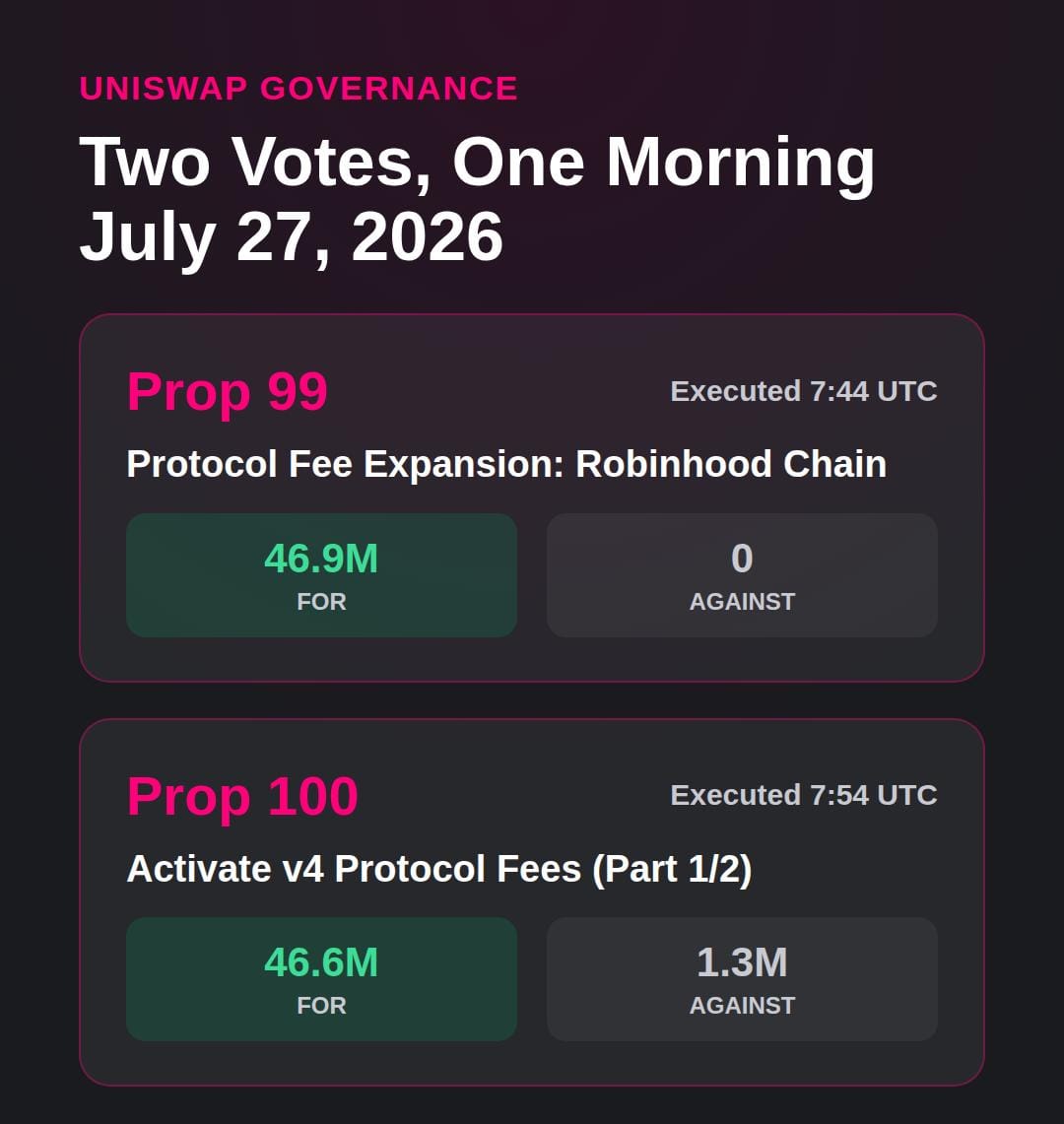
The culmination of these efforts manifested on July 27, 2026, when two pivotal Uniswap governance proposals executed on-chain within minutes of each other, setting the stage for UNI’s subsequent market performance. The transparency and verifiability of these actions are cornerstones of decentralized governance, with full on-chain execution transactions logged directly on Etherscan for public scrutiny.
The first to execute, at 7:44 am UTC, was Proposal 99, "Protocol Fee Expansion: Robinhood Chain." This proposal passed with overwhelming consensus, garnering 46,881,791 UNI in favor and zero against. Its swift and decisive passage underscored the community’s strong support for integrating the newly launched Robinhood Chain into Uniswap’s evolving fee structure.
Minutes later, at 7:54 am UTC, Proposal 100, "Activate v4 Protocol Fees (Part 1/2)," successfully executed. This proposal, while facing a small minority of opposition, passed comfortably with 46,604,583 UNI in favor against 1,274,746 opposed, significantly clearing the required 40 million UNI quorum. The "Part 1/2" designation is crucial, indicating that this was the initial phase of a broader rollout, with additional chains slated for future consideration.
Collectively, these two proposals effectively activated the new protocol fee mechanism for select Uniswap v4 pools across a total of seven prominent blockchain networks: Ethereum, Arbitrum, Base, BNB Chain, Polygon, OP Mainnet, and the aforementioned Robinhood Chain. This strategic activation marked a monumental shift, transforming Uniswap from a protocol primarily focused on facilitating decentralized trading into one that also directly captures and accrues value for its underlying governance token through a carefully designed economic model.
The Ingenious Burn Mechanism: TokenJar and Firepit
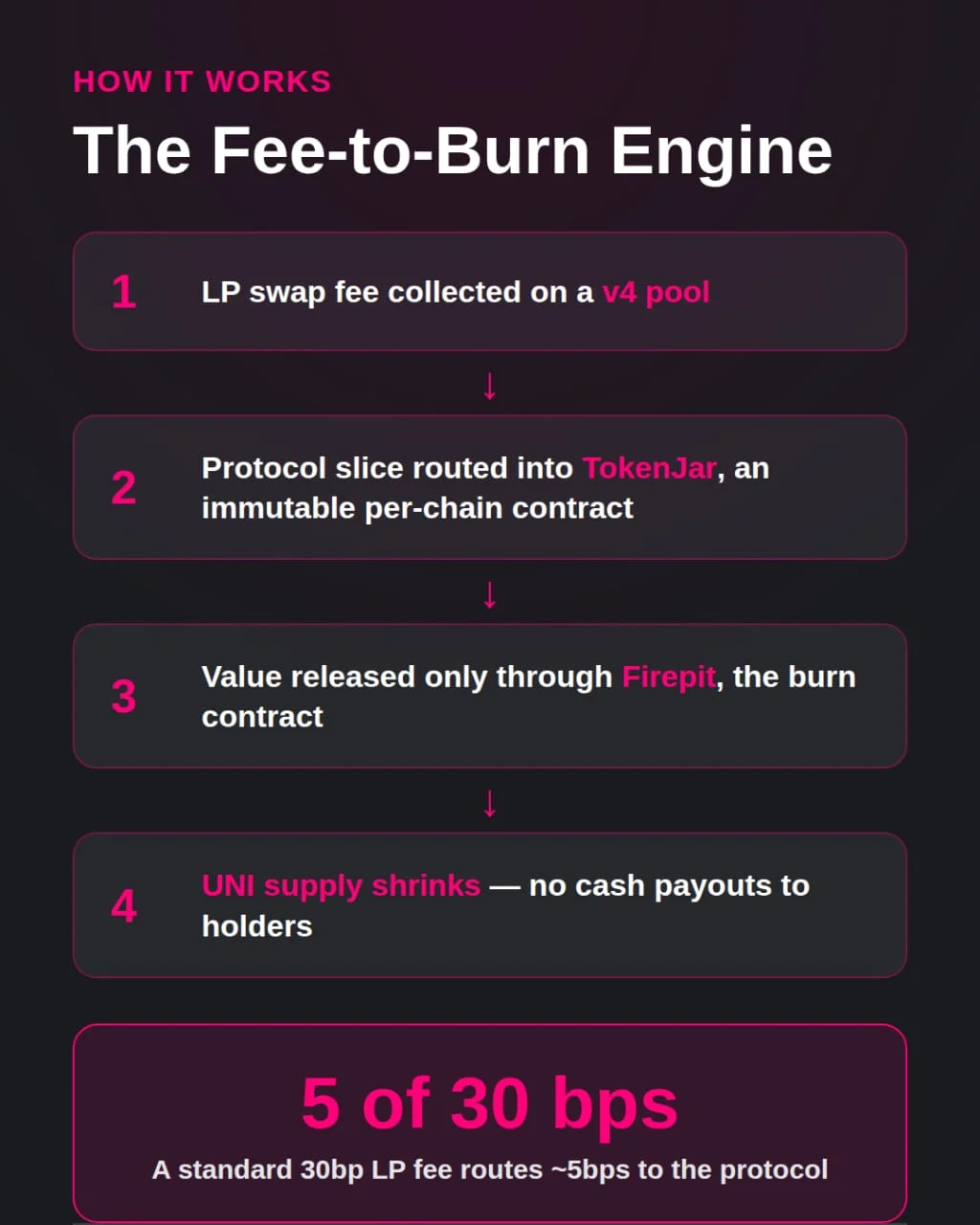
The mechanism by which these newly activated protocol fees accrue value to UNI holders is both innovative and deliberately structured to navigate regulatory complexities. Unlike traditional equity dividends, fees collected under this system are not directly paid out to UNI holders. Instead, they flow into an immutable, per-chain smart contract known as TokenJar.
The TokenJar contract acts as a transparent repository for collected fees across the various supported networks. The only method to extract value from TokenJar is through a companion contract called Firepit, which functions as a token burn mechanism. Specifically, value from TokenJar is used to acquire UNI tokens from the open market, which are then permanently removed from circulation by being sent to an unspendable address – effectively "burned." This process directly reduces the total supply of UNI, thereby creating deflationary pressure and enhancing the scarcity of existing tokens.
This structure is a testament to sophisticated protocol design. By tying protocol revenue to a shrinking token supply rather than a direct payout, Uniswap’s governance strategically sidesteps many of the regulatory ambiguities that have historically kept the fee switch dormant. The fee sizing itself is precise and transparent; Proposal 100’s published rate table details the mechanics: a standard Uniswap v4 pool charging a 30 basis-point (0.30%) liquidity provider (LP) fee will now route approximately 5 basis points (0.05%) of that to the protocol. This specific allocation was approved directly within the proposal text, ensuring community oversight and transparency. Furthermore, Uniswap’s commitment to open-source principles is evident in the public availability of the full v4 fee-adapter contracts and deployment addresses on Uniswap’s GitHub repository, allowing anyone to verify the entire mechanism line by line.
Robinhood Chain: A Catalyst for Immediate Impact
The inclusion of Robinhood Chain in this initial fee activation proved to be a significant accelerant for UNI’s July performance. Robinhood Chain, an Arbitrum-based Layer 2 solution, launched on July 1, 2026, marking a strategic expansion for the popular trading platform into the decentralized ecosystem. Uniswap was a day-one partner on this new chain, with its v2, v3, v4, and UniswapX protocols all deployed as the chain’s primary public Automated Market Maker (AMM). This early and comprehensive integration, highlighted in Uniswap Labs’ own launch post, positioned Uniswap to capture a substantial share of early trading volume on the burgeoning network.
The timing of Proposal 99’s execution was impeccable. By July 10, just ten days after its launch, cumulative swap volume on Uniswap’s Robinhood Chain deployments had already surpassed an impressive $6 billion, a figure explicitly confirmed within the text of Proposal 99 itself. Extending the fee-and-burn mechanism to this rapidly growing chain precisely when its volume was ramping up meant that the "burn engine" immediately gained access to a high-velocity, fee-generating venue. This avoided a common pitfall where new features are enabled months after initial excitement fades, ensuring that the protocol’s new value accrual mechanism began operating at peak efficiency from its inception. The swift adoption and high trading volume on Robinhood Chain thus provided immediate and substantial fuel for the newly activated fee and burn mechanism, directly contributing to the positive market reaction observed in UNI’s price.
On-Chain Activity Validates Governance Impact
The surge in UNI’s price and the corresponding on-chain activity paint a clear picture of market participants reacting directly to these pivotal governance events. The data unequivocally supports the narrative of informed investor action rather than speculative froth.
The doubling of new addresses creating UNI wallets over July 30 and 31, compared to the month’s preceding daily average, suggests a significant influx of fresh capital and new participants drawn to the token’s enhanced utility. Simultaneously, the daily active addresses on those same two days soared well above anything else recorded in July, indicating heightened engagement from both new and existing holders. Perhaps most telling was the spike in whale-sized transactions – those exceeding $100,000 – which hit their second-highest single-day count of the month on July 30. This pattern of increased participation from both retail and institutional-grade investors strongly suggests a collective response to the profound implications of Uniswap’s governance decisions. It is not merely coincidental overlap but a direct reflection of a market acknowledging and valuing the protocol’s proactive steps to bolster its tokenomics.
Broader Implications and Future Outlook
The successful activation of protocol fees and the burn mechanism represents a significant milestone for Uniswap and a potential blueprint for the broader DeFi sector. It demonstrates that decentralized governance can effectively evolve a protocol’s economic model to create sustainable value for its token holders while navigating complex regulatory landscapes. This move reinforces Uniswap’s leadership in the DeFi space, offering a more robust value proposition for UNI holders beyond mere voting rights.
The strategic choice of a burn mechanism over direct payouts is particularly impactful. It addresses a long-standing criticism of many governance tokens lacking intrinsic economic utility, providing an indirect but tangible benefit through supply reduction. This approach could inspire other major DeFi protocols to explore similar models, fostering a new wave of innovation in tokenomics that prioritizes long-term sustainability and regulatory compliance.
However, the journey is far from over. Proposal 100 is explicitly labeled "Part 1/2," signaling that additional phases of fee activation are anticipated. Five more chains – Celo, Soneium, X Layer, Worldchain, and Zora – are still awaiting a follow-up governance vote before v4 fees go live on their respective networks. The continued success of the burn engine, and UNI’s ability to sustain its July gains into August and beyond, will largely depend on the sustained swap volume and fee generation across all newly fee-enabled pools. The entire mechanism’s efficacy is directly tied to the consistent flow of fees into the TokenJar contracts.
Despite the natural pullback from the July peak of $4.54 back to around $4.07, indicating some resistance near the $4 handle, Uniswap’s July performance stands out in a month characterized by general market stagnation. The clear alignment between the price movement, the detailed governance record, and the verifiable on-chain activity makes UNI a rare example where all indicators point in the same strategic direction. This confluence of factors underscores the growing maturity of decentralized protocols and their ability to execute significant, value-accretive changes through robust, transparent governance processes. The DeFi community will undoubtedly be watching closely to see how Uniswap builds on this momentum and continues to shape the future of decentralized finance.