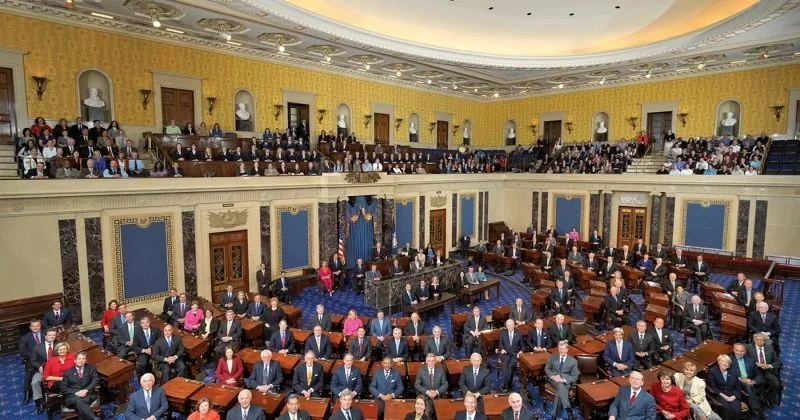
The United States Senate is currently navigating a narrow legislative window to address the Digital Asset Market Clarity Act, a comprehensive piece of legislation designed to establish a definitive framework for the regulation of cryptocurrencies and digital assets within the American financial system. Despite intensive efforts by industry stakeholders and key lawmakers to finalize the bill before the upcoming summer recess, the probability of meeting the self-imposed August 7 deadline is rapidly diminishing. Senate leadership remains hopeful that the chamber can at least initiate the floor process before lawmakers depart for their respective states, ensuring that the momentum generated over the past year is not entirely lost to the political pressures of the upcoming midterm election cycle.
Senate Majority Leader John Thune expressed a cautious desire to begin the formal consideration of the bill during a press briefing on Thursday. Thune noted that while the legislative calendar is crowded with judicial nominations and pressing defense matters, the urgency of providing regulatory certainty to the digital asset sector remains a priority. "I would like to at least get Clarity started," Thune told reporters, referring to the Act by its shorthand. "We’ll see where the votes are." His comments reflect the delicate balancing act currently taking place within the Senate, as leaders attempt to gauge whether there is sufficient bipartisan support to overcome potential procedural hurdles and filibusters.
The Legislative Landscape and the August Deadline
The August 7 deadline was widely regarded by industry representatives and congressional negotiators as the "practical" cutoff point for the bill’s passage. This timeline was established based on the reality of the congressional calendar: once lawmakers return from the summer recess on September 14, their focus will shift almost exclusively toward the November midterm elections. Legislative sessions in September are traditionally brief and often dominated by mandatory spending bills and emergency measures, leaving little room for complex, multi-layered financial regulations like the Digital Asset Market Clarity Act.
Furthermore, the legislative process for this specific bill is uniquely complicated. Because the Senate version is an amended draft that combines proposals from both the Senate Banking Committee and the Senate Agriculture Committee, any version approved by the Senate would necessitate a return to the House of Representatives for a reconciliation vote. Given that the House approved its original version of the market structure bill in July 2025, the two chambers must align their language before the legislation can be sent to President Donald Trump’s desk for signing. If the Senate fails to act decisively in August, the risk of the bill languishing in a post-election "lame duck" session increases significantly.
Chronology of the Digital Asset Market Clarity Act
The path toward the current legislative impasse has been long and fraught with jurisdictional disputes between various government agencies. The need for a cohesive market structure bill became a central theme in Washington following several high-profile collapses in the digital asset space during the previous years, which highlighted the "regulatory gaps" between the Securities and Exchange Commission (SEC) and the Commodity Futures Trading Commission (CFTC).
- July 2025: The House of Representatives passed its version of the Digital Asset Market Clarity Act with bipartisan support. This version leaned heavily toward classifying most digital assets as commodities, thereby granting the CFTC primary oversight.
- Late 2025 – Early 2026: The Senate Banking and Agriculture committees began a series of joint hearings and negotiations to draft a companion bill. The primary challenge was reconciling the Banking Committee’s focus on investor protection and securities law with the Agriculture Committee’s focus on commodity market integrity.
- July 2026: Senate leadership released a combined draft that sought to merge the priorities of both committees. This draft introduced new rules for digital asset exchanges, intermediaries, and stablecoin issuers.
- Late July 2026: Senate Majority Leader John Thune signaled that while floor consideration is desired, the Senate remains preoccupied with judicial confirmations, an Iran war powers resolution, and the annual National Defense Authorization Act (NDAA).
Core Provisions and Agency Jurisdiction
The Digital Asset Market Clarity Act is designed to provide the most significant overhaul of US financial regulation since the Dodd-Frank Act. Its primary goal is to define the specific roles of the SEC and the CFTC, ending years of "regulation by enforcement" that many industry participants claim has stifled innovation in the United States.
Under the current draft, the bill establishes a "functional test" to determine whether a digital asset is a security or a commodity. Assets that are fully decentralized and do not represent an investment contract in a common enterprise would fall under the CFTC’s jurisdiction. Conversely, assets that are centralized or sold as investment vehicles would remain under the SEC’s purview. The bill also sets forth rigorous registration requirements for digital asset exchanges, mandating that they implement consumer protection measures similar to those found in traditional stock and commodity exchanges, including the segregation of customer funds and prohibitions against commingling.
Contentious Issues: Stablecoins and Ethics Restrictions
Despite the broad agreement on the need for a framework, two specific areas of contention have stalled progress in the Senate: stablecoin rewards and ethics restrictions on senior government officials.
The debate over stablecoins centers on the treatment of "rewards" or interest-bearing features of these assets. Some Republicans argue that stablecoin issuers should be allowed to offer rewards to holders without being classified as investment companies or banks. They contend that this is essential for the US to remain competitive with international markets, such as the European Union, which has already implemented its Markets in Crypto-Assets (MiCA) regulation. However, several Democrats have raised concerns that these rewards resemble unregistered securities offerings and could pose systemic risks to the financial system if not strictly regulated.
The second major hurdle involves ethics restrictions. The bill includes provisions that would prevent senior government officials from the SEC, CFTC, and Treasury Department from moving directly into high-paying roles at digital asset firms—a "revolving door" policy. Democrats have insisted that the Department of Justice (DOJ) be given the primary responsibility for enforcing these ethics rules to ensure independence. Some Republicans, however, oppose this expansion of DOJ authority, suggesting that the individual agencies should handle their own internal ethics enforcement.
Senator Cynthia Lummis, a prominent advocate for digital asset legislation, acknowledged these friction points. She indicated that the most contentious provisions remain open to revision as negotiators seek the 60 votes required to overcome a Senate filibuster. "We are working through the fine print to ensure that we protect consumers without driving the industry offshore," Lummis stated, emphasizing that the goal is to secure enough Democratic support to reach the 60-vote threshold.
Supporting Data and Market Impact
The stakes for the passage of the Clarity Act are high, as the US digital asset market continues to represent a significant portion of global trading volume. According to recent market data, US-based institutional investors account for over 40% of the global liquidity in Bitcoin and Ethereum. The lack of a clear regulatory framework has led to several major firms relocating their operations to jurisdictions like Singapore, Dubai, and the EU.
Economists have noted that the "regulatory premium"—the cost associated with legal uncertainty in the US—has deterred approximately $150 billion in potential institutional capital from entering the digital asset market over the last 24 months. Proponents of the bill argue that its passage would unlock this capital, potentially leading to a more stable and mature market. Conversely, critics warn that a poorly drafted bill could legitimize risky financial products without providing adequate safeguards, potentially leading to another market contagion.
Broader Implications and Global Competition
The delay in the Senate carries implications that extend beyond the domestic financial sector. Internationally, the United States is in a race to set the global standard for digital finance. The European Union’s MiCA framework is already being phased in, providing a clear roadmap for businesses operating across the continent. Similarly, Hong Kong and the United Kingdom have made significant strides in establishing their own bespoke regulatory regimes for digital assets.
If the US Senate misses the August window, it sends a signal to the global market that the American legislative process remains gridlocked on technology and finance. This could accelerate the "brain drain" of blockchain developers and fintech entrepreneurs moving to more welcoming jurisdictions. Furthermore, the proximity of the midterm elections means that if the bill is not passed now, it may not be revisited until a new Congress is seated in 2027, leaving the industry in a state of limbo for another year.
Official Responses and Industry Reactions
The crypto industry has reacted to the potential delay with a mixture of frustration and pragmatic resignation. Several major trade associations, including the Blockchain Association and the Chamber of Digital Commerce, issued statements urging the Senate to prioritize the bill.
"The industry has been asking for clarity for years," said a spokesperson for a leading digital asset advocacy group. "While we understand the complexities of the legislative calendar, every day of delay is a day of lost opportunity for American innovation. We urge Leader Thune and the Senate to at least begin the process so that we have a foundation to build on in the fall."
On the other side of the aisle, some progressive groups have praised the Senate’s cautious approach. These groups argue that the current draft of the Clarity Act does not go far enough in preventing the types of fraud and market manipulation that have characterized the crypto sector in the past. They maintain that the Senate should take the time to ensure the bill is "bulletproof" before rushing it to a vote.
Conclusion and Outlook
As the August 10 recess date looms, the fate of the Digital Asset Market Clarity Act rests on the ability of Senate negotiators to bridge the gap on stablecoin regulation and enforcement oversight. While the prospect of a final vote before the break is increasingly unlikely, the initiation of the floor process would be a significant procedural victory. It would allow the Senate to bypass several preliminary stages when they return in September, potentially providing a narrow path to passage before the midterm elections dominate the national discourse.
For now, the digital asset industry remains in a "wait-and-see" mode. The coming days will determine whether the Senate can muster the political will to address one of the most complex and consequential financial issues of the decade, or whether the Clarity Act will become another casualty of a divided and time-constrained Congress. The eyes of the global financial community remain fixed on the Senate floor, waiting for a signal that the world’s largest economy is ready to define the future of digital money.