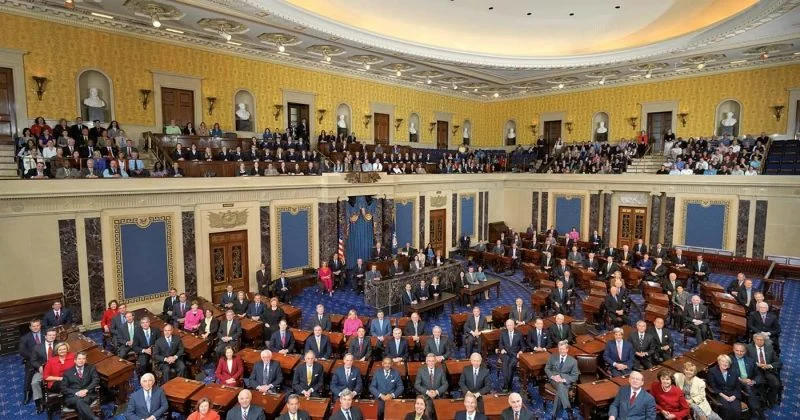
The United States Senate is currently navigating a complex legislative landscape as it weighs the potential for floor consideration of the Digital Asset Market Clarity Act, a pivotal piece of legislation aimed at establishing a comprehensive regulatory framework for the cryptocurrency industry. Despite a stated desire from Senate leadership to initiate the process before the upcoming summer recess, industry experts and congressional observers are signaling that the goal of passing the bill by the preferred August 7 deadline is becoming increasingly untenable. Senate Majority Leader John Thune addressed the press on Thursday, expressing a cautious optimism regarding the bill’s initiation while acknowledging the significant procedural and political obstacles that remain. Thune indicated that while he would like to see the "Clarity" process begin, the ultimate progression of the bill depends heavily on a delicate whipped vote count that has yet to coalesce.
The urgency surrounding the Digital Asset Market Clarity Act stems from a long-standing demand for regulatory certainty within the digital asset ecosystem. For years, market participants, including exchanges, institutional investors, and retail traders, have navigated a fragmented regulatory environment characterized by overlapping jurisdictions between the Securities and Exchange Commission (SEC) and the Commodity Futures Trading Commission (CFTC). The proposed legislation seeks to bridge these gaps, but the window for action is rapidly closing. The Senate is scheduled to depart for its summer state work period on August 10, returning only on September 14. This leaves a narrow sliver of time for floor debate, amendments, and a final vote—a process that is often protracted in a chamber currently preoccupied with a backlog of other high-priority legislative items.
Legislative Logjam and Competing Priorities
The primary challenge facing the Digital Asset Market Clarity Act is not merely the complexity of the bill itself, but the sheer volume of competing business currently on the Senate floor. As of late July, the chamber’s schedule is dominated by a series of judicial nominations, which the administration has prioritized to fill vacancies in the federal court system. Additionally, lawmakers are grappling with an Iran war powers resolution and the perennial necessity of the annual National Defense Authorization Act (NDAA). These items represent "must-pass" or high-stakes political maneuvers that frequently push specialized sector legislation, such as crypto regulation, to the periphery.
Industry representatives and congressional negotiators had long circled August 7 on their calendars as the "practical deadline." The logic behind this date is rooted in the political reality of the 2026 midterm elections. Once lawmakers return from the summer recess in mid-September, their focus shifts almost entirely toward campaigning and constituent outreach. Historically, complex and controversial legislation—particularly that which requires significant bipartisan compromise—struggles to find oxygen in the weeks leading up to a major national election. If the Senate fails to make substantial progress before the August break, the bill risks being relegated to a "lame duck" session or, worse, expiring at the end of the current congressional term, requiring a total restart in 2027.
A Chronology of the Clarity Act’s Development
The journey of the Digital Asset Market Clarity Act began in earnest in early 2025, following a series of high-profile market failures and enforcement actions that underscored the need for statutory clarity. The House of Representatives was the first to act, approving its version of a market structure bill in July 2025. That version focused heavily on defining the boundaries of digital commodities and providing a pathway for "decentralized" assets to escape the more stringent registration requirements associated with securities.
The Senate’s approach has been more deliberative, involving a merger of proposals from two powerful committees: the Senate Banking Committee and the Senate Agriculture Committee. The Banking Committee, which oversees the SEC, has traditionally leaned toward more robust investor protections and a broader definition of securities. Conversely, the Agriculture Committee, which oversees the CFTC, has advocated for a framework that treats most high-volume digital assets as commodities, fostering a more flexible trading environment.
The current draft, released just this week, represents a fragile compromise between these two factions. It aims to set clear rules for digital asset exchanges, intermediaries such as brokers and dealers, and the issuers of digital tokens. Furthermore, it seeks to formalize federal oversight, ensuring that no digital asset operates in a "regulatory vacuum." However, the release of the combined draft has also brought long-simmering disagreements to the forefront, particularly regarding the nuances of stablecoin regulation and internal government ethics.
Contentious Provisions and Partisan Divides
Two primary issues continue to stall the bill’s progress: the treatment of stablecoin rewards and the enforcement of ethics restrictions on senior government officials. These disputes are not merely technical; they reflect fundamental ideological differences between Democrats and Republicans regarding the role of the executive branch and the nature of financial innovation.
Stablecoins—digital assets pegged to the value of a fiat currency like the U.S. dollar—are a cornerstone of the crypto economy. The current draft of the Clarity Act includes provisions regarding "stablecoin rewards," which are essentially interest or incentives paid to holders of these assets. Some Republicans have expressed opposition to the proposed treatment of these rewards, arguing that overly restrictive rules could stifle the utility of stablecoins and drive innovation offshore to jurisdictions with more favorable tax and regulatory treatments.
On the other side of the aisle, Democrats have raised significant objections to the enforcement mechanisms for new ethics rules. The bill proposes strict restrictions on senior government officials to prevent conflicts of interest involving digital asset holdings. However, the draft currently designates the Department of Justice (DOJ) as the primary body responsible for enforcing these rules. Democratic leadership has pushed back against this, suggesting that independent regulatory bodies or specific ethics offices should handle oversight to prevent the politicization of enforcement.
Senator Cynthia Lummis, a prominent advocate for digital asset legislation, has noted that these contentious provisions remain "open to revision." Negotiators are currently working behind the scenes to find a middle ground that can secure the 60 votes necessary to overcome a potential filibuster. In a closely divided Senate, the bill requires significant Democratic buy-in to advance, making the resolution of the DOJ enforcement issue a top priority for the bill’s sponsors.
Defining the Roles of the SEC and CFTC
One of the most significant achievements of the Clarity Act, if passed, would be the definitive allocation of power between the SEC and the CFTC. For years, the two agencies have engaged in a "turf war," with the SEC under Chair Gary Gensler asserting that the vast majority of digital tokens are investment contracts (securities), while the CFTC has argued that assets like Bitcoin and Ethereum are commodities.
The Clarity Act proposes a multi-tiered system:
- SEC Jurisdiction: The SEC would retain oversight of digital assets that function as investment contracts, where there is a clear expectation of profit derived from the efforts of a centralized management team.
- CFTC Jurisdiction: The CFTC would gain expanded authority over "digital commodities." The bill provides a specific legal test to determine when an asset has become sufficiently decentralized to transition from SEC to CFTC oversight.
- Dual Registration: Intermediaries that deal in both securities and commodities would be required to register with both agencies, though the bill aims to streamline this process to avoid redundant compliance costs.
This clarity is viewed as essential for institutional adoption. Major financial institutions, such as BlackRock and Fidelity, have increasingly integrated digital assets into their offerings, but they remain wary of the legal risks associated with an unpredictable regulatory landscape. By codifying these roles, the Clarity Act would provide the "rules of the road" that many believe are necessary for the U.S. to remain a global hub for financial technology.
Broader Impact and Global Implications
The delay in passing the Digital Asset Market Clarity Act has implications that extend far beyond the halls of Congress. Globally, other jurisdictions are moving rapidly to implement their own frameworks. The European Union’s Markets in Crypto-Assets (MiCA) regulation is already providing a blueprint for 27 nations, offering a level of certainty that the U.S. currently lacks. Industry leaders have warned that if the U.S. Senate fails to act before the midterm elections, there could be a "brain drain" of talent and capital to more welcoming markets in Europe, the Middle East, or Asia.
Furthermore, the failure to pass the bill before the August recess would leave it vulnerable to the shifting winds of the November elections. If the balance of power in the Senate shifts, the entire focus of crypto regulation could change. A Republican-controlled Senate might push for even more deregulation, while a stronger Democratic majority might double down on consumer protection and environmental disclosures related to crypto mining.
From a market perspective, the uncertainty has contributed to ongoing volatility. While Bitcoin and other major assets have shown resilience, the lack of a federal framework for stablecoins and exchanges creates a "risk premium" for U.S.-based companies. Investors are looking for a sign that the U.S. government is capable of passing sensible, bipartisan legislation in a sector that is increasingly becoming a permanent fixture of the global financial system.
The Path Forward: September and Beyond
As the August 10 recess approaches, the strategy for Majority Leader Thune and the bill’s proponents appears to be one of "momentum building." By starting the floor process now—even if a final vote is not reached—they can "lock in" the current draft and use the August break to continue negotiations on the remaining sticking points. This would allow the Senate to hit the ground running when they return on September 14.
However, the path remains fraught. Any version of the bill passed by the Senate must be reconciled with the House version. This means the bill would have to return to the House for a final vote before it can be sent to President Donald Trump’s desk for signature. With the legislative calendar for the remainder of 2026 looking incredibly sparse, every day of delay increases the likelihood that the Digital Asset Market Clarity Act will become a casualty of partisan gridlock.
The coming days will be critical. If Thune can successfully move the bill to the floor and begin the amendment process, it will signal to the industry that there is still a path forward. If, however, the Senate remains bogged down in judicial confirmations and defense spending, the "Clarity" that the market so desperately seeks may remain elusive for another year. For now, the crypto industry remains in a state of watchful waiting, hoping that the legislative gears can turn fast enough to beat the summer heat and the looming election cycle.