On June 22, 2026, the U.S. Department of the Treasury’s Office of Foreign Assets Control (OFAC) announced a sweeping enforcement action targeting a sophisticated financial network facilitating transactions for the Islamic State of Iraq and Syria (ISIS). The designation includes three high-profile individuals and six business entities spanning the Middle East, Africa, and Europe. This coordinated effort aims to dismantle the digital and physical infrastructure that has allowed ISIS to move capital across international borders, increasingly utilizing cryptocurrency to bypass traditional financial surveillance.
The enforcement action underscores a growing trend in terrorist financing where traditional informal value transfer systems, such as hawala, are being integrated with modern virtual asset service providers (VASPs). By targeting nodes in Syria, Turkey, and Nigeria, the U.S. government is attempting to sever the "financial lifelines" that sustain ISIS’s global operations, recruitment, and logistical capabilities.
The Nexus of Digital Finance: Bitcoin Xchange and the Syrian Node
At the center of the Syrian operations is Bitcoin Xchange, a money services business (MSB) established in late 2020. According to OFAC, the entity was founded and managed by Abdelhakim Boukich, a former Dutch national who transitioned into an extremist financial facilitator. Bitcoin Xchange served as a critical gateway for ISIS-linked funds originating from Western Europe and beyond.
Investigation records indicate that Boukich and his associates utilized Bitcoin Xchange to process transfers from supporters and operatives in Norway, Belgium, the Netherlands, South Africa, and the United States. The firm functioned as a hybrid model, accepting traditional fiat currency and converting it into digital assets to facilitate rapid, cross-border movement of wealth. This designation highlights the persistent role of Syria as a logistical hub for the group, despite the loss of its physical caliphate years prior. The ability of a former European national to establish such a network demonstrates the group’s ongoing appeal to radicalized individuals with technical and financial expertise.
The Turkish Network: Legitimate Fronts for Illicit Flows
The Treasury’s action also focused on the Turkish financial landscape, specifically targeting two entities: Spider Gayrimenkul Ve Genel Ticaret Limited Sirketi (Spider) and Alkaram Danismanlik Gayrimenkul Ic Ve Dis Genel Ticaret Limited Sirketi (Alkaram). Both firms are allegedly owned and controlled by Mohamad Alhmidan, a figure long known to international intelligence agencies.
Alhmidan’s history with U.S. sanctions dates back to March 2016, when he was first designated for his role in ISIS’s financial hierarchy. Despite previous sanctions, Alhmidan continued to operate by leveraging the Turkish real estate and general trade sectors. Spider, which originated as a hawala operation in Syria, was repurposed to move money from formerly ISIS-controlled territories into other regions. By masking transactions as legitimate real estate investments or commercial trade payments, the network attempted to evade the scrutiny of Turkish and international banking regulators. The re-designation of Alhmidan and the targeting of his companies reflect the difficulty of permanently dismantling financial networks that can easily rebrand or shift their legal registrations.
West African Expansion: The Nigerian Bureau de Change Entities
In a significant move against the group’s African affiliates, OFAC designated Mukhtar Adamu Muhammad, a Nigeria-based financial facilitator for ISIS-West Africa (ISIS-WA). Muhammad is accused of managing a cluster of Bureau de Change (BDC) entities that provided the liquidity necessary for ISIS-WA to sustain its insurgency in the Lake Chad Basin.
The sanctioned entities include Nine to Nine Exchange Bureau de Change Limited, Manhattan Bureau de Change Limited, and Generation Currency Bureau de Change Limited. These businesses served as vital conduits for laundering the proceeds of criminal activity and local "taxation" into the broader financial system. The inclusion of Nigerian entities in this global crackdown signals the U.S. government’s recognition of the growing threat posed by ISIS’s regional branches, which have become increasingly autonomous and financially self-sufficient. By targeting these BDCs, the Treasury aims to disrupt the local economy that fuels militant activities in Western Africa.
The Role of Blockchain Analytics and TRON Networks
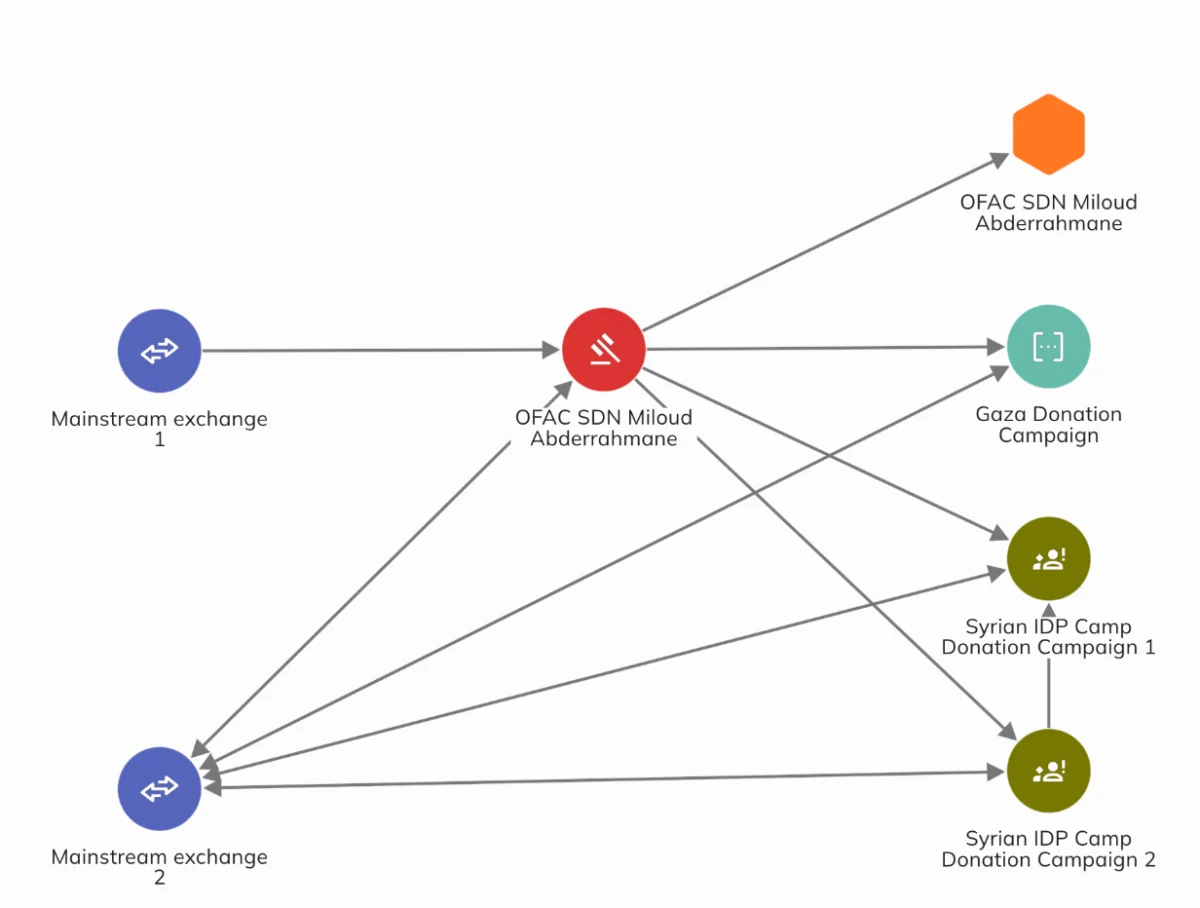
A pivotal aspect of the June 2026 designations is the identification of specific cryptocurrency infrastructure. Miloud Abderrahmane, a French national, was sanctioned not only for financial facilitation but also for providing technical assistance to ISIS. Abderrahmane allegedly provided instructions to ISIS supporters on the construction of explosive devices, bridging the gap between financial support and operational violence.

OFAC identified two specific TRON blockchain addresses linked to Abderrahmane. Blockchain analytics, including data provided by firms like Chainalysis, revealed a trail of transfers from Abderrahmane’s digital wallets to campaigns supporting ISIS affiliates in Syria and Gaza. The preference for the TRON network among extremist groups has been noted by analysts due to its high transaction speed and lower fees compared to the Bitcoin network. Furthermore, the widespread use of stablecoins like USDT on the TRON blockchain allows these groups to avoid the price volatility associated with traditional cryptocurrencies while still benefiting from the pseudonymity of the ledger.
The identification of these addresses provides a roadmap for global exchanges to freeze assets and block future transactions. It also serves as a case study in how blockchain transparency can be leveraged by law enforcement to track "downstream exposure," identifying not just the primary facilitator but also the secondary recipients of illicit funds.
Chronology of the ISIS Financial Evolution
The 2026 designations represent a specific point in a multi-year effort to adapt to ISIS’s changing financial strategies.
- 2014–2017: ISIS relied heavily on territorial control, taxing local populations, and selling oil on the black market. Financial flows were largely physical and localized.
- 2018–2020: Following the loss of its territory, the group shifted to the "clandestine cell" model. It began utilizing the hawala system more aggressively to move assets out of the conflict zone.
- 2020–2023: Entities like Bitcoin Xchange were established as the group began to experiment with cryptocurrency, specifically Bitcoin, to receive international donations.
- 2024–2026: The group moved toward "stablecoin" ecosystems and alternative blockchains like TRON to enhance operational security and financial stability.
The current action by the U.S. Treasury is a response to this final stage of evolution, where the group has successfully integrated into the global virtual asset economy.
Official Responses and Strategic Implications
While the U.S. Department of the Treasury led the action, the enforcement is expected to trigger a ripple effect across the global financial system. Under U.S. law, all property and interests in property of the designated individuals and entities that are in the United States or in the possession or control of U.S. persons must be blocked and reported to OFAC.
The implications for international Virtual Asset Service Providers (VASPs) are particularly acute. "Foreign financial institutions that knowingly facilitate significant transactions for these individuals or entities risk being subject to U.S. secondary sanctions," a Treasury spokesperson noted in a briefing. This means that a crypto exchange in Europe or Asia that continues to allow Abderrahmane’s TRON addresses to interact with its platform could be cut off from the U.S. dollar-clearing system, a "financial death sentence" for most legitimate institutions.
Industry experts suggest that this action will force a mandatory update to automated sanctions screening tools worldwide. Compliance officers must now ensure that their transaction monitoring systems are tuned to flag any interaction with the identified TRON wallets and the newly designated Nigerian and Turkish MSBs.
Broader Impact on Global Compliance Standards
The designation of these nine targets serves as a reminder of the complexity of modern Counter-Terrorism Financing (CTF). It demonstrates that no single region or technology is the sole culprit; rather, it is the intersection of informal traditional systems (hawala), legitimate-appearing commercial fronts (real estate and BDCs), and cutting-edge digital assets that creates the risk.
For global financial institutions, the "know your customer" (KYC) requirements are no longer sufficient if they do not include "know your transaction" (KYT) blockchain analytics. The ability to trace the origin of funds—even when they have passed through several intermediary wallets—is now a baseline expectation for regulators.
As ISIS continues to decentralize, the U.S. government’s strategy appears to be one of "financial friction." By making it harder, slower, and more expensive for the group to move money, the Treasury hopes to degrade the group’s ability to plan and execute large-scale attacks. The June 2026 action is a clear message to the crypto industry: the era of digital assets being a "safe haven" for illicit finance is rapidly closing as transparency tools and regulatory enforcement reach technological parity with the facilitators they pursue.