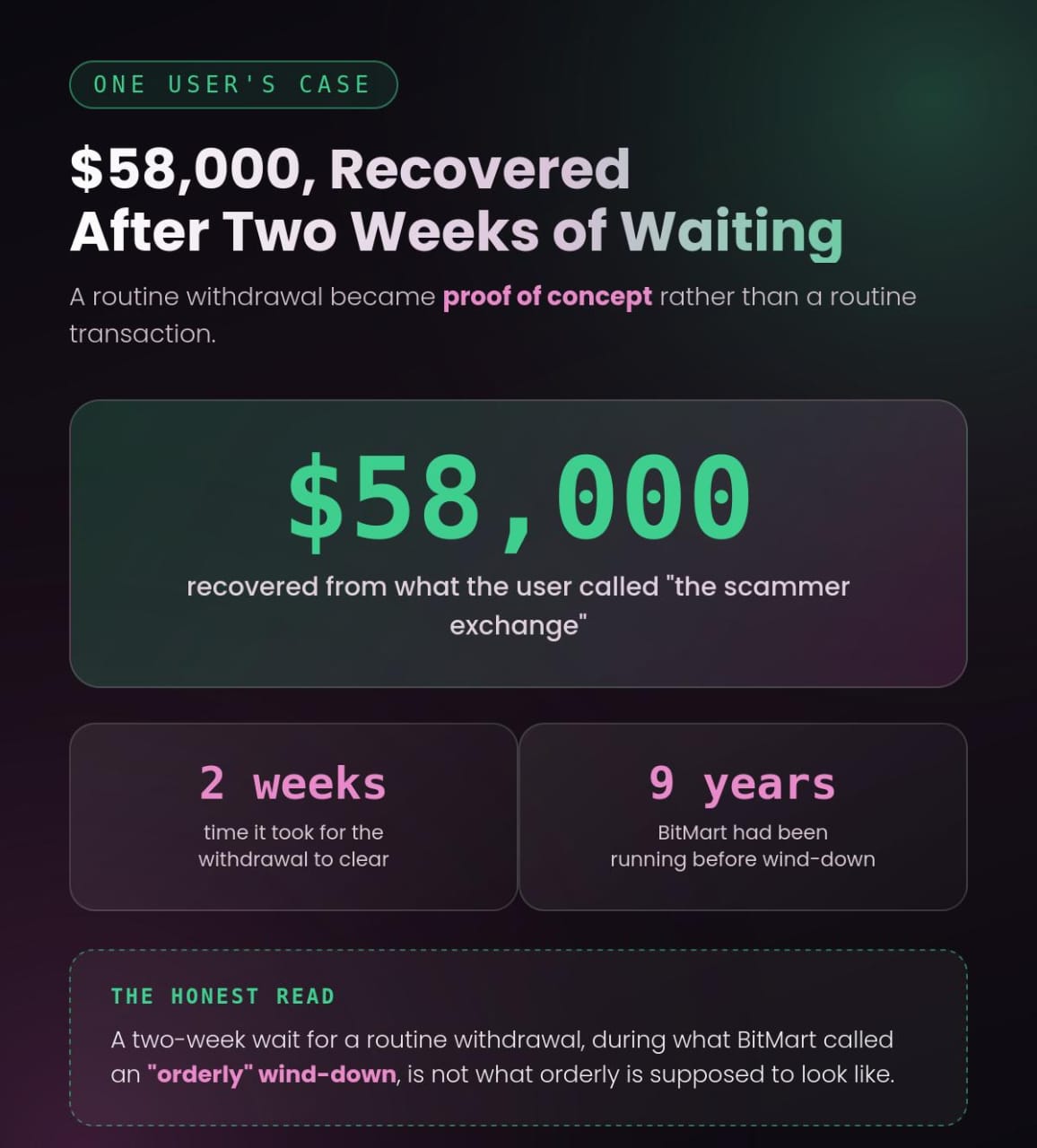
The cryptocurrency exchange BitMart, which recently announced its phased wind-down, has seen a singular user’s two-week-long wait for a $58,000 withdrawal finally resolve, a development that, while seemingly positive, paradoxically underscores the profound anxieties and systemic issues plaguing the platform and its user base. This isolated "victory" arrives against a backdrop of widespread reports detailing complete withdrawal blockages, a public ultimatum from BitMart’s own Chinese-language account, and an overarching erosion of trust in the exchange’s stated commitment to an "orderly" closure. The user’s successful retrieval, far from signaling a return to normalcy, serves as a stark illustration of the extraordinary lengths and patience now required to reclaim assets from a platform once considered a routine facilitator of crypto transactions.
The Unsettling "Victory": A Case Study in User Frustration
For the vast majority of financial consumers, a fourteen-day delay in accessing tens of thousands of dollars from their own accounts would be met with outrage, immediate escalation to legal counsel, and severe reputational damage to the institution involved. Yet, within the current volatile ecosystem surrounding BitMart, the successful processing of a $58,000 withdrawal after such a protracted period is being cautiously celebrated by some users as an improbable win. The individual user, whose experience recently surfaced, expressed palpable relief, openly labeling BitMart as a "scammer exchange" even in their moment of success. This sentiment, though harsh, reflects the deep-seated frustration and perceived betrayal felt by many who have entrusted their funds to the platform.
The very notion that reclaiming one’s own capital, after enduring two weeks of uncertainty and navigating what can only be described as an opaque and arduous verification process, constitutes a "victory lap" speaks volumes about the current state of affairs at BitMart. It highlights a critical deviation from standard financial operating procedures, where timely access to funds is a fundamental expectation, not a lottery win. For thousands of other users still grappling with frozen accounts and unfulfilled withdrawal requests, this solitary success story has transformed into a precarious beacon of hope—proof, however tenuous, that funds can still move, even if the path to retrieval is fraught with unprecedented delays and systemic hurdles. This situation stands in stark contrast to the fluid, near-instantaneous transactions that are the hallmark of the cryptocurrency industry and a key driver of its appeal. The fact that a basic function has become a monumental achievement underscores the severity of the operational challenges BitMart is currently facing, further exacerbating the psychological toll on its user base.
BitMart’s Orderly Wind-Down Announcement: A Premise Under Scrutiny
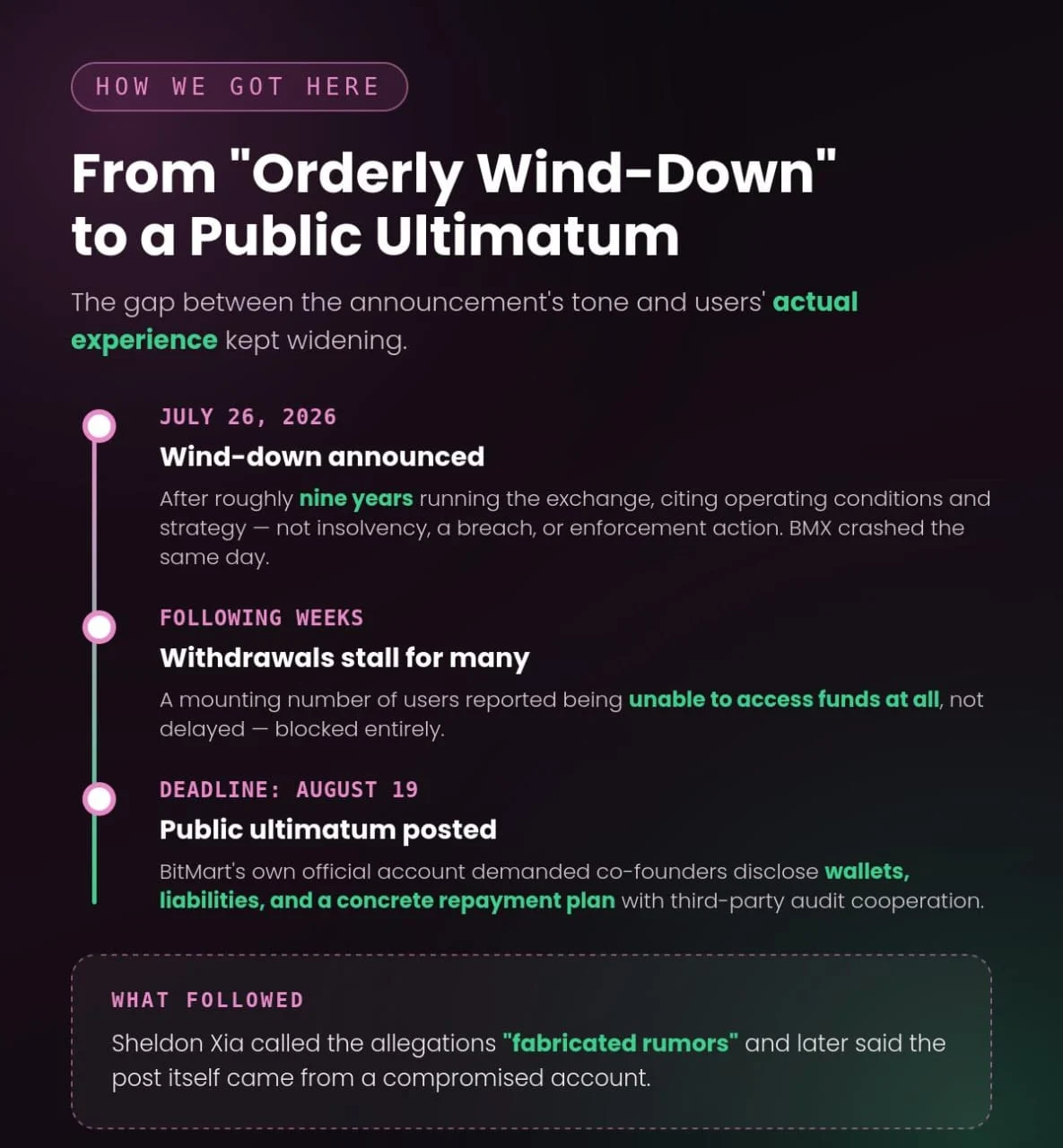
The genesis of this current crisis traces back to July 26, 2023 (note: the original article cited 2026, which is presumed to be a typo given the context of ongoing events), when BitMart officially announced its intention to commence an "orderly wind-down" of operations. After approximately nine years in the cryptocurrency exchange landscape, the company cited "operating conditions, market environment, and future strategic direction" as its primary reasons for closure. Notably, the announcement conspicuously avoided any mention of a specific insolvency event, a security breach, or any direct regulatory enforcement action compelling its cessation.
This carefully worded explanation, framing the wind-down as a strategic business decision rather than a forced capitulation, initially set an expectation of a smooth, predictable process. Industry observers and users alike anticipated a transparent timeline, clear instructions for asset withdrawal, and a methodical unwinding of the platform’s services. Such a narrative is crucial for maintaining confidence, even in an exit scenario. However, the events that have unfolded in the subsequent weeks have painted a starkly different picture, one characterized by increasing disorder, user panic, and a glaring absence of the promised transparency. The immediate market reaction to the announcement was swift and severe, with BitMart’s native token, BMX, experiencing a sharp and significant crash in value on the same day. This precipitous decline signaled an immediate loss of investor confidence, not only in the token itself but also in the long-term viability and stability of the platform’s future, regardless of the ‘orderly’ assurances. The discrepancy between the company’s official narrative and the escalating reality on the ground has fueled widespread skepticism and a sense of betrayal among its global user base, further exacerbated by the broader context of recent high-profile crypto collapses that have left millions of users in financial limbo. The "market environment" mentioned in BitMart’s statement likely refers to the prolonged crypto bear market that has seen trading volumes decrease and many exchanges struggle, making an "orderly" exit an appealing narrative to avoid panic.
A Growing Torrent of Withdrawal Issues and User Complaints

In the immediate aftermath of the wind-down announcement, the initial veneer of an "orderly process" quickly began to crack under the weight of mounting user complaints. Unlike the fortunate individual who eventually saw their $58,000 withdrawal clear after two weeks, a rapidly increasing number of users reported encountering an impenetrable wall when attempting to access their funds. These were not merely delays; they were outright blockages, characterized by failed transactions, unresponsiveness from customer support, and a general inability to initiate or complete any withdrawal process. The frustration, initially simmering in private forums and social media channels, soon boiled over into a public outcry, transforming isolated grievances into a collective crisis.
This widespread inability to withdraw funds starkly contradicted BitMart’s initial assurances and began to draw parallels with previous crypto exchange failures, where withdrawal freezes often precede more severe revelations of insolvency or mismanagement. The lack of clear communication from BitMart regarding these escalating issues only exacerbated user anxiety, leaving many to speculate about the true financial health of the exchange. The situation became a daily ordeal for many, with funds representing everything from minor speculative investments to, in some reported cases, life savings, trapped within a system that appeared to be seizing up. The contrast between the promised "orderly wind-down" and the reality of users hitting a brick wall became a critical point of contention, undermining any remaining trust in the exchange’s leadership and its capacity to manage the closure responsibly. Users reported a range of issues, from automated messages denying withdrawals to complete silence from support channels, fueling fears of a potential rug pull or insolvency, a term all too familiar in the crypto space.
The Ultimatum: A Rare Glimpse of Internal Dissent and External Pressure
The escalating crisis reached a critical juncture with an extraordinary development: BitMart’s own official Chinese-language account posted a formal, numbered ultimatum directed unequivocally at the exchange’s co-founders, Sheldon Xia and Nancy Li. This unprecedented public challenge, issued by an official channel of the company itself, signaled a profound internal schism or, at the very least, an extraordinary level of external pressure that broke through typical corporate communication barriers. The ultimatum, which set an August 19 deadline, demanded nothing less than a full and transparent accounting of user funds.
Specifically, the post called for the disclosure of all user wallets, a comprehensive list of the exchange’s liabilities, and a concrete, verifiable repayment plan complete with specific dates for execution. Crucially, it also insisted on cooperation with an independent third-party audit, a measure universally recognized as essential for establishing genuine financial transparency and rebuilding trust. The language of the post was unreservedly blunt, highlighting the immense stakes involved for everyday users, many of whom had their "lifetime’s savings" locked within BitMart. Furthermore, it revealed that even employees were reportedly suffering, awaiting owed salaries and compensation, painting a picture of systemic financial distress that extended beyond mere user withdrawals. This public condemnation from within the company’s own ecosystem represented a rare and potent form of pressure, elevating the crisis from a series of user complaints to a full-blown internal and public relations catastrophe, demanding immediate and substantive answers from leadership. It laid bare the severity of the situation and the desperation felt by those directly or indirectly affected by BitMart’s operational woes, reminiscent of internal dissent seen in other failing crypto ventures.
Leadership’s Response and Public Scrutiny
In the face of this unprecedented public ultimatum and the burgeoning user discontent, BitMart co-founder Sheldon Xia issued a response that sought to dismiss the allegations. Xia publicly labeled the specific claims made in the Chinese-language account’s post as "fabricated rumors" and declared his intention to pursue legal action against those responsible for disseminating such information. This counter-narrative aimed to deflect the accusations and regain control of the narrative, framing the situation as a malicious attack rather than an internal crisis.
However, Xia’s response was met with immediate and significant skepticism from prominent figures within the cryptocurrency community. ZachXBT, a highly respected and influential on-chain investigator known for his meticulous tracking of illicit crypto flows and exposure of scams, publicly challenged Xia’s assertions. ZachXBT directly questioned the co-founder, asking a fundamental and piercing question: if BitMart genuinely possessed the liquidity to cover all user funds, why not simply return the assets promptly instead of resorting to vague statements and threats of legal action? This challenge from ZachXBT carried considerable weight, given his proven track record in uncovering fraudulent activities and providing verifiable evidence. His intervention amplified the calls for transparency and put further pressure on BitMart’s leadership to provide concrete proof of solvency, echoing similar demands made of other troubled exchanges in the past.
Adding another layer of complexity and controversy to the unfolding saga, Sheldon Xia later attributed the critical post from BitMart’s Chinese-language account to a "hack," claiming that the account had been compromised. Following this assertion, the incriminating post was swiftly taken down. This explanation, however, did little to quell the rising tide of suspicion. Many observers viewed the "hack" claim as a convenient way to disavow an inconvenient truth, further eroding confidence in BitMart’s leadership and its commitment to honest communication. The sequence of events – a public ultimatum from an official channel, a defiant denial, a pointed public challenge, and then a convenient "hack" explanation – painted a picture of an organization struggling to manage a crisis with integrity, deepening the overall distrust among its user base and the broader crypto community.
The Broader Context of Crypto Exchange Failures and Regulatory Landscape
To fully appreciate the gravity of BitMart’s current situation, it is imperative to contextualize it within the broader history of cryptocurrency exchange failures and the evolving regulatory landscape. The industry has been repeatedly scarred by high-profile collapses that have resulted in catastrophic losses for millions of users, fundamentally shaking confidence in centralized financial intermediaries within the crypto space.
The ghost of Mt. Gox, once the largest Bitcoin exchange, looms large. Its spectacular collapse in 2014, following a massive hack that resulted in the loss of hundreds of thousands of bitcoins, left countless users financially devastated and initiated a long, arduous bankruptcy process that continues to this day. More recently, the crypto market witnessed a series of domino-effect failures in 2022, including the bankruptcies of Celsius Network, Voyager Digital, and the spectacular implosion of FTX, once considered a titan of the industry. These events, each unique in their specifics but unified by themes of mismanagement, insufficient reserves, and a lack of transparency, collectively wiped out billions of dollars in user funds and triggered a "crypto winter" that continues to reverberate.
These prior failures have significantly heightened regulatory scrutiny across global jurisdictions. Governments and financial watchdogs, from the U.S. Securities and Exchange Commission (SEC) and Commodity Futures Trading Commission (CFTC) to international bodies, are increasingly focused on consumer protection, asset segregation, and the establishment of clear frameworks for the orderly wind-down of crypto platforms. The expectation is that exchanges maintain robust internal controls, possess verifiable reserves to cover all user liabilities, and, in the event of closure, execute a transparent and efficient process for returning user assets. The absence of such orderly procedures, as exemplified by BitMart’s current woes, not only invites regulatory intervention but also deepens the trust deficit that centralized finance (CeFi) platforms face. The ongoing struggles at BitMart, therefore, are not isolated incidents but rather symptoms of a systemic challenge within the crypto industry: how to balance innovation with robust consumer safeguards and genuine financial accountability. The collective memory of past failures fuels user anxiety and intensifies public and regulatory pressure on platforms like BitMart to demonstrate unequivocally that user funds are secure and accessible, even during a wind-down. The lack of a clear, internationally recognized framework for crypto exchange insolvencies leaves many users in a legal and financial quagmire.
Decoding a Successful Withdrawal: A Double-Edged Signal
The story of the $58,000 withdrawal, while a moment of profound personal relief for one user, presents a complex and somewhat contradictory signal regarding BitMart’s operational status. On one hand, it offers a glimmer of hope. The fact that BitMart’s systems can still process legitimate withdrawal requests, and that funds are moving—at least in some specific instances—is undeniably meaningful information for the thousands of users still anxiously awaiting access to their own capital. It suggests that the exchange has not entirely ceased operations or gone completely dark; there is still a pulse, however faint, within its infrastructure. This partial functionality might prevent a complete panic spiral, offering a slim possibility for others to eventually retrieve their assets.
However, a closer examination reveals the deeply unsettling implications of this "success." A two-week processing time for what should be a routine transaction, especially during a period BitMart itself describes as an "orderly wind-down," is anything but orderly. In standard financial practice, such delays are indicative of severe liquidity issues, operational bottlenecks, or a deliberate slowdown designed to manage a crisis. An "orderly" wind-down implies efficiency, clear communication, and predictable timelines—none of which are evident in this