The VVV token, native to the Venice AI platform, has recently surged to a new all-time high of $25.35, signaling a decisive shift in market perception. This remarkable ascent is underpinned by a series of verifiable fundamental catalysts, distinguishing Venice from the speculative hype often associated with nascent AI-crypto projects. Unlike many tokens that exhibit fleeting vertical charts and unverified narratives, VVV’s current trajectory appears to be a culmination of sustained operational growth, strategic financial backing, and intelligently designed tokenomics.
As of the morning of September 8, 2026, VVV stands at $23.62, boasting a market capitalization of $1.13 billion, reflecting a substantial 36% increase over the past 24 hours. The trading volume has exploded, reaching $132.68 million in the last day—a staggering 711% surge from the preceding period. This confluence of price appreciation and volume expansion suggests a broad-based conviction in the project’s long-term viability, moving beyond mere speculative interest. The circulating supply currently stands at 48.1 million VVV out of a total of 80.93 million, a figure that is intentionally shrinking through integrated deflationary mechanisms, rather than remaining static or expanding. The all-time high of $25.35 was achieved just over an hour before this report, marking a significant milestone in the token’s journey.
A Foundation Built on Real-World Utility: The Venice Platform
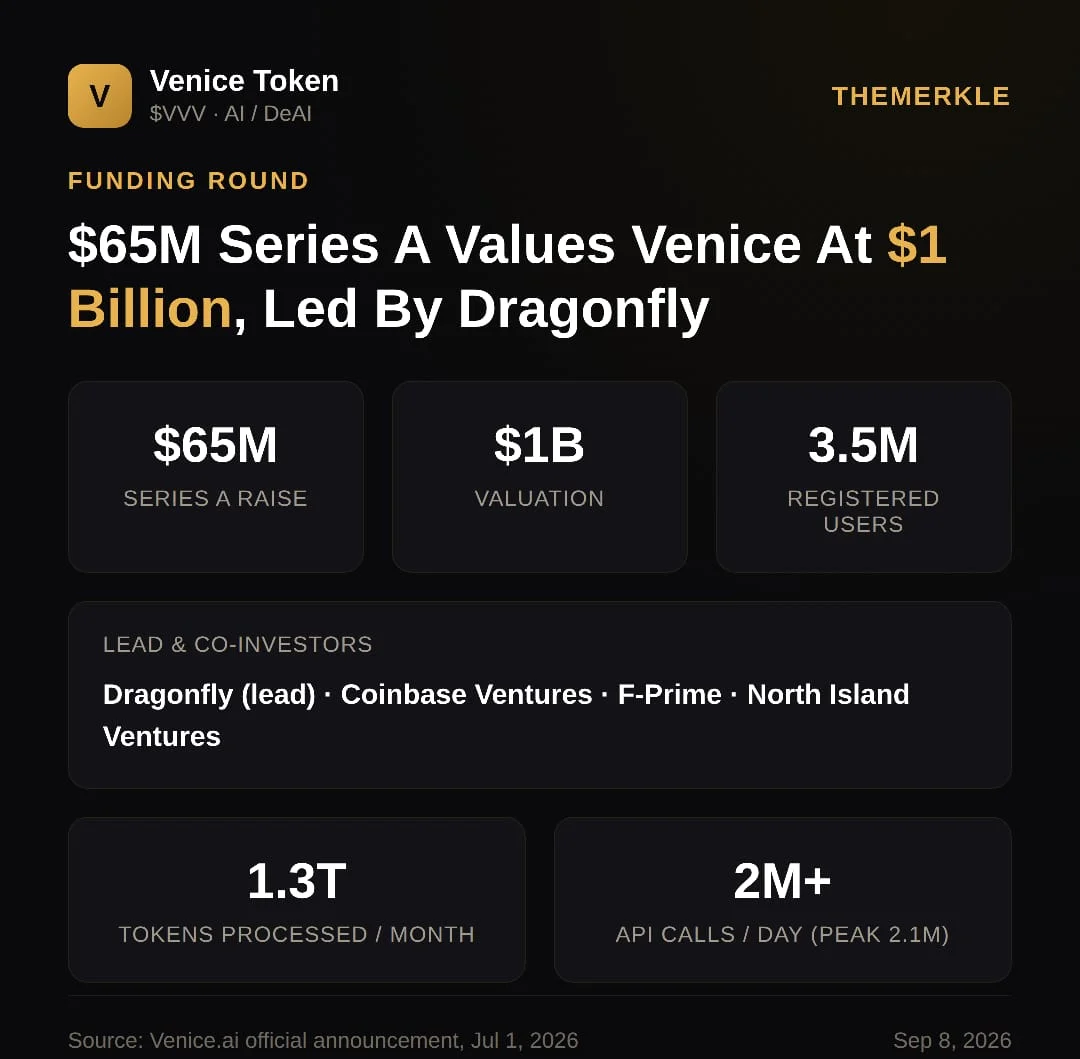
At the core of VVV’s resurgence is the Venice platform itself—a live, operational ecosystem serving 3.5 million registered accounts. Founded in 2024, Venice has quietly cultivated a robust user base and developer community, processing an astounding 1.3 trillion tokens per month. The platform facilitates over 2 million API calls daily from developers, peaking above 2.1 million, and handles 300,000 inference requests per hour during peak activity. These are not aspirational figures or projections but demonstrable operational metrics from a platform that ran for approximately two years without external funding, a testament to its organic growth and product-market fit.

Venice’s founder and CEO, Erik Voorhees, has been a vocal proponent of permissionless artificial intelligence long before the acronym "DeAI" (Decentralized AI) entered common parlance. His vision for Venice is clear: to safeguard "intelligence, the lifeblood of civilizational advancement," from mass surveillance and censorship. This commitment to privacy is not a mere marketing slogan; it is architecturally embedded within the platform. Venice never logs user prompts, and conversations are stored directly on the user’s device, bypassing Venice’s servers entirely. In an evolving landscape where major centralized AI providers are increasingly implementing stringent content filters and various jurisdictions are grappling with AI-output liability regulations, Venice’s privacy-centric architecture is rapidly transforming from a mere feature into a formidable competitive moat. This fundamental difference addresses a growing demand for secure, censorship-resistant AI interactions, positioning Venice at the forefront of the decentralized AI movement.
Institutional Validation: A $65 Million Series A Funding Round
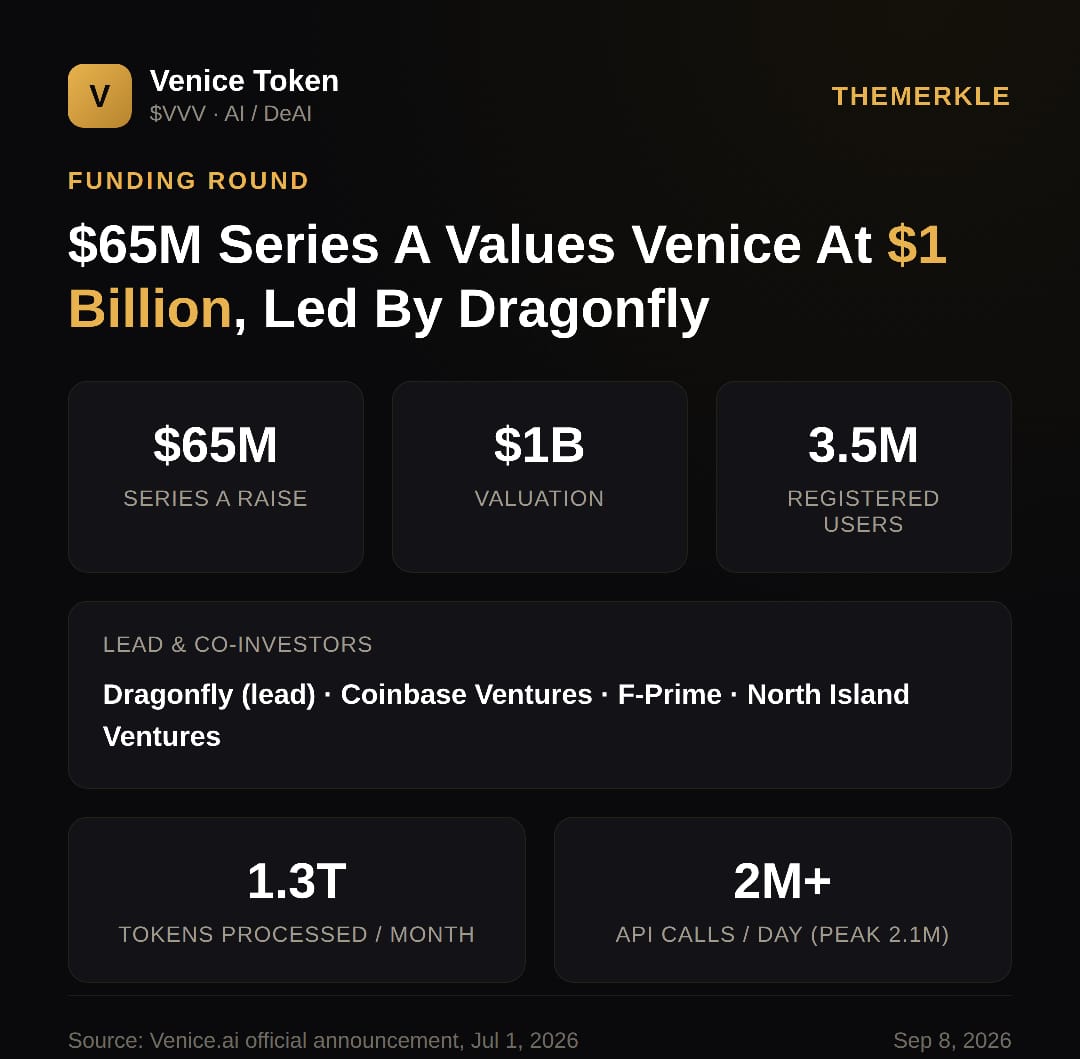
A pivotal moment that undeniably caught the attention of the broader crypto and tech world was Venice’s announcement on July 1, 2026, of a $65 million Series A funding round. This significant capital infusion, led by the prominent venture capital firm Dragonfly, valued the company at a staggering $1 billion. This was Venice’s inaugural external capital raise since its inception in 2024, highlighting its capacity for self-sustained growth prior to institutional investment.
The list of co-investors further underscores the gravity of this funding round. Backing came from industry heavyweights such as Coinbase Ventures, F-Prime, and North Island Ventures, among others. These are not funds known for chasing fleeting narratives or speculative trends; rather, they are institutions with rigorous due diligence processes and a proven track record of identifying and investing in platforms with genuine staying power and long-term potential. Their collective endorsement of Venice lends substantial credibility to the project, signaling to the market that the underlying technology, business model, and team have met stringent professional scrutiny. This institutional validation serves as a powerful counter-narrative to the skepticism that often surrounds early-stage crypto projects, particularly those in the volatile AI sector.
Evolving Tokenomics: A Deliberate Path Towards Deflation
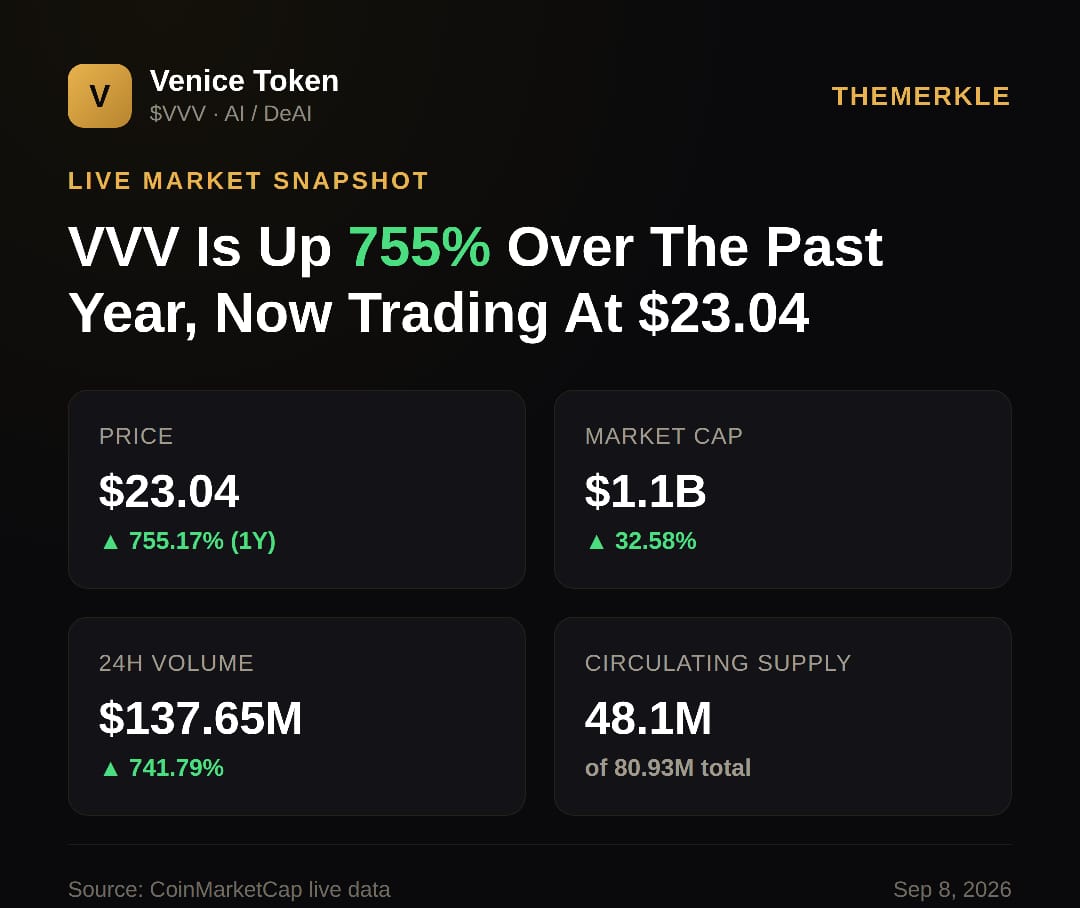
Beyond operational metrics and institutional backing, Venice has meticulously engineered its tokenomics structure to actively reduce the VVV circulating supply, fostering a structurally tighter market as the platform expands. This proactive approach to token value management is a critical differentiator.
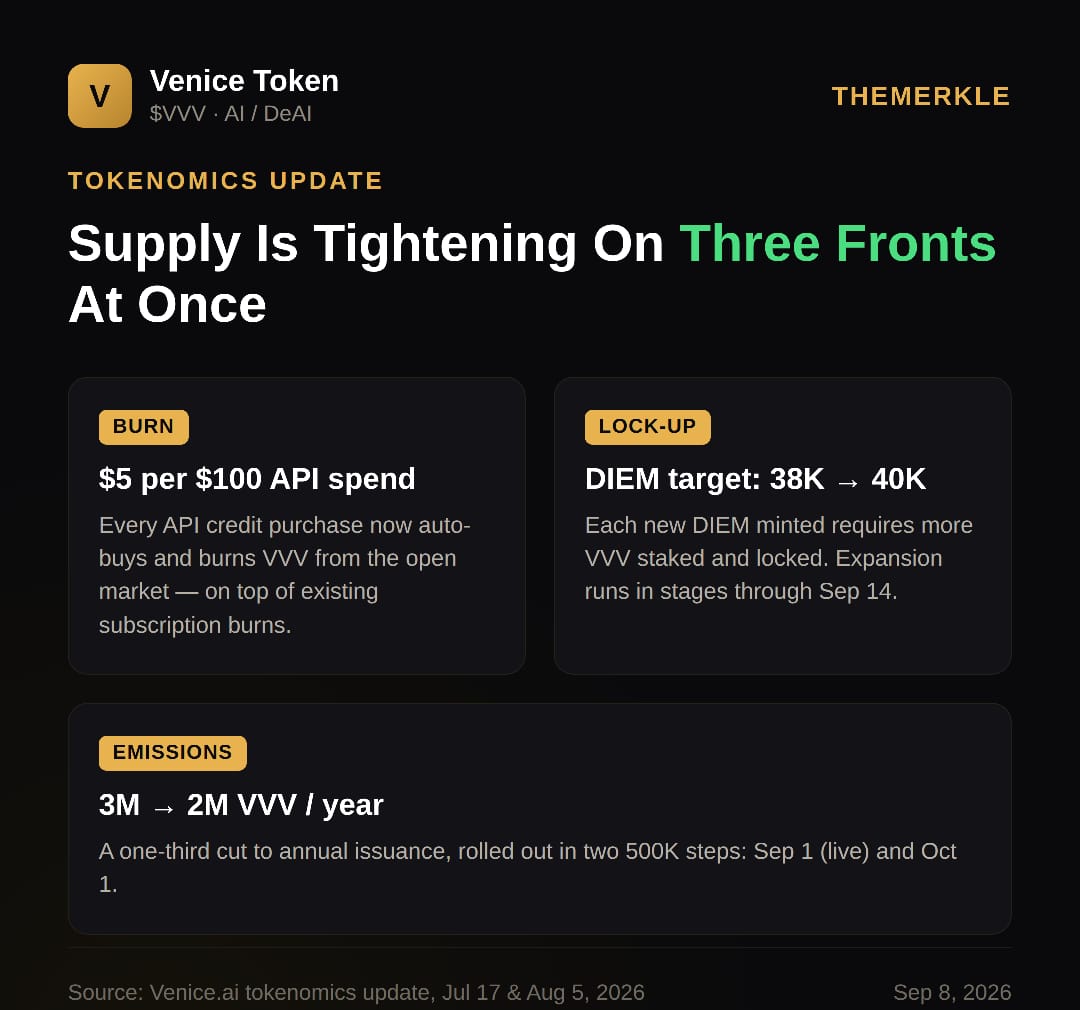
On July 17, 2026, Venice unveiled a comprehensive tokenomics update that introduced two powerful deflationary mechanics. The first is a new programmatic burn mechanism: for every $100 worth of API credits purchased through Venice, $5 is automatically used to buy VVV from the open market, which is then permanently burned. This burn is transparently tracked on Venice’s live burn tracker, distinct from the existing subscription burns already derived from Pro, Pro+, and Max tier revenue. The implication is profound: every single API call, whether from a developer, an AI agent, or any workflow utilizing Venice’s infrastructure, now directly contributes to a diminishing VVV supply. This creates a direct link between platform utility and token scarcity, aligning the incentives of users, developers, and token holders.
The second key update involves DIEM, Venice’s secondary token. One DIEM staked provides $1 in daily API credits, refreshed every day, for as long as it remains staked. Critically, every new DIEM minted requires a corresponding amount of VVV to be locked out of circulation. The DIEM supply target was raised from 38,000 to 40,000, with this expansion rolling out in four staged steps starting August 3, 2026, and concluding on September 14, 2026. The final 500 DIEM of supply space is set to open this coming weekend. Each step of this expansion permanently locks more VVV, as staked VVV cannot be unlocked while DIEM is outstanding against it. This mechanism creates a continuous demand for VVV locking, further tightening the liquid supply.
Adding to these measures, on August 5, 2026, Venice announced a significant reduction in VVV emissions, cutting the annual issuance from 3 million VVV to 2 million. This represents a full one-third reduction, implemented in two stages: a 500,000 VVV cut on September 1, 2026 (already live), and another 500,000 VVV cut scheduled for October 1, 2026. This explicit strategy underscores a clear direction: to systematically move towards a deflationary VVV, progressively reducing emissions while increasing burns. The resulting feedback loop is designed to be self-reinforcing: increased platform revenue leads to more buy-and-burns, which reduces supply, thereby establishing a structurally higher floor for the VVV price. It’s noteworthy that at the time of the July 1 Series A announcement, Venice had already burned 33.7 million VVV, approximately 42% of the total supply at that time, and annual emissions had stepped down from 4 million to 3 million. This number has continued to climb since, reinforcing the deflationary trend.
Market Performance: A Chart Reflecting Fundamentals
The one-year chart for VVV provides a compelling visual narrative of a token that has steadily appreciated, moving from $2.62 in late 2025 to its current price of $23.62—a staggering 778% increase over the CoinMarketCap 1Y tab. Crucially, the shape of this chart deviates significantly from the typical "pump and dump" patterns observed in many speculative tokens. This was not a sudden, unsustainable vertical spike in early 2026 that quickly faded. Instead, the chart depicts a sustained, multi-month ramp that began discreetly and has steadily accelerated as each subsequent catalyst reinforced the underlying value proposition.
For those who identified VVV at its all-time low of $0.5133 on January 27, 2025, the day it launched, the returns are extraordinary, reaching 4,478%. More realistically, for investors who began paying attention in late 2025 as the platform crossed a million users and the initial burn mechanics became active, the journey has still yielded exceptional gains. Today’s all-time high of $25.35 is not an isolated spike disconnected from the project’s fundamentals; rather, it appears to be a market correction, reflecting months of underpricing a platform that consistently executed its roadmap and expanded its utility.
While the 24-hour range of $17.53 to $25.35 indicates inherent volatility, typical of rapidly appreciating assets in the cryptocurrency market, metrics such as the Vol/Mkt Cap ratio of 11.57% and a Liq/Mkt Cap of 1.73% suggest a liquid yet dynamic asset. This is not an illiquid token easily manipulated but rather one experiencing genuine market discovery driven by verifiable developments. Investors are cautioned against blindly chasing a single-day candle; however, the foundational case for VVV is robust and built on transparent, auditable factors.
Broader Implications and Future Outlook
Venice’s journey and VVV’s performance offer a compelling case study for the burgeoning Decentralized AI sector. It demonstrates that projects with real-world utility, strong operational metrics, clear privacy principles, institutional backing, and intelligent tokenomics can thrive, even in a market often characterized by speculation. The competitive moat created by Venice’s permissionless and privacy-preserving architecture is increasingly relevant in an era of heightened concerns over data sovereignty and algorithmic censorship. As regulatory frameworks around AI continue to evolve, platforms that offer verifiable guarantees of user privacy and open access are likely to command significant market share.
The explicit timeline for upcoming events provides clear points of interest for investors and observers. The DIEM supply target expansion is set to conclude on September 14, 2026, with the next emissions cut scheduled for October 1, 2026. These dated, on-chain events will further impact the VVV supply dynamics and provide continued catalysts for market activity.
Venice (VVV) is available on major exchanges including Coinbase Exchange, Aerodrome Finance, Upbit, and Bybit, enhancing its accessibility for a global investor base. To stay updated on future developments, the official Venice blog and their X (formerly Twitter) account, @AskVenice, are the primary sources of information. The unfolding narrative of Venice and VVV presents a fascinating intersection of technological innovation, market dynamics, and the evolving landscape of decentralized artificial intelligence.
Figures reflect live CoinMarketCap data as of the morning of September 8, 2026, and are subject to rapid change given current market volatility.
Disclosure: This article is for informational purposes only and does not constitute trading or investment advice. Always conduct thorough research and consult with a financial professional before making any investment decisions in cryptocurrencies or related services.