The Western European cryptocurrency market has emerged as a cornerstone of the global digital asset landscape, demonstrating remarkable resilience during a period of significant international volatility. Between July 2025 and June 2026, the region’s total crypto economy reached an estimated $2.08 trillion, solidifying its status as the second-largest cryptocurrency market in the world. Despite a broader global downturn that saw total market capitalization across the industry contract by nearly 50%, Western Europe managed a modest but significant growth rate of 1.2%. This performance places the region among an elite group of only three global territories—including Sub-Saharan Africa and Latin America—to record positive growth during this reporting cycle. This stability is largely attributed to a maturing regulatory environment, a surge in institutional participation, and the increasing integration of blockchain technology into traditional financial infrastructures.

A Fragmented but Formidable Regional Landscape
The regional total is driven by a handful of key markets that serve as the engines of European digital finance. Currently, six nations account for approximately two-thirds of the region’s total crypto activity. The United Kingdom continues to hold the mantle as the largest crypto economy in Western Europe, valued at $424.5 billion. Representing 20% of the regional total, the UK’s market is characterized by deep capital reserves and a sophisticated banking sector that has increasingly viewed digital assets as a natural extension of traditional financial services. However, the UK market saw an 8% contraction during the 12-month period, a decline primarily linked to a cooling of decentralized exchange (DEX) activity.
Following the UK, Germany ranks as the second-largest market at $288.8 billion, though it also experienced a slight contraction driven by shifts in decentralized finance (DeFi) engagement. France holds the third position with $215.8 billion, maintaining a relatively flat growth trajectory. Conversely, Spain ($156.1 billion) and Switzerland ($132.8 billion) demonstrated robust growth, largely fueled by increased trading volumes on centralized exchanges (CEXs). The Netherlands also remains a vital player, contributing $207.8 billion to the regional total.

Industry leaders suggest this data points to a fundamental transition. Christopher Beck, co-CEO of Boerse Stuttgart Digital, noted that institutional adoption is no longer a theoretical trend but a concrete reality. He observed that crypto is rapidly evolving from an "emerging asset class" into a "mainstream financial product." This sentiment is echoed by Faustine Fleuret, Global Head of Public Affairs at Morpho, who highlighted that banks and asset managers now view on-chain finance as a "new technological infrastructure" rather than a competing system.
The Impact of MiCA and the Regulatory Chronology
The period between late 2024 and mid-2026 marks a pivotal era for European crypto regulation, defined primarily by the rollout of the Markets in Crypto-Assets (MiCA) framework. This landmark legislation has provided a harmonized set of rules across the European Union, significantly reducing the legal ambiguity that previously deterred large-scale institutional entry.

The chronology of this regulatory shift is essential to understanding the market’s current state:
- December 2024: Initial implementation of MiCA began, introducing stricter compliance requirements for stablecoin issuers and service providers.
- July 2025 – June 2026: The reporting period for this analysis, during which the industry prepared for the final transition deadlines.
- July 2026: The final deadline for existing regional providers to achieve full MiCA authorization, granting them "passporting rights" to operate across all EU member states without needing individual national licenses.
While the UK remains outside the EU, its regulatory path has been parallel yet distinct. The Financial Conduct Authority (FCA) is expected to finalize its own comprehensive crypto regime by September 2026. Experts suggest the UK’s recent 8% contraction may be a "wait-and-see" response from investors awaiting the finalization of these domestic rules. In contrast, the EU’s 2.2% growth suggests that the clarity provided by MiCA is already yielding dividends in terms of investor confidence.

The Euro as a Gateway to Digital Assets
One of the most significant trends identified is the rising role of the euro as a bridge asset in the crypto market. Historically, the US dollar has dominated global crypto trading pairs. However, as of June 2026, euro-denominated trading accounted for 11.8% of crypto volume across the 33 leading government-issued currencies. This is a substantial increase that brings the euro’s share of crypto trading closer to its share in traditional foreign exchange (FX) markets, where it typically accounts for about 14.5% of adjusted global turnover.
The increased use of the euro is seen as a direct consequence of the MiCA framework, which has made it easier for euro-backed stablecoins to operate within a regulated environment. Laurynas Spangevičius, General Manager at Robinhood Europe, stated that the market clarity provided by MiCA has replaced regional speculation with "mainstream, long-term investor confidence."

The Unprecedented Surge in Stablecoin Holdings
Stablecoins have become the preferred vehicle for digital asset storage and transfer across Western Europe. Regional stablecoin holdings in personal wallets surged by 131% over the reporting period, a figure that dwarfs the global growth rate of 52%. This expansion has increased Western Europe’s share of global stablecoin balances from 3.4% to 5.1%.
The motivations for this shift vary by country:

- The United Kingdom: The UK has become the regional leader in domestic stablecoin activity. Wallet-to-wallet transfers within the UK surged to $2.09 billion, compared to just $109 million in the previous year. This suggests that stablecoins are being used for internal value movement rather than just cross-border remittances.
- France: Faced with rising public debt and fiscal uncertainty, French users have turned toward self-custodied stablecoins. The number of personal wallets in France holding stablecoins tripled during the reporting period, reaching over 12,000 by June 2026.
- Austria and Italy: These markets also recorded strong gains, with Italy’s retail conversion rate into stablecoins rising 2.5 times over the previous year.
However, this growth has prompted a reaction from central banks. In September 2026, the European Central Bank (ECB) and various national central banks called for revisions to MiCA’s reserve requirements. They expressed concern that if stablecoin issuers hold too much of their reserves (currently mandated at 30% to 60%) in traditional bank deposits, sudden large-scale redemptions could trigger liquidity crises within the banking sector.
Sovereign Risk and the Flight to Alternative Assets
The reporting period was marked by significant economic pressure in the Eurozone, particularly in France, where 10-year government bond yields climbed above 5.14% in October—the highest level in more than two decades. This spike in yields reflects mounting investor anxiety regarding sovereign debt and political gridlock.

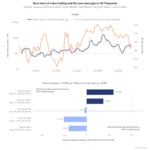
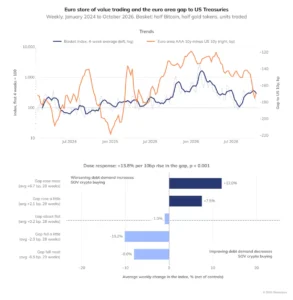
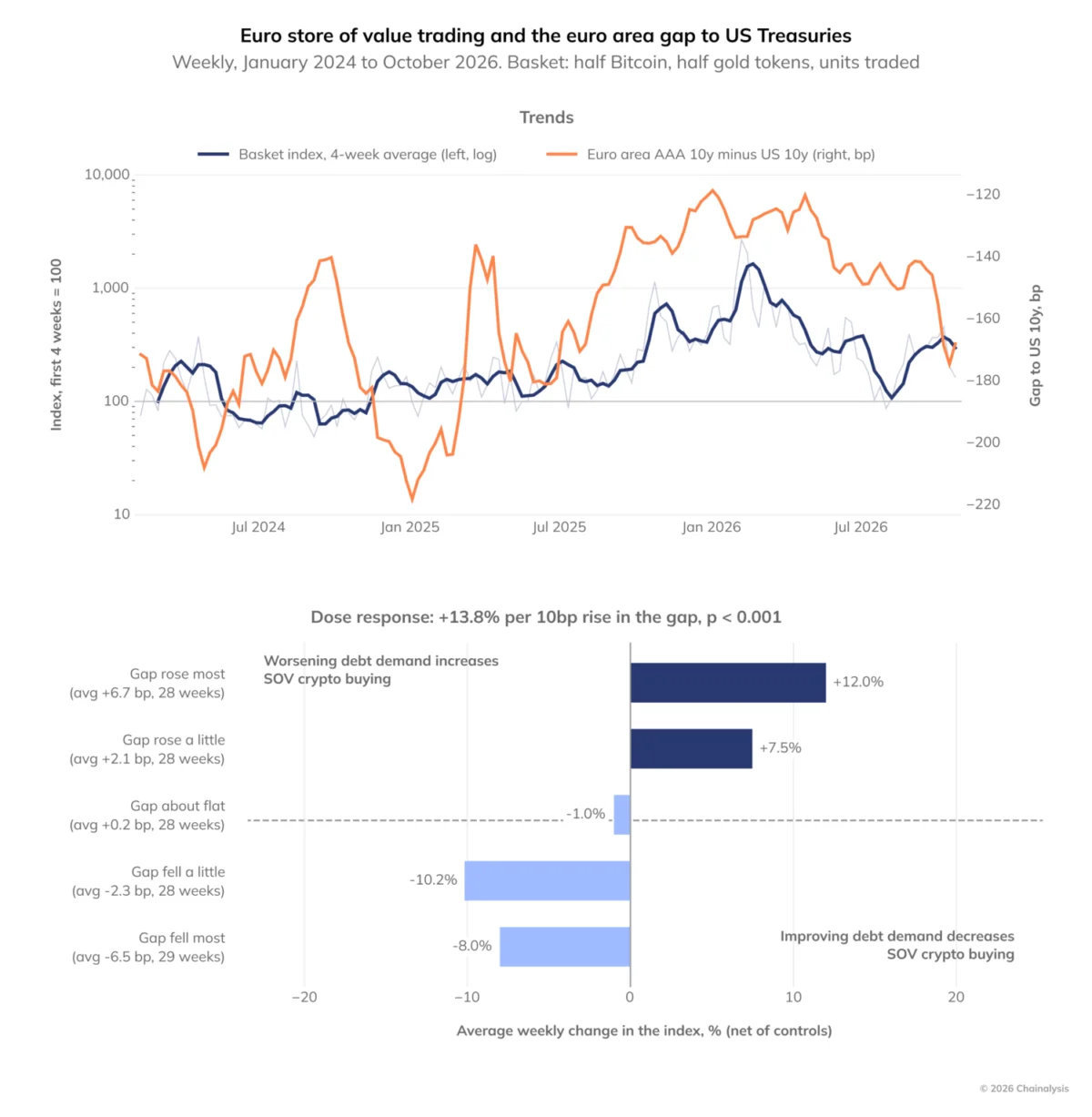
Analysis of weekly data reveals a clear correlation between sovereign risk and crypto trading behavior. As the gap between euro-area government bond yields and US Treasury yields widened, there was a corresponding increase in euro-denominated trading for Bitcoin and tokenized gold. For every 2 basis point rise in relative euro yields, euro-denominated trading in these "store of value" assets rose by approximately 7.5%. When the yield gap reached 7 basis points, the increase in trading volume hit 12%. This suggests that European investors are increasingly utilizing Bitcoin and tokenized gold as a hedge against domestic fiscal instability.
Spain as a Rising Hub for Pan-European Exchange Activity
Spain’s crypto market is undergoing a unique transformation, evolving into a service hub for the broader continent. Inflows to Spanish-registered exchanges from users outside of Spain grew by 79.1%, significantly outpacing the 24.6% growth of Spain’s domestic crypto economy. By 2026, international customers became the primary source of funds for Spanish exchanges.

The growth was particularly pronounced in flows from neighboring Portugal and Italy. Inflows from Italy grew by 329%, while Portuguese inflows skyrocketed by 751%. Gabriel Ayala, Director at Bit2Me, Spain’s largest exchange, attributed this to the lack of consolidated domestic operators in neighboring countries. He noted that Spanish platforms are leveraging their regulatory expertise and operational scale to capture users in markets where local sectors remain fragmented.
Geopolitical Speculation and Prediction Markets
The report also highlighted the use of cryptocurrency in prediction markets, where users bet on the outcomes of real-world events. In early 2026, Western European wallets showed a high level of engagement in binary markets related to US-Iran relations. Interestingly, European users placed 74% of their volume on negative outcomes (predicting no conflict or specific de-escalations), even though these bets often delivered weaker returns than the opposing side.

This trend was curtailed in July 2026 when the European Securities and Markets Authority (ESMA) classified certain event contracts as retail binary options, effectively banning most prediction markets within the EU. This regulatory intervention reflects a broader effort by European authorities to protect retail investors from high-risk, speculative products.
Conclusion: Toward a Structural Maturity
The $2.08 trillion Western European crypto economy has entered a new chapter defined by institutional integration and regulatory oversight. While the UK remains the regional heavyweight, the EU’s MiCA framework has provided a blueprint for growth that is currently outperforming the more cautious UK market. The surge in stablecoin adoption, the use of Bitcoin as a fiscal hedge, and the emergence of regional hubs like Spain all point to a sector that is no longer peripheral to the financial system.

As the region moves forward, the focus is expected to shift toward the links between digital assets and traditional banking. With institutional participation deepening, the success of the European market will depend on its ability to maintain a balance between innovation and financial stability. The data from 2025-2026 suggests that Western Europe is not only weathering the global crypto storm but is actively building the infrastructure for the next generation of digital finance.