


For many, the memory of Bitcoin’s "cheap" days is a hazy recollection, often associated with anecdotal tales of purchasing digital currency for the cost of a pizza. However, a meticulous examination of Bitcoin’s actual yearly low prices since 2012 reveals a far more intricate and instructive pattern than mere nostalgic anecdotes suggest. This deep dive into the floors, rather than the peaks, of Bitcoin’s valuation offers critical insights into its market behavior, resilience, and evolution from a nascent digital experiment to a maturing global asset. The data uncovers a trajectory that is neither a linear ascent nor a predictable staircase, but a dynamic interplay of market forces, technological developments, and significant real-world events.
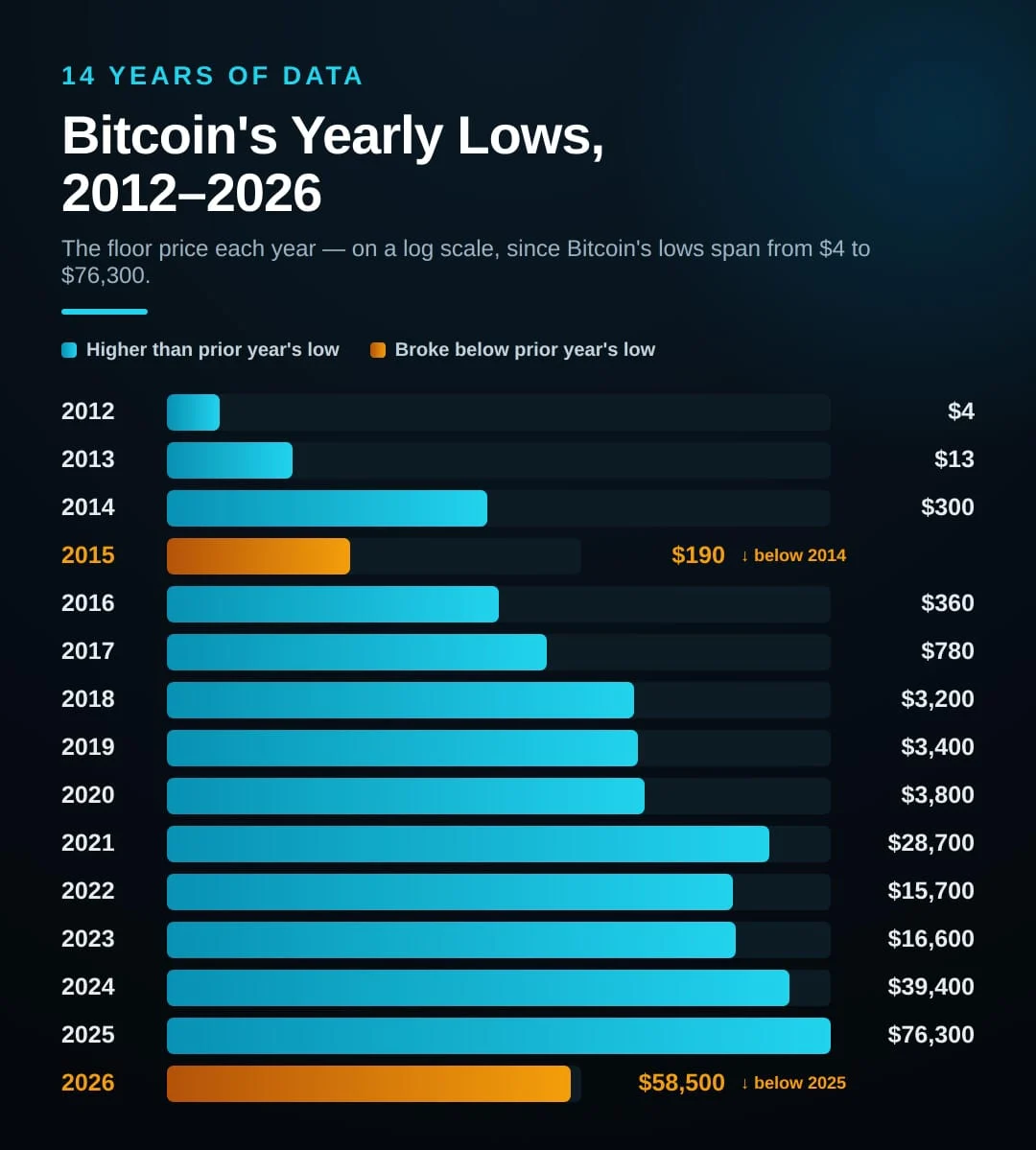
The historical data, compiled year by year, presents a compelling narrative, showing how Bitcoin’s foundational price points have shifted dramatically over time. While the general trend points towards higher lows, two specific instances stand out as significant deviations: 2015, when the yearly low dipped below that of 2014, and 2026, which has thus far seen its low fall beneath 2025’s floor. Understanding the contextual backdrop of these particular years is paramount to deciphering the underlying mechanics of this unique asset. These breaks in the general pattern are not random fluctuations but rather direct consequences of structural shifts, market shocks, and evolving regulatory landscapes, offering a clearer lens through which to comprehend Bitcoin’s journey and potential future trajectory.
The Genesis Years: Volatility and the Mt. Gox Catastrophe (2012-2014)
In its earliest years, Bitcoin existed on the fringes of the financial world, characterized by extreme volatility and a largely unregulated environment. The period from 2012 to 2014 encapsulates this foundational era, setting the stage for both its remarkable growth and its inherent vulnerabilities.
2012: The Humble Beginnings
Bitcoin’s yearly low in 2012 was a mere $4. At this point, Bitcoin was largely known only within niche technological communities and among early adopters experimenting with decentralized digital currency. Trading volumes were minuscule compared to later years, and market capitalization was in the low millions. The concept of "mining" Bitcoin on personal computers was still viable for individuals, and the asset’s utility was primarily experimental, focusing on peer-to-peer transactions outside traditional banking systems. Mainstream financial institutions paid virtually no attention, and regulatory bodies had yet to even acknowledge its existence meaningfully.
2013: A Glimmer of Potential
The following year, 2013, saw Bitcoin’s yearly low climb to $13. This period marked the asset’s first significant bull run, driven by increasing media attention and a growing community of enthusiasts. Bitcoin’s price surged from single digits to over $1,000 by the end of the year, attracting a wave of new users and developers. This exponential growth, however, also highlighted the nascent infrastructure supporting it. Exchanges were rudimentary, security protocols were often untested, and the market remained highly susceptible to speculative trading and manipulation. Despite the dramatic price appreciation, the underlying market structure remained fragile.
2014: The Mt. Gox Aftermath and Market Reset
The year 2014 proved to be a pivotal, albeit painful, period. Bitcoin’s yearly low registered at $300, a significant jump from previous years, but this figure is profoundly overshadowed by the collapse of Mt. Gox. At its peak, Mt. Gox handled over 70% of all Bitcoin transactions globally, making it the de facto central exchange for the nascent cryptocurrency market. Its abrupt cessation of trading in February 2014, followed by the revelation that hundreds of thousands of bitcoins had been lost due to alleged hacking and mismanagement, sent shockwaves through the entire ecosystem. The event not only wiped out vast sums of user funds but also severely eroded trust in the security and viability of centralized crypto exchanges.
The impact of Mt. Gox was multifaceted. It triggered a prolonged bear market, with prices tumbling from their late-2013 highs. More importantly, it initiated a decade-long process of legal and financial rehabilitation, with the Tokyo court-appointed trustee still working to repay creditors over a decade later. This systemic failure, occurring when Bitcoin lacked any institutional safeguards, vividly demonstrates why the market’s response was so severe. Analysts at the time widely questioned Bitcoin’s long-term survival, with many pundits declaring its demise. The lack of regulatory oversight and robust security protocols became glaringly apparent, prompting early calls for improved industry standards.
The Post-Gox Recovery and Early Institutional Forays (2015-2017)
The years immediately following the Mt. Gox collapse were characterized by a slow, arduous recovery and the gradual laying of groundwork for future institutional involvement. This period also saw the first significant break in Bitcoin’s "higher lows" pattern.
2015: A Lingering Shadow
In 2015, Bitcoin’s yearly low fell to $190, a notable dip below the 2014 floor of $300. This regression was a direct consequence of the lingering skepticism and fear introduced by the Mt. Gox debacle. The market was still processing the implications of such a massive exchange failure, and confidence remained fragile. New capital was hesitant to enter, and many early investors who had been burned were liquidating their holdings. This period can be seen as a necessary market reset, flushing out speculative excesses and forcing the ecosystem to confront its vulnerabilities. Despite the price dip, however, foundational work continued behind the scenes, with developers focusing on improving Bitcoin’s core protocol and new, more secure exchanges slowly emerging. The overall market capitalization struggled to regain its previous highs, and trading volumes remained subdued.
2016: Rebuilding and Halving Hype
The year 2016 saw Bitcoin’s low recover to $360, marking a healthy rebound from the previous year. This recovery was fueled by several factors, including the anticipation and eventual execution of Bitcoin’s second halving event in July. Halving events, which cut the reward for mining new blocks by half, are programmed into Bitcoin’s protocol and are often associated with supply shock narratives that precede price appreciation. Furthermore, the industry began to mature, with better-capitalized and more secure exchanges gaining prominence, gradually restoring investor confidence. Regulatory discussions, though still nascent, also began to pick up pace in various jurisdictions, signaling a potential path towards greater legitimacy.

2017: Mainstream Breakthrough and Futures Launch
The year 2017 was a watershed moment for Bitcoin, with its yearly low climbing to $780. This year marked Bitcoin’s genuine entry into mainstream financial consciousness. The price soared dramatically, culminating in an all-time high near $20,000 by year-end, driven by a surge in retail interest and increasing media coverage. Crucially, 2017 also saw the launch of regulated Bitcoin futures contracts on major derivatives exchanges like the Chicago Mercantile Exchange (CME) and the Chicago Board Options Exchange (CBOE). This development was a monumental step, providing institutional investors with a regulated avenue to gain exposure to Bitcoin without directly holding the underlying asset. It signaled a growing acceptance of Bitcoin as a legitimate financial instrument, attracting capital from hedge funds and institutional traders who previously could not participate due to compliance restrictions. The introduction of futures also provided a mechanism for price discovery and risk management, further integrating Bitcoin into the broader financial ecosystem.
The Bear Market and Consolidation (2018-2019)
Following the euphoric highs of 2017, the subsequent two years brought a significant correction, often dubbed the "crypto winter," as the market recalibrated expectations.
2018: Post-Bubble Correction
The 2018 yearly low plummeted to $3,200, a stark reminder of Bitcoin’s inherent volatility despite its growing maturity. This crash was a classic post-bubble correction, as the speculative fervor of late 2017 unwound. Many altcoins, which had seen even more exaggerated gains, experienced even steeper declines. The market capitalization of the entire cryptocurrency sector shrank dramatically. Regulatory scrutiny also intensified globally, with many jurisdictions grappling with how to classify and govern digital assets, leading to a period of uncertainty. Despite the sharp decline, the $3,200 floor was still significantly higher than any pre-2017 low, indicating a new baseline of value had been established.
2019: Finding a New Floor
Remarkably, the 2019 yearly low of $3,400 barely moved from 2018’s floor. Bitcoin essentially spent two full years consolidating within a relatively narrow range after the intense correction. This period of sideways movement, while frustrating for investors, was crucial for the asset’s long-term health. It allowed the market to digest the previous year’s losses, shed weak hands, and build a more stable foundation. Development continued apace, with focus shifting towards scalability solutions, layer-two technologies, and enterprise blockchain applications. This consolidation phase set the stage for the next wave of growth, demonstrating Bitcoin’s capacity to find a durable bottom even after severe downturns.
The Pandemic Shock and Resurgence (2020-2021)
The turn of the decade brought unprecedented global events that profoundly impacted all financial markets, including Bitcoin, which surprisingly emerged stronger.
2020: The COVID-19 Crash and Fed Response
The 2020 yearly low of $3,800 is deceptive without its critical context. This floor was established in March 2020, during the initial panic phase of the COVID-19 pandemic. As global economies faced an abrupt halt and markets seized up, traditional assets and cryptocurrencies alike experienced a massive sell-off. Bitcoin, often touted as "digital gold," initially correlated with other risk assets, as investors sought liquidity in a flight to safety.
However, the response from central banks, particularly the U.S. Federal Reserve, fundamentally altered the market landscape. In rapid succession, the Fed implemented emergency measures, cutting its primary credit rate by 150 basis points and reducing reserve requirements to zero percent. These actions, as detailed in the Federal Reserve’s official March 2020 announcement, were designed to inject liquidity into the financial system and prevent a complete collapse of credit markets. The subsequent massive quantitative easing programs and unprecedented fiscal stimulus led to a surge in money supply and fears of inflation, which many investors saw as a strong tailwind for scarce assets like Bitcoin. This period marked a turning point where Bitcoin began to be increasingly viewed as a hedge against inflation and a store of value in an environment of expansive monetary policy.
2021: The Bull Market Resumes
Fueled by the macroeconomic environment and increasing institutional adoption, Bitcoin’s yearly low soared to $28,700 in 2021, nearly 7.5 times higher than the previous year. This remarkable ascent saw Bitcoin reach new all-time highs above $60,000. Institutional interest exploded, with major corporations like Tesla adding Bitcoin to their balance sheets and payment processors like PayPal integrating cryptocurrency services. The narrative of Bitcoin as a legitimate "digital gold" gained significant traction, attracting a diverse range of investors. The robust infrastructure built over the preceding years, coupled with growing regulatory clarity in some regions, provided a more stable foundation for this bull run compared to 2017.
Maturation and Regulatory Milestones (2022-2024)
Following another period of explosive growth, the market once again entered a corrective phase, but with significant regulatory developments hinting at long-term institutionalization.
2022: The Crypto Bear Market
The year 2022 saw Bitcoin’s yearly low dip to $15,700, reflecting a broader bear market across the cryptocurrency ecosystem. This downturn was exacerbated by a series of high-profile collapses within the industry, including the Terra/LUNA algorithmic stablecoin ecosystem and the FTX exchange, one of the largest crypto trading platforms at the time. These events, driven by unsustainable financial models and alleged fraud, shattered investor confidence and led to widespread deleveraging. The macroeconomic backdrop of rising interest rates and tightening monetary policy globally also contributed to the sell-off in risk assets. Despite the significant price depreciation, Bitcoin’s core protocol remained robust, and the market began to differentiate between legitimate decentralized assets and centralized, opaque entities.
2023: Recovery and Anticipation
In 2023, Bitcoin’s yearly low settled at $16,600, indicating a modest recovery from the deepest troughs of the previous year. While still a challenging period for many investors, the market began to stabilize, and attention increasingly turned towards the potential approval of a spot Bitcoin exchange-traded fund (ETF) in the United States. A spot ETF, which would hold actual Bitcoin, was seen as a holy grail for institutional adoption, offering regulated and accessible exposure to the asset through traditional brokerage accounts. Throughout the year, major financial institutions filed applications, and extensive discussions with the SEC signaled a potential breakthrough after over a decade of rejections.
2024: The Spot ETF Revolution
The jump to a $39,400 yearly low in 2024 directly aligns with one of the most significant regulatory shifts in Bitcoin’s history. On January 10, 2024, the U.S. Securities and Exchange Commission (SEC) approved the listing and trading of several spot Bitcoin exchange-traded products on national securities exchanges. As stated in the SEC’s official announcement, this decision marked the culmination of a decade-long struggle for such products, opening the floodgates for a wave of institutional and retail capital that had previously been on the sidelines due to regulatory uncertainty and custody challenges. The approval legitimized Bitcoin in the eyes of many traditional investors and financial advisors, leading to unprecedented inflows into these new investment vehicles. This regulatory endorsement fundamentally altered Bitcoin’s market structure, integrating it more deeply into traditional finance.
The Current Landscape: A New Context for Pullbacks (2025-2026)
The post-ETF era has ushered in a new dynamic for Bitcoin, with its market behavior now influenced by a broader array of sophisticated financial participants and a more robust infrastructure.
2025: Surging to New Heights
The 2025 yearly low of $76,300 represents an astonishing increase, more than four and a half times higher than the 2023 floor. This surge is directly attributable to the profound impact of the spot Bitcoin ETFs. The accessibility provided by these products, coupled with continued institutional interest and a generally favorable macroeconomic environment, propelled Bitcoin to new all-time highs. The significant influx of capital from pension funds, wealth managers, and retail investors seeking diversified exposure to digital assets cemented Bitcoin’s status as a formidable player in the global financial landscape. This period demonstrated the power of regulatory clarity in unlocking previously untapped market demand.
2026: A Maturing Asset’s Correction
This is where the historical comparison becomes particularly insightful. After years of consistently higher lows, 2026 has thus far seen its yearly low settle at $58,500, meaningfully below 2025’s $76,300 floor. This marks only the second year in the fourteen-year dataset where Bitcoin’s low fell beneath the prior year’s low, echoing the pattern observed in 2015. However, the context surrounding this pullback could not be more different.
In 2015, Bitcoin was a largely unregulated, thinly traded asset reeling from the structural crisis of the Mt. Gox collapse, struggling for credibility. The dip reflected an existential crisis. In 2026, Bitcoin is an asset with regulated spot ETFs, sophisticated institutional custody solutions, and over a decade of exchange-traded history behind it. The market is significantly deeper, more liquid, and more transparent. This suggests that the current pullback in 2026 is less indicative of a structural crisis and more reflective of a typical market correction within a maturing asset class. Factors such as macroeconomic shifts (e.g., changes in interest rate expectations), profit-taking after significant gains, or rebalancing by large institutional holders are more likely drivers of this consolidation.
Broader Impact and Implications
The fourteen-year journey of Bitcoin’s yearly lows provides an invaluable lesson: every major deviation from its pattern of higher lows has coincided not with random chance, but with a significant real-world shock or a transformative regulatory shift. The Mt. Gox collapse in 2014 directly precipitated the lower low of 2015, forcing a painful but necessary recalibration of market trust and infrastructure. Similarly, the extraordinary economic measures taken by central banks in response to the COVID-19 pandemic in 2020 laid the groundwork for the subsequent bull run and significantly higher lows. Most recently, the landmark approval of spot Bitcoin ETFs in early 2024 fundamentally reshaped the asset’s market access and institutional appeal, driving its floor to unprecedented levels, even amidst subsequent corrections.
The current dip in 2026, while mirroring the statistical anomaly of 2015, occurs within an entirely different market ecosystem. It signals a transition for Bitcoin from a speculative, niche asset to one that is increasingly integrated into the global financial system. Such pullbacks, in this new context, are more likely to be interpreted as healthy market cycles, allowing for price discovery, consolidation, and the absorption of new capital, rather than indicators of existential threat. Understanding these historical patterns and their underlying causes is crucial for investors, policymakers, and market observers seeking to navigate the evolving landscape of digital assets. The story of Bitcoin’s floors is ultimately a story of its resilience, adaptation, and ongoing journey towards global financial integration.
Disclosure: This is not trading or investment advice. Always do your research before buying any cryptocurrency or investing in any services.
Follow us on Twitter @themerklehash to stay updated with the latest Crypto, NFT, AI, Cybersecurity, and Metaverse news!














